
At a glance
- Adult size
- About 10–11 in; see details
- Space
- 70+ US gallons; see details
- Social needs
- Peaceful and nocturnal; the retailer rates it a good community fish for a large tank.
Starting guidance, not a universal minimum. See the care details and sources below.
Adult size
FishBase reports a maximum of 25 cm standard length (9.8 inches, excluding the tail) for Hypostomus plecostomus and a common length of 28 cm (11 inches) with the tail. LiveAquaria lists 11 inches for the Hypostomus punctatus it sells. The sailfin catfish Pterygoplichthys pardalis, also sold as common pleco, is recorded to 57.8 cm (22.8 inches).
Aquarium space
LiveAquaria recommends an aquarium of at least 70 US gallons (265 litres) and says the fish gets rather large, so provide plenty of room for it to move. Treat that as a starting point: the larger species sold under this name need considerably more.
Water conditions
LiveAquaria lists 72–82°F (22–28°C) and pH 6.0–7.5; FishBase lists 20–28°C for Hypostomus plecostomus. These are maintenance ranges, not targets to swing between; avoid abrupt changes.
Natural home
Quiet, muddy lower rivers and swamps of the Guianas, some still under tidal influence.
Food and feeding
Algae in the tank, topped up with algae wafers and other herbivore foods; wild fish also eat small crustaceans.
Tankmates and behavior
Peaceful and nocturnal; the retailer rates it a good community fish for a large tank.
Setting up the habitat
Plants, rocks and driftwood for security, and plenty of room to move.
A closer look
It can breathe air, and wild fish guard their eggs on smooth rocks.
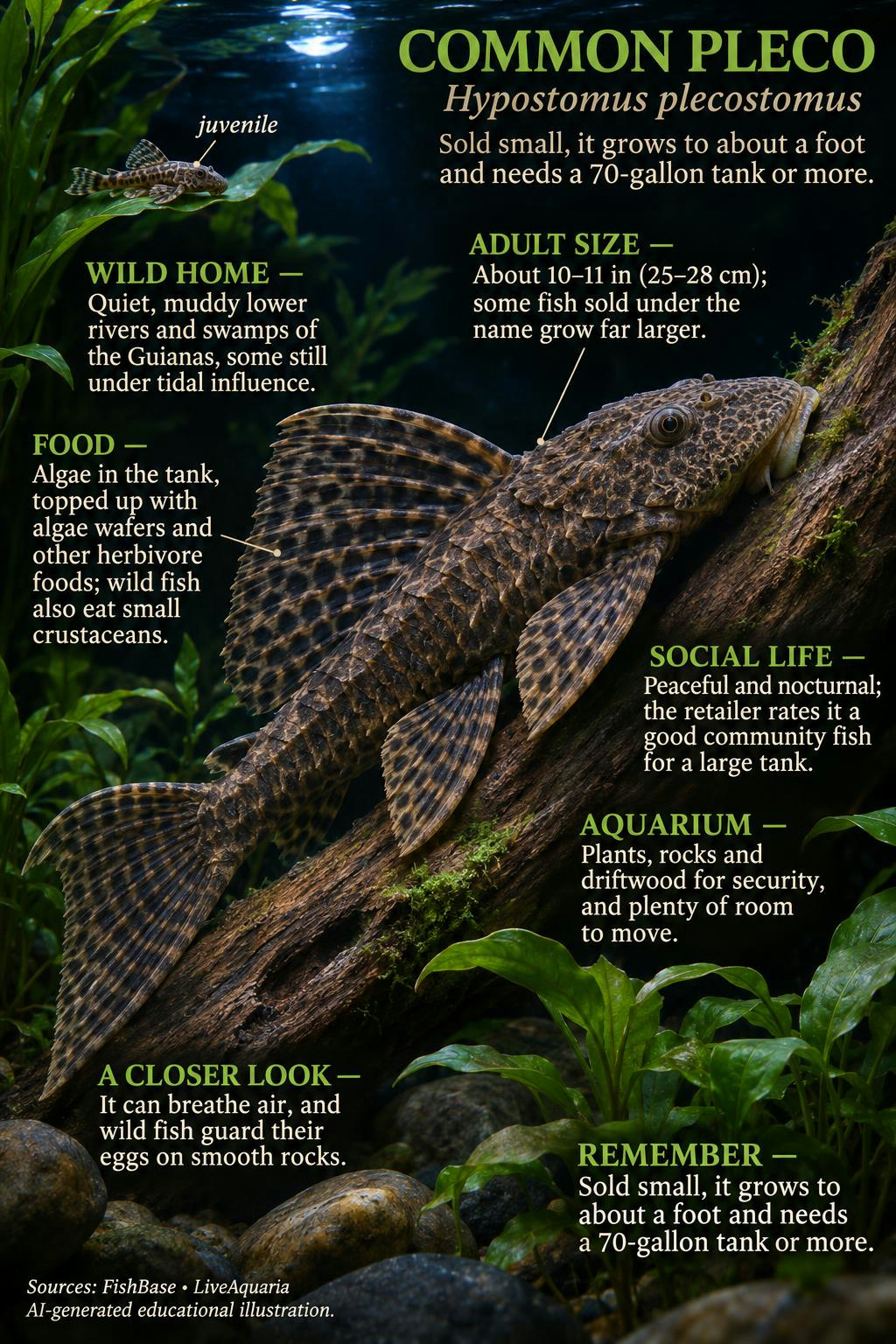
Read the infographic as text
- WILD HOME — Quiet, muddy lower rivers and swamps of the Guianas, some still under tidal influence.
- ADULT SIZE — About 10–11 in (25–28 cm); some fish sold under the name grow far larger.
- FOOD — Algae in the tank, topped up with algae wafers and other herbivore foods; wild fish also eat small crustaceans.
- SOCIAL LIFE — Peaceful and nocturnal; the retailer rates it a good community fish for a large tank.
- AQUARIUM — Plants, rocks and driftwood for security, and plenty of room to move.
- A CLOSER LOOK — It can breathe air, and wild fish guard their eggs on smooth rocks.
- REMEMBER — Sold small, it grows to about a foot and needs a 70-gallon tank or more.
How to use these figures
Published care ranges and suggested tank sizes are starting points, not guarantees. Tank footprint, group size, filtration, feeding, companions and the individual fish all matter. Standard length excludes the tail fin. Do not abruptly change established water conditions to match a number on a page.
Use a cycled aquarium, monitor water quality and quarantine new arrivals using a suitable species-specific plan. Persistent appetite loss, rapid breathing or weight loss warrants investigation.
Common questions
What should I know before choosing this fish?
Sold small, it grows to about a foot and needs a 70-gallon tank or more. Peaceful and nocturnal; the retailer rates it a good community fish for a large tank.
What should I feed it?
Algae in the tank, topped up with algae wafers and other herbivore foods; wild fish also eat small crustaceans.
Sources & review
Checked November 12, 2026. Retailer care guidance is not a universal biological minimum.
- FishBase — Hypostomus plecostomus species account
- FishBase — Pterygoplichthys pardalis species account
- LiveAquaria — Trinidad Plecostomus care profile — reviewed care reference