
At a glance
- Adult size
- FishBase records 9 cm TL; a care article gives 3.5 in
- Space
- 55+ US gallons
- Social needs
- Docile and shy: keep it with calm, shade-loving fish such as cardinalfish and dartfish. Wild fish live singly, in pairs or harems of 3–7.
Starting guidance, not a universal minimum. See the care details and sources below.
Adult size
FishBase reports a maximum recorded length of 9 cm (3.5 inches), including the tail. A recorded maximum is not a promise of typical aquarium size. Kenneth Wingerter’s care article gives the same 3.5 inches and says males are only a little bigger than females.
Aquarium space
Kenneth Wingerter’s care article says 30 US gallons (114 litres) might suffice in some cases, but 55 US gallons (208 litres) or larger is best; it is not a nano fish. Wild fish are usually suggested for more experienced keepers.
Water conditions
No source gives a temperature, pH, alkalinity or salinity range; FishBase lists it only as tropical. Kenneth Wingerter asks for a stable, well-maintained system with excellent water quality and lower light. Keep conditions steady and avoid abrupt changes.
Natural home
Crevices and caves on outer-reef drop-offs 20–110 m deep, from Cocos-Keeling to Indonesia, Palau, Guam, Fiji and the Marshall Islands.
Food and feeding
Wild fish are picky and may starve at first; one keeper got two eating frozen lobster eggs and mysis, live mysis and live brine shrimp.
Tankmates and behavior
Docile and shy: keep it with calm, shade-loving fish such as cardinalfish and dartfish. Wild fish live singly, in pairs or harems of 3–7.
Setting up the habitat
55 gallons or more, stable and mature, with dim light, rocky caves and shady overhangs. Watch stony corals, zoanthids and clams.
A closer look
FishBase calls it rare and almost never exported. It lives deep, so collectors must guard against decompression injury.
Read the infographic as text
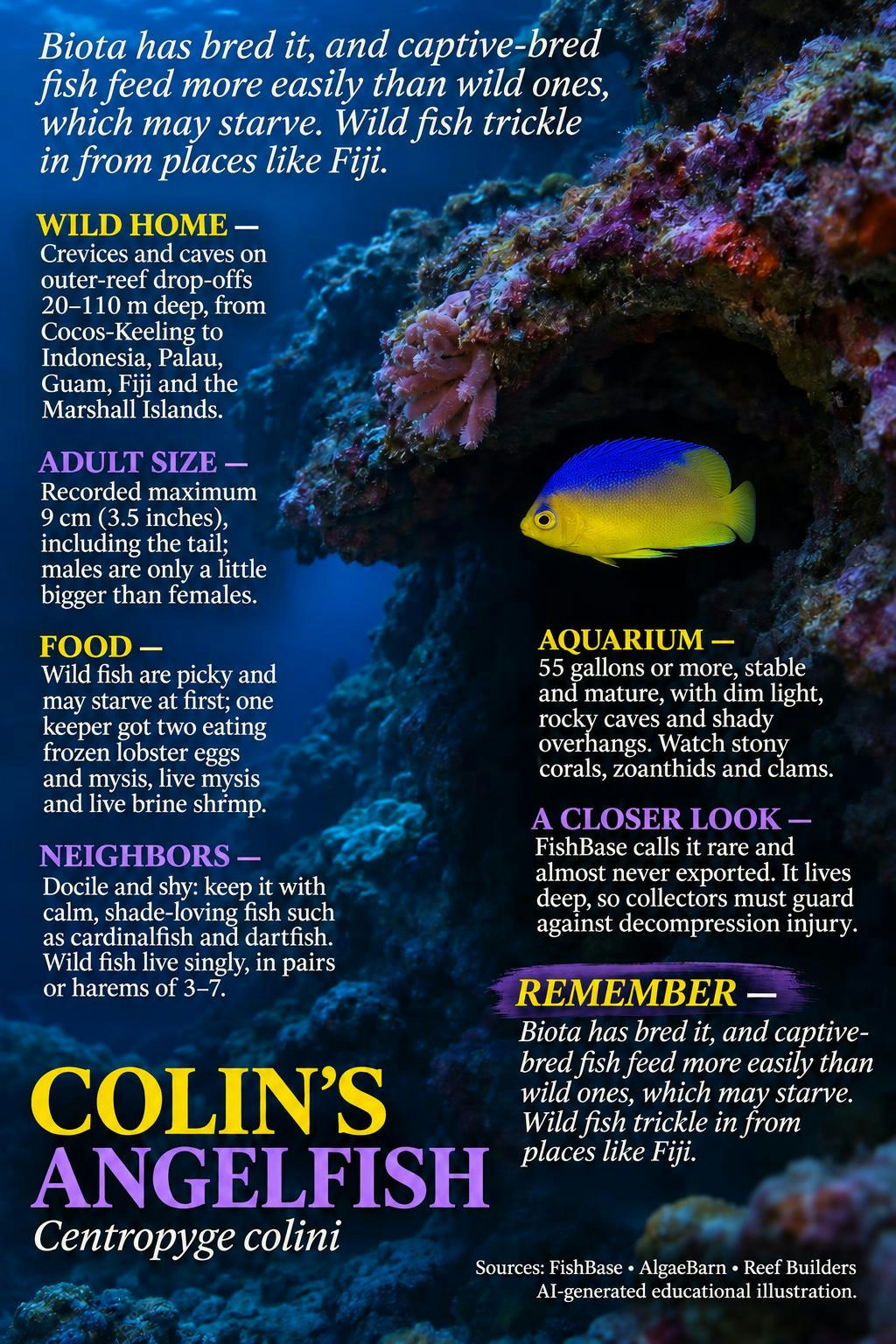
- WILD HOME — Crevices and caves on outer-reef drop-offs 20–110 m deep, from Cocos-Keeling to Indonesia, Palau, Guam, Fiji and the Marshall Islands.
- ADULT SIZE — Recorded maximum 9 cm (3.5 inches), including the tail; males are only a little bigger than females.
- FOOD — Wild fish are picky and may starve at first; one keeper got two eating frozen lobster eggs and mysis, live mysis and live brine shrimp.
- NEIGHBORS — Docile and shy: keep it with calm, shade-loving fish such as cardinalfish and dartfish. Wild fish live singly, in pairs or harems of 3–7.
- AQUARIUM — 55 gallons or more, stable and mature, with dim light, rocky caves and shady overhangs. Watch stony corals, zoanthids and clams.
- A CLOSER LOOK — FishBase calls it rare and almost never exported. It lives deep, so collectors must guard against decompression injury.
- REMEMBER — Biota has bred it, and captive-bred fish feed more easily than wild ones, which may starve. Wild fish trickle in from places like Fiji.
How to use these figures
Published care ranges and suggested tank sizes are starting points, not guarantees. Tank footprint, group size, filtration, feeding, companions and the individual fish all matter. Standard length excludes the tail fin. Do not abruptly change established water conditions to match a number on a page.
Use a cycled aquarium, monitor water quality and quarantine new arrivals using a suitable species-specific plan. Persistent appetite loss, rapid breathing or weight loss warrants investigation.
Common questions
What should I know before choosing this fish?
Biota has bred it, and captive-bred fish feed more easily than wild ones, which may starve. Wild fish trickle in from places like Fiji. Docile and shy: keep it with calm, shade-loving fish such as cardinalfish and dartfish. Wild fish live singly, in pairs or harems of 3–7.
What should I feed it?
Wild fish are picky and may starve at first; one keeper got two eating frozen lobster eggs and mysis, live mysis and live brine shrimp.
Why is it rare?
FishBase calls it rare and almost never exported. It lives deep, so collectors must guard against decompression injury.
Sources & review
Checked November 12, 2026. Retailer care guidance is not a universal biological minimum.
- FishBase — Centropyge colini species account
- AlgaeBarn — Keeping the Colin’s Angelfish (Kenneth Wingerter care article) — reviewed care reference
- Reef Builders — Centropyge colini, the mysterious Colin’s angelfish (keeper’s account)