
At a glance
- Adult size
- About 3 in body length
- Space
- 90 × 38 cm (36 × 15 in) base, about 41 US gallons
- Social needs
- Very quick and can be very aggressive: keep it only with bigger, robust fish. Anything half its size is seen as food.
Starting guidance, not a universal minimum. See the care details and sources below.
Adult size
Seriously Fish gives a maximum standard length of 76 mm (about 3.0 inches), excluding the tail fin; FishBase gives 5.7 cm SL and the Nordiska Ciklidsällskapet register 7 cm.
Aquarium space
Seriously Fish gives a 90 × 38 cm (36 × 15 in) base, about 154 litres (41 US gallons), and its text suggests 36 × 18 × 15 in, about 160 litres (about 42 US gallons): more than its size suggests, because it swims a great deal, is very quick and can be very aggressive. The Nordiska Ciklidsällskapet register gives 80 cm (about 31.5 inches) and 100 litres (about 26 US gallons).
Water conditions
Seriously Fish lists 75–81°F (24–27°C), pH 5.0–6.8 and 2–8 dGH, says it needs a steady temperature and a well-established tank, and warns that dwarf pikes are quite sensitive to pollutants, so make regular partial water changes. FishBase gives pH 5.5–7.2 and 24–27°C; the Nordiska Ciklidsällskapet register gives 24–29°C. These are maintenance ranges, not targets to swing between; avoid abrupt changes.
Natural home
Known only from the lower Rio Tocantins basin in Brazil, where it waits quietly, then sweeps down on insects, often feeding in the dark.
Food and feeding
Tank-bred fish take most foods, but wild fish may demand live or frozen food. Feed live and frozen foods regularly; worms and crustaceans suit.
Tankmates and behavior
Very quick and can be very aggressive: keep it only with bigger, robust fish. Anything half its size is seen as food.
Setting up the habitat
Plenty of hiding places from wood and leaves scattered over the substrate; plants are safe. Some keepers needed target fish to spawn it.
A closer look
Known only from the lower Rio Tocantins basin in Brazil; FishBase lists it as Data Deficient, so its wild status is unknown.
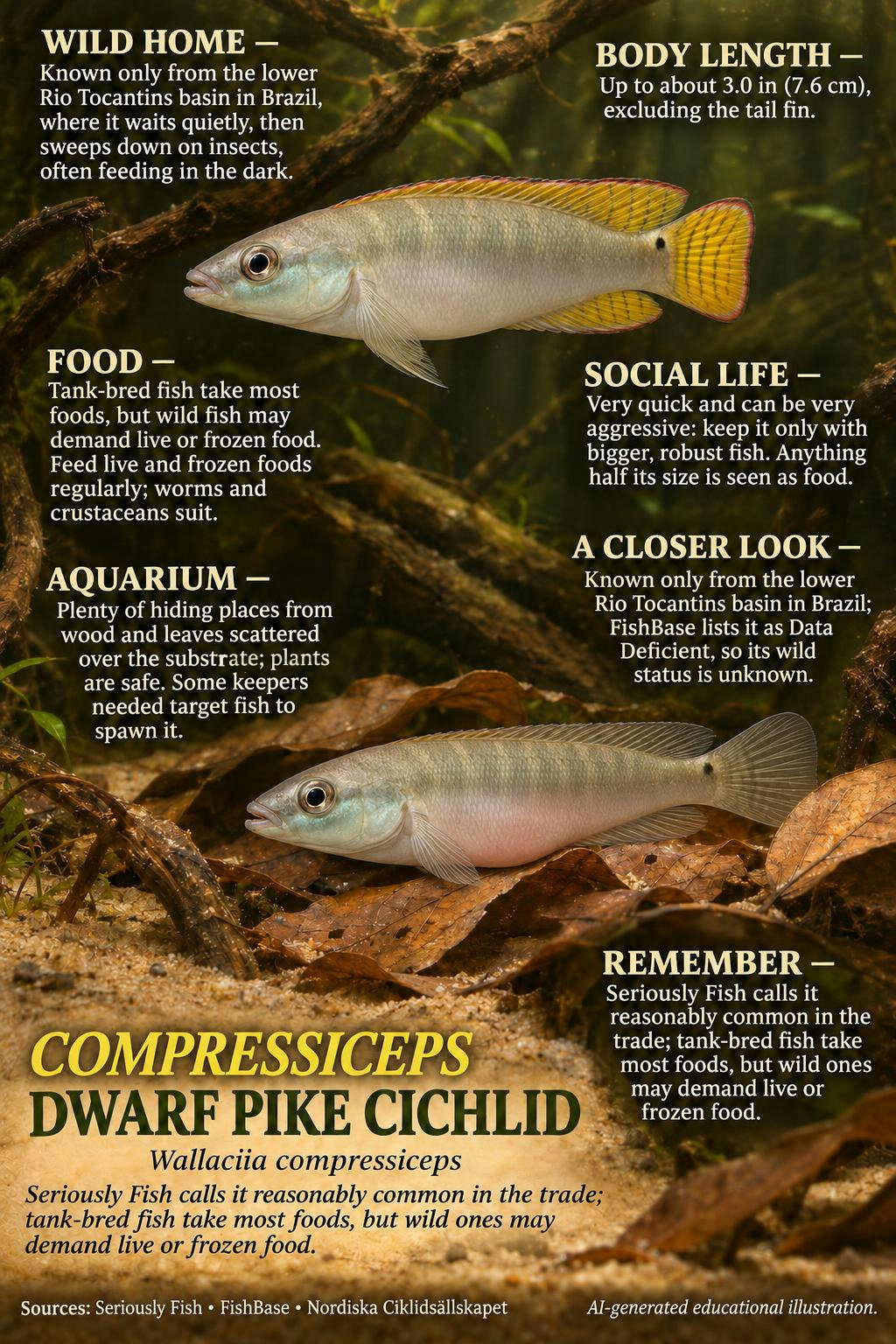
Read the infographic as text
- WILD HOME — Known only from the lower Rio Tocantins basin in Brazil, where it waits quietly, then sweeps down on insects, often feeding in the dark.
- BODY LENGTH — Up to about 3.0 in (7.6 cm), excluding the tail fin.
- FOOD — Tank-bred fish take most foods, but wild fish may demand live or frozen food. Feed live and frozen foods regularly; worms and crustaceans suit.
- SOCIAL LIFE — Very quick and can be very aggressive: keep it only with bigger, robust fish. Anything half its size is seen as food.
- AQUARIUM — Plenty of hiding places from wood and leaves scattered over the substrate; plants are safe. Some keepers needed target fish to spawn it.
- A CLOSER LOOK — Known only from the lower Rio Tocantins basin in Brazil; FishBase lists it as Data Deficient, so its wild status is unknown.
- REMEMBER — Seriously Fish calls it reasonably common in the trade; tank-bred fish take most foods, but wild ones may demand live or frozen food.
How to use these figures
Published care ranges and suggested tank sizes are starting points, not guarantees. Tank footprint, group size, filtration, feeding, companions and the individual fish all matter. Standard length excludes the tail fin. Do not abruptly change established water conditions to match a number on a page.
Use a cycled aquarium, monitor water quality and quarantine new arrivals using a suitable species-specific plan. Persistent appetite loss, rapid breathing or weight loss warrants investigation.
Common questions
What should I know before choosing this fish?
Seriously Fish calls it reasonably common in the trade; tank-bred fish take most foods, but wild ones may demand live or frozen food. Very quick and can be very aggressive: keep it only with bigger, robust fish. Anything half its size is seen as food.
What should I feed it?
Tank-bred fish take most foods, but wild fish may demand live or frozen food. Feed live and frozen foods regularly; worms and crustaceans suit.
Why is it rare?
Known only from the lower Rio Tocantins basin in Brazil; FishBase lists it as Data Deficient, so its wild status is unknown.
Sources & review
Checked November 12, 2026. Retailer care guidance is not a universal biological minimum.