
At a glance
- Adult size
- Up to 92 cm (36.2 in)
- Space
- 180 US gallons
- Social needs
- Rated aggressive, and it may eat its tankmates; FishBase says wild fish feed on fishes. Reef compatible only with caution.
Starting guidance, not a universal minimum. See the care details and sources below.
Adult size
FishBase records a maximum of 92.0 cm (about 36.2 inches) total length. No other source gives an adult size; a retailer sells fish of 12 inches and up.
Aquarium space
A retailer care sheet says it needs 180 US gallons (681 litres) or more, with shelter to hide in, though its quick-facts panel lists 160 gallons. A tight-fitting lid is essential to stop escapes.
Water conditions
A retailer care sheet gives only dKH 8–12; no source gives a temperature, pH or salinity range. FishBase says it is common in warm-temperate waters. Keep conditions steady and avoid abrupt changes.
Natural home
Coral and rocky reefs 5–60 m deep, from Réunion to Hawaii and the Line and Society islands, north to southern Japan and Korea.
Food and feeding
A fish-eater: live feeder fish, squid and octopus, says a retailer care sheet, and it may eat the other fish in the tank.
Tankmates and behavior
Rated aggressive, and it may eat its tankmates; FishBase says wild fish feed on fishes. Reef compatible only with caution.
Setting up the habitat
At least 180 gallons with rockwork shelter to hide in until it settles; in time it lies out in full view. Fit a tight lid.
A closer look
Sources give no rarity reason: FishBase calls it common in warm-temperate waters from Réunion to Hawaii and Japan (Least Concern).
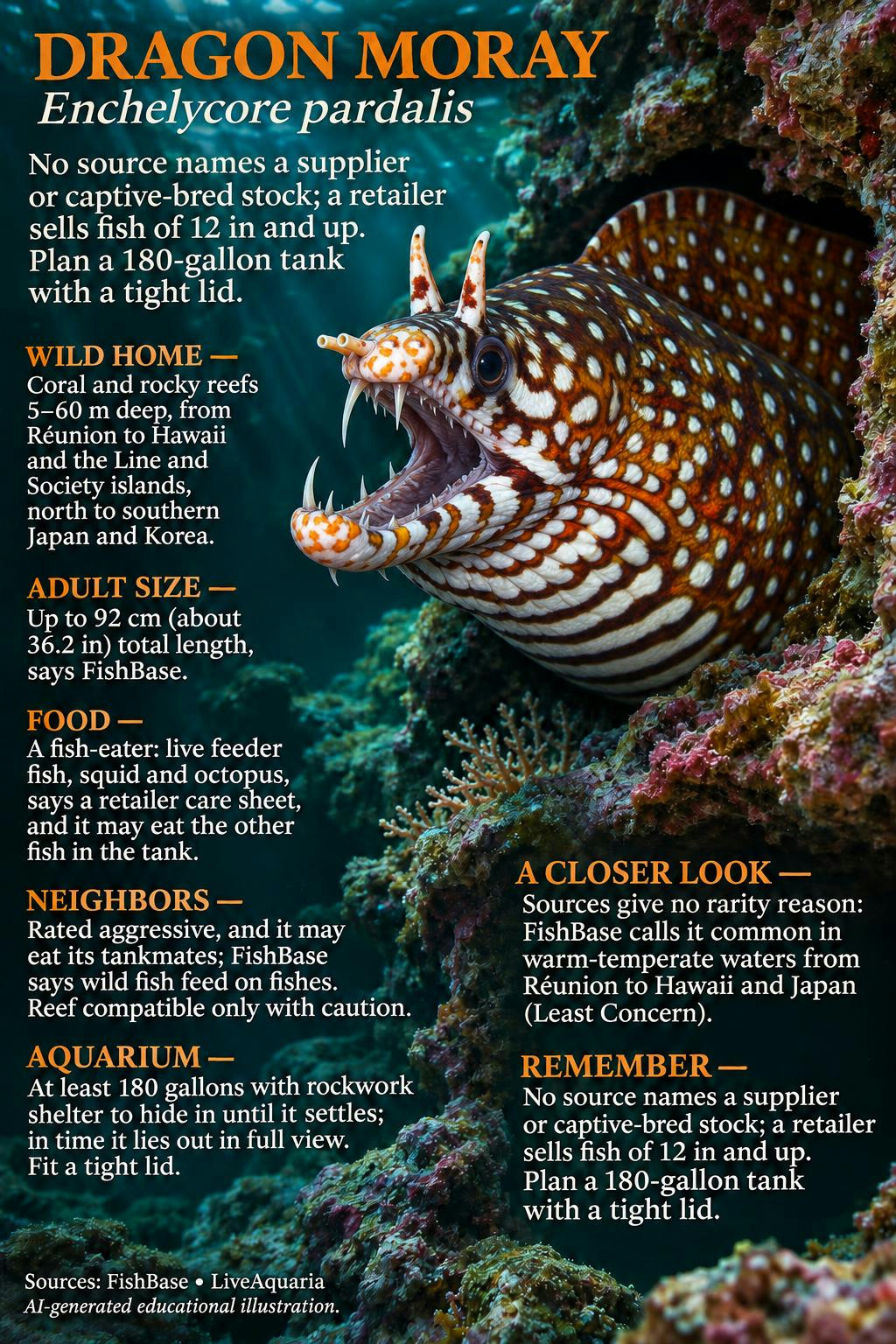
Read the infographic as text
- WILD HOME — Coral and rocky reefs 5–60 m deep, from Réunion to Hawaii and the Line and Society islands, north to southern Japan and Korea.
- ADULT SIZE — Up to 92 cm (about 36.2 in) total length, says FishBase.
- FOOD — A fish-eater: live feeder fish, squid and octopus, says a retailer care sheet, and it may eat the other fish in the tank.
- NEIGHBORS — Rated aggressive, and it may eat its tankmates; FishBase says wild fish feed on fishes. Reef compatible only with caution.
- AQUARIUM — At least 180 gallons with rockwork shelter to hide in until it settles; in time it lies out in full view. Fit a tight lid.
- A CLOSER LOOK — Sources give no rarity reason: FishBase calls it common in warm-temperate waters from Réunion to Hawaii and Japan (Least Concern).
- REMEMBER — No source names a supplier or captive-bred stock; a retailer sells fish of 12 in and up. Plan a 180-gallon tank with a tight lid.
How to use these figures
Published care ranges and suggested tank sizes are starting points, not guarantees. Tank footprint, group size, filtration, feeding, companions and the individual fish all matter. Standard length excludes the tail fin. Do not abruptly change established water conditions to match a number on a page.
Use a cycled aquarium, monitor water quality and quarantine new arrivals using a suitable species-specific plan. Persistent appetite loss, rapid breathing or weight loss warrants investigation.
Common questions
What should I know before choosing this fish?
No source names a supplier or captive-bred stock; a retailer sells fish of 12 in and up. Plan a 180-gallon tank with a tight lid. Rated aggressive, and it may eat its tankmates; FishBase says wild fish feed on fishes. Reef compatible only with caution.
What should I feed it?
A fish-eater: live feeder fish, squid and octopus, says a retailer care sheet, and it may eat the other fish in the tank.
Why is it rare?
Sources give no rarity reason: FishBase calls it common in warm-temperate waters from Réunion to Hawaii and Japan (Least Concern).
Sources & review
Checked November 12, 2026. Retailer care guidance is not a universal biological minimum.
- FishBase — Enchelycore pardalis species account
- LiveAquaria — Japanese Dragon Eel care profile — reviewed care reference