
At a glance
- Adult size
- About 9 in
- Space
- 180 US gallons
- Social needs
- Extremely territorial in the wild. Keep it apart from other Zebrasoma and similar-shaped tangs, with non-aggressive tankmates.
Starting guidance, not a universal minimum. See the care details and sources below.
Adult size
FishBase records a maximum of 22.0 cm (about 8.7 inches) total length, including the tail; a retailer care sheet lists a maximum of 9 inches.
Aquarium space
A retailer care sheet gives a minimum of 180 US gallons (681 litres); Quality Marine, quoted by Reef Builders, asks for a large, mature aquarium of at least 150–180 gallons with open swimming space and rockwork. Plan on 180 gallons: this is a big-tank fish.
Water conditions
A retailer care sheet lists 72–78°F (22–26°C), pH 8.1–8.4, dKH 8–12 and specific gravity 1.020–1.025; FishBase gives 24–28°C (75–82°F) for wild fish. These are maintenance ranges, not targets to swing between; avoid abrupt changes.
Natural home
Coral and rocky reefs 10–61 m deep off Mozambique, South Africa, Madagascar, Réunion and Mauritius; juveniles live in shallow water.
Food and feeding
Mostly algae: dried seaweed on a clip or tied to rock at least 3 times a week, plus marine flakes, pellets and some meaty foods.
Tankmates and behavior
Extremely territorial in the wild. Keep it apart from other Zebrasoma and similar-shaped tangs, with non-aggressive tankmates.
Setting up the habitat
180 gallons with lots of open swimming room, plenty of rockwork for grazing and hiding, good lighting and moderate to strong flow.
A closer look
It lives in deeper water and surge zones of the western Indian Ocean, which makes collecting it hard and keeps its price high.
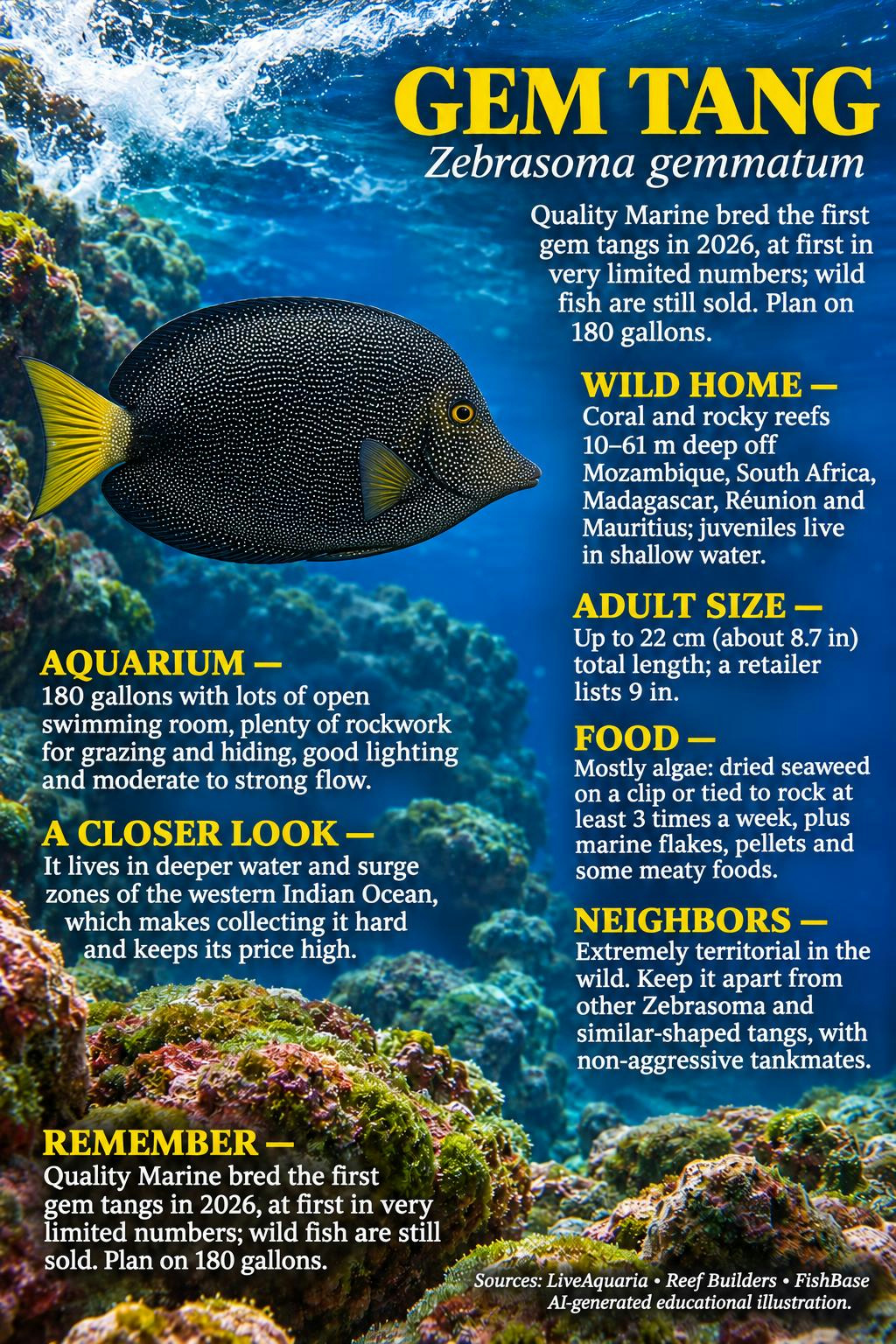
Read the infographic as text
- WILD HOME — Coral and rocky reefs 10–61 m deep off Mozambique, South Africa, Madagascar, Réunion and Mauritius; juveniles live in shallow water.
- ADULT SIZE — Up to 22 cm (about 8.7 in) total length; a retailer lists 9 in.
- FOOD — Mostly algae: dried seaweed on a clip or tied to rock at least 3 times a week, plus marine flakes, pellets and some meaty foods.
- NEIGHBORS — Extremely territorial in the wild. Keep it apart from other Zebrasoma and similar-shaped tangs, with non-aggressive tankmates.
- AQUARIUM — 180 gallons with lots of open swimming room, plenty of rockwork for grazing and hiding, good lighting and moderate to strong flow.
- A CLOSER LOOK — It lives in deeper water and surge zones of the western Indian Ocean, which makes collecting it hard and keeps its price high.
- REMEMBER — Quality Marine bred the first gem tangs in 2026, at first in very limited numbers; wild fish are still sold. Plan on 180 gallons.
How to use these figures
Published care ranges and suggested tank sizes are starting points, not guarantees. Tank footprint, group size, filtration, feeding, companions and the individual fish all matter. Standard length excludes the tail fin. Do not abruptly change established water conditions to match a number on a page.
Use a cycled aquarium, monitor water quality and quarantine new arrivals using a suitable species-specific plan. Persistent appetite loss, rapid breathing or weight loss warrants investigation.
Common questions
What should I know before choosing this fish?
Quality Marine bred the first gem tangs in 2026, at first in very limited numbers; wild fish are still sold. Plan on 180 gallons. Extremely territorial in the wild. Keep it apart from other Zebrasoma and similar-shaped tangs, with non-aggressive tankmates.
What should I feed it?
Mostly algae: dried seaweed on a clip or tied to rock at least 3 times a week, plus marine flakes, pellets and some meaty foods.
Why is it rare?
It lives in deeper water and surge zones of the western Indian Ocean, which makes collecting it hard and keeps its price high.
Sources & review
Checked November 12, 2026. Retailer care guidance is not a universal biological minimum.
- LiveAquaria — Gemmatum Tang care profile — reviewed care reference
- Reef Builders — Code Cracked: The Aquacultured Gem Tang by QM (Quality Marine release)
- FishBase — Zebrasoma gemmatum species account