
At a glance
- Adult size
- About 4.7 in body length
- Space
- 30 × 12 in base for one fish
- Social needs
- Aggressive and intolerant: keep it alone. Its beak-like mouth can bite chunks from other fish, and it must never be kept in groups.
Starting guidance, not a universal minimum. See the care details and sources below.
Adult size
Seriously Fish and FishBase give a maximum standard length of 12 cm (about 4.7 inches), excluding the tail fin.
Aquarium space
Seriously Fish lists 75 × 30 × 30 cm (30 × 12 × 12 in), about 68 litres (18 US gallons). It should be kept alone.
Water conditions
Seriously Fish lists 73–81°F (23–27°C) and says it needs a steady temperature. No measured pH or hardness exists: Seriously Fish says one batch was collected in water of around neutral pH and suggests assuming pH 6.5–7.5, with hardness somewhere around 5–12°H. These are maintenance ranges, not targets to swing between; avoid abrupt changes.
Natural home
Rocky stretches of large rivers in the Mekong basin of Thailand and Laos, including whitewater rapids in the mainstream.
Food and feeding
Shellfish, worms and other live and frozen foods. Give snails and unshelled shellfish such as mussels regularly to wear down its growing teeth.
Tankmates and behavior
Aggressive and intolerant: keep it alone. Its beak-like mouth can bite chunks from other fish, and it must never be kept in groups.
Setting up the habitat
Sand scattered with smooth, water-worn rocks arranged as hiding places, and a moderate current; it will not chew plants.
A closer look
Rare in the hobby and relatively costly; it is not thought to have been bred in aquaria. FishBase lists it as Least Concern.
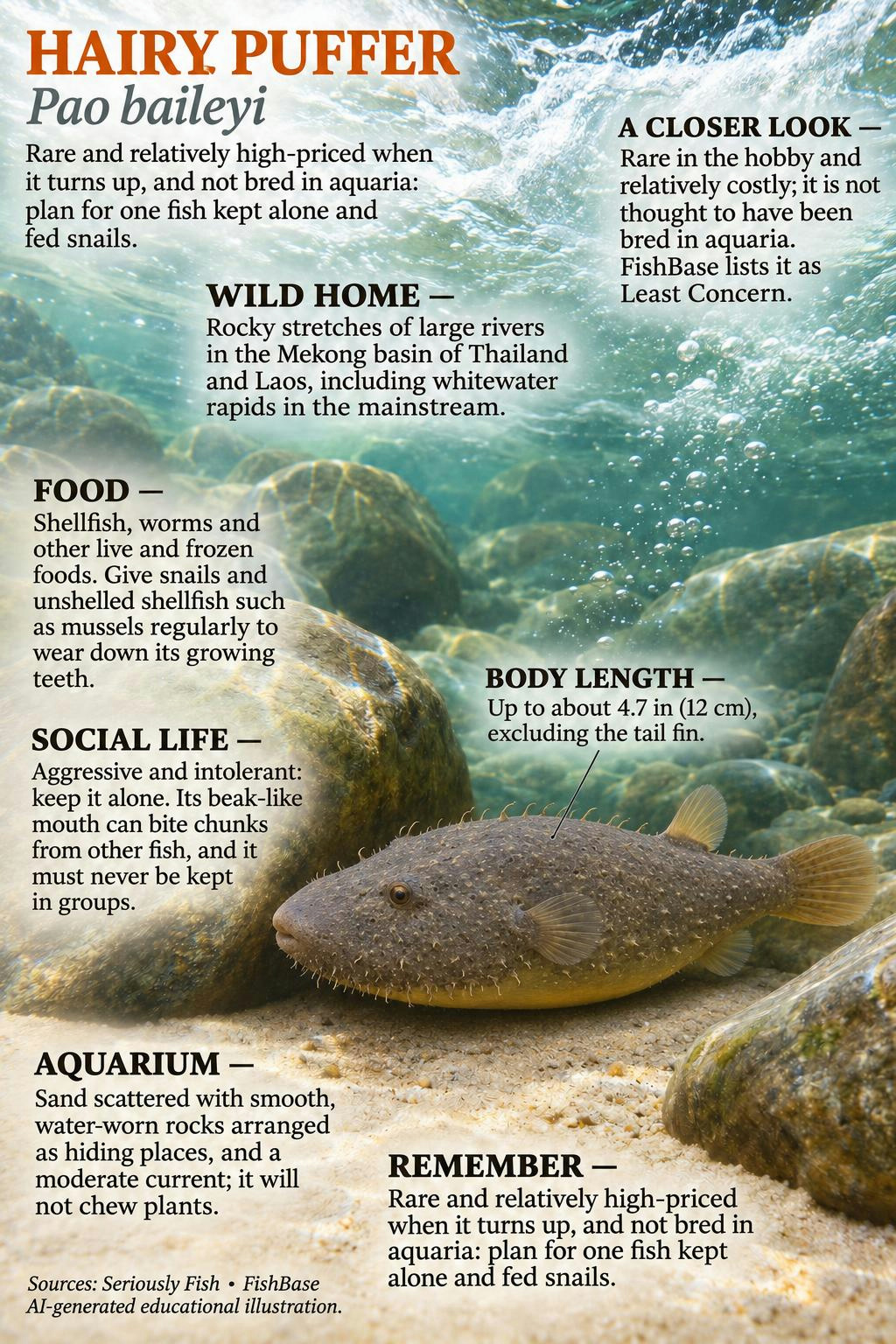
Read the infographic as text
- WILD HOME — Rocky stretches of large rivers in the Mekong basin of Thailand and Laos, including whitewater rapids in the mainstream.
- BODY LENGTH — Up to about 4.7 in (12 cm), excluding the tail fin.
- FOOD — Shellfish, worms and other live and frozen foods. Give snails and unshelled shellfish such as mussels regularly to wear down its growing teeth.
- SOCIAL LIFE — Aggressive and intolerant: keep it alone. Its beak-like mouth can bite chunks from other fish, and it must never be kept in groups.
- AQUARIUM — Sand scattered with smooth, water-worn rocks arranged as hiding places, and a moderate current; it will not chew plants.
- A CLOSER LOOK — Rare in the hobby and relatively costly; it is not thought to have been bred in aquaria. FishBase lists it as Least Concern.
- REMEMBER — Rare and relatively high-priced when it turns up, and not bred in aquaria: plan for one fish kept alone and fed snails.
How to use these figures
Published care ranges and suggested tank sizes are starting points, not guarantees. Tank footprint, group size, filtration, feeding, companions and the individual fish all matter. Standard length excludes the tail fin. Do not abruptly change established water conditions to match a number on a page.
Use a cycled aquarium, monitor water quality and quarantine new arrivals using a suitable species-specific plan. Persistent appetite loss, rapid breathing or weight loss warrants investigation.
Common questions
What should I know before choosing this fish?
Rare and relatively high-priced when it turns up, and not bred in aquaria: plan for one fish kept alone and fed snails. Aggressive and intolerant: keep it alone. Its beak-like mouth can bite chunks from other fish, and it must never be kept in groups.
What should I feed it?
Shellfish, worms and other live and frozen foods. Give snails and unshelled shellfish such as mussels regularly to wear down its growing teeth.
Why is it rare?
Rare in the hobby and relatively costly; it is not thought to have been bred in aquaria. FishBase lists it as Least Concern.
Sources & review
Checked November 12, 2026. Retailer care guidance is not a universal biological minimum.