
At a glance
- Adult size
- Up to about 5.9 in body length
- Space
- 100 cm (39.4 in) long tank; no volume given
- Social needs
- Lightly territorial with its own kind; good with top-dwelling fish and small tetras. Shy young fish need help getting food.
Starting guidance, not a universal minimum. See the care details and sources below.
Adult size
PlanetCatfish gives a maximum standard length of 5.9 inches (15 cm) for the species as a whole, excluding the tail fin; FishBase gives 11.7 cm SL, and Welsfans about 12 cm total length for L236.
Aquarium space
Welsfans recommends a tank 100 cm (about 39.4 inches) long and gives no volume; PlanetCatfish and FishBase give no tank size.
Water conditions
PlanetCatfish lists 24–31°C (75–88°F) and pH 5.8–7.6, with good current and high oxygen; Welsfans gives 26–30°C (79–86°F) and pH 5.0–7.0. No source gives a hardness range; for breeding, PlanetCatfish advises very soft water, a neutral pH and about 30°C. These are maintenance ranges, not targets to swing between; avoid abrupt changes.
Natural home
Clear water in Brazil’s Rio Xingu, where the species uses the broadest range of habitats known in its genus, down to 40 m deep.
Food and feeding
Omnivorous but prefers meaty foods such as bloodworm, Gammarus and brine shrimp; sinking catfish foods and Spirulina tablets are eaten avidly.
Tankmates and behavior
Lightly territorial with its own kind; good with top-dwelling fish and small tetras. Shy young fish need help getting food.
Setting up the habitat
Sand with many caves or holes for the males, good current and high oxygen; wood and plants are optional, and plants may be grazed.
A closer look
Introduced in 1997 from a handful of wild fish; today’s pale L236 is a line-bred form of a variable species found only in the Xingu.
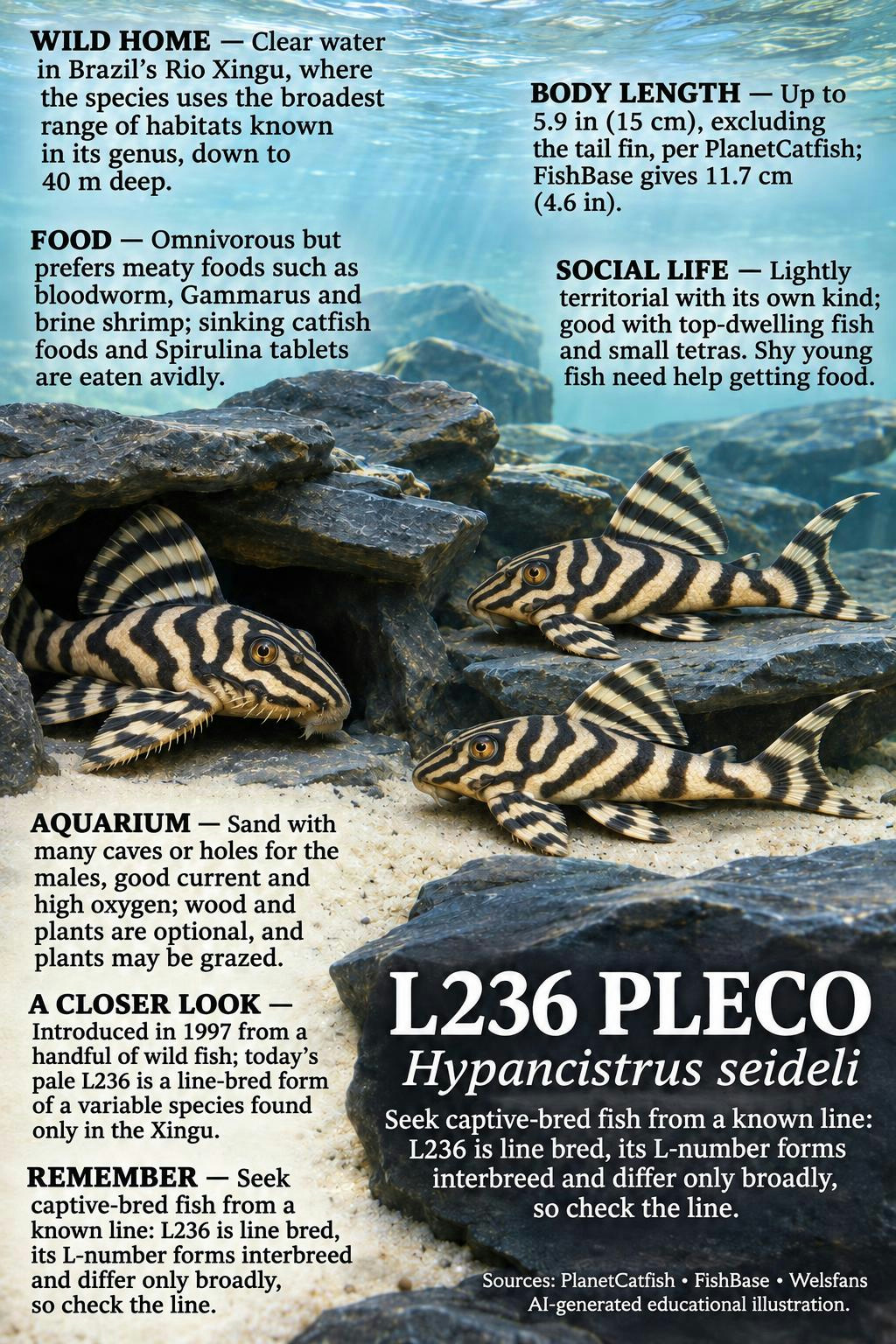
Read the infographic as text
- WILD HOME — Clear water in Brazil’s Rio Xingu, where the species uses the broadest range of habitats known in its genus, down to 40 m deep.
- BODY LENGTH — Up to 5.9 in (15 cm), excluding the tail fin, per PlanetCatfish; FishBase gives 11.7 cm (4.6 in).
- FOOD — Omnivorous but prefers meaty foods such as bloodworm, Gammarus and brine shrimp; sinking catfish foods and Spirulina tablets are eaten avidly.
- SOCIAL LIFE — Lightly territorial with its own kind; good with top-dwelling fish and small tetras. Shy young fish need help getting food.
- AQUARIUM — Sand with many caves or holes for the males, good current and high oxygen; wood and plants are optional, and plants may be grazed.
- A CLOSER LOOK — Introduced in 1997 from a handful of wild fish; today’s pale L236 is a line-bred form of a variable species found only in the Xingu.
- REMEMBER — Seek captive-bred fish from a known line: L236 is line bred, its L-number forms interbreed and differ only broadly, so check the line.
How to use these figures
Published care ranges and suggested tank sizes are starting points, not guarantees. Tank footprint, group size, filtration, feeding, companions and the individual fish all matter. Standard length excludes the tail fin. Do not abruptly change established water conditions to match a number on a page.
Use a cycled aquarium, monitor water quality and quarantine new arrivals using a suitable species-specific plan. Persistent appetite loss, rapid breathing or weight loss warrants investigation.
Common questions
What should I know before choosing this fish?
Seek captive-bred fish from a known line: L236 is line bred, its L-number forms interbreed and differ only broadly, so check the line. Lightly territorial with its own kind; good with top-dwelling fish and small tetras. Shy young fish need help getting food.
What should I feed it?
Omnivorous but prefers meaty foods such as bloodworm, Gammarus and brine shrimp; sinking catfish foods and Spirulina tablets are eaten avidly.
Why is it rare?
Introduced in 1997 from a handful of wild fish; today’s pale L236 is a line-bred form of a variable species found only in the Xingu.
Sources & review
Checked November 12, 2026. Retailer care guidance is not a universal biological minimum.