
At a glance
- Adult size
- About 2.6 in body length
- Space
- No source gives a tank size; a small community tank
- Social needs
- Peaceful and fine in small groups, but some reportedly ate tiny fish; keep it with similar-sized fish such as Anomalochromis thomasi.
Starting guidance, not a universal minimum. See the care details and sources below.
Adult size
The sources disagree. PlanetCatfish gives a standard length of 65 mm (about 2.6 inches), excluding the tail fin, and FishBase only 3.6 cm (about 1.4 inches) SL. ScotCat gives 8.0 cm (about 3.1 inches) and Practical Fishkeeping about 2 in (5 cm).
Aquarium space
No source gives a tank size. Practical Fishkeeping calls it ideal for the smaller community aquarium, and ScotCat calls it an excellent addition to any community tank.
Water conditions
PlanetCatfish and FishBase give 22–24°C (72–75°F); ScotCat gives 22–26°C (72–79°F) and pH 6.2–7.5, and PlanetCatfish says its home stream measured pH 6.6. No source gives a hardness range. Practical Fishkeeping says no precise water data exist: slightly acid water is probably best, though it usually adapts to harder water. Water low in pollution is essential. These are maintenance ranges, not targets to swing between; avoid abrupt changes.
Natural home
A forest stream in Sierra Leone’s Kasewe Forest Reserve, measured at pH 6.6, is its type locality; it has also been recorded near Mano.
Food and feeding
Takes most prepared foods: frozen bloodworm, whiteworm, shrimp, tablets, flake, pellets. Wild fish probably eat insects and zooplankton.
Tankmates and behavior
Peaceful and fine in small groups, but some reportedly ate tiny fish; keep it with similar-sized fish such as Anomalochromis thomasi.
Setting up the habitat
Secretive by day: give bogwood, logs, pipes or rockwork as hiding places and it will come out now and then. Keep the water clean.
A closer look
Known only from Sierra Leone, which exports few ornamental fish, so it turns up only sporadically; it is listed as Least Concern.
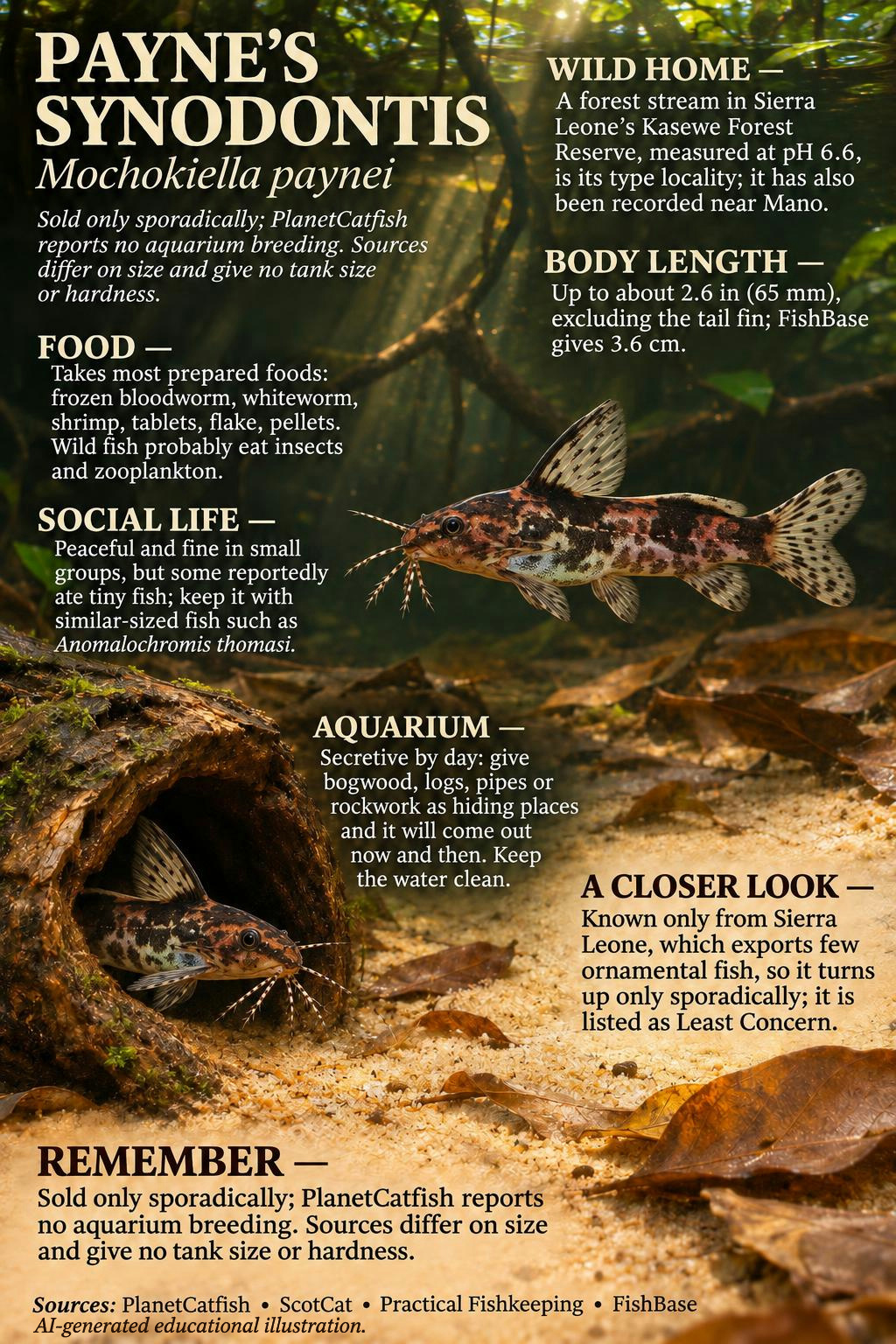
Read the infographic as text
- WILD HOME — A forest stream in Sierra Leone’s Kasewe Forest Reserve, measured at pH 6.6, is its type locality; it has also been recorded near Mano.
- BODY LENGTH — Up to about 2.6 in (65 mm), excluding the tail fin; FishBase gives 3.6 cm.
- FOOD — Takes most prepared foods: frozen bloodworm, whiteworm, shrimp, tablets, flake, pellets. Wild fish probably eat insects and zooplankton.
- SOCIAL LIFE — Peaceful and fine in small groups, but some reportedly ate tiny fish; keep it with similar-sized fish such as Anomalochromis thomasi.
- AQUARIUM — Secretive by day: give bogwood, logs, pipes or rockwork as hiding places and it will come out now and then. Keep the water clean.
- A CLOSER LOOK — Known only from Sierra Leone, which exports few ornamental fish, so it turns up only sporadically; it is listed as Least Concern.
- REMEMBER — Sold only sporadically; PlanetCatfish reports no aquarium breeding. Sources differ on size and give no tank size or hardness.
How to use these figures
Published care ranges and suggested tank sizes are starting points, not guarantees. Tank footprint, group size, filtration, feeding, companions and the individual fish all matter. Standard length excludes the tail fin. Do not abruptly change established water conditions to match a number on a page.
Use a cycled aquarium, monitor water quality and quarantine new arrivals using a suitable species-specific plan. Persistent appetite loss, rapid breathing or weight loss warrants investigation.
Common questions
What should I know before choosing this fish?
Sold only sporadically; PlanetCatfish reports no aquarium breeding. Sources differ on size and give no tank size or hardness. Peaceful and fine in small groups, but some reportedly ate tiny fish; keep it with similar-sized fish such as Anomalochromis thomasi.
What should I feed it?
Takes most prepared foods: frozen bloodworm, whiteworm, shrimp, tablets, flake, pellets. Wild fish probably eat insects and zooplankton.
Why is it rare?
Known only from Sierra Leone, which exports few ornamental fish, so it turns up only sporadically; it is listed as Least Concern.
Sources & review
Checked November 12, 2026. Retailer care guidance is not a universal biological minimum.