
At a glance
- Adult size
- About 10 in body length
- Space
- 48 × 18 in base or larger; see details
- Social needs
- More territorial with age; adults often will not tolerate other bottom dwellers, especially synodontis. Avoid fish small enough to eat.
Starting guidance, not a universal minimum. See the care details and sources below.
Adult size
Seriously Fish gives a maximum standard length of 250 mm (10 inches), excluding the tail fin. FishBase gives 55 cm total length, and PlanetCatfish’s data sheet lists 21.7 inches (55 cm) SL, though its own remarks say the FishBase figure appears erroneous.
Aquarium space
Seriously Fish lists 48 × 18 × 15 inches (120 × 45 × 38 cm), about 205 litres (54 US gallons). PlanetCatfish and FishBase give no tank size.
Water conditions
Seriously Fish lists 75–82°F (24–28°C), pH 6.0–8.0 and 3–20 dGH and says it needs a steady temperature; FishBase also gives 24–28°C and pH 6.0–8.0, and PlanetCatfish 23–27°C (73–81°F), calling it a hardy fish that adapts to most conditions. These are maintenance ranges, not targets to swing between; avoid abrupt changes.
Natural home
Slow-moving stretches of rivers in the Congo basin of DR Congo, the Republic of Congo and Cameroon; it breeds in seasonally flooded areas.
Food and feeding
An unfussy omnivore: frozen, live and dried foods, plus shelled peas, cucumber or spirulina discs, which it rasps with its lower-jaw teeth.
Tankmates and behavior
More territorial with age; adults often will not tolerate other bottom dwellers, especially synodontis. Avoid fish small enough to eat.
Setting up the habitat
Soft substrate, rocks, driftwood and twisted roots forming caves, and floating plants to diffuse light. Very nocturnal; seldom seen by day.
A closer look
Seriously Fish calls it quite rare in its native waters, and it has not bred naturally in aquariums; FishBase rates it Least Concern.
Read the infographic as text
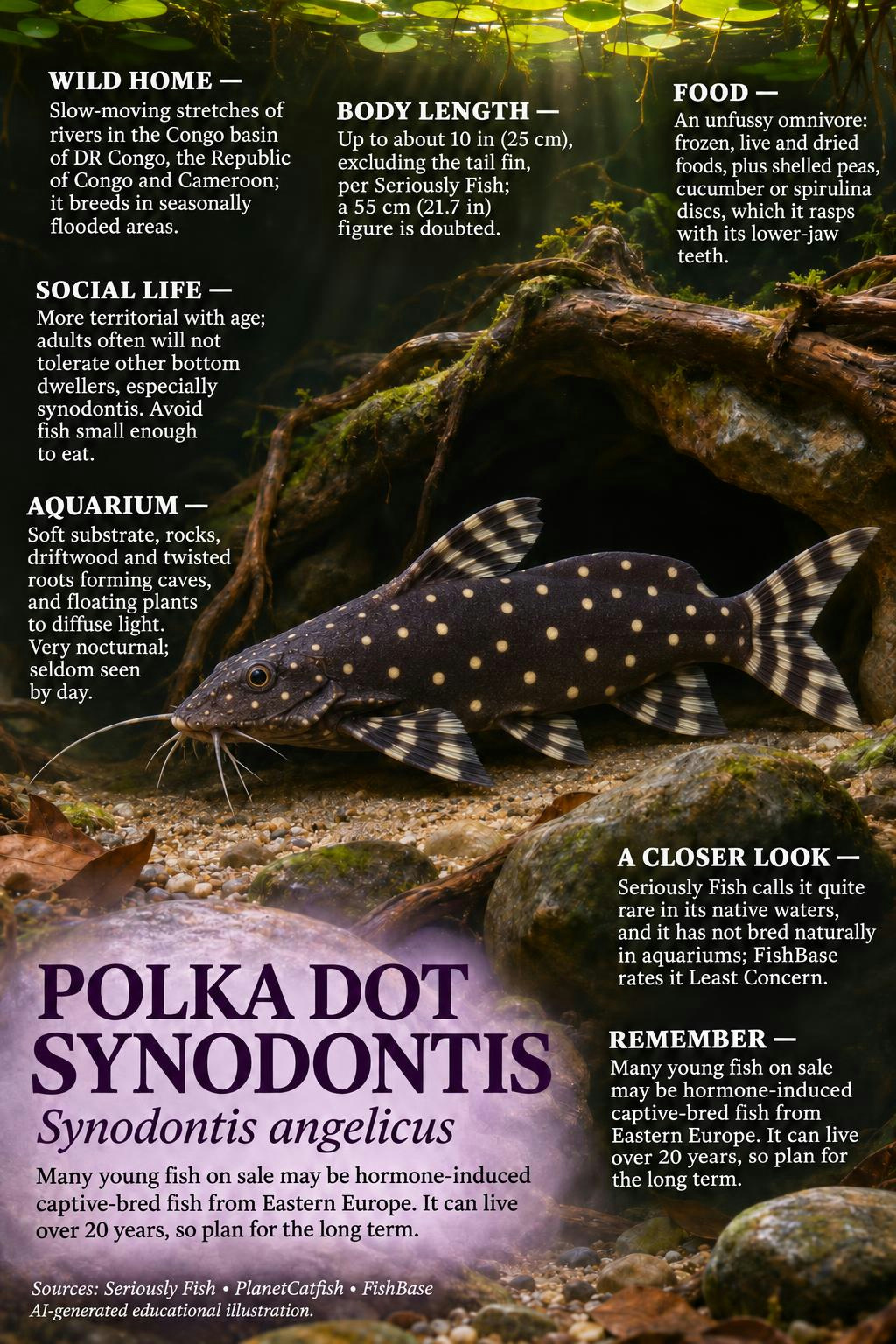
- WILD HOME — Slow-moving stretches of rivers in the Congo basin of DR Congo, the Republic of Congo and Cameroon; it breeds in seasonally flooded areas.
- BODY LENGTH — Up to about 10 in (25 cm), excluding the tail fin, per Seriously Fish; a 55 cm (21.7 in) figure is doubted.
- FOOD — An unfussy omnivore: frozen, live and dried foods, plus shelled peas, cucumber or spirulina discs, which it rasps with its lower-jaw teeth.
- SOCIAL LIFE — More territorial with age; adults often will not tolerate other bottom dwellers, especially synodontis. Avoid fish small enough to eat.
- AQUARIUM — Soft substrate, rocks, driftwood and twisted roots forming caves, and floating plants to diffuse light. Very nocturnal; seldom seen by day.
- A CLOSER LOOK — Seriously Fish calls it quite rare in its native waters, and it has not bred naturally in aquariums; FishBase rates it Least Concern.
- REMEMBER — Many young fish on sale may be hormone-induced captive-bred fish from Eastern Europe. It can live over 20 years, so plan for the long term.
How to use these figures
Published care ranges and suggested tank sizes are starting points, not guarantees. Tank footprint, group size, filtration, feeding, companions and the individual fish all matter. Standard length excludes the tail fin. Do not abruptly change established water conditions to match a number on a page.
Use a cycled aquarium, monitor water quality and quarantine new arrivals using a suitable species-specific plan. Persistent appetite loss, rapid breathing or weight loss warrants investigation.
Common questions
What should I know before choosing this fish?
Many young fish on sale may be hormone-induced captive-bred fish from Eastern Europe. It can live over 20 years, so plan for the long term. More territorial with age; adults often will not tolerate other bottom dwellers, especially synodontis. Avoid fish small enough to eat.
What should I feed it?
An unfussy omnivore: frozen, live and dried foods, plus shelled peas, cucumber or spirulina discs, which it rasps with its lower-jaw teeth.
Why is it rare?
Seriously Fish calls it quite rare in its native waters, and it has not bred naturally in aquariums; FishBase rates it Least Concern.
Sources & review
Checked November 12, 2026. Retailer care guidance is not a universal biological minimum.