
At a glance
- Adult size
- FishBase 6.7 cm SL; ANGFA up to 9–10 cm
- Space
- 10+ US gallons; a group of six or more
- Social needs
- Peaceful schooling fish for groups of six or more. Avoid fish big enough to eat it, and other Melanotaenia: it may hybridise with them.
Starting guidance, not a universal minimum. See the care details and sources below.
Adult size
FishBase records a maximum standard length of 6.7 cm (about 2.6 inches), excluding the tail fin, and a common length of 4.5 cm SL. ANGFA says it may reach 9–10 cm, and a retailer care sheet lists 3–4 inches.
Aquarium space
A retailer care sheet recommends at least 10 US gallons (38 litres) and a group of at least six. No other source gives a tank size.
Water conditions
A retailer care sheet lists 72–78°F (22–26°C), pH 6.0–7.5 and hardness 4–15° (unit not stated); FishProfiles gives 24–26°C (75–79°F), pH 6.5–7.5 and 12–16 dH. These are maintenance ranges, not targets to swing between; avoid abrupt changes.
Natural home
Only Lake Kurumoi, a small, isolated, turbid lake with muddy shores on the Vogelkop isthmus of New Guinea, among dense shoreline plants.
Food and feeding
An omnivore that eats mostly insects in the wild but takes most foods offered.
Tankmates and behavior
Peaceful schooling fish for groups of six or more. Avoid fish big enough to eat it, and other Melanotaenia: it may hybridise with them.
Setting up the habitat
Heavily planted, with clean, clear water and a low current; its colours show best in a planted tank. Use spawning mops to save eggs.
A closer look
Known only from one small lake whose level has fallen sharply, below its natural outlet; FishBase lists it as Critically Endangered.
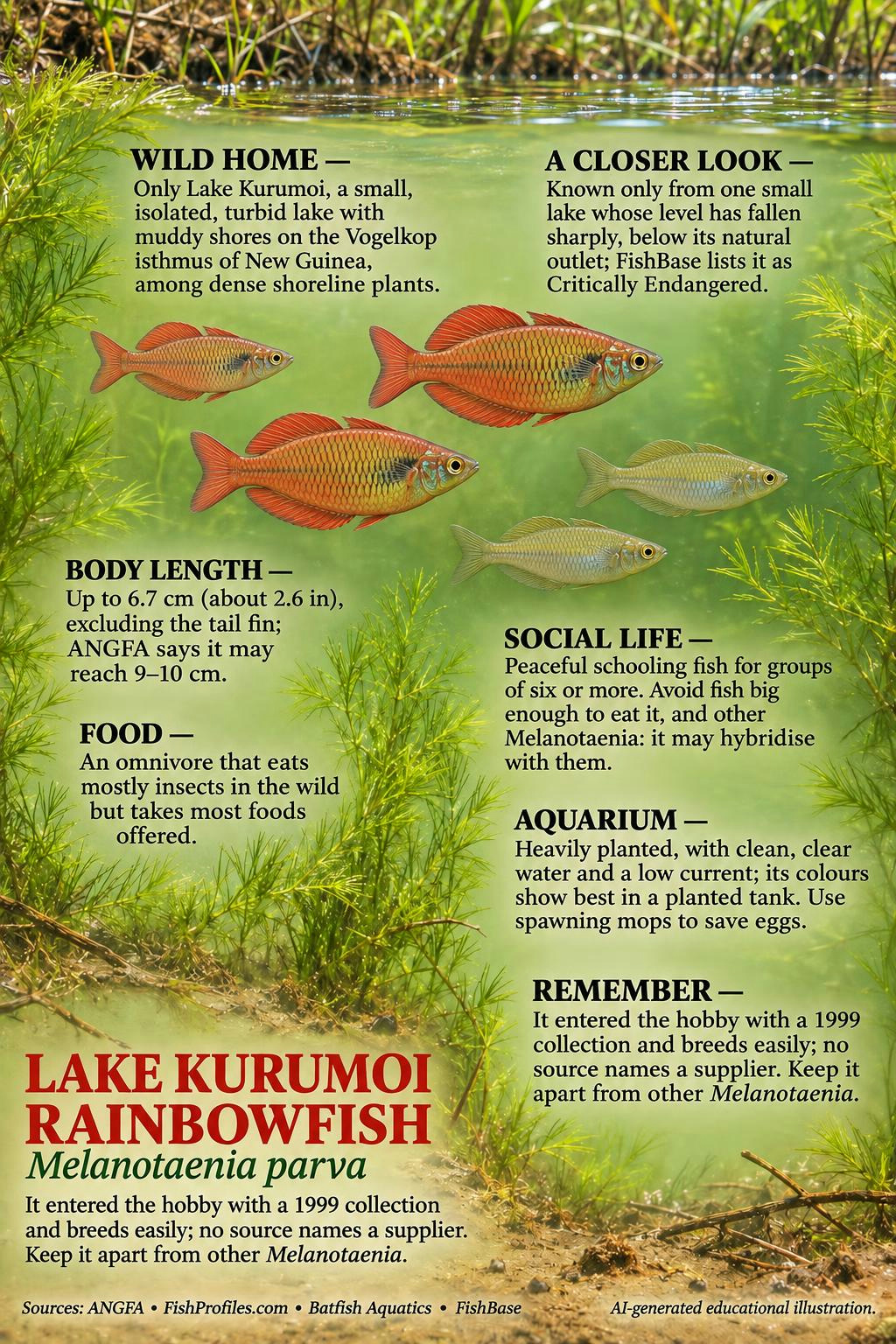
Read the infographic as text
- WILD HOME — Only Lake Kurumoi, a small, isolated, turbid lake with muddy shores on the Vogelkop isthmus of New Guinea, among dense shoreline plants.
- BODY LENGTH — Up to 6.7 cm (about 2.6 in), excluding the tail fin; ANGFA says it may reach 9–10 cm.
- FOOD — An omnivore that eats mostly insects in the wild but takes most foods offered.
- SOCIAL LIFE — Peaceful schooling fish for groups of six or more. Avoid fish big enough to eat it, and other Melanotaenia: it may hybridise with them.
- AQUARIUM — Heavily planted, with clean, clear water and a low current; its colours show best in a planted tank. Use spawning mops to save eggs.
- A CLOSER LOOK — Known only from one small lake whose level has fallen sharply, below its natural outlet; FishBase lists it as Critically Endangered.
- REMEMBER — It entered the hobby with a 1999 collection and breeds easily; no source names a supplier. Keep it apart from other Melanotaenia.
How to use these figures
Published care ranges and suggested tank sizes are starting points, not guarantees. Tank footprint, group size, filtration, feeding, companions and the individual fish all matter. Standard length excludes the tail fin. Do not abruptly change established water conditions to match a number on a page.
Use a cycled aquarium, monitor water quality and quarantine new arrivals using a suitable species-specific plan. Persistent appetite loss, rapid breathing or weight loss warrants investigation.
Common questions
What should I know before choosing this fish?
It entered the hobby with a 1999 collection and breeds easily; no source names a supplier. Keep it apart from other Melanotaenia. Peaceful schooling fish for groups of six or more. Avoid fish big enough to eat it, and other Melanotaenia: it may hybridise with them.
What should I feed it?
An omnivore that eats mostly insects in the wild but takes most foods offered.
Why is it rare?
Known only from one small lake whose level has fallen sharply, below its natural outlet; FishBase lists it as Critically Endangered.
Sources & review
Checked November 12, 2026. Retailer care guidance is not a universal biological minimum.
- ANGFA — Melanotaenia parva species account (Adrian R. Tappin)
- FishProfiles.com — Melanotaenia parva species profile
- Batfish Aquatics — Dwarf Flame Rainbowfish care sheet — reviewed care reference
- FishBase — Melanotaenia parva species account