
At a glance
- Adult size
- About 1.2–1.6 in
- Space
- 60+ litres (16+ US gallons)
- Social needs
- Keep it in a species tank, or with fish that will not bother it; non-predatory bottom-dwelling fish work well.
Starting guidance, not a universal minimum. See the care details and sources below.
Adult size
FishBase records a maximum total length of 3 cm (about 1.2 inches) for males and 4 cm (about 1.6 inches) for females, including the tail; Aquarium Glaser gives the same sizes.
Aquarium space
The ÖVVÖ conservation project recommends 60 litres (about 16 US gallons) or more for all northern platies; bigger is better, as it allows a larger colony.
Water conditions
The ÖVVÖ project keeps northern platies at normal room temperature, for example 20°C (68°F) in winter and 28°C (82°F) in summer, with an optimum of 23–26°C (73–79°F). FishBase lists pH 7.0–7.7 and 5–20 dH. These are maintenance ranges, not targets to swing between; avoid abrupt changes.
Natural home
Known only from La Cascada and El Socavón at Melchor Múzquiz, Coahuila, in Mexico’s Río Salado ecoregion; it is gone from both sites.
Food and feeding
No special needs: it eats live and frozen foods and flakes.
Tankmates and behavior
Keep it in a species tank, or with fish that will not bother it; non-predatory bottom-dwelling fish work well.
Setting up the habitat
Clean water, with a third changed every week. Otherwise care is much like the parrot platy’s, though it breeds far less freely.
A closer look
Extinct in the wild: rising water use dried up its few sites, and it was last seen in 1997. Hobbyists now keep it going.
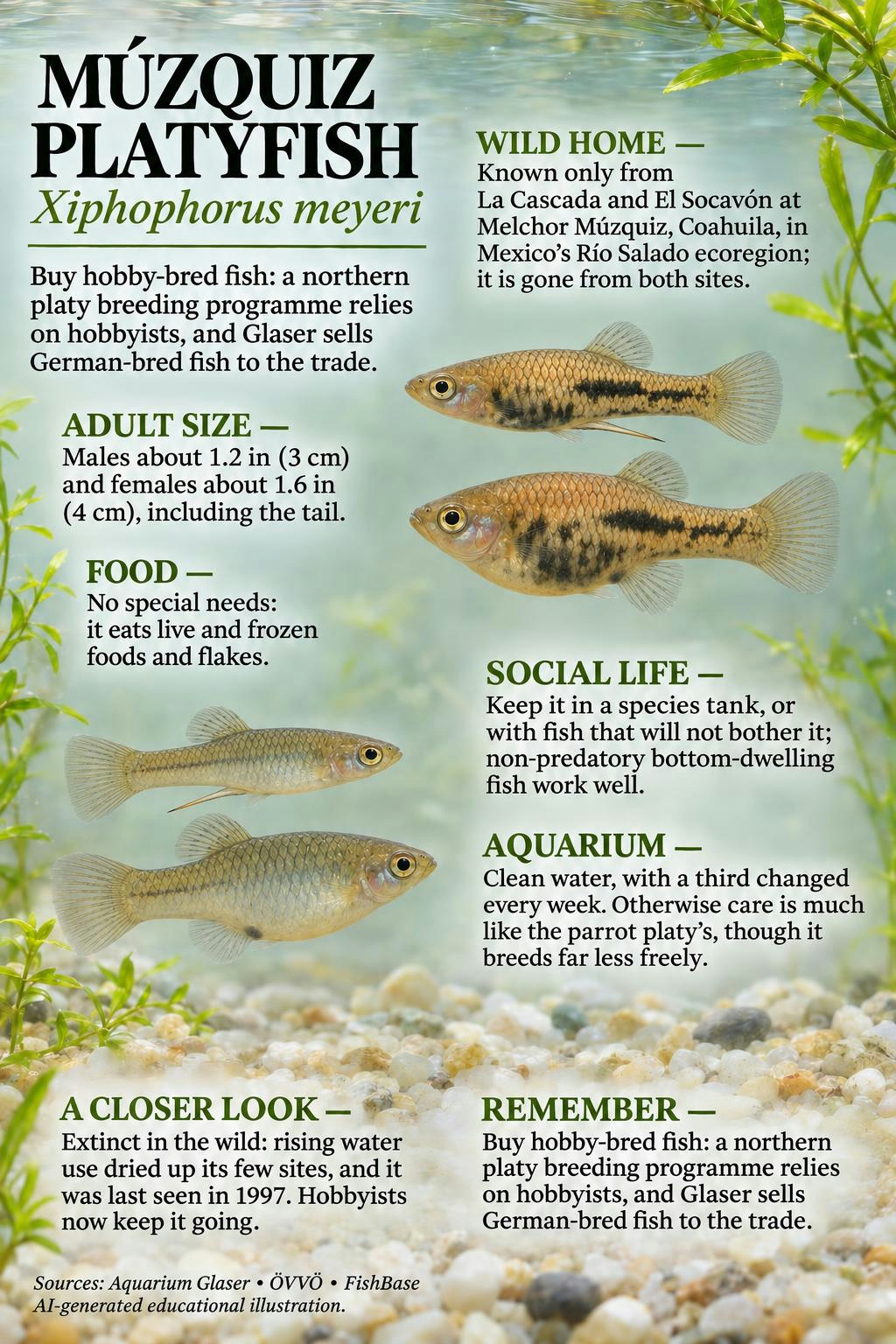
Read the infographic as text
- WILD HOME — Known only from La Cascada and El Socavón at Melchor Múzquiz, Coahuila, in Mexico’s Río Salado ecoregion; it is gone from both sites.
- ADULT SIZE — Males about 1.2 in (3 cm) and females about 1.6 in (4 cm), including the tail.
- FOOD — No special needs: it eats live and frozen foods and flakes.
- SOCIAL LIFE — Keep it in a species tank, or with fish that will not bother it; non-predatory bottom-dwelling fish work well.
- AQUARIUM — Clean water, with a third changed every week. Otherwise care is much like the parrot platy’s, though it breeds far less freely.
- A CLOSER LOOK — Extinct in the wild: rising water use dried up its few sites, and it was last seen in 1997. Hobbyists now keep it going.
- REMEMBER — Buy hobby-bred fish: a northern platy breeding programme relies on hobbyists, and Glaser sells German-bred fish to the trade.
How to use these figures
Published care ranges and suggested tank sizes are starting points, not guarantees. Tank footprint, group size, filtration, feeding, companions and the individual fish all matter. Standard length excludes the tail fin. Do not abruptly change established water conditions to match a number on a page.
Use a cycled aquarium, monitor water quality and quarantine new arrivals using a suitable species-specific plan. Persistent appetite loss, rapid breathing or weight loss warrants investigation.
Common questions
What should I know before choosing this fish?
Buy hobby-bred fish: a northern platy breeding programme relies on hobbyists, and Glaser sells German-bred fish to the trade. Keep it in a species tank, or with fish that will not bother it; non-predatory bottom-dwelling fish work well.
What should I feed it?
No special needs: it eats live and frozen foods and flakes.
Why is it rare?
Extinct in the wild: rising water use dried up its few sites, and it was last seen in 1997. Hobbyists now keep it going.
Sources & review
Checked November 12, 2026. Retailer care guidance is not a universal biological minimum.
- Aquarium Glaser — Xiphophorus meyeri (update) stock note — reviewed care reference
- ÖVVÖ conservation — Xiphophorus species list and northern platy care
- FishBase — Xiphophorus meyeri species account