
At a glance
- Adult size
- About 2 in body length
- Space
- 80+ litres (21+ US gallons); see details
- Social needs
- The fish often hide deep in cover, while males court and fight in the open; adults rarely eat fry.
Starting guidance, not a universal minimum. See the care details and sources below.
Adult size
The GWG gives a maximum standard length of 5.7 cm (about 2.2 inches), excluding the tail fin; FishBase gives 5.1 cm standard length for males and 4.5 cm total length for females.
Aquarium space
The GWG recommends at least 80 litres (about 21 US gallons); bigger tanks are better.
Water conditions
FishBase lists pH 6.5–7.2 and 5–15 dH. The GWG warns that constant temperatures above 24°C (75°F) make the fish sick, so give a winter rest below 20°C (68°F) for 2–3 months; breeding restarts at 20–21°C and stops when it gets too warm (25°C). It asks for oxygen of at least 8 mg/l and 60–80% water changes every week. These are maintenance ranges, not targets to swing between; make the seasonal change slowly and avoid abrupt changes.
Natural home
Lakes, streams, ponds and canals in Guanajuato and Michoacán, Mexico, in shallow water with little current and dense plants.
Food and feeding
A small predator: water fleas, mysids and other small animal foods, plus flake, granules and brine shrimp nauplii.
Tankmates and behavior
The fish often hide deep in cover, while males court and fight in the open; adults rarely eat fry.
Setting up the habitat
Dense plants, many roots and wood, open areas where males can display, and moderate flow with high oxygen.
A closer look
Endangered (IUCN): since 2000, pollution, water diversions and non-native fish have wiped it out of many areas.
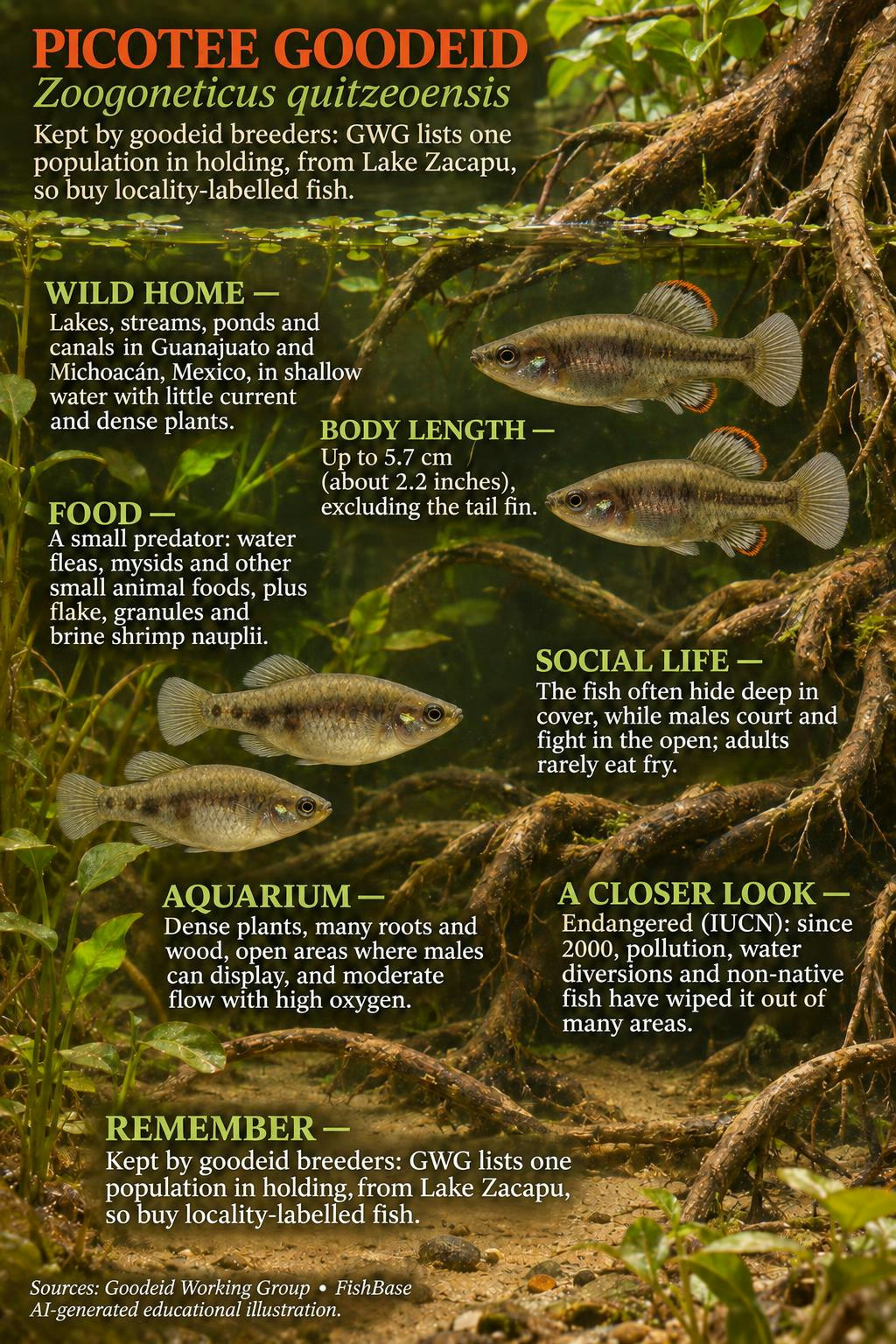
Read the infographic as text
- WILD HOME — Lakes, streams, ponds and canals in Guanajuato and Michoacán, Mexico, in shallow water with little current and dense plants.
- BODY LENGTH — Up to 5.7 cm (about 2.2 inches), excluding the tail fin.
- FOOD — A small predator: water fleas, mysids and other small animal foods, plus flake, granules and brine shrimp nauplii.
- SOCIAL LIFE — The fish often hide deep in cover, while males court and fight in the open; adults rarely eat fry.
- AQUARIUM — Dense plants, many roots and wood, open areas where males can display, and moderate flow with high oxygen.
- A CLOSER LOOK — Endangered (IUCN): since 2000, pollution, water diversions and non-native fish have wiped it out of many areas.
- REMEMBER — Kept by goodeid breeders: GWG lists one population in holding, from Lake Zacapu, so buy locality-labelled fish.
How to use these figures
Published care ranges and suggested tank sizes are starting points, not guarantees. Tank footprint, group size, filtration, feeding, companions and the individual fish all matter. Standard length excludes the tail fin. Do not abruptly change established water conditions to match a number on a page.
Use a cycled aquarium, monitor water quality and quarantine new arrivals using a suitable species-specific plan. Persistent appetite loss, rapid breathing or weight loss warrants investigation.
Common questions
What should I know before choosing this fish?
Kept by goodeid breeders: GWG lists one population in holding, from Lake Zacapu, so buy locality-labelled fish. The fish often hide deep in cover, while males court and fight in the open; adults rarely eat fry.
What should I feed it?
A small predator: water fleas, mysids and other small animal foods, plus flake, granules and brine shrimp nauplii.
Why is it rare?
Endangered (IUCN): since 2000, pollution, water diversions and non-native fish have wiped it out of many areas.
Sources & review
Checked November 12, 2026. Retailer care guidance is not a universal biological minimum.