
At a glance
- Adult size
- About 2.6 in body length
- Space
- At least a 120 × 30 cm (48 × 12 in) base; GWG 150+ litres
- Social needs
- Best kept alone for breeding. Males are territorially aggressive but coexist with enough cover. Never mix populations or strains.
Starting guidance, not a universal minimum. See the care details and sources below.
Adult size
Seriously Fish gives a maximum standard length of 65 mm (about 2.6 inches), excluding the tail fin, and says females grow larger than males; FishBase gives total lengths of 4 cm for males and 5.5 cm for females.
Aquarium space
Seriously Fish recommends a base of at least 120 × 30 cm (48 × 12 in), about 108 litres (29 US gallons). The GWG recommends at least 150 litres (about 40 US gallons), ideally a tank with a generous base and little height; it says 25 cm of water depth is enough.
Water conditions
Seriously Fish lists 64–75°F (18–24°C), pH 6.0–8.0 and 5–15 dGH; FishBase gives 18–27°C. It needs cool winters: the GWG warns that constant temperatures above 24°C (75°F) make the fish sick and age it too fast, so give a winter rest below 20°C (68°F) for 2 or 3 months, when breeding stops. In spring it starts spawning at 20 or 21°C and stops again when it gets too warm, at 25°C (77°F). The GWG adds that it does well outdoors from spring to fall once the daytime water exceeds 17°C, and asks for a high oxygen level and 60–80% water changes every week. These are maintenance ranges, not targets to swing between; make the seasonal change slowly and avoid abrupt changes.
Natural home
Shallow, weedy springs and their outflows with little or no flow, about 1800 m up in Durango, Mexico, over sand, gravel, mud or clay.
Food and feeding
Small live foods such as Daphnia and Artemia, plus algae, Spirulina or blanched spinach; dried foods are taken but should not be the staple.
Tankmates and behavior
Best kept alone for breeding. Males are territorially aggressive but coexist with enough cover. Never mix populations or strains.
Setting up the habitat
Dense plants or filamentous algae to curb male aggression and hide fry. Seriously Fish says no strong flow; the GWG wants moderate flow.
A closer look
Critically Endangered by pumping, diversions and introduced fish; it survives only at Los Berros and one tiny private spring.
Read the infographic as text
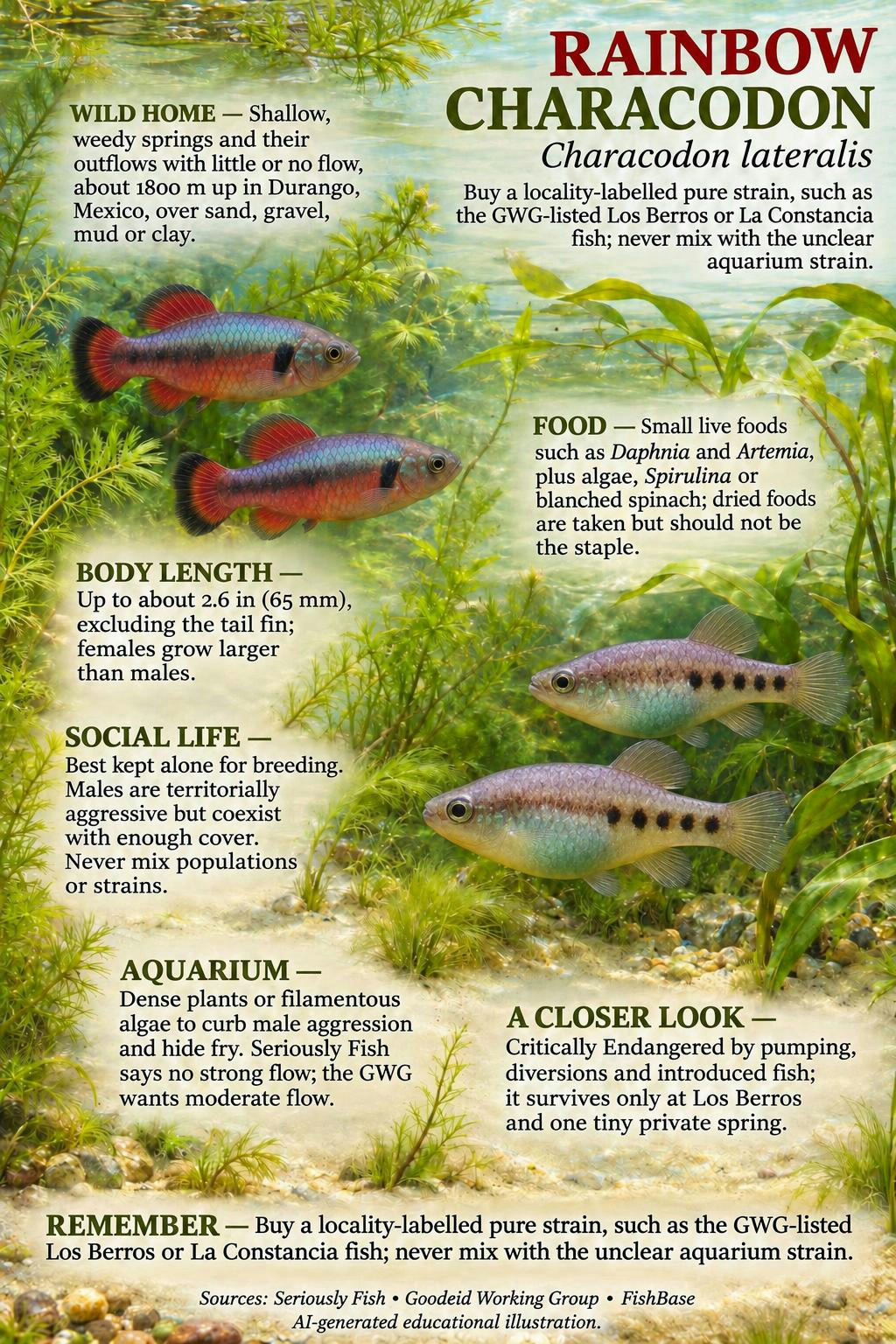
- WILD HOME — Shallow, weedy springs and their outflows with little or no flow, about 1800 m up in Durango, Mexico, over sand, gravel, mud or clay.
- BODY LENGTH — Up to about 2.6 in (65 mm), excluding the tail fin; females grow larger than males.
- FOOD — Small live foods such as Daphnia and Artemia, plus algae, Spirulina or blanched spinach; dried foods are taken but should not be the staple.
- SOCIAL LIFE — Best kept alone for breeding. Males are territorially aggressive but coexist with enough cover. Never mix populations or strains.
- AQUARIUM — Dense plants or filamentous algae to curb male aggression and hide fry. Seriously Fish says no strong flow; the GWG wants moderate flow.
- A CLOSER LOOK — Critically Endangered by pumping, diversions and introduced fish; it survives only at Los Berros and one tiny private spring.
- REMEMBER — Buy a locality-labelled pure strain, such as the GWG-listed Los Berros or La Constancia fish; never mix with the unclear aquarium strain.
How to use these figures
Published care ranges and suggested tank sizes are starting points, not guarantees. Tank footprint, group size, filtration, feeding, companions and the individual fish all matter. Standard length excludes the tail fin. Do not abruptly change established water conditions to match a number on a page.
Use a cycled aquarium, monitor water quality and quarantine new arrivals using a suitable species-specific plan. Persistent appetite loss, rapid breathing or weight loss warrants investigation.
Common questions
What should I know before choosing this fish?
Buy a locality-labelled pure strain, such as the GWG-listed Los Berros or La Constancia fish; never mix with the unclear aquarium strain. Best kept alone for breeding. Males are territorially aggressive but coexist with enough cover. Never mix populations or strains.
What should I feed it?
Small live foods such as Daphnia and Artemia, plus algae, Spirulina or blanched spinach; dried foods are taken but should not be the staple.
Why is it rare?
Critically Endangered by pumping, diversions and introduced fish; it survives only at Los Berros and one tiny private spring.
Sources & review
Checked November 12, 2026. Retailer care guidance is not a universal biological minimum.