
At a glance
- Adult size
- Males about 1.5 in, females 1.9 in body length
- Space
- CLS 10–20 US gallons; GWG 150+ litres
- Social needs
- Bold. Keep six or more to spread chasing between same-size males; a species tank is advised, though Ancistrus caused no trouble.
Starting guidance, not a universal minimum. See the care details and sources below.
Adult size
FishBase gives maximum standard lengths of 3.7 cm (about 1.5 inches) for males and 4.7 cm (about 1.9 inches) for females, excluding the tail fin. The Chicago Livebearer Society gives 1.75 in for males and 2.0 in for females.
Aquarium space
The GWG recommends at least 150 litres (about 40 US gallons); a tank with a generous base and little height is better. The Chicago Livebearer Society starts a group of six or more in a long tank of 10 US gallons (38 litres) to 20 US gallons (76 litres).
Water conditions
The Chicago Livebearer Society keeps it at 60–75°F (16–24°C), unheated unless a heater is needed for stability. No source gives a pH or hardness range. The GWG warns that constant temperatures above 25°C (77°F) make the fish sick, so give a winter rest below 20°C (68°F) for 2 or 3 months; spawning restarts at 20 or 21°C and stops when it gets too warm, at 25°C. It asks for moderate flow, a high oxygen level and 60–80% water changes every week. These are maintenance ranges, not targets to swing between; make the seasonal change slowly and avoid abrupt changes.
Natural home
Springs, ponds, a dam and seasonal streams around Etzatlán and San Marcos, Jalisco, in clear, weedy water or turbid, plantless mud ponds.
Food and feeding
An omnivore: algae and plant foods such as spirulina, plus flake, tablets and some animal food. Too much animal protein can cause bloat.
Tankmates and behavior
Bold. Keep six or more to spread chasing between same-size males; a species tank is advised, though Ancistrus caused no trouble.
Setting up the habitat
Roots or rocks, dense plant patches in the corners, open swimming space, moderate flow and bright light for algae; protect the first fry.
A closer look
Critically Endangered (IUCN): pumping dried many springs and introduced fish displaced it; only a handful of populations persist.
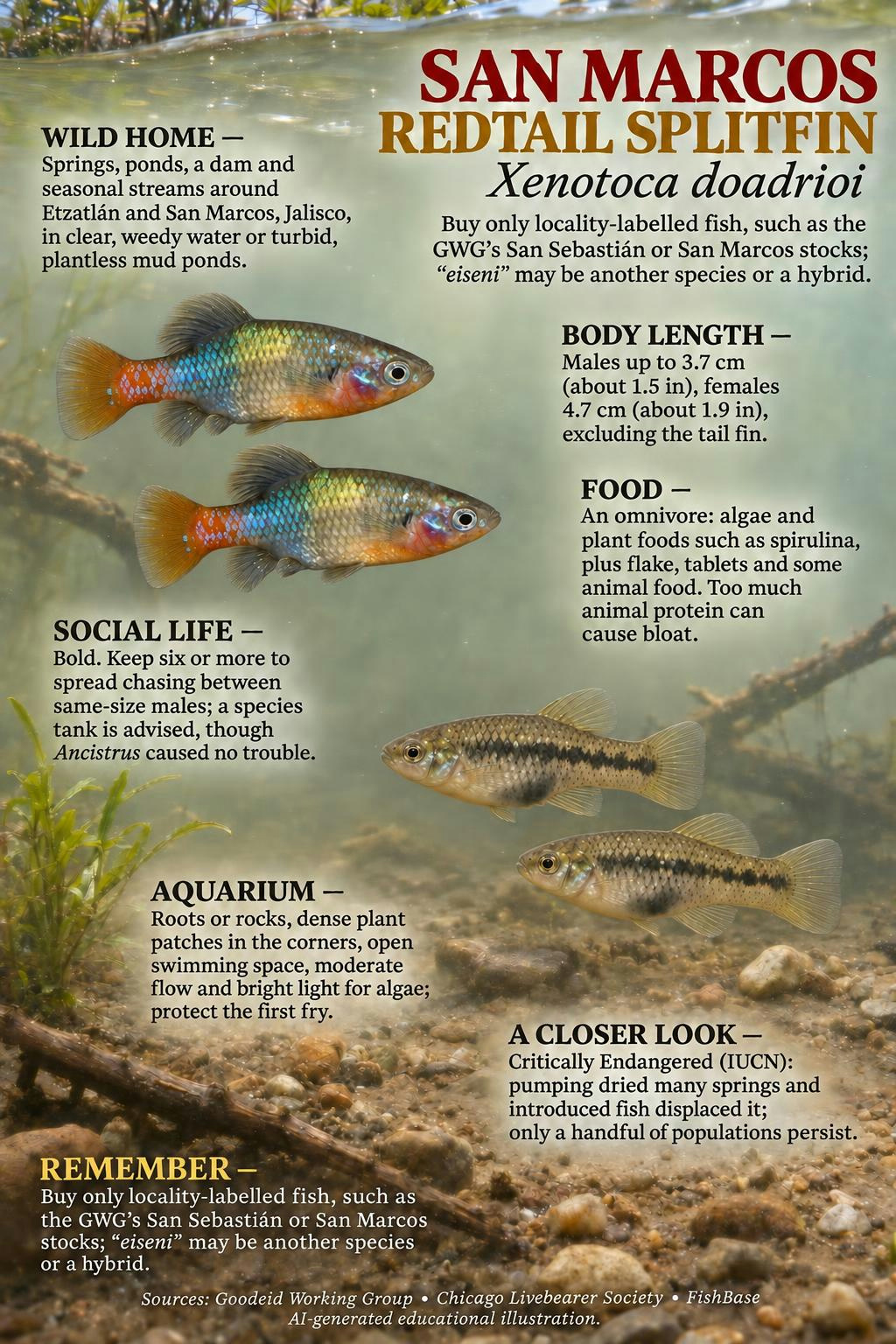
Read the infographic as text
- WILD HOME — Springs, ponds, a dam and seasonal streams around Etzatlán and San Marcos, Jalisco, in clear, weedy water or turbid, plantless mud ponds.
- BODY LENGTH — Males up to 3.7 cm (about 1.5 in), females 4.7 cm (about 1.9 in), excluding the tail fin.
- FOOD — An omnivore: algae and plant foods such as spirulina, plus flake, tablets and some animal food. Too much animal protein can cause bloat.
- SOCIAL LIFE — Bold. Keep six or more to spread chasing between same-size males; a species tank is advised, though Ancistrus caused no trouble.
- AQUARIUM — Roots or rocks, dense plant patches in the corners, open swimming space, moderate flow and bright light for algae; protect the first fry.
- A CLOSER LOOK — Critically Endangered (IUCN): pumping dried many springs and introduced fish displaced it; only a handful of populations persist.
- REMEMBER — Buy only locality-labelled fish, such as the GWG’s San Sebastián or San Marcos stocks; “eiseni” may be another species or a hybrid.
How to use these figures
Published care ranges and suggested tank sizes are starting points, not guarantees. Tank footprint, group size, filtration, feeding, companions and the individual fish all matter. Standard length excludes the tail fin. Do not abruptly change established water conditions to match a number on a page.
Use a cycled aquarium, monitor water quality and quarantine new arrivals using a suitable species-specific plan. Persistent appetite loss, rapid breathing or weight loss warrants investigation.
Common questions
What should I know before choosing this fish?
Buy only locality-labelled fish, such as the GWG’s San Sebastián or San Marcos stocks; “eiseni” may be another species or a hybrid. Bold. Keep six or more to spread chasing between same-size males; a species tank is advised, though Ancistrus caused no trouble.
What should I feed it?
An omnivore: algae and plant foods such as spirulina, plus flake, tablets and some animal food. Too much animal protein can cause bloat.
Why is it rare?
Critically Endangered (IUCN): pumping dried many springs and introduced fish displaced it; only a handful of populations persist.
Sources & review
Checked November 12, 2026. Retailer care guidance is not a universal biological minimum.