
At a glance
- Adult size
- FishBase records 7 cm TL; under 3 in
- Space
- No minimum given; one fish lived in 130 US gallons
- Social needs
- Keep it alone or with calm, retiring fish; one was kept with a harem of Cook Islands ventralis anthias collected on the same trip.
Starting guidance, not a universal minimum. See the care details and sources below.
Adult size
FishBase reports a maximum recorded length of 7 cm (2.8 inches), including the tail. A recorded maximum is not a promise of typical aquarium size. A retailer’s account of one fish says it stays under 3 inches.
Aquarium space
No source gives a minimum tank size. The one fish described in detail lived in a 130 US gallon (492 litres) aquarium with a chiller, very dim light and stacked-rock caves.
Water conditions
Quality Marine says wild fish live at 22–24°C (72–75°F) despite the depth. One retailer started its single fish at 72.5°F (23°C) in a chilled tank and raised it very gradually to 74.5°F (24°C) over 7 weeks. No source gives pH, alkalinity or salinity. Keep conditions steady and avoid abrupt changes.
Natural home
Ledges, caves and rubble on steep seaward reefs 53–120 m deep at Rarotonga in the Cook Islands; never seen shallower than 53 m.
Food and feeding
Needs live foods at first: seed live copepods weeks ahead, then offer baby brine shrimp and frozen Calanus, later mysis. Many starve.
Tankmates and behavior
Keep it alone or with calm, retiring fish; one was kept with a harem of Cook Islands ventralis anthias collected on the same trip.
Setting up the habitat
An extremely mature tank, dim light, rock caves, slower flow than a typical reef and a UV sterilizer. One fish ignored LPS and zoanthids.
A closer look
Known only from Rarotonga, deeper than 53 m: collectors need rebreathers, and FishBase says it is never or rarely exported.
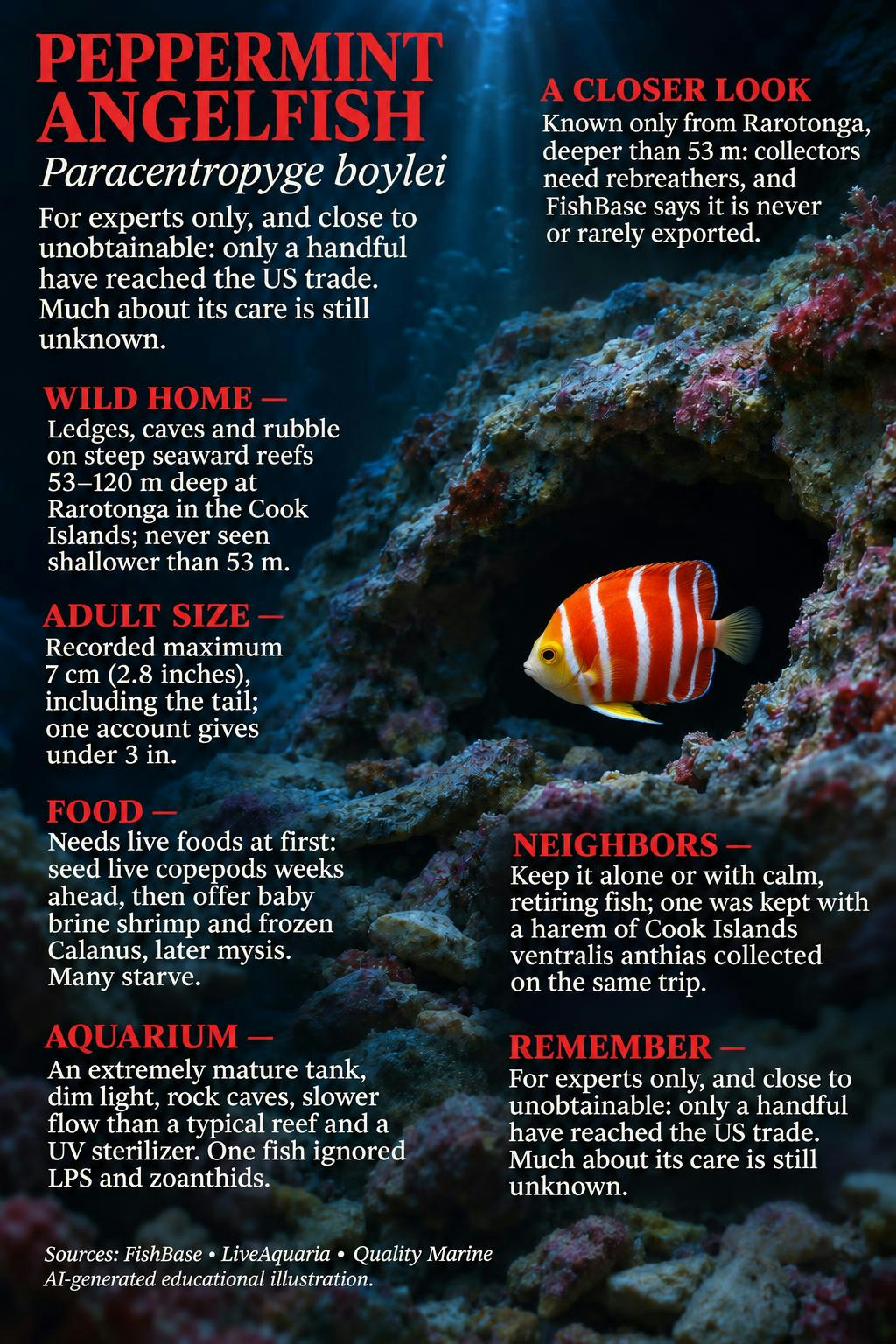
Read the infographic as text
- WILD HOME — Ledges, caves and rubble on steep seaward reefs 53–120 m deep at Rarotonga in the Cook Islands; never seen shallower than 53 m.
- ADULT SIZE — Recorded maximum 7 cm (2.8 inches), including the tail; one account gives under 3 in.
- FOOD — Needs live foods at first: seed live copepods weeks ahead, then offer baby brine shrimp and frozen Calanus, later mysis. Many starve.
- NEIGHBORS — Keep it alone or with calm, retiring fish; one was kept with a harem of Cook Islands ventralis anthias collected on the same trip.
- AQUARIUM — An extremely mature tank, dim light, rock caves, slower flow than a typical reef and a UV sterilizer. One fish ignored LPS and zoanthids.
- A CLOSER LOOK — Known only from Rarotonga, deeper than 53 m: collectors need rebreathers, and FishBase says it is never or rarely exported.
- REMEMBER — For experts only, and close to unobtainable: only a handful have reached the US trade. Much about its care is still unknown.
How to use these figures
Published care ranges and suggested tank sizes are starting points, not guarantees. Tank footprint, group size, filtration, feeding, companions and the individual fish all matter. Standard length excludes the tail fin. Do not abruptly change established water conditions to match a number on a page.
Use a cycled aquarium, monitor water quality and quarantine new arrivals using a suitable species-specific plan. Persistent appetite loss, rapid breathing or weight loss warrants investigation.
Common questions
What should I know before choosing this fish?
For experts only, and close to unobtainable: only a handful have reached the US trade. Much about its care is still unknown. Keep it alone or with calm, retiring fish; one was kept with a harem of Cook Islands ventralis anthias collected on the same trip.
What should I feed it?
Needs live foods at first: seed live copepods weeks ahead, then offer baby brine shrimp and frozen Calanus, later mysis. Many starve.
Why is it rare?
Known only from Rarotonga, deeper than 53 m: collectors need rebreathers, and FishBase says it is never or rarely exported.
Sources & review
Checked November 12, 2026. Retailer care guidance is not a universal biological minimum.
- FishBase — Centropyge boylei (Paracentropyge boylei) species account
- LiveAquaria — Peppermint Angelfish species spotlight (one conditioned fish) — reviewed care reference
- Quality Marine — Peppermint Angel (Paracentropyge boylei) article — reviewed care reference