
At a glance
- Adult size
- About 6 in body length
- Space
- 48 × 12 in base or larger; see details
- Social needs
- Peaceful with most fish, but males fight each other; tetras, peaceful South American cichlids and Corydoras suit.
Starting guidance, not a universal minimum. See the care details and sources below.
Adult size
Seriously Fish gives a maximum standard length of 150 mm (6 inches), excluding the tail fin; PlanetCatfish and FishBase give only 9.8 cm SL, and Catfish Codex gives 20 cm (8 inches) without saying how it was measured.
Aquarium space
Seriously Fish lists 48 × 12 × 12 inches (120 × 30 × 30 cm), about 108 litres (29 US gallons), and says a spacious tank is required, with room for territories if you keep a group.
Water conditions
Seriously Fish lists 77–81°F (25–27°C), pH 6.0–7.5 and 2–15 dGH and says it needs a very steady temperature; PlanetCatfish gives pH 6.0–7.6 at the same temperatures. The water must be highly oxygenated, and PlanetCatfish says it is sensitive to nitrites and to nitrates above 50 mg/l. These are maintenance ranges, not targets to swing between; avoid abrupt changes.
Natural home
Rapids and other fast-flowing water among rocks and driftwood snags in Brazil’s Rio Tapajós basin.
Food and feeding
Mostly meaty foods: bloodworm, chopped mussel and prawn, krill and sinking dried foods; it may nibble cucumber or courgette now and then.
Tankmates and behavior
Peaceful with most fish, but males fight each other; tetras, peaceful South American cichlids and Corydoras suit.
Setting up the habitat
Sand, big driftwood and smooth rocks for caves and shade, dim light, strong water movement and efficient filtration for its heavy waste.
A closer look
Found only in Brazil’s Rio Tapajós basin; FishBase lists it as Vulnerable, and Catfish Codex reports rumours of a decline in the wild.
Read the infographic as text
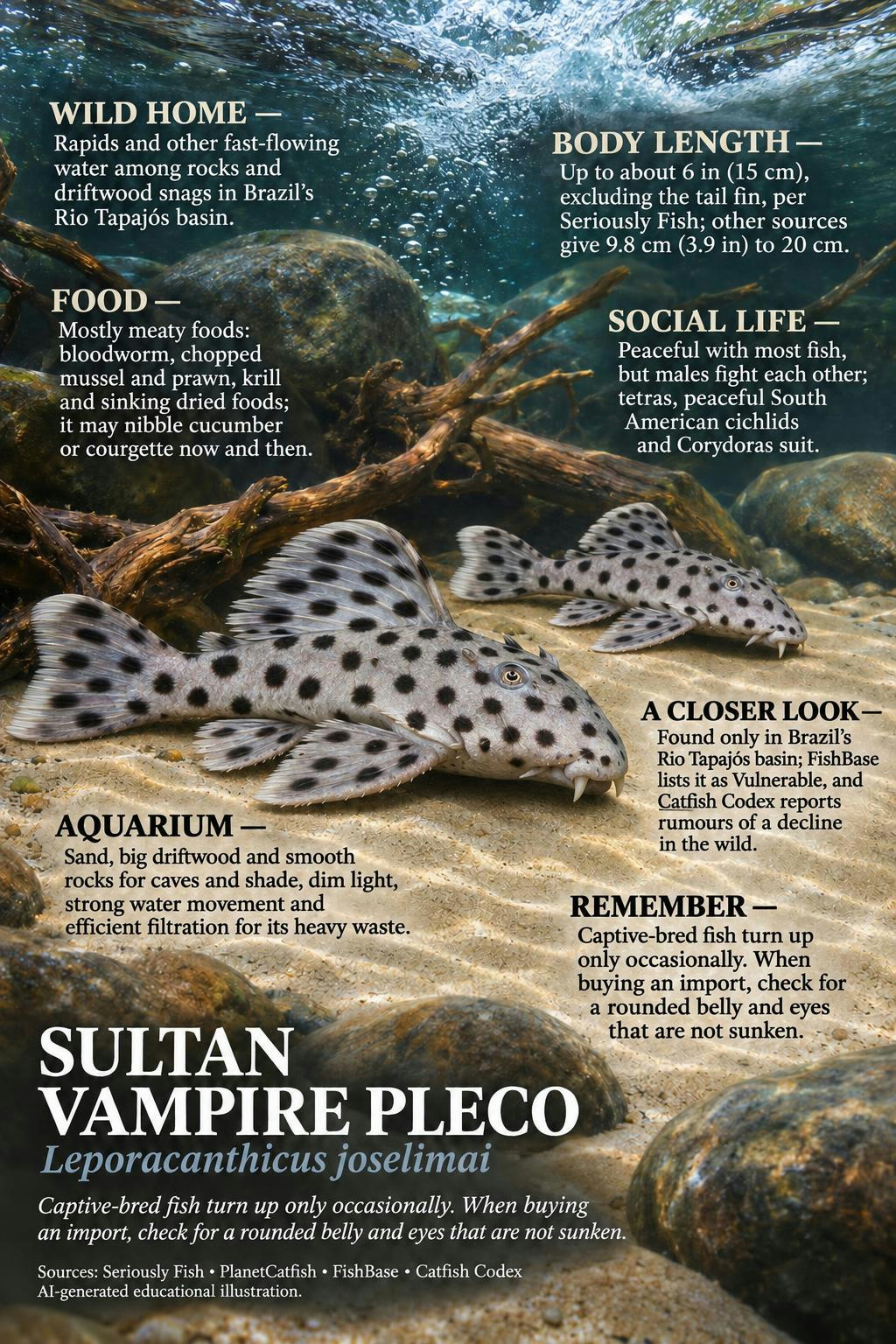
- WILD HOME — Rapids and other fast-flowing water among rocks and driftwood snags in Brazil’s Rio Tapajós basin.
- BODY LENGTH — Up to about 6 in (15 cm), excluding the tail fin, per Seriously Fish; other sources give 9.8 cm (3.9 in) to 20 cm.
- FOOD — Mostly meaty foods: bloodworm, chopped mussel and prawn, krill and sinking dried foods; it may nibble cucumber or courgette now and then.
- SOCIAL LIFE — Peaceful with most fish, but males fight each other; tetras, peaceful South American cichlids and Corydoras suit.
- AQUARIUM — Sand, big driftwood and smooth rocks for caves and shade, dim light, strong water movement and efficient filtration for its heavy waste.
- A CLOSER LOOK — Found only in Brazil’s Rio Tapajós basin; FishBase lists it as Vulnerable, and Catfish Codex reports rumours of a decline in the wild.
- REMEMBER — Captive-bred fish turn up only occasionally. When buying an import, check for a rounded belly and eyes that are not sunken.
How to use these figures
Published care ranges and suggested tank sizes are starting points, not guarantees. Tank footprint, group size, filtration, feeding, companions and the individual fish all matter. Standard length excludes the tail fin. Do not abruptly change established water conditions to match a number on a page.
Use a cycled aquarium, monitor water quality and quarantine new arrivals using a suitable species-specific plan. Persistent appetite loss, rapid breathing or weight loss warrants investigation.
Common questions
What should I know before choosing this fish?
Captive-bred fish turn up only occasionally. When buying an import, check for a rounded belly and eyes that are not sunken. Peaceful with most fish, but males fight each other; tetras, peaceful South American cichlids and Corydoras suit.
What should I feed it?
Mostly meaty foods: bloodworm, chopped mussel and prawn, krill and sinking dried foods; it may nibble cucumber or courgette now and then.
Why is it rare?
Found only in Brazil’s Rio Tapajós basin; FishBase lists it as Vulnerable, and Catfish Codex reports rumours of a decline in the wild.
Sources & review
Checked November 12, 2026. Retailer care guidance is not a universal biological minimum.