
At a glance
- Adult size
- Up to about 40 cm (15.7 in) total length
- Space
- 150 cm (59.1 in) long tank; no volume given
- Social needs
- Robust; suits discus, angelfish or South American cichlids, not cooler Central Americans. Give rival plecos caves and feeding spots.
Starting guidance, not a universal minimum. See the care details and sources below.
Adult size
PlanetCatfish gives a maximum standard length of 9.8 inches (25 cm), excluding the tail fin; FishBase gives 29 cm total length, and Welsfans about 40 cm (about 15.7 inches) total length.
Aquarium space
Welsfans recommends a tank 150 cm (about 59.1 inches) long and gives no volume; PlanetCatfish and FishBase give no tank size.
Water conditions
It needs warm water. PlanetCatfish lists 25–29°C (77–84°F) and pH 5.8–7.2 in clean, clear, highly oxygenated water, ideally with a noticeable current; Welsfans gives 26–30°C (79–86°F) and pH 5.0–7.0. No source gives a hardness range for keeping it; Welsfans’s breeding entry lists 28–31°C (82–88°F) and GH 4–15. These are maintenance ranges, not targets to swing between; avoid abrupt changes.
Natural home
Clear water with normal to strong flow in Brazil’s Rio Xingu basin, including the Rio Iriri.
Food and feeding
Sinking pellets and frozen bloodworm, whole prawns and mussels for large fish, and some vegetables such as pumpkin; wild fish eat crustaceans.
Tankmates and behavior
Robust; suits discus, angelfish or South American cichlids, not cooler Central Americans. Give rival plecos caves and feeding spots.
Setting up the habitat
Sand or small pea gravel with groups of rounded stones and few or no plants, in clean, warm, highly oxygenated water with some current.
A closer look
Vulnerable per FishBase, and on Brazil’s 2020 negative export list per Welsfans; older PlanetCatfish text calls it a frequent import.
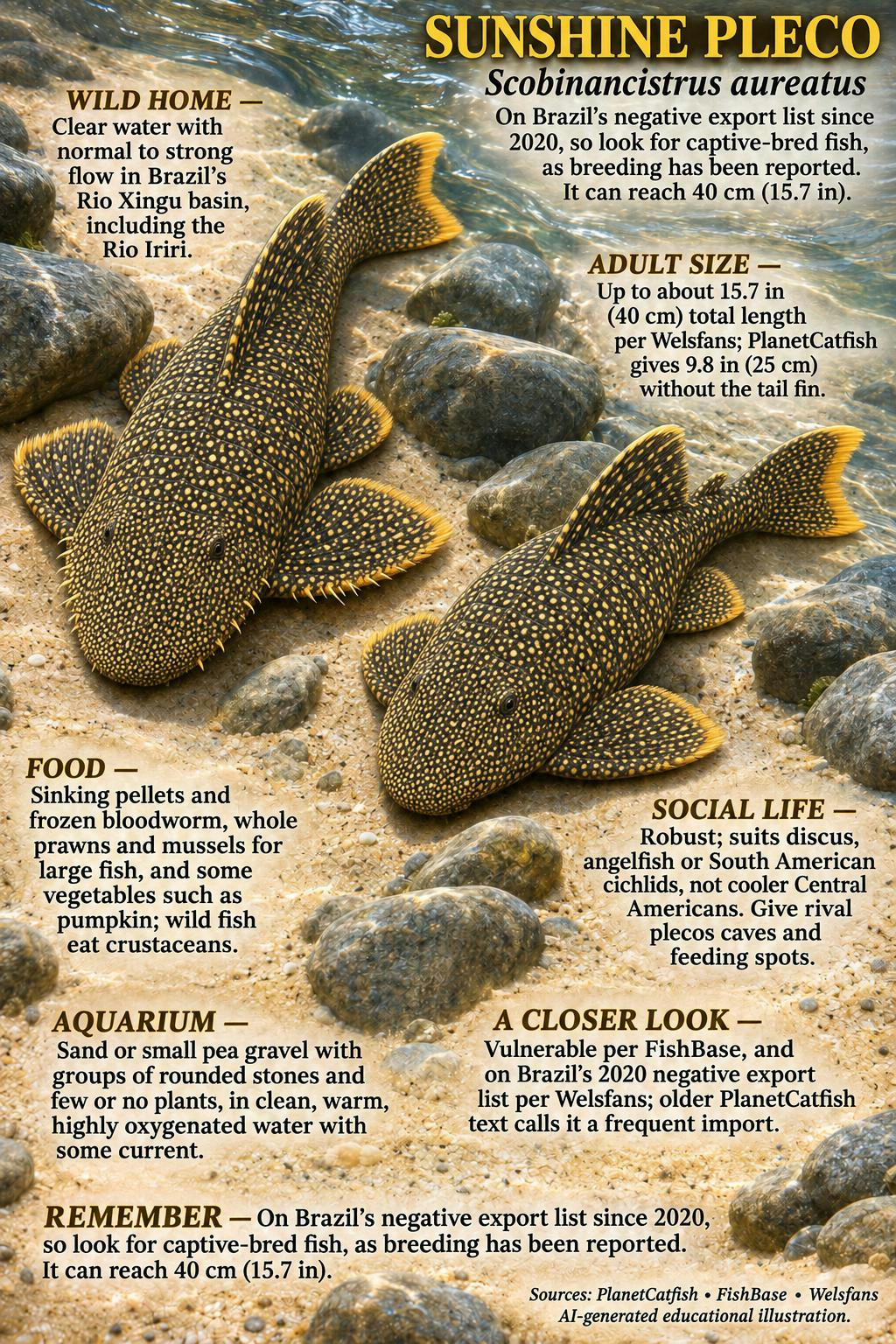
Read the infographic as text
- WILD HOME — Clear water with normal to strong flow in Brazil’s Rio Xingu basin, including the Rio Iriri.
- ADULT SIZE — Up to about 15.7 in (40 cm) total length per Welsfans; PlanetCatfish gives 9.8 in (25 cm) without the tail fin.
- FOOD — Sinking pellets and frozen bloodworm, whole prawns and mussels for large fish, and some vegetables such as pumpkin; wild fish eat crustaceans.
- SOCIAL LIFE — Robust; suits discus, angelfish or South American cichlids, not cooler Central Americans. Give rival plecos caves and feeding spots.
- AQUARIUM — Sand or small pea gravel with groups of rounded stones and few or no plants, in clean, warm, highly oxygenated water with some current.
- A CLOSER LOOK — Vulnerable per FishBase, and on Brazil’s 2020 negative export list per Welsfans; older PlanetCatfish text calls it a frequent import.
- REMEMBER — On Brazil’s negative export list since 2020, so look for captive-bred fish, as breeding has been reported. It can reach 40 cm (15.7 in).
How to use these figures
Published care ranges and suggested tank sizes are starting points, not guarantees. Tank footprint, group size, filtration, feeding, companions and the individual fish all matter. Standard length excludes the tail fin. Do not abruptly change established water conditions to match a number on a page.
Use a cycled aquarium, monitor water quality and quarantine new arrivals using a suitable species-specific plan. Persistent appetite loss, rapid breathing or weight loss warrants investigation.
Common questions
What should I know before choosing this fish?
On Brazil’s negative export list since 2020, so look for captive-bred fish, as breeding has been reported. It can reach 40 cm (15.7 in). Robust; suits discus, angelfish or South American cichlids, not cooler Central Americans. Give rival plecos caves and feeding spots.
What should I feed it?
Sinking pellets and frozen bloodworm, whole prawns and mussels for large fish, and some vegetables such as pumpkin; wild fish eat crustaceans.
Why is it rare?
Vulnerable per FishBase, and on Brazil’s 2020 negative export list per Welsfans; older PlanetCatfish text calls it a frequent import.
Sources & review
Checked November 12, 2026. Retailer care guidance is not a universal biological minimum.