
At a glance
- Adult size
- About 2.2 in body length
- Space
- No size given; spawned in 10–20-gallon tanks
- Social needs
- Sociable; always keep a group. Good with small to medium tetras and possibly dwarf cichlids such as Apistogramma.
Starting guidance, not a universal minimum. See the care details and sources below.
Adult size
PlanetCatfish gives a maximum standard length of 5.5 cm (about 2.2 inches), excluding the tail fin, with females slightly larger than males; FishBase gives no size.
Aquarium space
No source gives a tank size; PlanetCatfish reports spawning in 10–20-gallon tanks.
Water conditions
PlanetCatfish and FishBase list 22–26°C (72–79°F), pH 6.0–8.0 and dH 2–25. Aquarium Glaser says it has no special temperature or water needs, and that old advice to keep it cold is wrong. A breeder spawned it at about pH 7.0, 10 dGH and 78°F (25.5°C). These are maintenance ranges, not targets to swing between; avoid abrupt changes.
Natural home
The western Amazon basin; imports come from the Rio Araza in the Madre de Dios river system of southern Peru.
Food and feeding
Takes sinking tablets, granules and flakes, with live or frozen bloodworm, white worm, Daphnia or Tubifex to condition it for spawning.
Tankmates and behavior
Sociable; always keep a group. Good with small to medium tetras and possibly dwarf cichlids such as Apistogramma.
Setting up the habitat
Soft sand, not sharp gravel; an open foraging area edged with driftwood and plants, and a clump of Java moss, where it lays its eggs.
A closer look
Lost for decades through a wrong 1971 type locality; rediscovered in Peru in the early 2000s, where gold mining pollutes its home.
Read the infographic as text
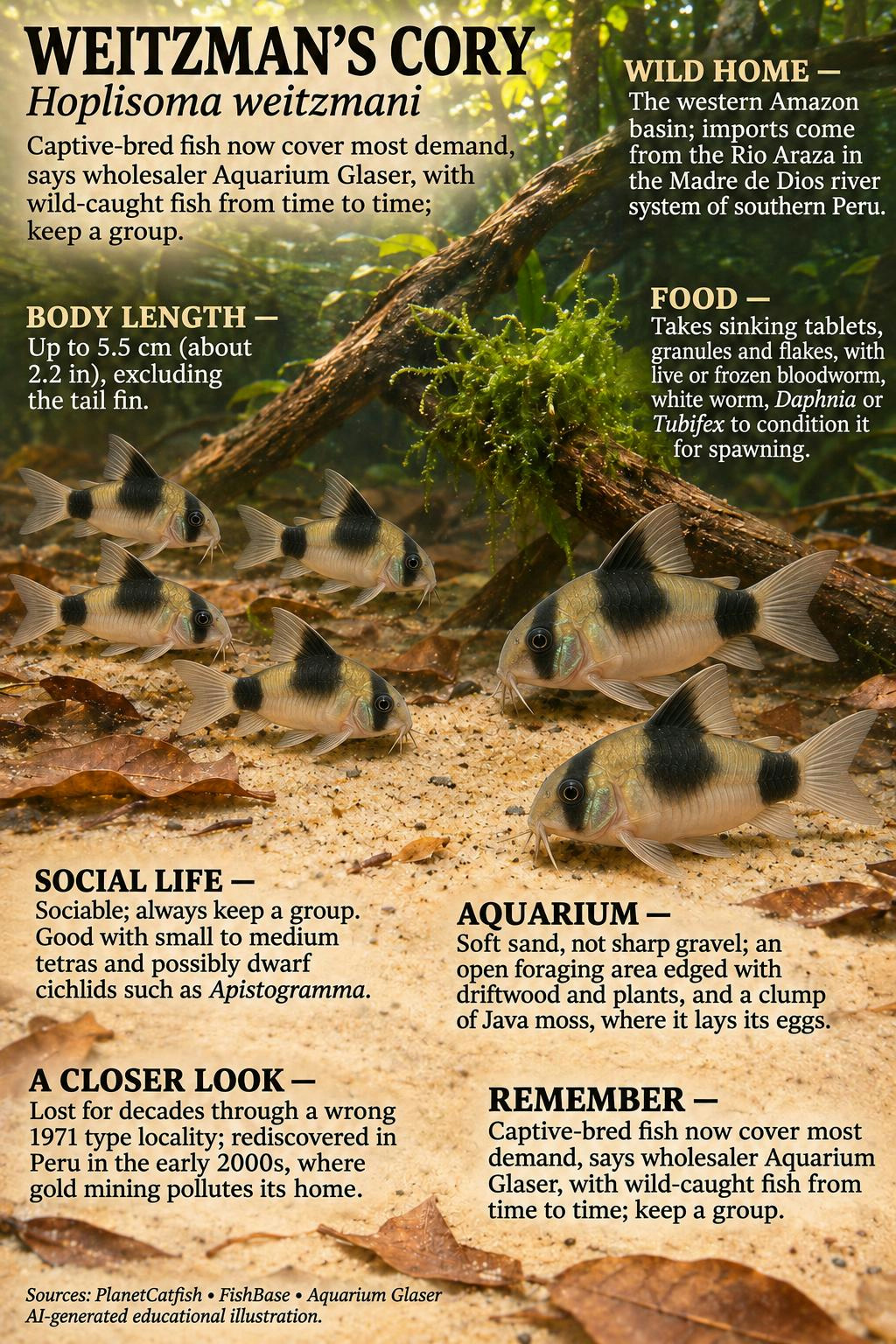
- WILD HOME — The western Amazon basin; imports come from the Rio Araza in the Madre de Dios river system of southern Peru.
- BODY LENGTH — Up to 5.5 cm (about 2.2 in), excluding the tail fin.
- FOOD — Takes sinking tablets, granules and flakes, with live or frozen bloodworm, white worm, Daphnia or Tubifex to condition it for spawning.
- SOCIAL LIFE — Sociable; always keep a group. Good with small to medium tetras and possibly dwarf cichlids such as Apistogramma.
- AQUARIUM — Soft sand, not sharp gravel; an open foraging area edged with driftwood and plants, and a clump of Java moss, where it lays its eggs.
- A CLOSER LOOK — Lost for decades through a wrong 1971 type locality; rediscovered in Peru in the early 2000s, where gold mining pollutes its home.
- REMEMBER — Captive-bred fish now cover most demand, says wholesaler Aquarium Glaser, with wild-caught fish from time to time; keep a group.
How to use these figures
Published care ranges and suggested tank sizes are starting points, not guarantees. Tank footprint, group size, filtration, feeding, companions and the individual fish all matter. Standard length excludes the tail fin. Do not abruptly change established water conditions to match a number on a page.
Use a cycled aquarium, monitor water quality and quarantine new arrivals using a suitable species-specific plan. Persistent appetite loss, rapid breathing or weight loss warrants investigation.
Common questions
What should I know before choosing this fish?
Captive-bred fish now cover most demand, says wholesaler Aquarium Glaser, with wild-caught fish from time to time; keep a group. Sociable; always keep a group. Good with small to medium tetras and possibly dwarf cichlids such as Apistogramma.
What should I feed it?
Takes sinking tablets, granules and flakes, with live or frozen bloodworm, white worm, Daphnia or Tubifex to condition it for spawning.
Why is it rare?
Lost for decades through a wrong 1971 type locality; rediscovered in Peru in the early 2000s, where gold mining pollutes its home.
Sources & review
Checked November 12, 2026. Retailer care guidance is not a universal biological minimum.
- PlanetCatfish — Hoplisoma weitzmani Cat-eLog
- FishBase — Hoplisoma weitzmani species account
- Aquarium Glaser — Hoplisoma (previously Corydoras) weitzmani fish archive — reviewed care reference