
At a glance
- Adult size
- About 3 in body length
- Space
- 24 × 12 in base or larger; see details
- Social needs
- Peaceful but shy, and easily outcompeted at feeding time. PlanetCatfish suggests 1 male to 2–3 females with calm, current-loving fish.
Starting guidance, not a universal minimum. See the care details and sources below.
Adult size
Seriously Fish reports a maximum standard length of 8 cm (about 3.1 inches), excluding the tail fin; PlanetCatfish gives 7.5 cm SL and FishBase 7 cm total length.
Aquarium space
Seriously Fish lists 24 × 12 × 12 inches (60 × 30 × 30 cm, about 14 US gallons). To raise a breeding group of at least 6 it suggests something around 36 × 12 × 12 inches.
Water conditions
The species profile lists 79–86°F (26–30°C), pH 6.0–7.5 and 2–15 dGH, and says it will fail to thrive in cooler conditions. PlanetCatfish adds that oxygen-rich, warm water matters more than pH or hardness. Avoid abrupt changes.
Natural home
Flowing, highly oxygenated water over sand, rocks and stones in Brazil’s Rio Xingu basin, hiding in crevices among the rubble.
Food and feeding
Meaty foods: bloodworm, chopped mussel and prawn, and sinking dried foods. It seldom takes algae or vegetables.
Tankmates and behavior
Peaceful but shy, and easily outcompeted at feeding time. PlanetCatfish suggests 1 male to 2–3 females with calm, current-loving fish.
Setting up the habitat
Sand scattered with smooth rocks and pebbles, lots of small caves, strong water movement and pristine, warm water.
A closer look
Brazil banned its export in 2004, and FishBase lists it as Critically Endangered, with trade monitored under CITES Appendix II.
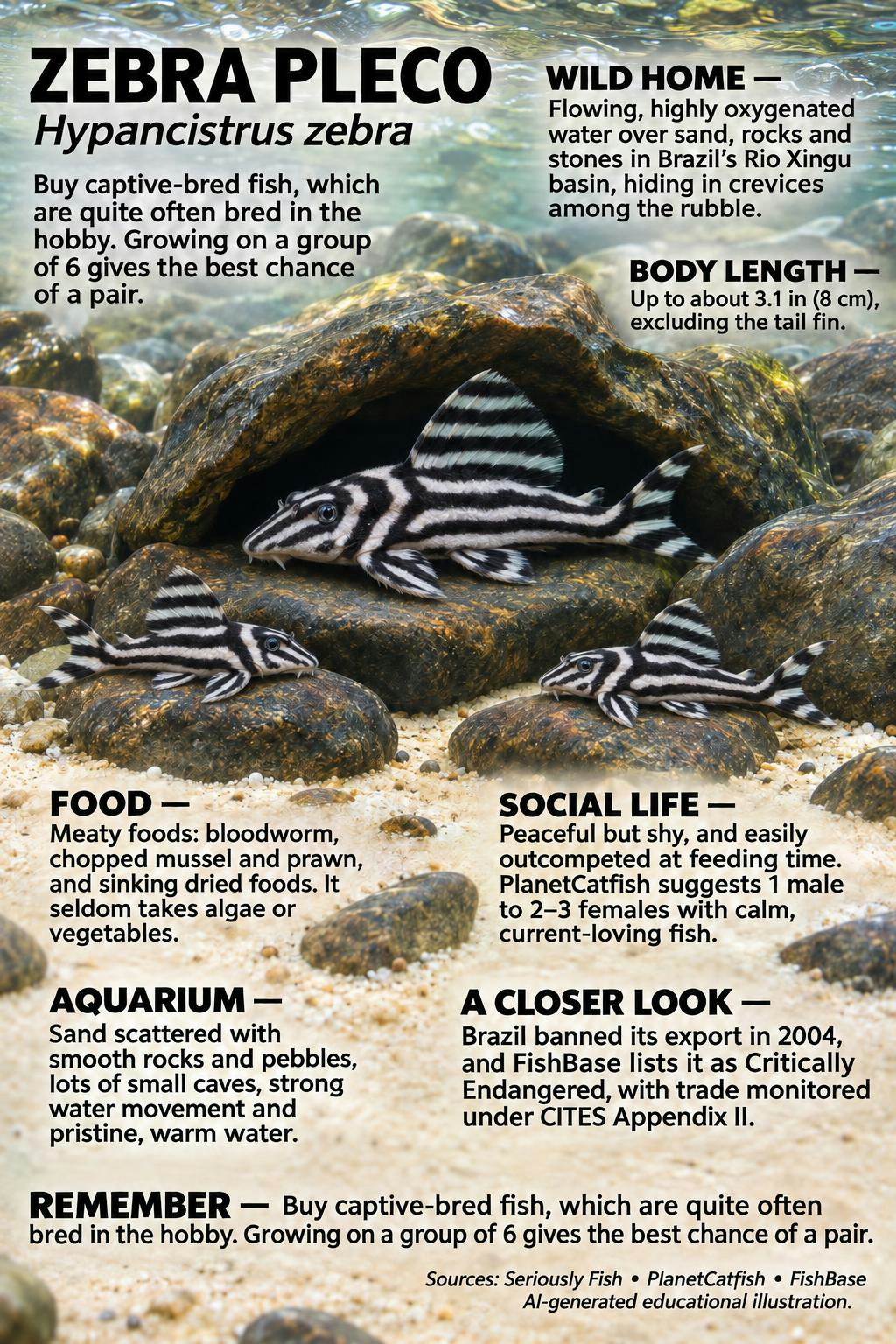
Read the infographic as text
- WILD HOME — Flowing, highly oxygenated water over sand, rocks and stones in Brazil’s Rio Xingu basin, hiding in crevices among the rubble.
- BODY LENGTH — Up to about 3.1 in (8 cm), excluding the tail fin.
- FOOD — Meaty foods: bloodworm, chopped mussel and prawn, and sinking dried foods. It seldom takes algae or vegetables.
- SOCIAL LIFE — Peaceful but shy, and easily outcompeted at feeding time. PlanetCatfish suggests 1 male to 2–3 females with calm, current-loving fish.
- AQUARIUM — Sand scattered with smooth rocks and pebbles, lots of small caves, strong water movement and pristine, warm water.
- A CLOSER LOOK — Brazil banned its export in 2004, and FishBase lists it as Critically Endangered, with trade monitored under CITES Appendix II.
- REMEMBER — Buy captive-bred fish, which are quite often bred in the hobby. Growing on a group of 6 gives the best chance of a pair.
How to use these figures
Published care ranges and suggested tank sizes are starting points, not guarantees. Tank footprint, group size, filtration, feeding, companions and the individual fish all matter. Standard length excludes the tail fin. Do not abruptly change established water conditions to match a number on a page.
Use a cycled aquarium, monitor water quality and quarantine new arrivals using a suitable species-specific plan. Persistent appetite loss, rapid breathing or weight loss warrants investigation.
Common questions
What should I know before choosing this fish?
Buy captive-bred fish, which are quite often bred in the hobby. Growing on a group of 6 gives the best chance of a pair. Peaceful but shy, and easily outcompeted at feeding time. PlanetCatfish suggests 1 male to 2–3 females with calm, current-loving fish.
What should I feed it?
Meaty foods: bloodworm, chopped mussel and prawn, and sinking dried foods. It seldom takes algae or vegetables.
Why is it rare?
Brazil banned its export in 2004, and FishBase lists it as Critically Endangered, with trade monitored under CITES Appendix II.
Sources & review
Checked November 12, 2026. Retailer care guidance is not a universal biological minimum.