
At a glance
- Adult size
- About 1.1 in body length
- Space
- 50 cm long, 50 litres (about 13 US gallons) for a pair
- Social needs
- Peaceful outside spawning; a male may keep a harem of females. Pair it with small, calm fish such as small tetras or guppies.
Starting guidance, not a universal minimum. See the care details and sources below.
Adult size
FishBase gives a maximum standard length of 2.7 cm (about 1.1 inches) for males and 2.3 cm for females, excluding the tail fin. The Nordiska Ciklidsällskapet register says females rarely reach 3 cm while males can sometimes approach 6 cm; AquaticCommunity gives 3 cm.
Aquarium space
The Nordiska Ciklidsällskapet register gives 50 cm (about 19.7 inches) and 50 litres (about 13 US gallons) for one pair; a group needs a tank over 1 metre long with as much floor as possible. ForAquarist says pairs are often kept in 10 litres (about 3 US gallons) to 20 litres (about 5 US gallons), with 15–20 cm of water depth enough.
Water conditions
The Nordiska Ciklidsällskapet register gives 25–30°C (77–86°F), noting fish turn sluggish at 28–30°C, and pH below 7, ideally near 6, in water as soft as possible. FishBase gives 23–30°C (73–86°F), pH from 5.5 and up to 5 dH. ForAquarist reports wild white water of pH 6.8–7.6, 4–17 dGH and 23–26°C (73–79°F); AquaticCommunity gives pH 6.4 and 23–28°C (73–82°F). These are maintenance ranges, not targets to swing between; avoid abrupt changes.
Natural home
From Pucallpa on Peru’s Río Ucayali to Santa Sofía Island in Colombia’s Amazon, caught mainly under carpets of floating plants.
Food and feeding
Prefers small live foods: give live or frozen brine shrimp, daphnia and bloodworm. It will taste flake, but rarely eats it gladly.
Tankmates and behavior
Peaceful outside spawning; a male may keep a harem of females. Pair it with small, calm fish such as small tetras or guppies.
Setting up the habitat
Dense plants, roots, leaf litter and fine sand, with caves such as coconut halves, good filtration and no strong current.
A closer look
Not threatened (FishBase: Least Concern), yet rarely seen in recent years; ForAquarist suspects its low price deters breeders.
Read the infographic as text
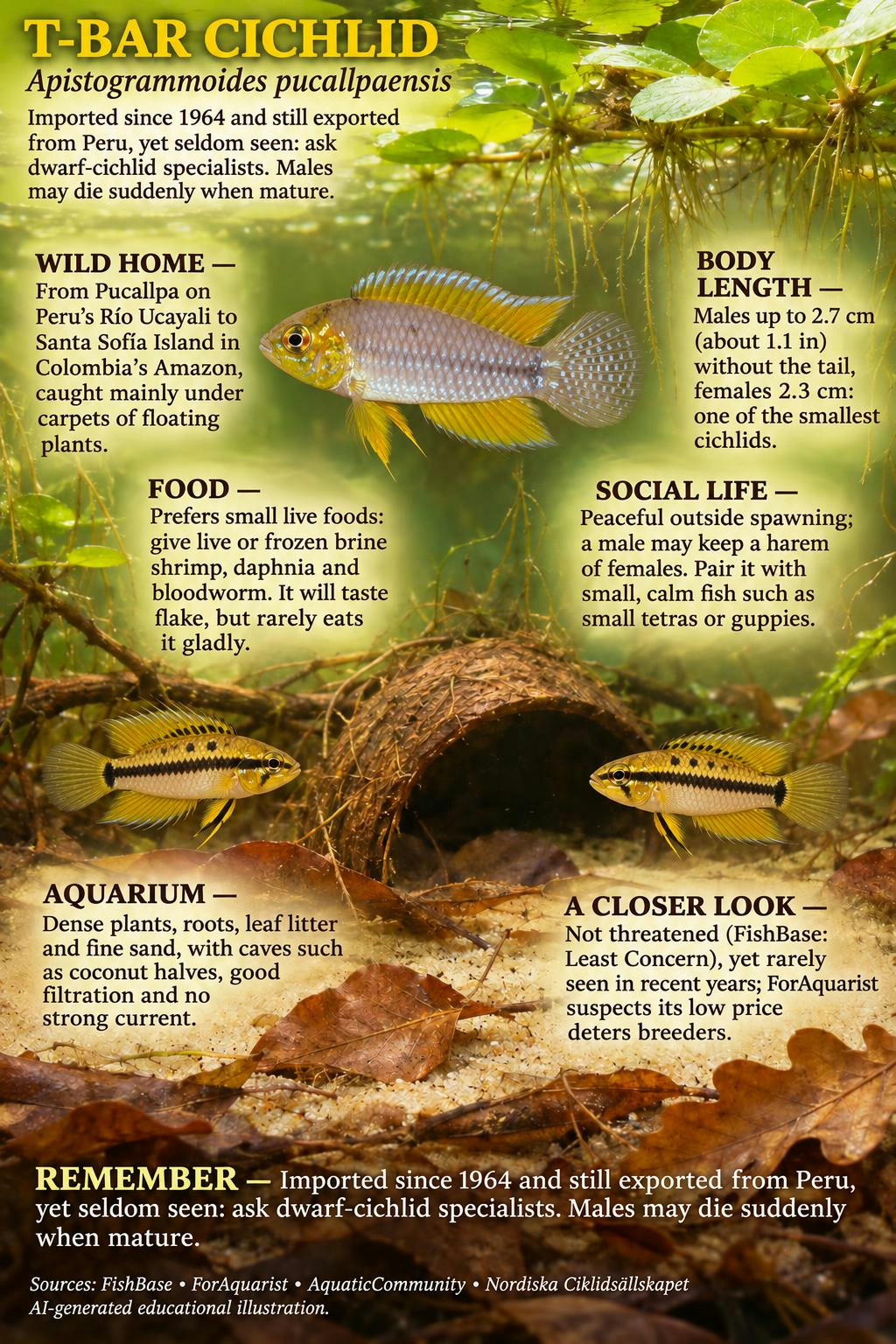
- WILD HOME — From Pucallpa on Peru’s Río Ucayali to Santa Sofía Island in Colombia’s Amazon, caught mainly under carpets of floating plants.
- BODY LENGTH — Males up to 2.7 cm (about 1.1 in) without the tail, females 2.3 cm: one of the smallest cichlids.
- FOOD — Prefers small live foods: give live or frozen brine shrimp, daphnia and bloodworm. It will taste flake, but rarely eats it gladly.
- SOCIAL LIFE — Peaceful outside spawning; a male may keep a harem of females. Pair it with small, calm fish such as small tetras or guppies.
- AQUARIUM — Dense plants, roots, leaf litter and fine sand, with caves such as coconut halves, good filtration and no strong current.
- A CLOSER LOOK — Not threatened (FishBase: Least Concern), yet rarely seen in recent years; ForAquarist suspects its low price deters breeders.
- REMEMBER — Imported since 1964 and still exported from Peru, yet seldom seen: ask dwarf-cichlid specialists. Males may die suddenly when mature.
How to use these figures
Published care ranges and suggested tank sizes are starting points, not guarantees. Tank footprint, group size, filtration, feeding, companions and the individual fish all matter. Standard length excludes the tail fin. Do not abruptly change established water conditions to match a number on a page.
Use a cycled aquarium, monitor water quality and quarantine new arrivals using a suitable species-specific plan. Persistent appetite loss, rapid breathing or weight loss warrants investigation.
Common questions
What should I know before choosing this fish?
Imported since 1964 and still exported from Peru, yet seldom seen: ask dwarf-cichlid specialists. Males may die suddenly when mature. Peaceful outside spawning; a male may keep a harem of females. Pair it with small, calm fish such as small tetras or guppies.
What should I feed it?
Prefers small live foods: give live or frozen brine shrimp, daphnia and bloodworm. It will taste flake, but rarely eats it gladly.
Why is it rare?
Not threatened (FishBase: Least Concern), yet rarely seen in recent years; ForAquarist suspects its low price deters breeders.
Sources & review
Checked November 12, 2026. Retailer care guidance is not a universal biological minimum.
- FishBase — Apistogrammoides pucallpaensis species account
- ForAquarist — Apistogrammoides pucallpaensis: the dwarf cichlid that disappeared from aquariums
- AquaticCommunity — Apistogrammoides pucallpaensis profile
- Nordiska Ciklidsällskapet — Apistogrammoides pucallpaensis species register entry (Swedish)