
At a glance
- Adult size
- About 5 in (12.7 cm) males; females smaller
- Space
- 40 US gallons (151 litres) for a group of six
- Social needs
- Not a very aggressive fish, says Borstein; males are larger and far more colourful than the silver females.
Starting guidance, not a universal minimum. See the care details and sources below.
Adult size
FishBase gives a maximum standard length of 14.8 cm (about 5.8 inches), excluding the tail fin. Borstein gives 5 in (12.7 cm) for males and 3.5 in (8.9 cm) for females, with maturity at 1.5 in (3.8 cm).
Aquarium space
Borstein says a full-grown group of six can be kept in a tank as small as a breeder tank of 40 US gallons (151 litres). He found it not easy to spawn: his female held 35 fry for about 24 days and cared for them in a tank of 55 US gallons (208 litres), letting them back into her mouth for a week once they swam free.
Water conditions
FishBase gives 18–24°C (64–75°F); no source gives a pH or hardness range. Borstein says keeping it poses few to no problems. These are maintenance ranges, not targets to swing between; avoid abrupt changes.
Natural home
Lake Victoria only: sheltered rocky shallows down to 17 m, where its big lips lever insect larvae off rocks.
Food and feeding
Mainly mayfly larvae, plus caddisfly and fly larvae, in the wild (FishBase); Borstein says it eats anything: feed varied flakes and pellets.
Tankmates and behavior
Not a very aggressive fish, says Borstein; males are larger and far more colourful than the silver females.
Setting up the habitat
No source describes a layout. In the wild it lives over rock and other hard bottoms; few are caught over mud (FishBase).
A closer look
Found only in Lake Victoria, with colours that vary by locality; FishBase lists it as Least Concern.
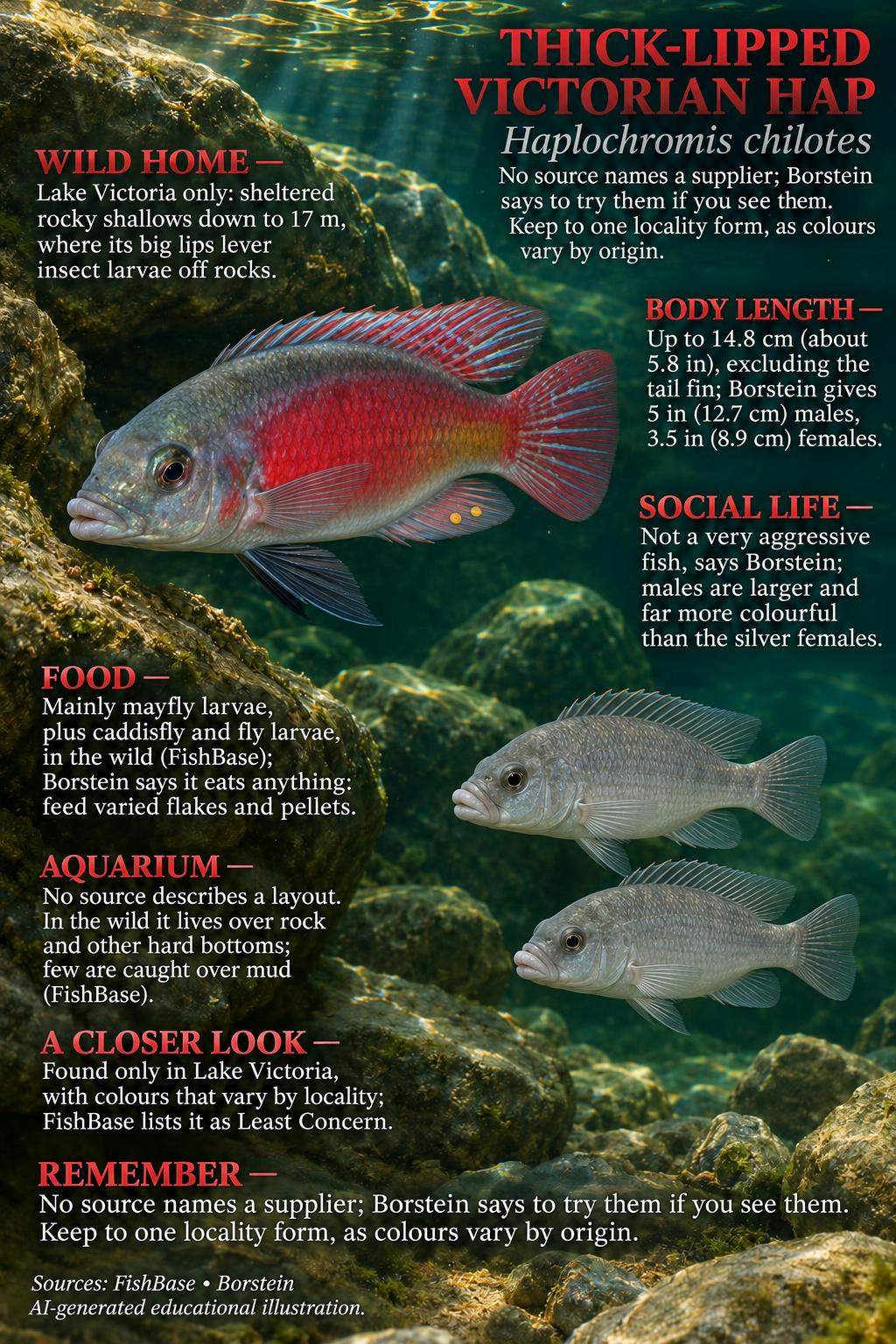
Read the infographic as text
- WILD HOME — Lake Victoria only: sheltered rocky shallows down to 17 m, where its big lips lever insect larvae off rocks.
- BODY LENGTH — Up to 14.8 cm (about 5.8 in), excluding the tail fin; Borstein gives 5 in (12.7 cm) males, 3.5 in (8.9 cm) females.
- FOOD — Mainly mayfly larvae, plus caddisfly and fly larvae, in the wild (FishBase); Borstein says it eats anything: feed varied flakes and pellets.
- SOCIAL LIFE — Not a very aggressive fish, says Borstein; males are larger and far more colourful than the silver females.
- AQUARIUM — No source describes a layout. In the wild it lives over rock and other hard bottoms; few are caught over mud (FishBase).
- A CLOSER LOOK — Found only in Lake Victoria, with colours that vary by locality; FishBase lists it as Least Concern.
- REMEMBER — No source names a supplier; Borstein says to try them if you see them. Keep to one locality form, as colours vary by origin.
How to use these figures
Published care ranges and suggested tank sizes are starting points, not guarantees. Tank footprint, group size, filtration, feeding, companions and the individual fish all matter. Standard length excludes the tail fin. Do not abruptly change established water conditions to match a number on a page.
Use a cycled aquarium, monitor water quality and quarantine new arrivals using a suitable species-specific plan. Persistent appetite loss, rapid breathing or weight loss warrants investigation.
Common questions
What should I know before choosing this fish?
No source names a supplier; Borstein says to try them if you see them. Keep to one locality form, as colours vary by origin. Not a very aggressive fish, says Borstein; males are larger and far more colourful than the silver females.
What should I feed it?
Mainly mayfly larvae, plus caddisfly and fly larvae, in the wild (FishBase); Borstein says it eats anything: feed varied flakes and pellets.
Why is it rare?
Found only in Lake Victoria, with colours that vary by locality; FishBase lists it as Least Concern.
Sources & review
Checked November 12, 2026. Retailer care guidance is not a universal biological minimum.