
A closer look beneath the surface
Know your fish.
Discover where they come from, how they live, and what they need from you.
438 illustrated guides. Real biology. Practical care. Sources you can follow.
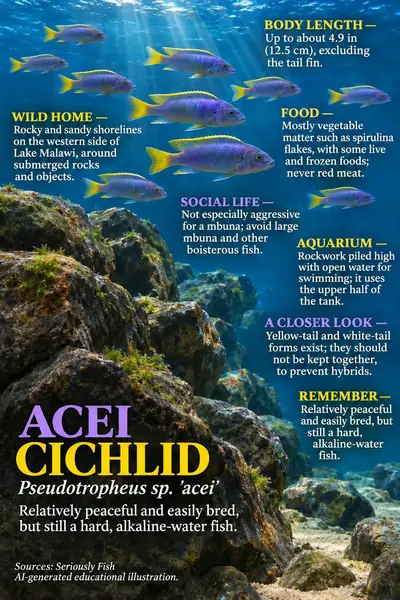
Acei cichlid
Pseudotropheus sp. 'acei'
Relatively peaceful and easily bred, but still a hard, alkaline-water fish.
Meet this fish →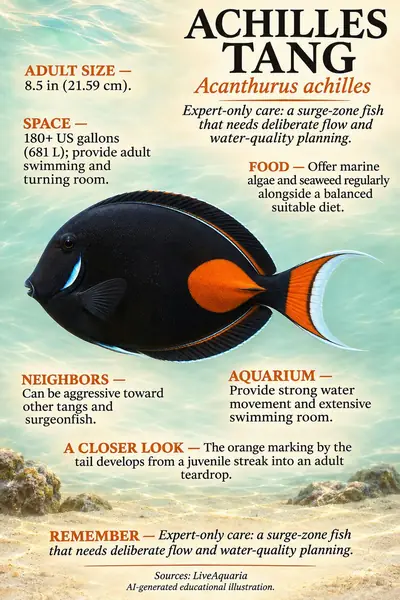
Achilles tang
Acanthurus achilles
Expert-only care: a surge-zone fish that needs deliberate flow and water-quality planning.
Meet this fish →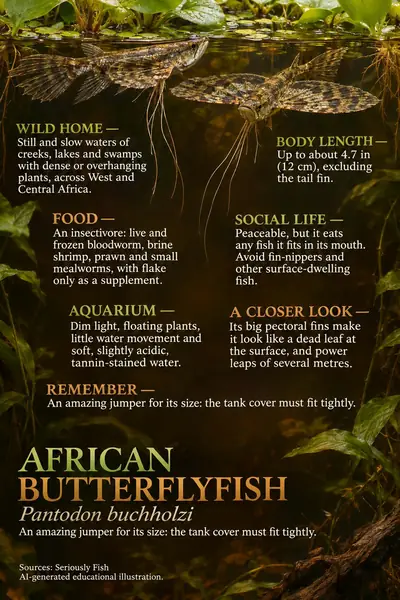
African butterflyfish
Pantodon buchholzi
An amazing jumper for its size: the tank cover must fit tightly.
Meet this fish →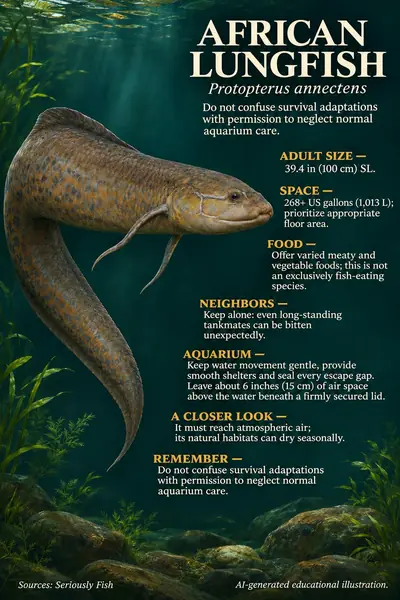
African lungfish
Protopterus annectens
Do not confuse survival adaptations with permission to neglect normal aquarium care.
Meet this fish →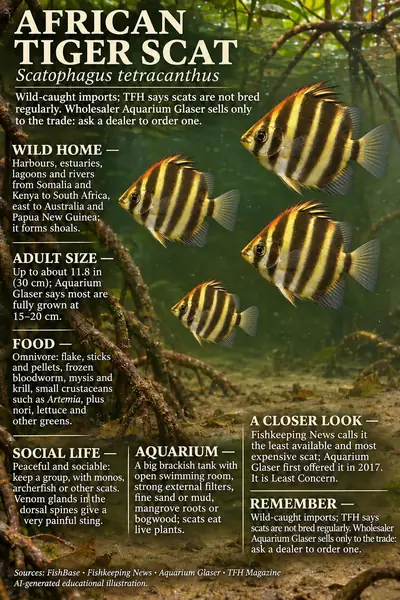
African tiger scat
Scatophagus tetracanthus
Wild-caught imports; TFH says scats are not bred regularly. Wholesaler Aquarium Glaser sells only to the trade: ask a dealer to order one.
Meet this fish →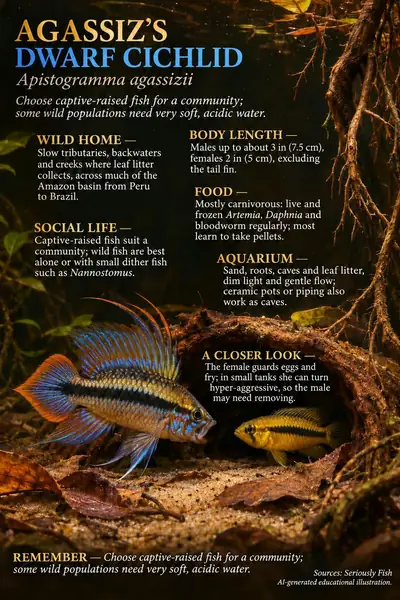
Agassiz’s dwarf cichlid
Apistogramma agassizii
Choose captive-raised fish for a community; some wild populations need very soft, acidic water.
Meet this fish →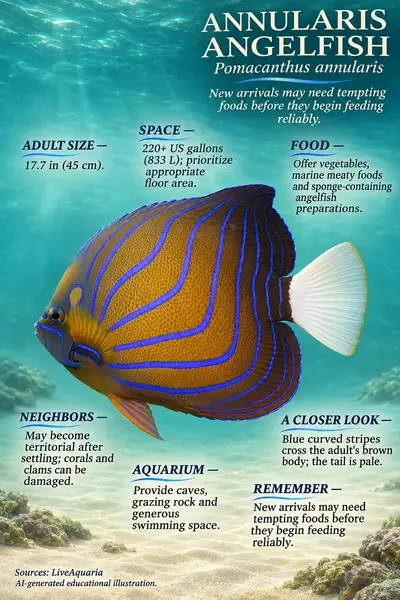
Annularis angelfish
Pomacanthus annularis
New arrivals may need tempting foods before they begin feeding reliably.
Meet this fish →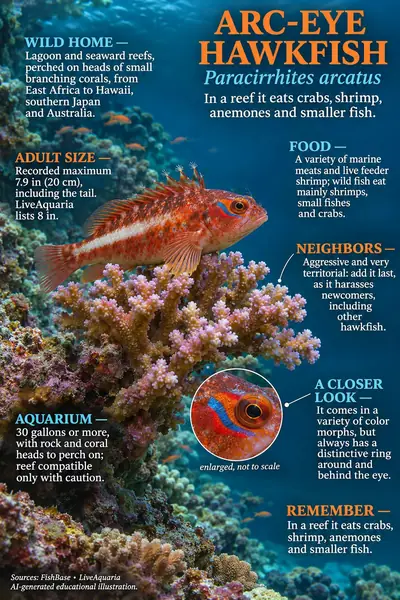
Arc-eye hawkfish
Paracirrhites arcatus
In a reef it eats crabs, shrimp, anemones and smaller fish.
Meet this fish →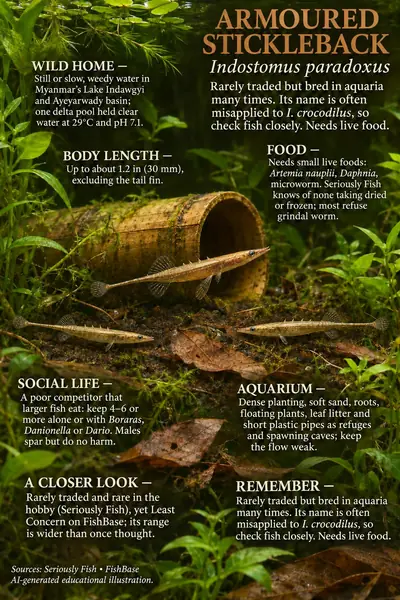
Armoured stickleback
Indostomus paradoxus
Rarely traded but bred in aquaria many times. Its name is often misapplied to I. crocodilus, so check fish closely. Needs live food.
Meet this fish →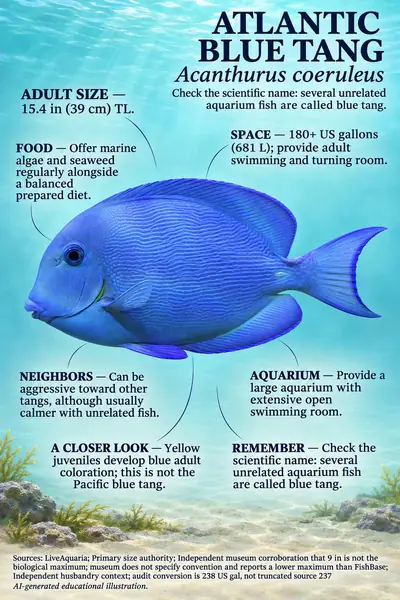
Atlantic blue tang
Acanthurus coeruleus
Check the scientific name: several unrelated aquarium fish are called blue tang.
Meet this fish →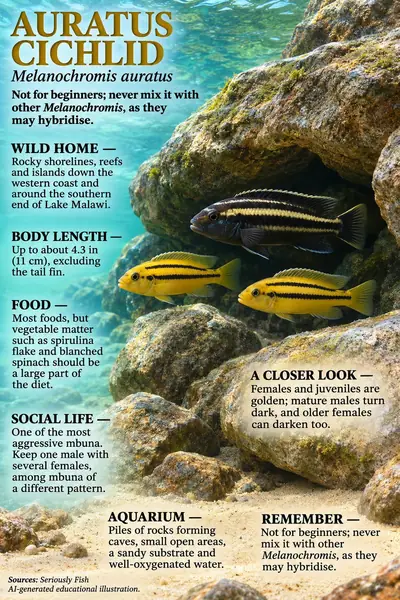
Auratus cichlid
Melanochromis auratus
Not for beginners; never mix it with other Melanochromis, as they may hybridise.
Meet this fish →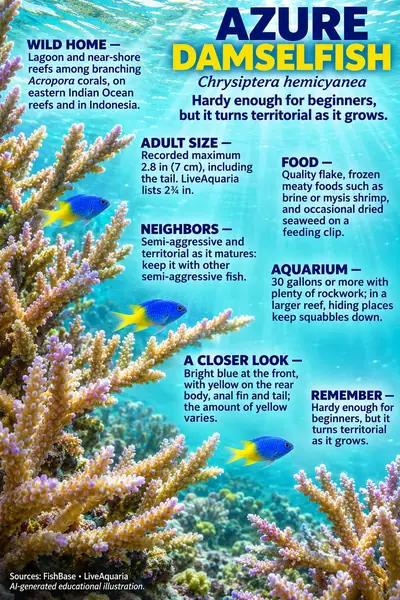
Azure damselfish
Chrysiptera hemicyanea
Hardy enough for beginners, but it turns territorial as it grows.
Meet this fish →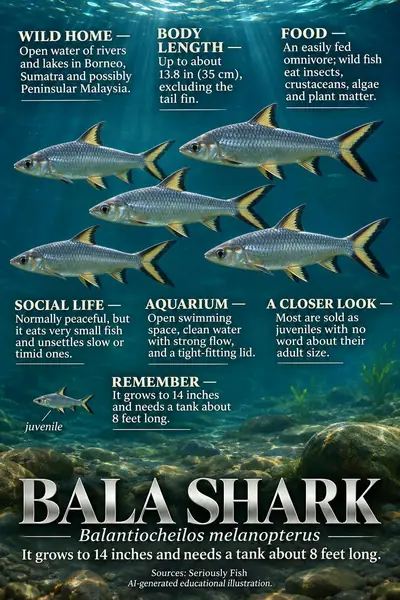
Bala shark
Balantiocheilos melanopterus
It grows to 14 inches and needs a tank about 8 feet long.
Meet this fish →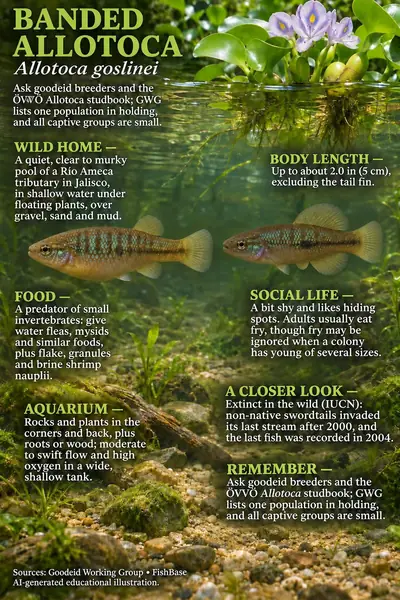
Banded allotoca
Allotoca goslinei
Ask goodeid breeders and the ÖVVÖ Allotoca studbook; GWG lists one population in holding, and all captive groups are small.
Meet this fish →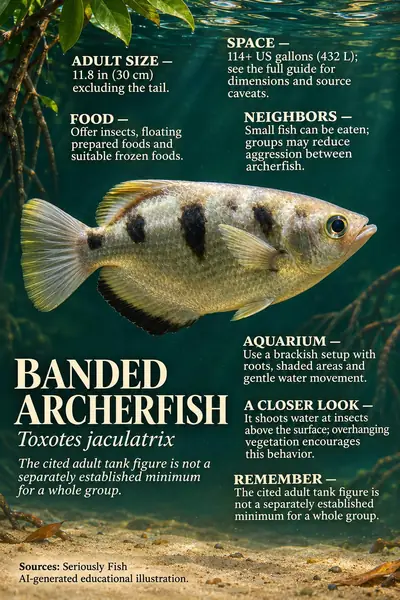
Banded archerfish
Toxotes jaculatrix
The cited adult tank figure is not a separately established minimum for a whole group.
Meet this fish →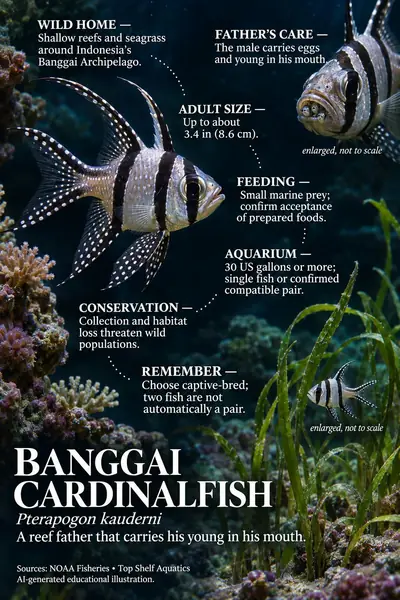
Banggai cardinalfish
Pterapogon kauderni
A reef father that carries his young in his mouth
Meet this fish →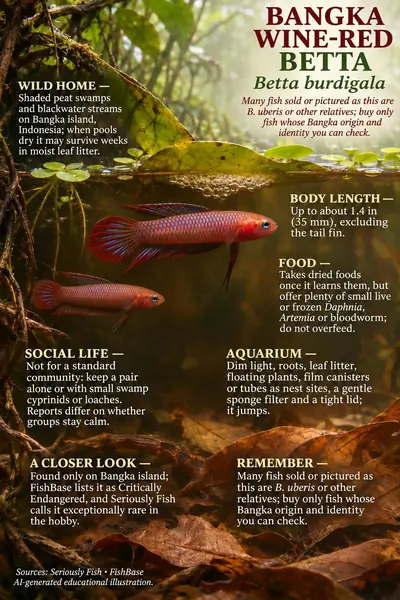
Bangka wine-red betta
Betta burdigala
Many fish sold or pictured as this are B. uberis or other relatives; buy only fish whose Bangka origin and identity you can check.
Meet this fish →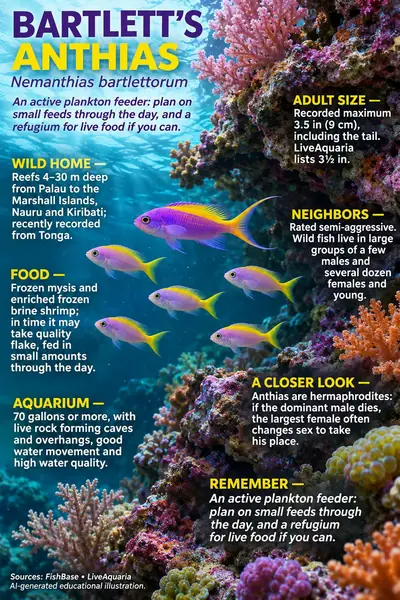
Bartlett’s anthias
Nemanthias bartlettorum
An active plankton feeder: plan on small feeds through the day, and a refugium for live food if you can.
Meet this fish →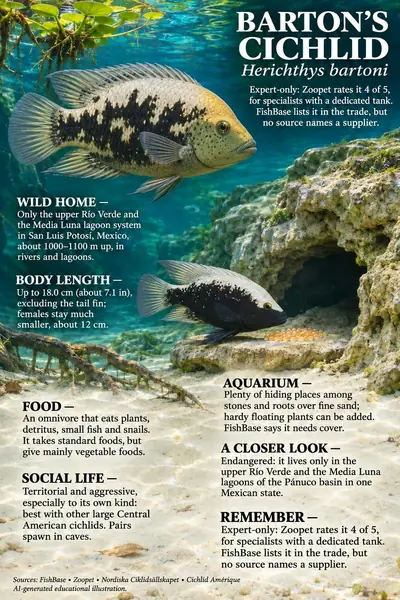
Barton’s cichlid
Herichthys bartoni
Expert-only: Zoopet rates it 4 of 5, for specialists with a dedicated tank. FishBase lists it in the trade, but no source names a supplier.
Meet this fish →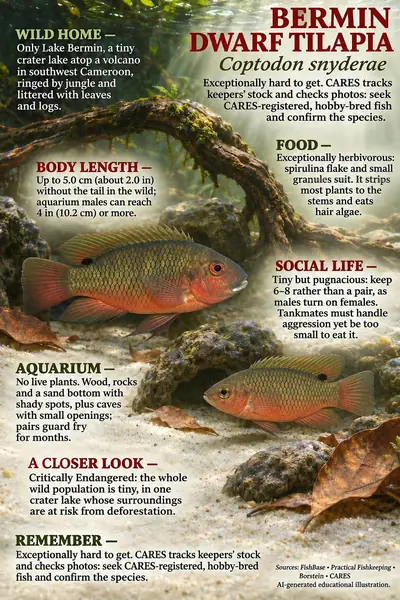
Bermin dwarf tilapia
Coptodon snyderae
Exceptionally hard to get. CARES tracks keepers’ stock and checks photos: seek CARES-registered, hobby-bred fish and confirm the species.
Meet this fish →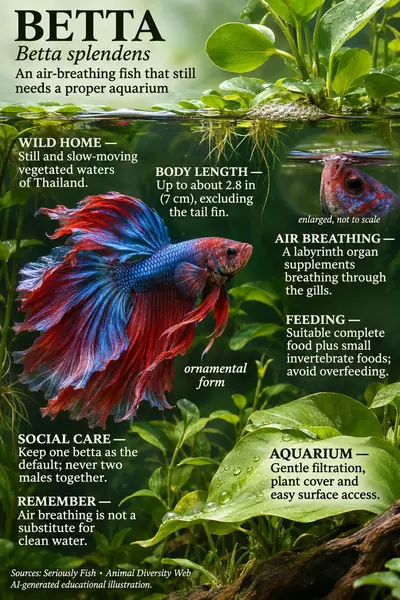
Betta
Betta splendens
An air-breathing fish that still needs a proper aquarium
Meet this fish →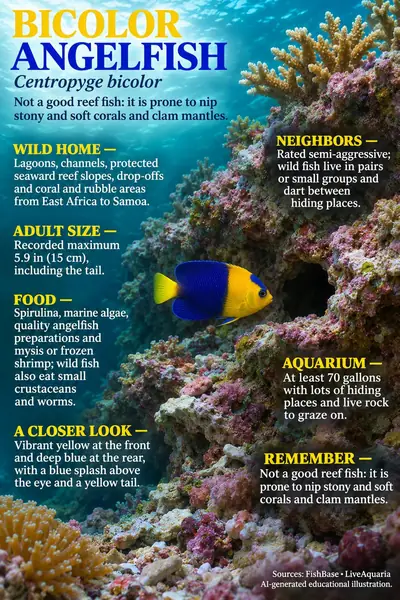
Bicolor angelfish
Centropyge bicolor
Not a good reef fish: it is prone to nip stony and soft corals and clam mantles.
Meet this fish →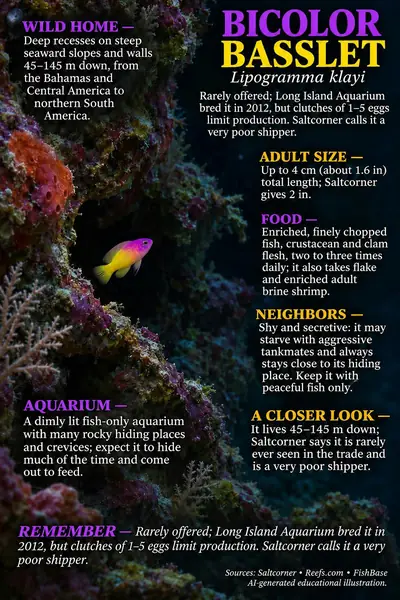
Bicolor basslet
Lipogramma klayi
Rarely offered; Long Island Aquarium bred it in 2012, but clutches of 1–5 eggs limit production. Saltcorner calls it a very poor shipper.
Meet this fish →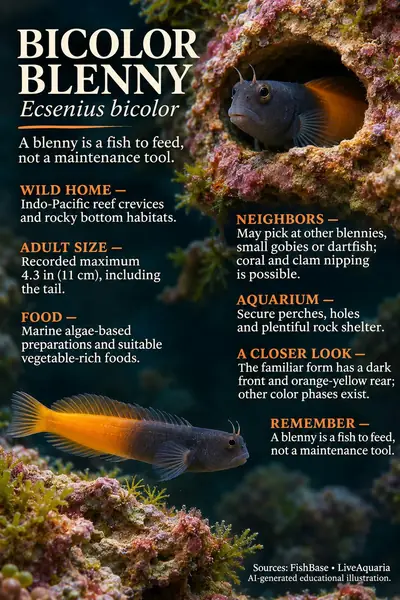
Bicolor blenny
Ecsenius bicolor
A blenny is a fish to feed, not a maintenance tool.
Meet this fish →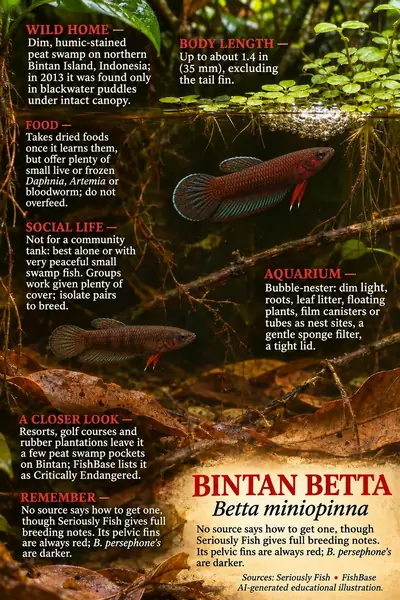
Bintan betta
Betta miniopinna
No source says how to get one, though Seriously Fish gives full breeding notes. Its pelvic fins are always red; B. persephone’s are darker.
Meet this fish →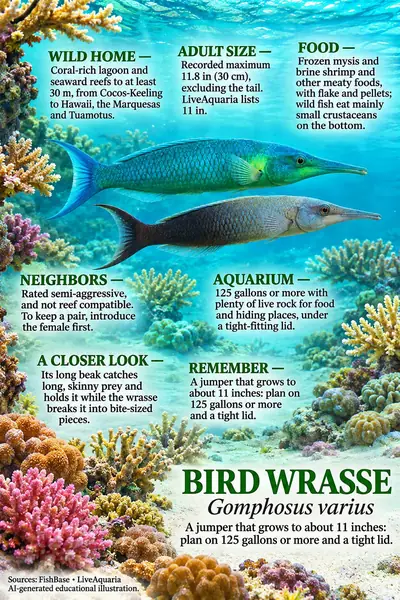
Bird wrasse
Gomphosus varius
A jumper that grows to about 11 inches: plan on 125 gallons or more and a tight lid.
Meet this fish →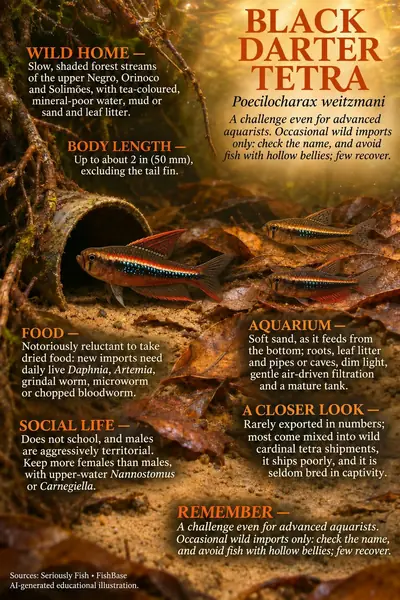
Black darter tetra
Poecilocharax weitzmani
A challenge even for advanced aquarists. Occasional wild imports only: check the name, and avoid fish with hollow bellies; few recover.
Meet this fish →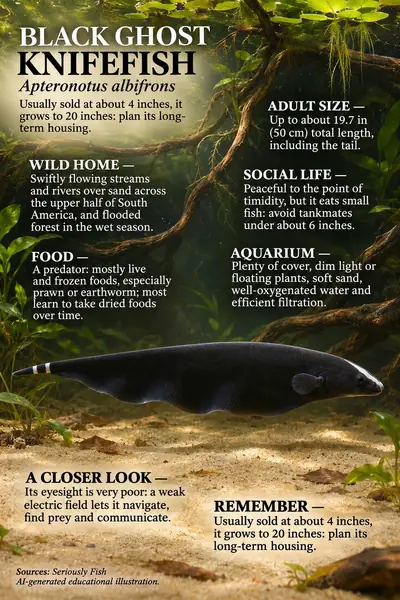
Black ghost knifefish
Apteronotus albifrons
Usually sold at about 4 inches, it grows to 20 inches: plan its long-term housing.
Meet this fish →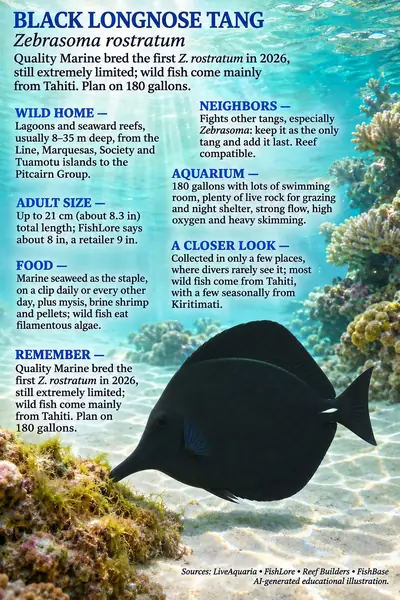
Black longnose tang
Zebrasoma rostratum
Quality Marine bred the first Z. rostratum in 2026, still extremely limited; wild fish come mainly from Tahiti. Plan on 180 gallons.
Meet this fish →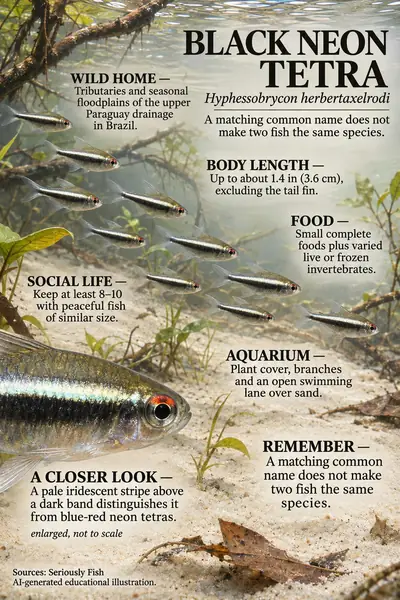
Black neon tetra
Hyphessobrycon herbertaxelrodi
A matching common name does not make two fish the same species.
Meet this fish →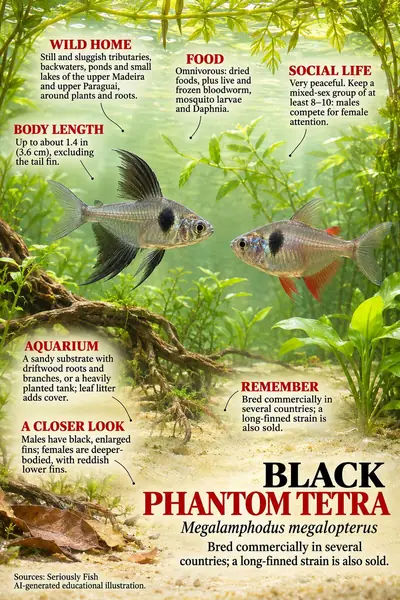
Black phantom tetra
Megalamphodus megalopterus
Bred commercially in several countries; a long-finned strain is also sold.
Meet this fish →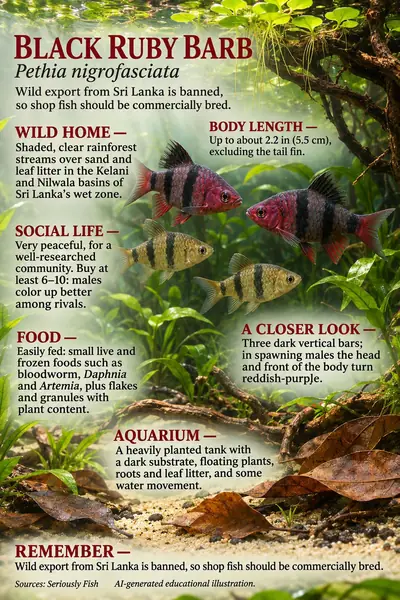
Black ruby barb
Pethia nigrofasciata
Wild export from Sri Lanka is banned, so shop fish should be commercially bred.
Meet this fish →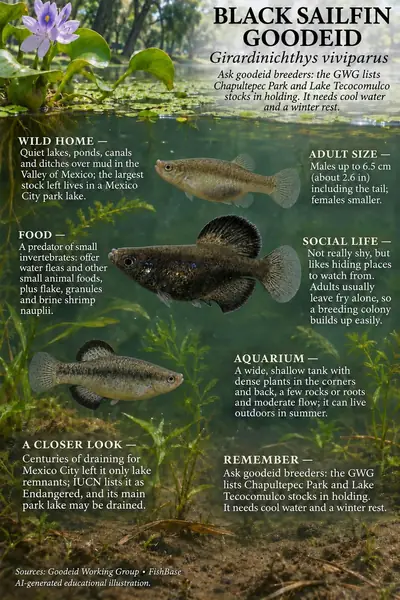
Black sailfin goodeid
Girardinichthys viviparus
Ask goodeid breeders: the GWG lists Chapultepec Park and Lake Tecocomulco stocks in holding. It needs cool water and a winter rest.
Meet this fish →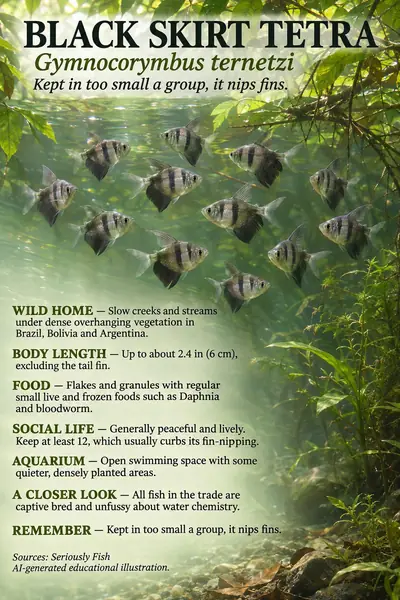
Black skirt tetra
Gymnocorymbus ternetzi
Kept in too small a group, it nips fins.
Meet this fish →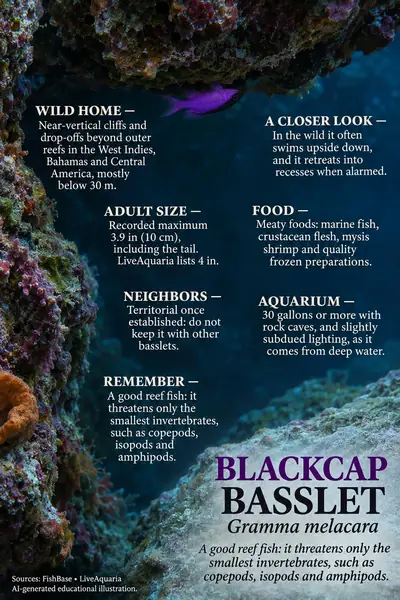
Blackcap basslet
Gramma melacara
A good reef fish: it threatens only the smallest invertebrates, such as copepods, isopods and amphipods.
Meet this fish →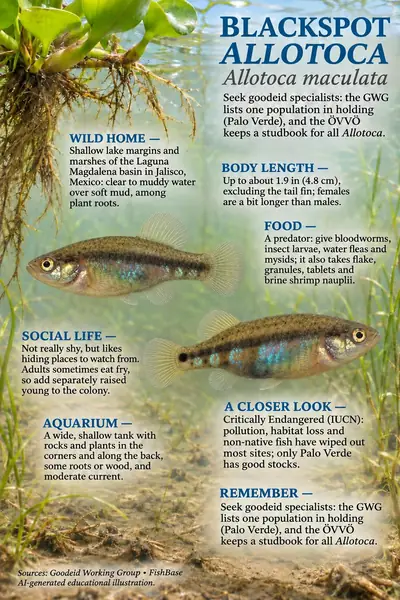
Blackspot allotoca
Allotoca maculata
Seek goodeid specialists: the GWG lists one population in holding (Palo Verde), and the ÖVVÖ keeps a studbook for all Allotoca.
Meet this fish →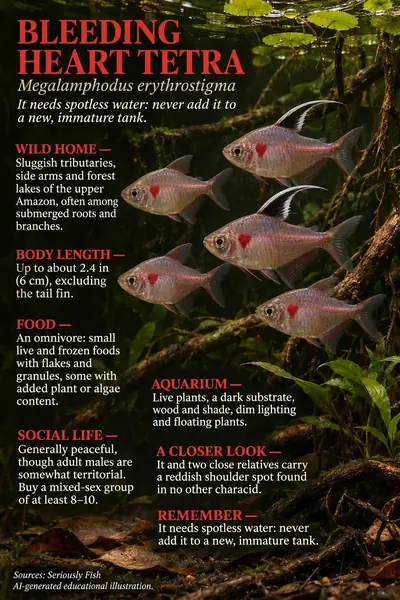
Bleeding heart tetra
Megalamphodus erythrostigma
It needs spotless water: never add it to a new, immature tank.
Meet this fish →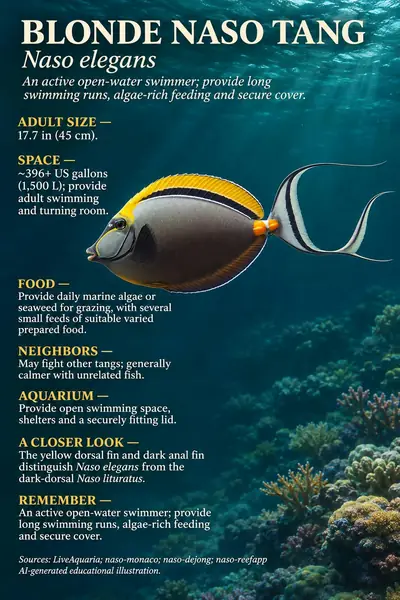
Blonde naso tang
Naso elegans
An active open-water swimmer; provide long swimming runs, algae-rich feeding and secure cover.
Meet this fish →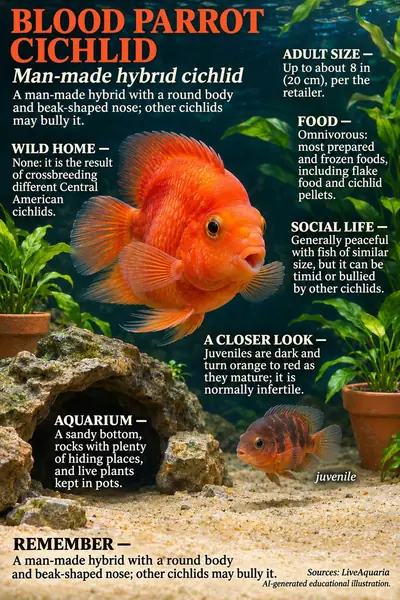
Blood parrot cichlid
Man-made hybrid cichlid
A man-made hybrid with a round body and beak-shaped nose; other cichlids may bully it.
Meet this fish →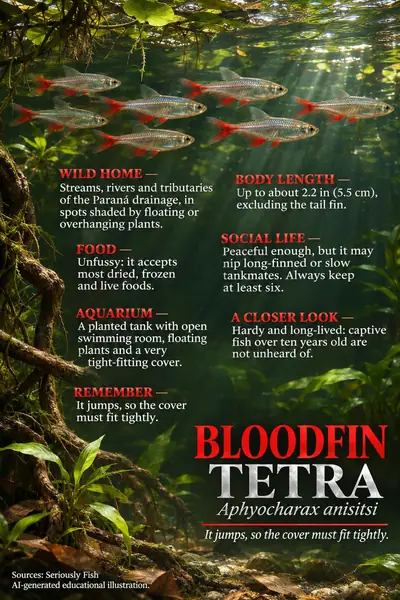
Bloodfin tetra
Aphyocharax anisitsi
It jumps, so the cover must fit tightly.
Meet this fish →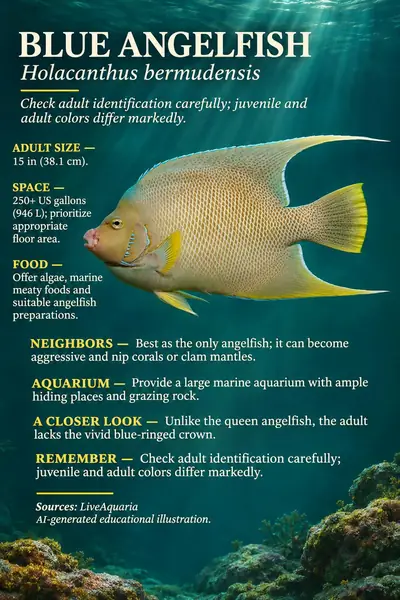
Blue angelfish
Holacanthus bermudensis
Check adult identification carefully; juvenile and adult colors differ markedly.
Meet this fish →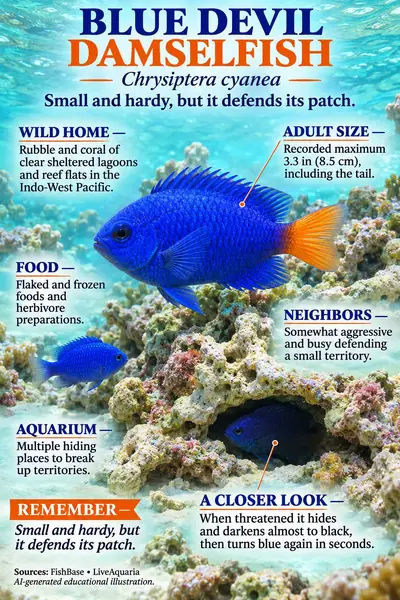
Blue devil damselfish
Chrysiptera cyanea
Small and hardy, but it defends its patch.
Meet this fish →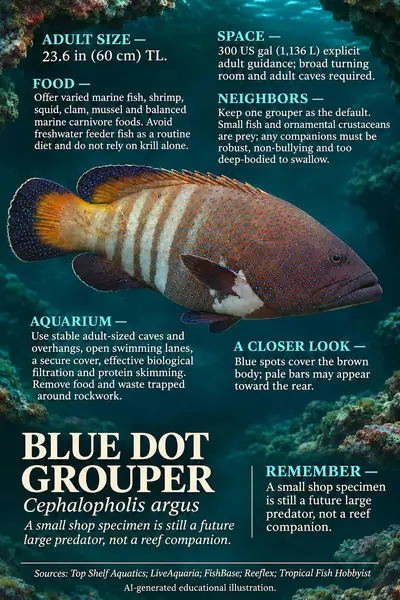
Blue dot grouper
Cephalopholis argus
A small shop specimen is still a future large predator, not a reef companion.
Meet this fish →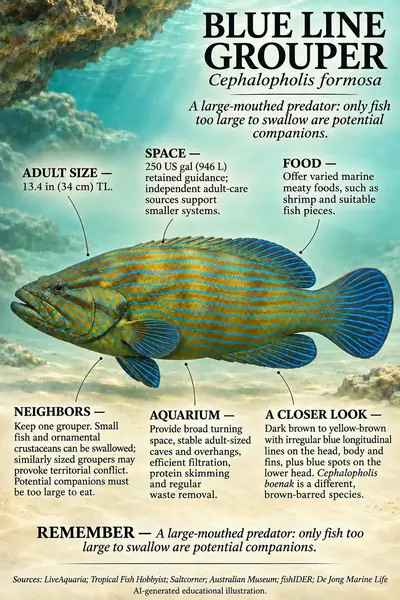
Blue line grouper
Cephalopholis formosa
A large-mouthed predator: only fish too large to swallow are potential companions.
Meet this fish →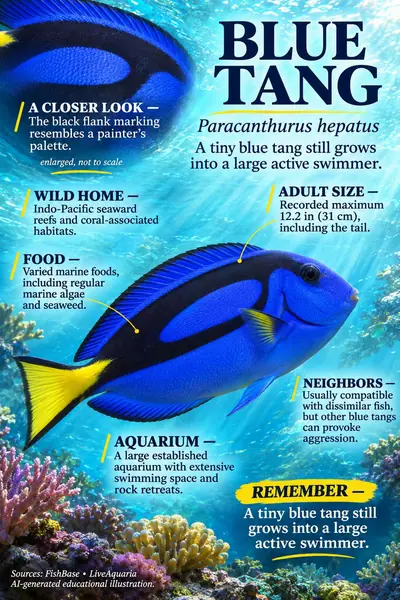
Blue tang
Paracanthurus hepatus
A tiny blue tang still grows into a large active swimmer.
Meet this fish →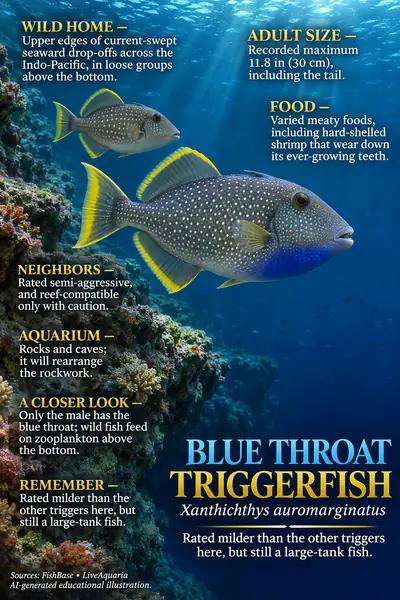
Blue throat triggerfish
Xanthichthys auromarginatus
Rated milder than the other triggers here, but still a large-tank fish.
Meet this fish →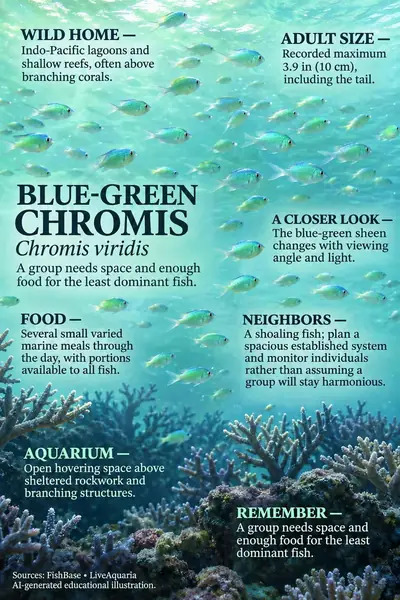
Blue-green chromis
Chromis viridis
A group needs space and enough food for the least dominant fish.
Meet this fish →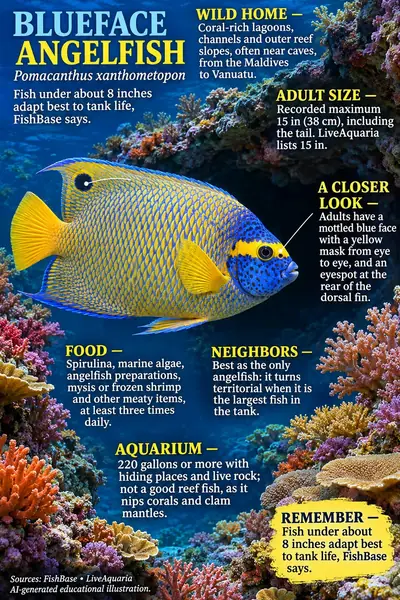
Blueface angelfish
Pomacanthus xanthometopon
Fish under about 8 inches adapt best to tank life, FishBase says.
Meet this fish →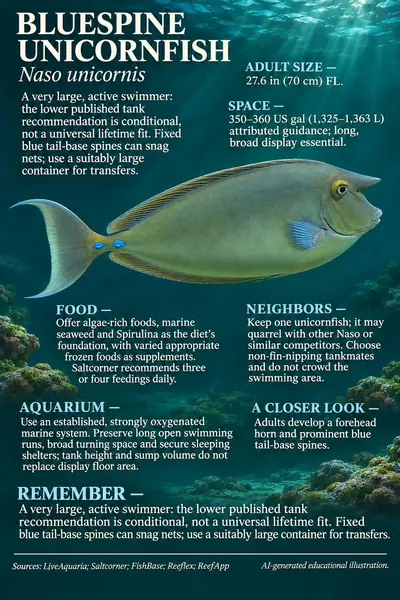
Bluespine unicornfish
Naso unicornis
A very large, active swimmer: the lower published tank recommendation is conditional, not a universal lifetime fit. Fixed blue tail-base spines can snag nets; use a suitably large container for transfers.
Meet this fish →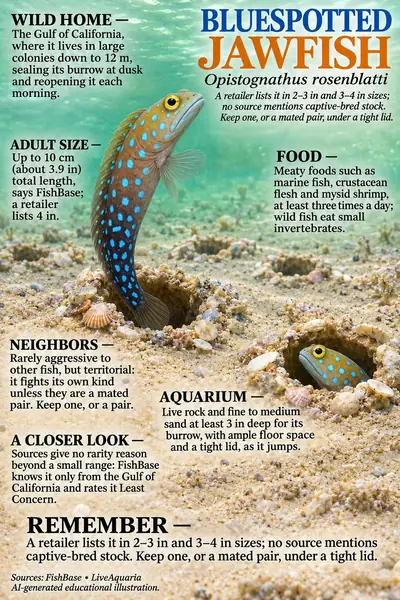
Bluespotted jawfish
Opistognathus rosenblatti
A retailer lists it in 2–3 in and 3–4 in sizes; no source mentions captive-bred stock. Keep one, or a mated pair, under a tight lid.
Meet this fish →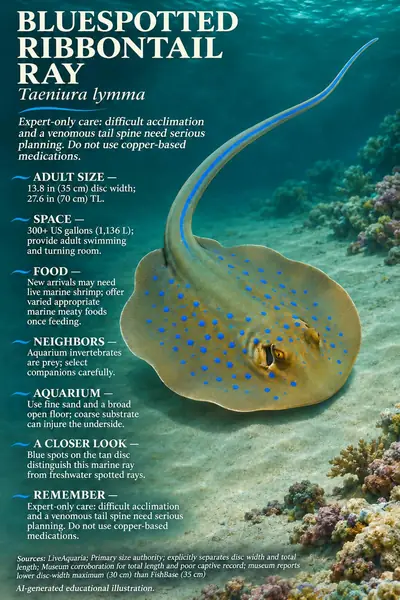
Bluespotted ribbontail ray
Taeniura lymma
Expert-only care: difficult acclimation and a venomous tail spine need serious planning. Do not use copper-based medications.
Meet this fish →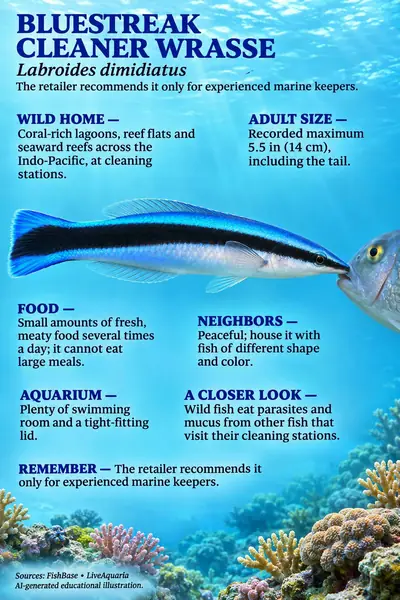
Bluestreak cleaner wrasse
Labroides dimidiatus
The retailer recommends it only for experienced marine keepers.
Meet this fish →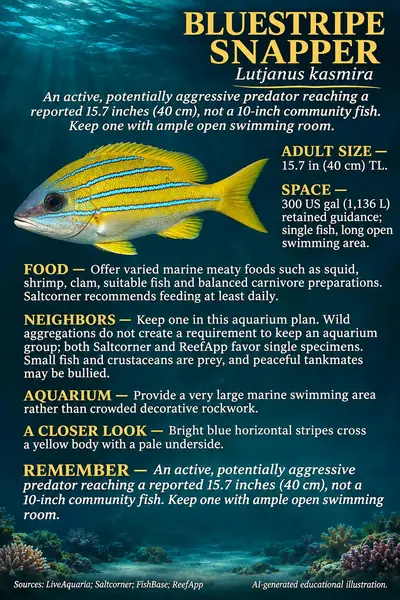
Bluestripe snapper
Lutjanus kasmira
An active, potentially aggressive predator reaching a reported 15.7 inches (40 cm), not a 10-inch community fish. Keep one with ample open swimming room.
Meet this fish →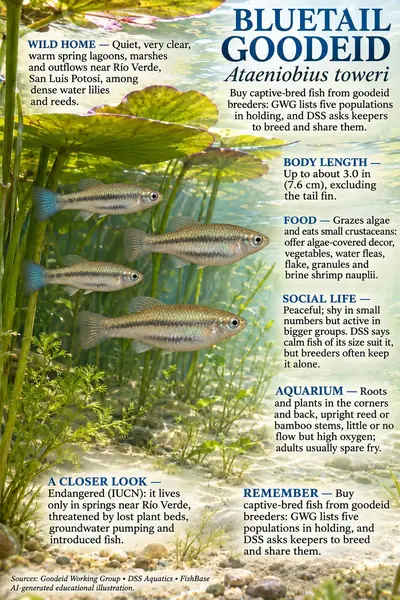
Bluetail goodeid
Ataeniobius toweri
Buy captive-bred fish from goodeid breeders: GWG lists five populations in holding, and DSS asks keepers to breed and share them.
Meet this fish →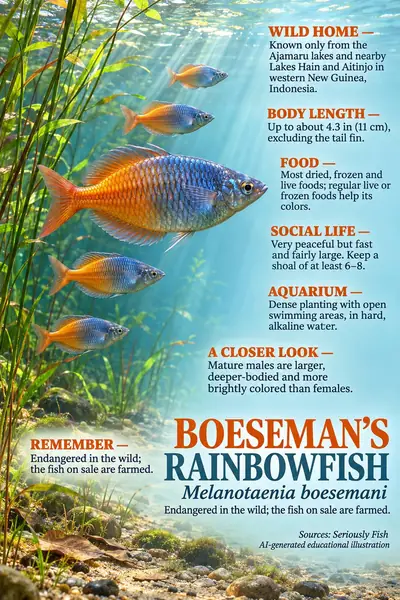
Boeseman’s rainbowfish
Melanotaenia boesemani
Endangered in the wild; the fish on sale are farmed.
Meet this fish →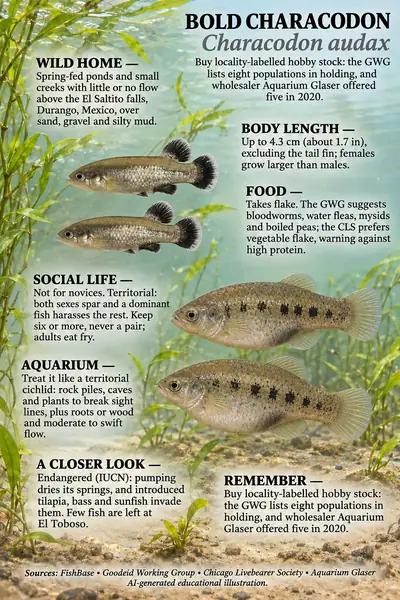
Bold characodon
Characodon audax
Buy locality-labelled hobby stock: the GWG lists eight populations in holding, and wholesaler Aquarium Glaser offered five in 2020.
Meet this fish →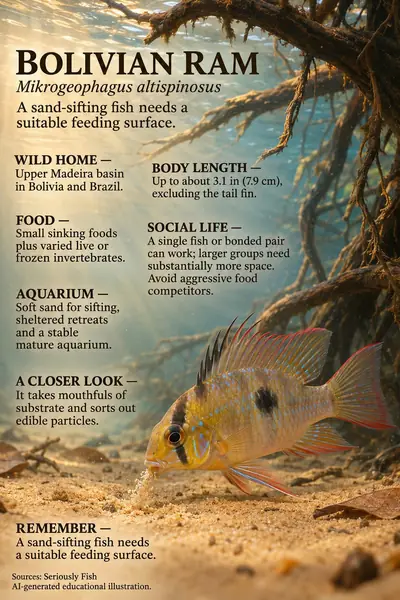
Bolivian ram
Mikrogeophagus altispinosus
A sand-sifting fish needs a suitable feeding surface.
Meet this fish →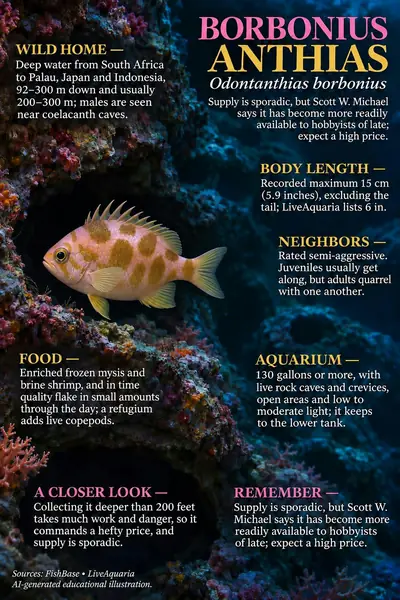
Borbonius anthias
Odontanthias borbonius
Supply is sporadic, but Scott W. Michael says it has become more readily available to hobbyists of late; expect a high price.
Meet this fish →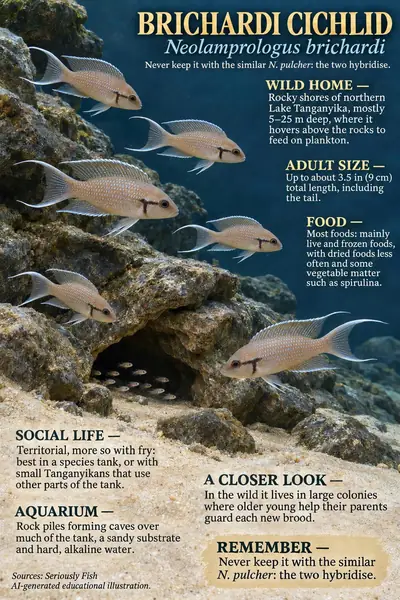
Brichardi cichlid
Neolamprologus brichardi
Never keep it with the similar N. pulcher: the two hybridise.
Meet this fish →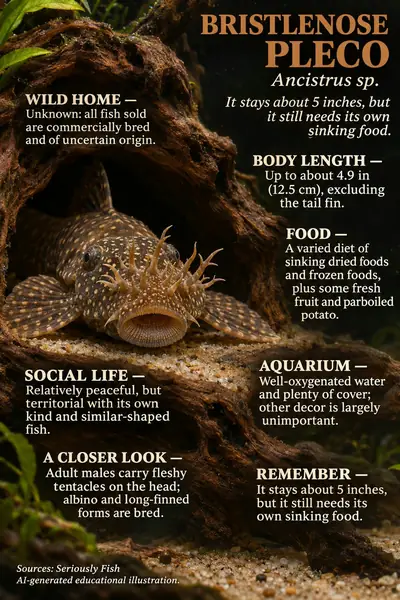
Bristlenose pleco
Ancistrus sp.
It stays about 5 inches, but it still needs its own sinking food.
Meet this fish →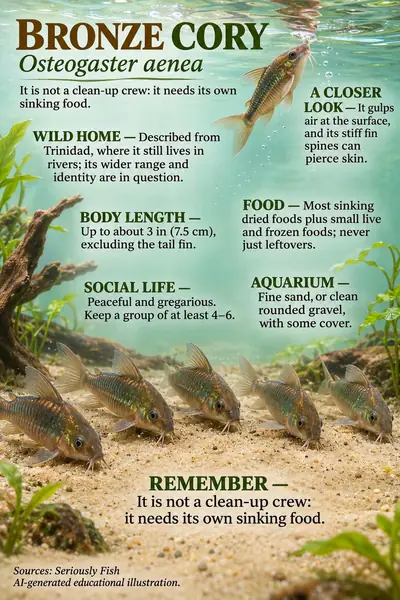
Bronze cory
Osteogaster aenea
It is not a clean-up crew: it needs its own sinking food.
Meet this fish →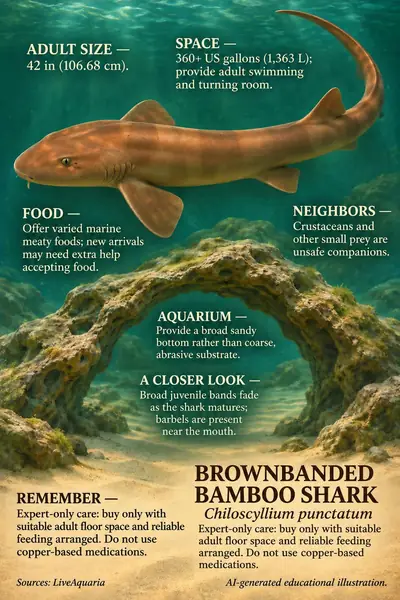
Brownbanded bamboo shark
Chiloscyllium punctatum
Expert-only care: buy only with suitable adult floor space and reliable feeding arranged. Do not use copper-based medications.
Meet this fish →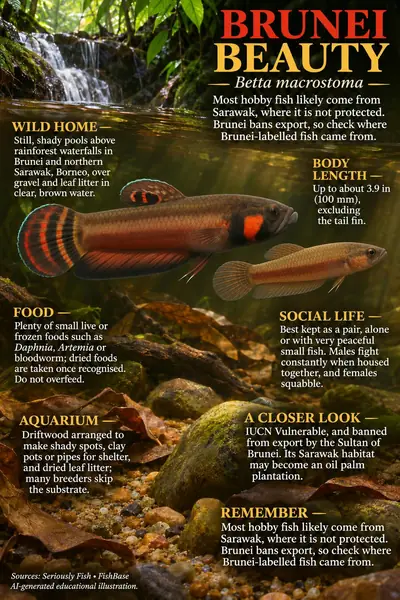
Brunei beauty
Betta macrostoma
Most hobby fish likely come from Sarawak, where it is not protected. Brunei bans export, so check where Brunei-labelled fish came from.
Meet this fish →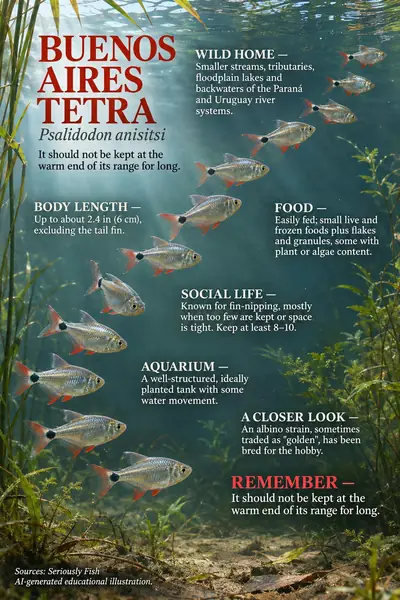
Buenos Aires tetra
Psalidodon anisitsi
It should not be kept at the warm end of its range for long.
Meet this fish →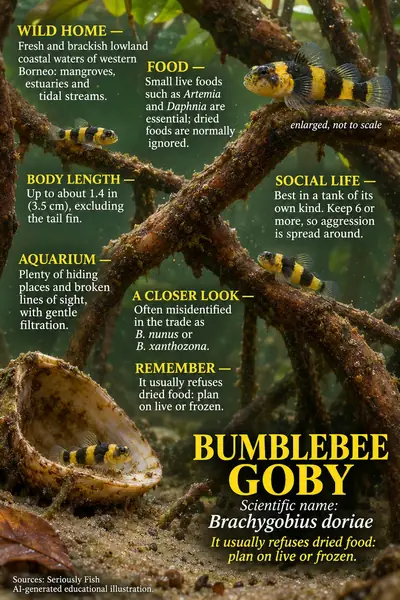
Bumblebee goby
Brachygobius doriae
It usually refuses dried food: plan on live or frozen.
Meet this fish →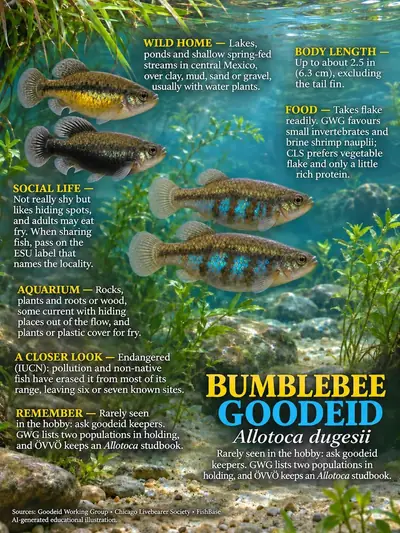
Bumblebee goodeid
Allotoca dugesii
Rarely seen in the hobby: ask goodeid keepers. GWG lists two populations in holding, and ÖVVÖ keeps an Allotoca studbook.
Meet this fish →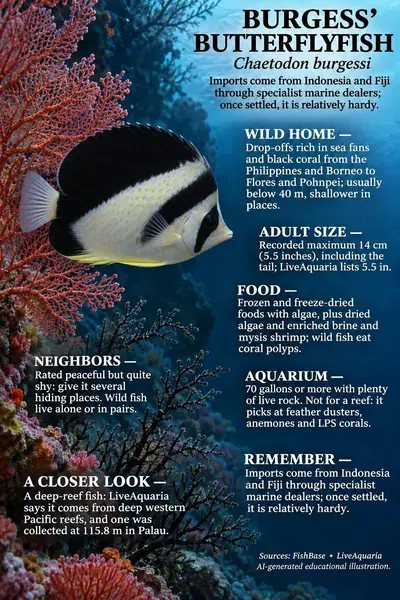
Burgess’ butterflyfish
Chaetodon burgessi
Imports come from Indonesia and Fiji through specialist marine dealers; once settled, it is relatively hardy.
Meet this fish →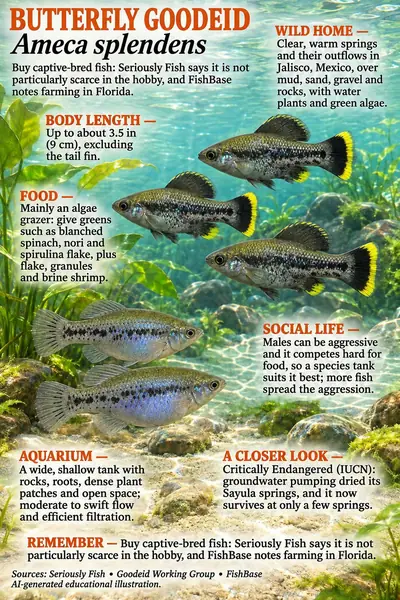
Butterfly goodeid
Ameca splendens
Buy captive-bred fish: Seriously Fish says it is not particularly scarce in the hobby, and FishBase notes farming in Florida.
Meet this fish →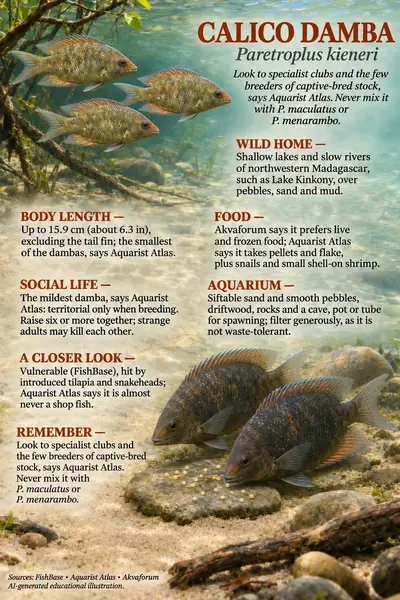
Calico damba
Paretroplus kieneri
Look to specialist clubs and the few breeders of captive-bred stock, says Aquarist Atlas. Never mix it with P. maculatus or P. menarambo.
Meet this fish →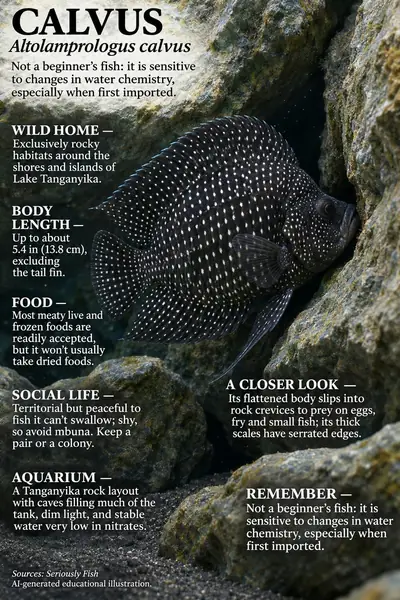
Calvus
Altolamprologus calvus
Not a beginner’s fish: it is sensitive to changes in water chemistry, especially when first imported.
Meet this fish →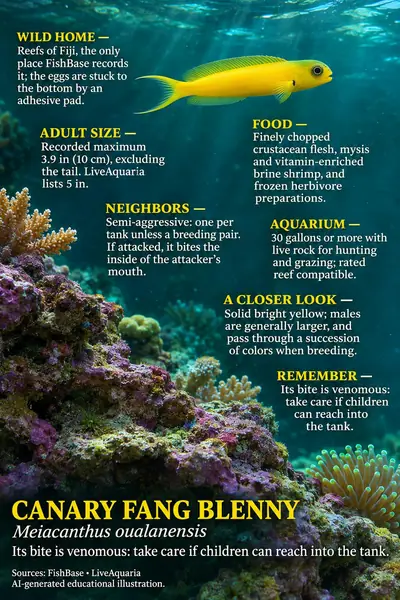
Canary fang blenny
Meiacanthus oualanensis
Its bite is venomous: take care if children can reach into the tank.
Meet this fish →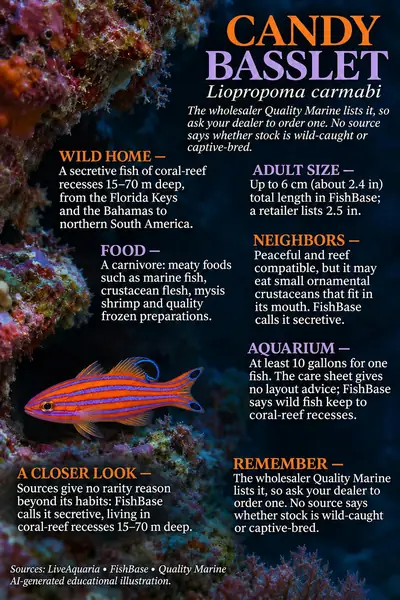
Candy basslet
Liopropoma carmabi
The wholesaler Quality Marine lists it, so ask your dealer to order one. No source says whether stock is wild-caught or captive-bred.
Meet this fish →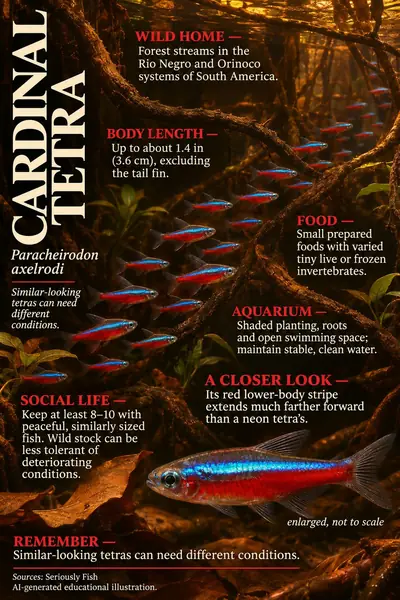
Cardinal tetra
Paracheirodon axelrodi
Similar-looking tetras can need different conditions.
Meet this fish →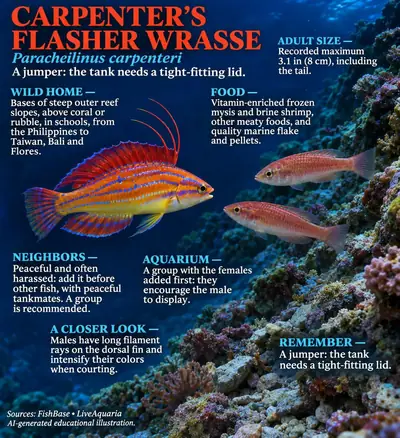
Carpenter’s flasher wrasse
Paracheilinus carpenteri
A jumper: the tank needs a tight-fitting lid.
Meet this fish →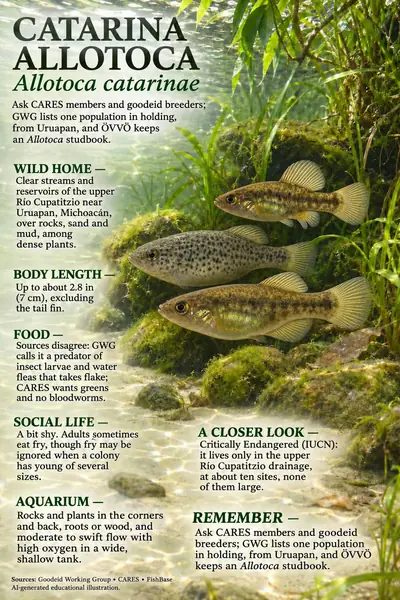
Catarina allotoca
Allotoca catarinae
Ask CARES members and goodeid breeders; GWG lists one population in holding, from Uruapan, and ÖVVÖ keeps an Allotoca studbook.
Meet this fish →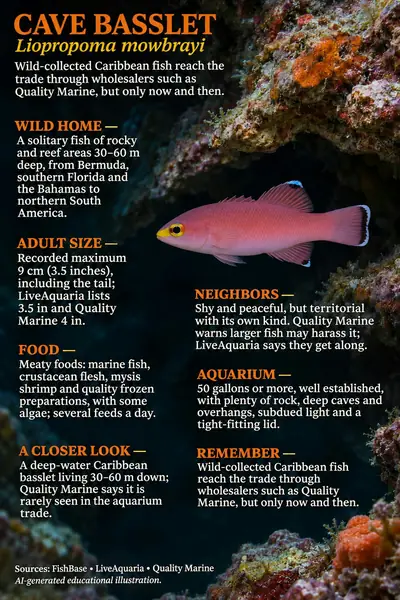
Cave basslet
Liopropoma mowbrayi
Wild-collected Caribbean fish reach the trade through wholesalers such as Quality Marine, but only now and then.
Meet this fish →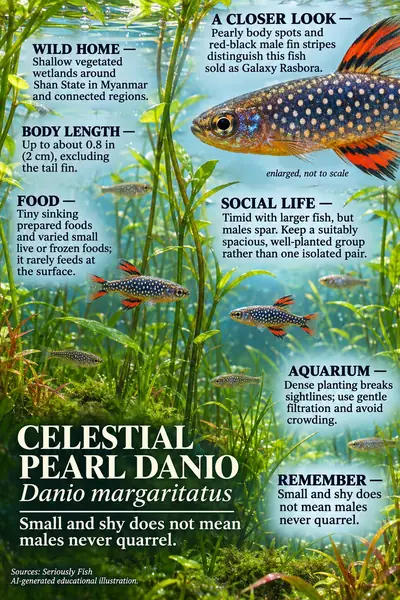
Celestial pearl danio
Danio margaritatus
Small and shy does not mean males never quarrel.
Meet this fish →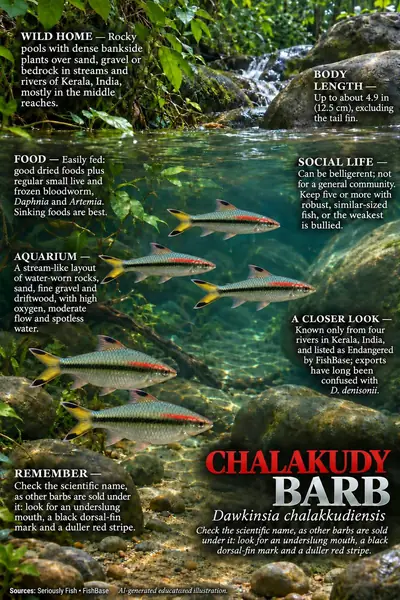
Chalakudy barb
Dawkinsia chalakkudiensis
Check the scientific name, as other barbs are sold under it: look for an underslung mouth, a black dorsal-fin mark and a duller red stripe.
Meet this fish →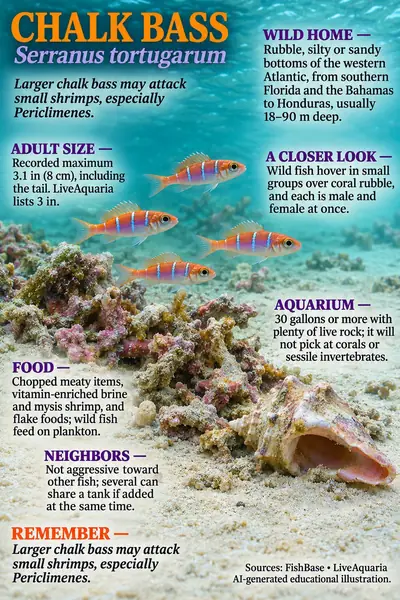
Chalk bass
Serranus tortugarum
Larger chalk bass may attack small shrimps, especially Periclimenes.
Meet this fish →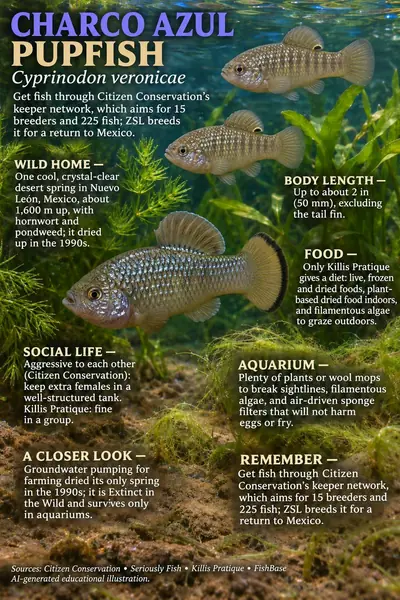
Charco Azul pupfish
Cyprinodon veronicae
Get fish through Citizen Conservation’s keeper network, which aims for 15 breeders and 225 fish; ZSL breeds it for a return to Mexico.
Meet this fish →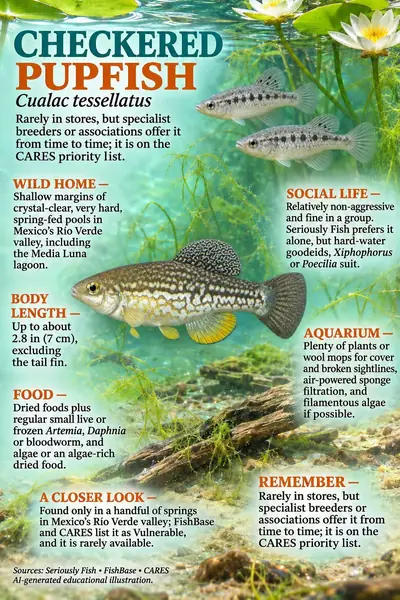
Checkered pupfish
Cualac tessellatus
Rarely in stores, but specialist breeders or associations offer it from time to time; it is on the CARES priority list.
Meet this fish →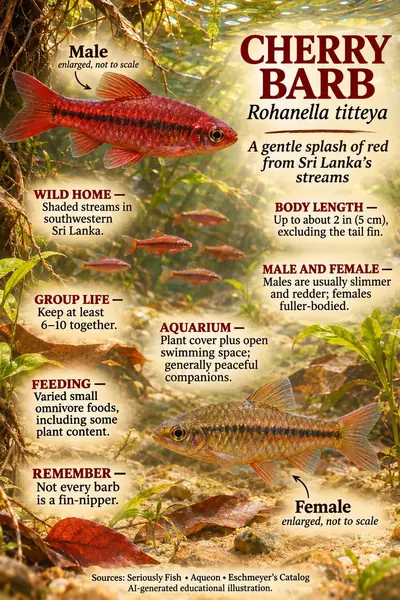
Cherry barb
Rohanella titteya
A gentle splash of red from Sri Lanka’s streams
Meet this fish →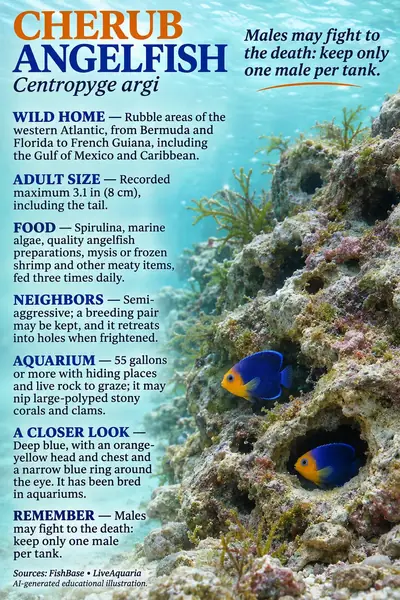
Cherub angelfish
Centropyge argi
Males may fight to the death: keep only one male per tank.
Meet this fish →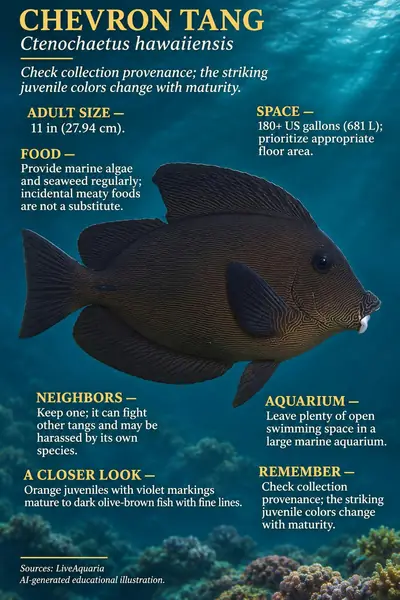
Chevron tang
Ctenochaetus hawaiiensis
Check collection provenance; the striking juvenile colors change with maturity.
Meet this fish →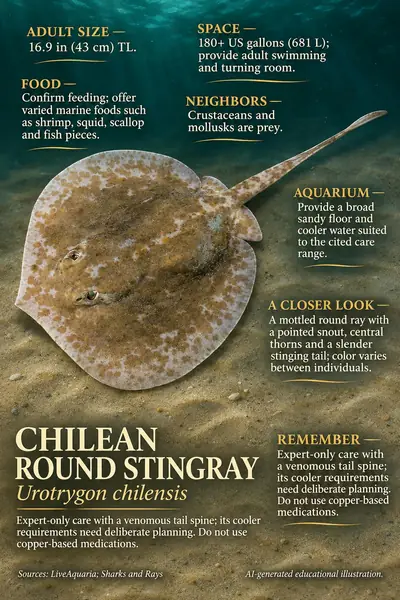
Chilean round stingray
Urotrygon chilensis
Expert-only care with a venomous tail spine; its cooler requirements need deliberate planning. Do not use copper-based medications.
Meet this fish →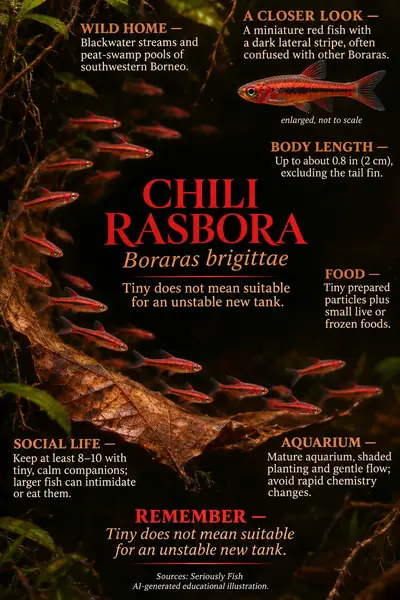
Chili rasbora
Boraras brigittae
Tiny does not mean suitable for an unstable new tank.
Meet this fish →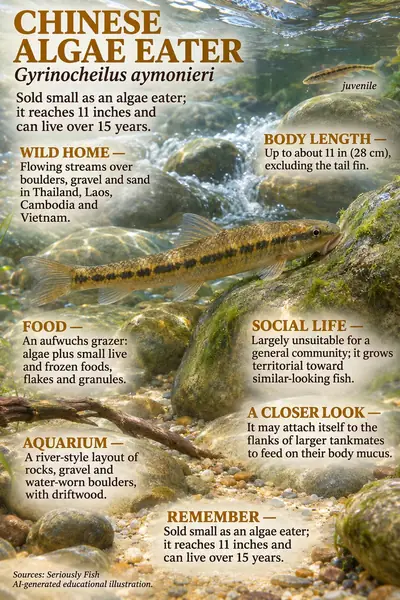
Chinese algae eater
Gyrinocheilus aymonieri
Sold small as an algae eater; it reaches 11 inches and can live over 15 years.
Meet this fish →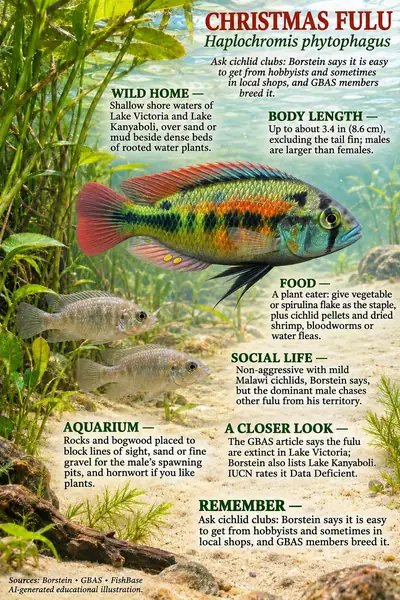
Christmas fulu
Haplochromis phytophagus
Ask cichlid clubs: Borstein says it is easy to get from hobbyists and sometimes in local shops, and GBAS members breed it.
Meet this fish →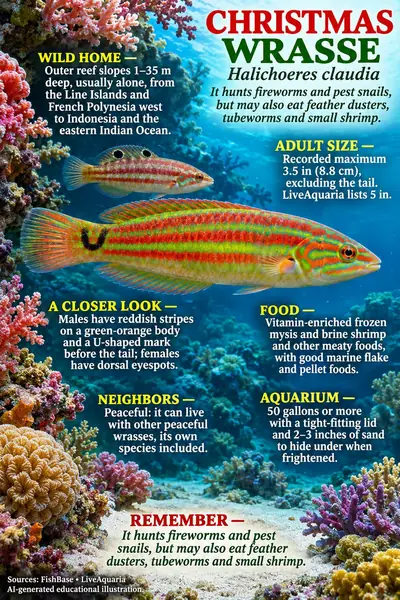
Christmas wrasse
Halichoeres claudia
It hunts fireworms and pest snails, but may also eat feather dusters, tubeworms and small shrimp.
Meet this fish →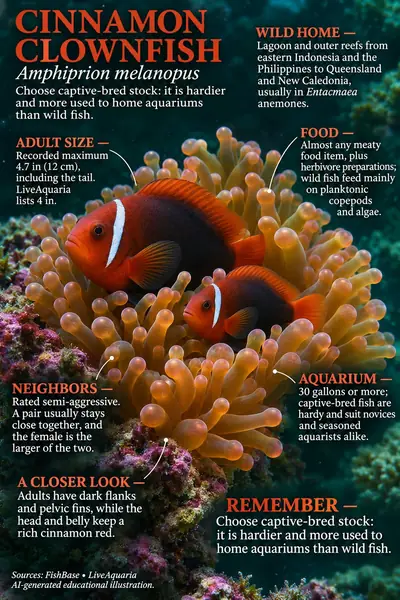
Cinnamon clownfish
Amphiprion melanopus
Choose captive-bred stock: it is hardier and more used to home aquariums than wild fish.
Meet this fish →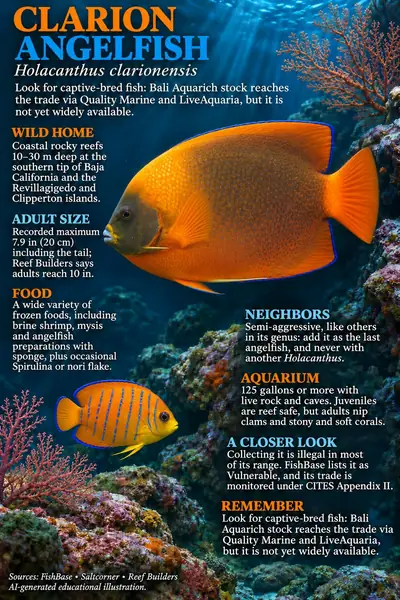
Clarion angelfish
Holacanthus clarionensis
Look for captive-bred fish: Bali Aquarich stock reaches the trade via Quality Marine and LiveAquaria, but it is not yet widely available.
Meet this fish →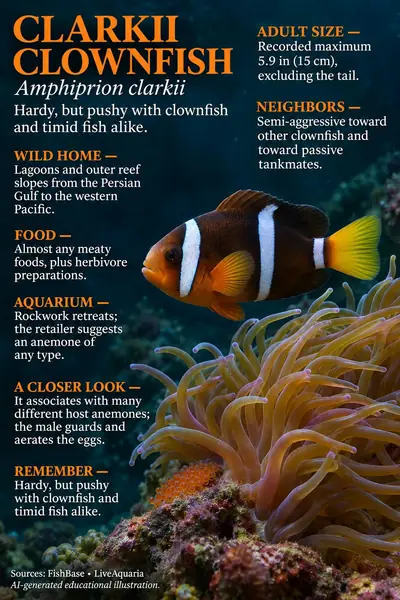
Clarkii clownfish
Amphiprion clarkii
Hardy, but pushy with clownfish and timid fish alike.
Meet this fish →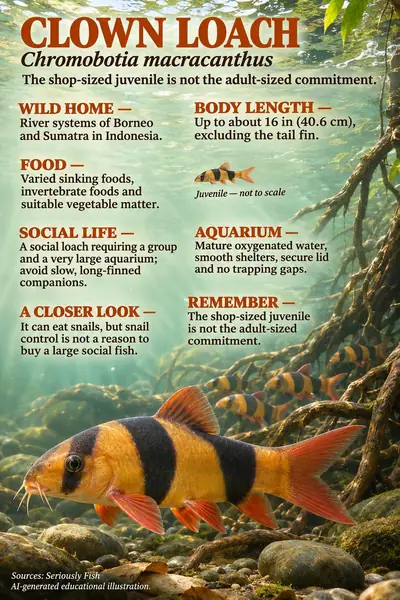
Clown loach
Chromobotia macracanthus
The shop-sized juvenile is not the adult-sized commitment.
Meet this fish →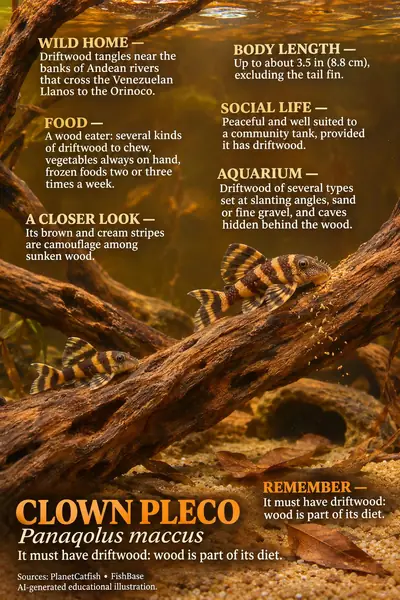
Clown pleco
Panaqolus maccus
It must have driftwood: wood is part of its diet.
Meet this fish →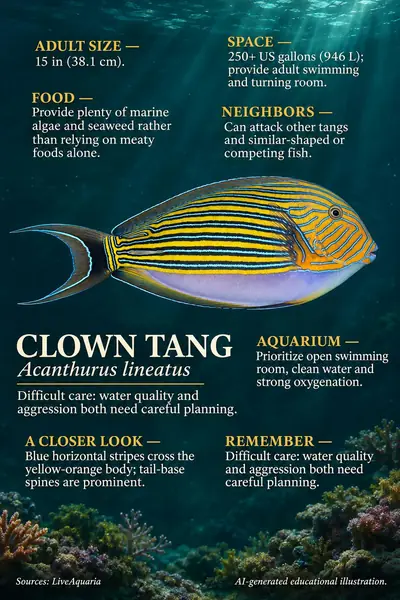
Clown tang
Acanthurus lineatus
Difficult care: water quality and aggression both need careful planning.
Meet this fish →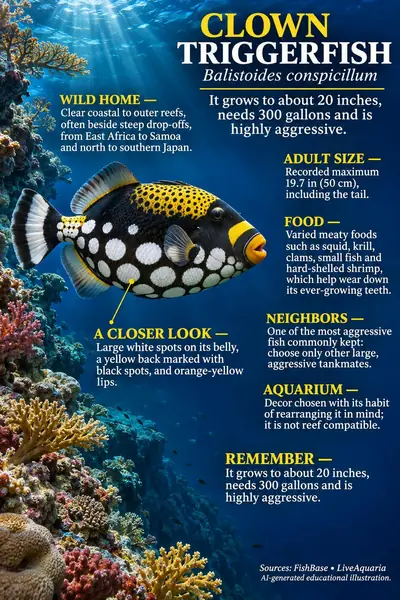
Clown triggerfish
Balistoides conspicillum
It grows to about 20 inches, needs 300 gallons and is highly aggressive.
Meet this fish →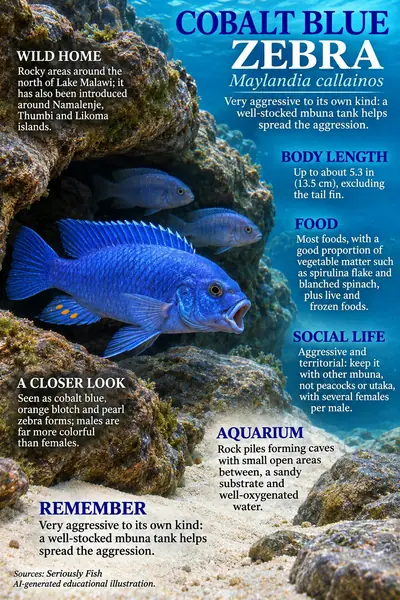
Cobalt blue zebra
Maylandia callainos
Very aggressive to its own kind: a well-stocked mbuna tank helps spread the aggression.
Meet this fish →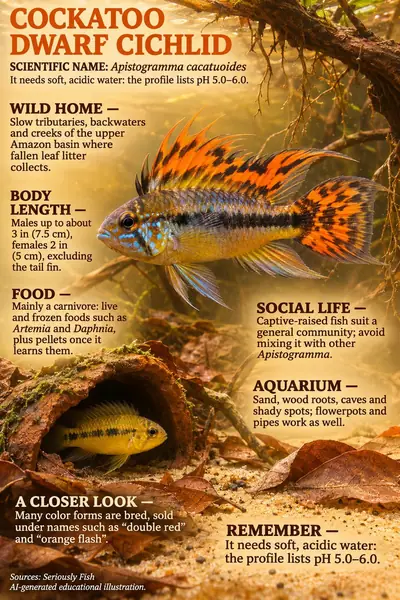
Cockatoo dwarf cichlid
Apistogramma cacatuoides
It needs soft, acidic water: the profile lists pH 5.0–6.0.
Meet this fish →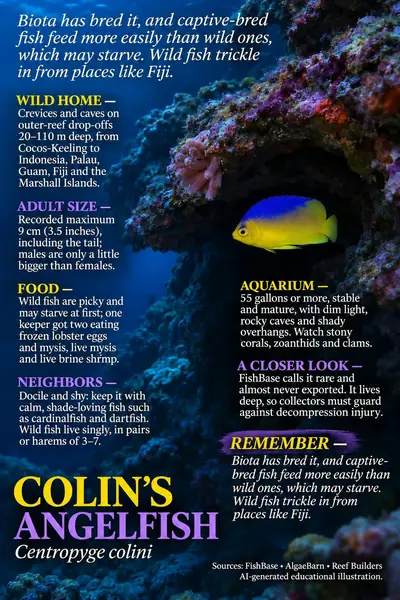
Colin’s angelfish
Centropyge colini
Biota has bred it, and captive-bred fish feed more easily than wild ones, which may starve. Wild fish trickle in from places like Fiji.
Meet this fish →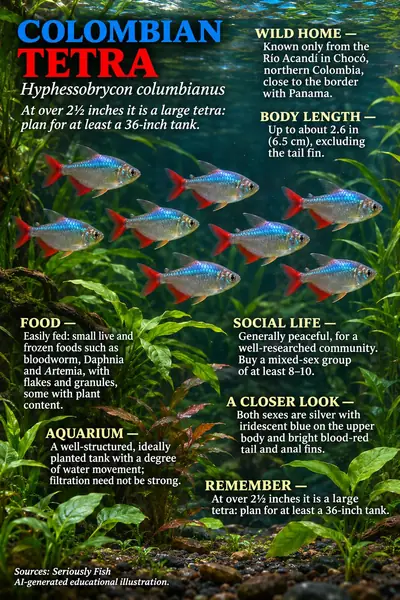
Colombian tetra
Hyphessobrycon columbianus
At over 2½ inches it is a large tetra: plan for at least a 36-inch tank.
Meet this fish →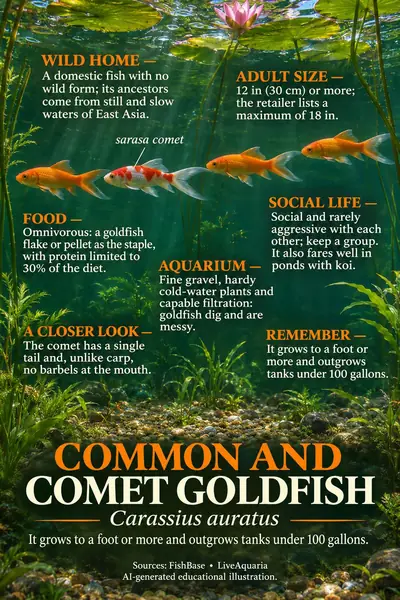
Common and comet goldfish
Carassius auratus
It grows to a foot or more and outgrows tanks under 100 gallons.
Meet this fish →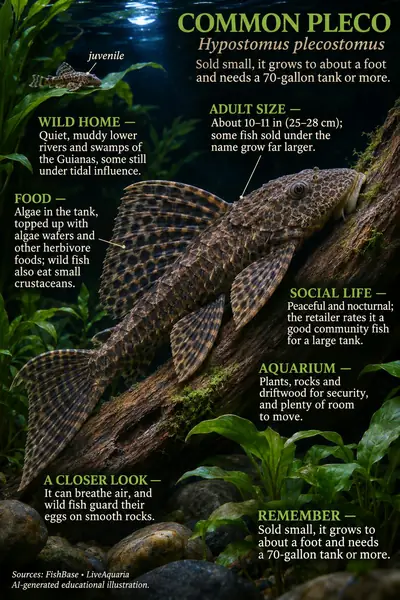
Common pleco
Hypostomus plecostomus
Sold small, it grows to about a foot and needs a 70-gallon tank or more.
Meet this fish →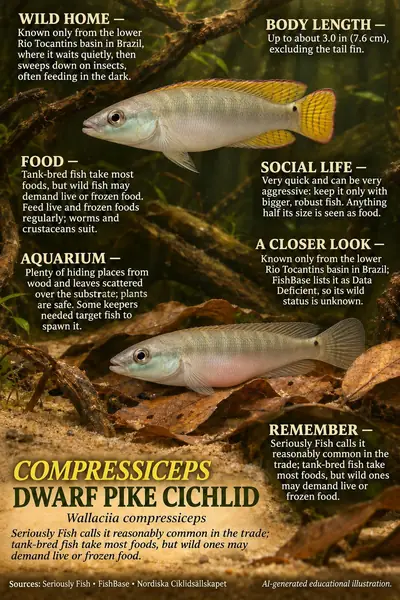
Compressiceps dwarf pike cichlid
Wallaciia compressiceps
Seriously Fish calls it reasonably common in the trade; tank-bred fish take most foods, but wild ones may demand live or frozen food.
Meet this fish →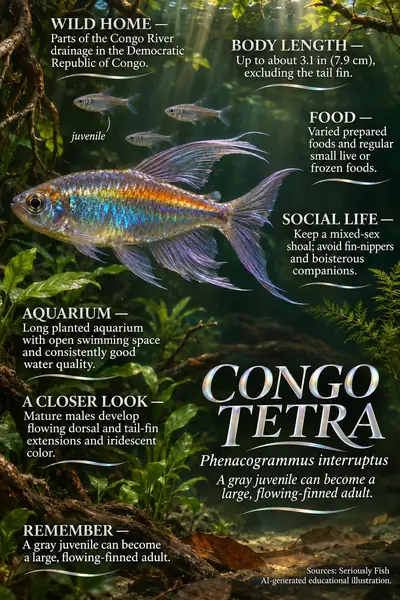
Congo tetra
Phenacogrammus interruptus
A gray juvenile can become a large, flowing-finned adult.
Meet this fish →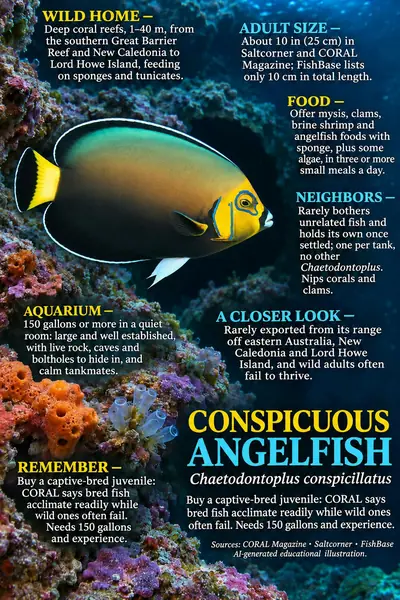
Conspicuous angelfish
Chaetodontoplus conspicillatus
Buy a captive-bred juvenile: CORAL says bred fish acclimate readily while wild ones often fail. Needs 150 gallons and experience.
Meet this fish →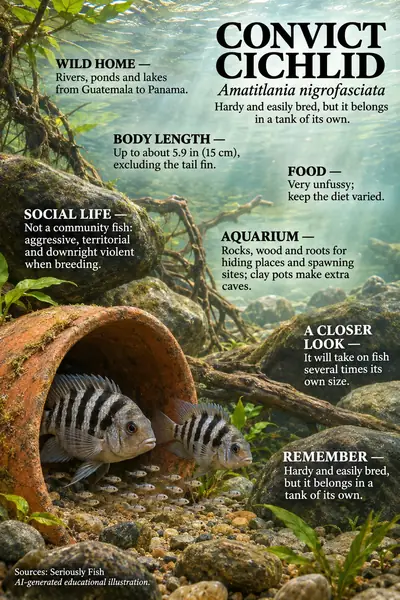
Convict cichlid
Amatitlania nigrofasciata
Hardy and easily bred, but it belongs in a tank of its own.
Meet this fish →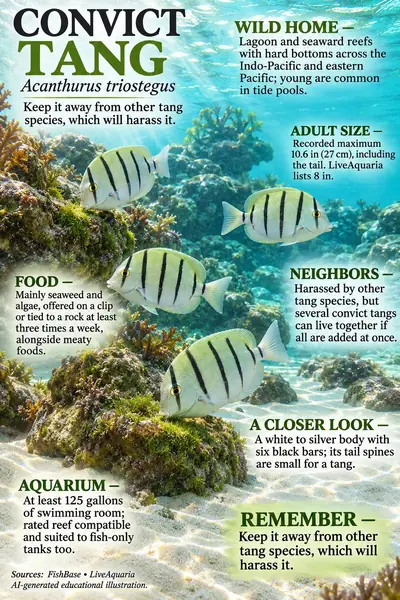
Convict tang
Acanthurus triostegus
Keep it away from other tang species, which will harass it.
Meet this fish →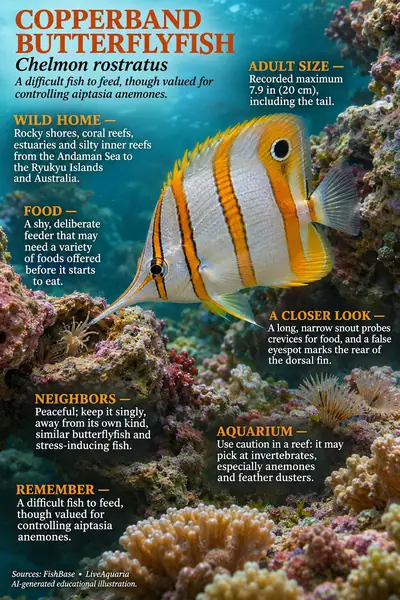
Copperband butterflyfish
Chelmon rostratus
A difficult fish to feed, though valued for controlling aiptasia anemones.
Meet this fish →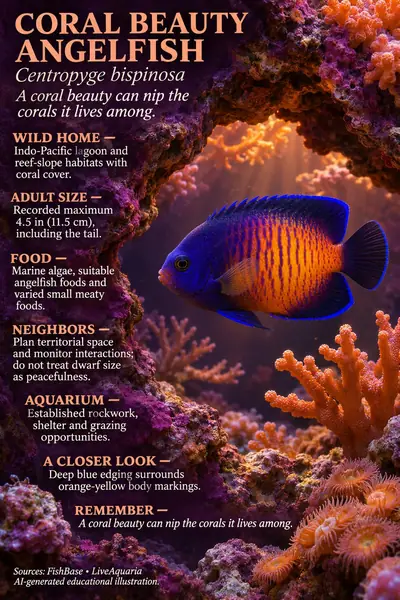
Coral beauty angelfish
Centropyge bispinosa
A coral beauty can nip the corals it lives among.
Meet this fish →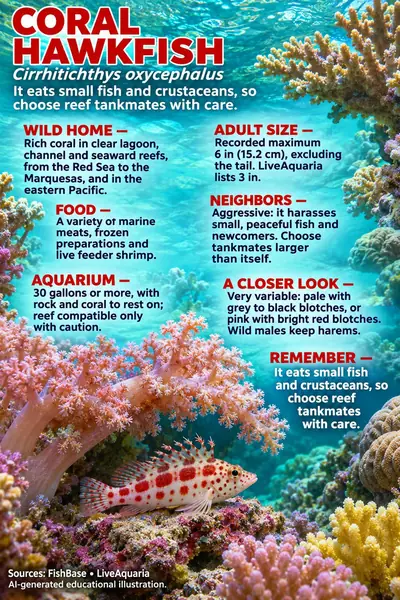
Coral hawkfish
Cirrhitichthys oxycephalus
It eats small fish and crustaceans, so choose reef tankmates with care.
Meet this fish →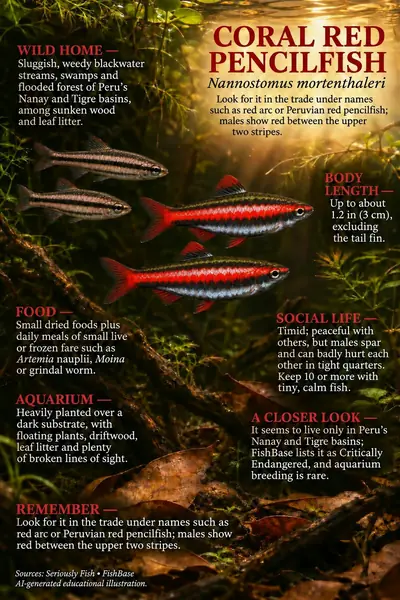
Coral red pencilfish
Nannostomus mortenthaleri
Look for it in the trade under names such as red arc or Peruvian red pencilfish; males show red between the upper two stripes.
Meet this fish →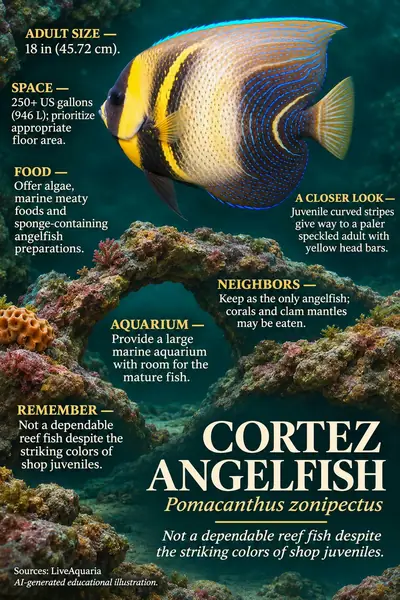
Cortez angelfish
Pomacanthus zonipectus
Not a dependable reef fish despite the striking colors of shop juveniles.
Meet this fish →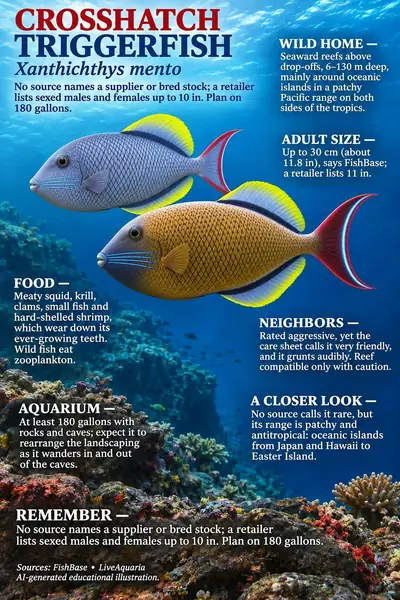
Crosshatch triggerfish
Xanthichthys mento
No source names a supplier or bred stock; a retailer lists sexed males and females up to 10 in. Plan on 180 gallons.
Meet this fish →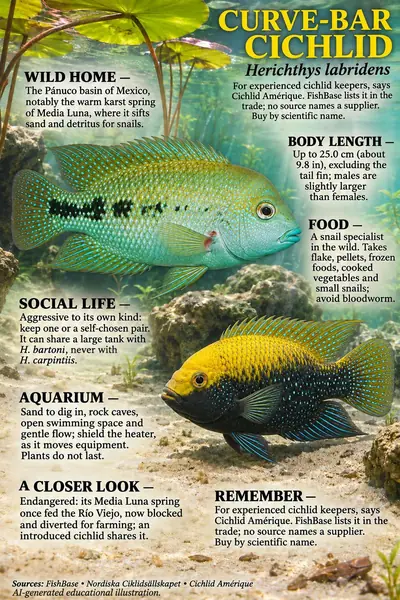
Curve-bar cichlid
Herichthys labridens
For experienced cichlid keepers, says Cichlid Amérique. FishBase lists it in the trade; no source names a supplier. Buy by scientific name.
Meet this fish →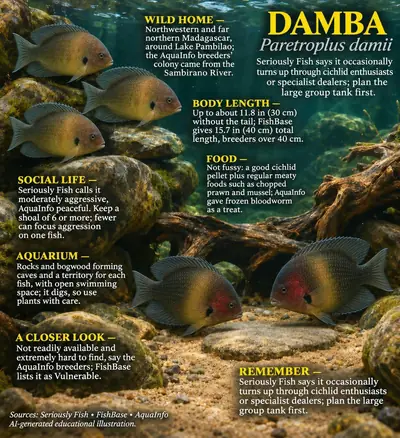
Damba
Paretroplus damii
Seriously Fish says it occasionally turns up through cichlid enthusiasts or specialist dealers; plan the large group tank first.
Meet this fish →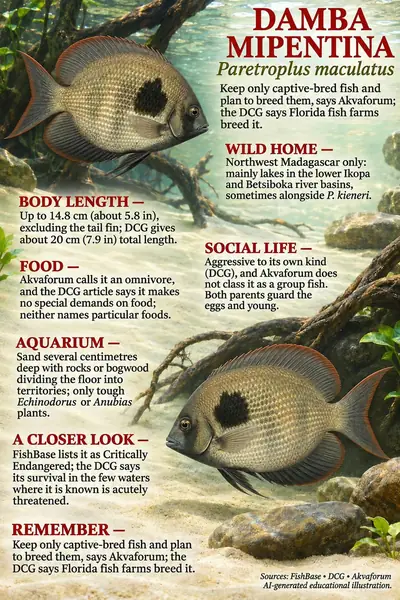
Damba mipentina
Paretroplus maculatus
Keep only captive-bred fish and plan to breed them, says Akvaforum; the DCG says Florida fish farms breed it.
Meet this fish →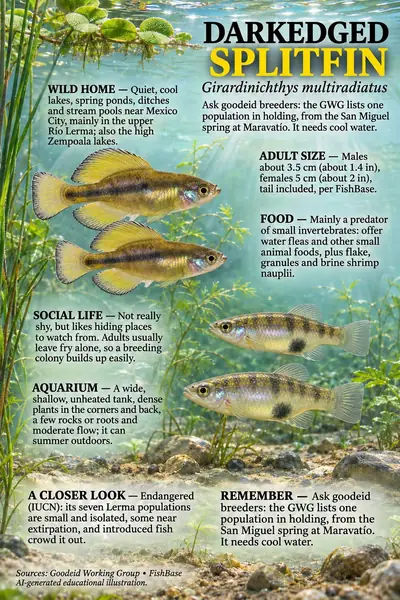
Darkedged splitfin
Girardinichthys multiradiatus
Ask goodeid breeders: the GWG lists one population in holding, from the San Miguel spring at Maravatío. It needs cool water.
Meet this fish →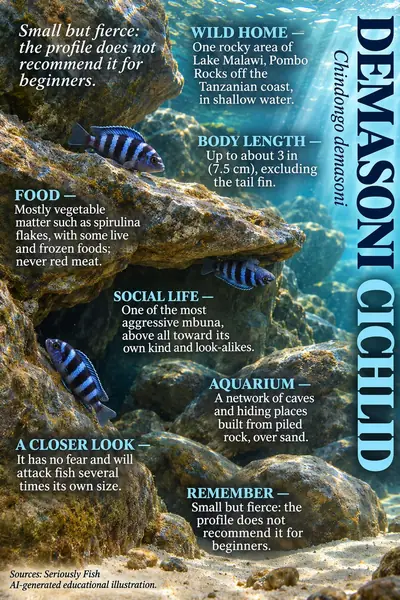
Demasoni cichlid
Chindongo demasoni
Small but fierce: the profile does not recommend it for beginners.
Meet this fish →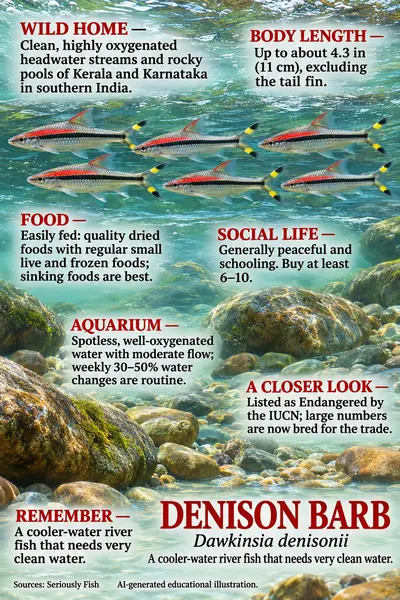
Denison barb
Dawkinsia denisonii
A cooler-water river fish that needs very clean water.
Meet this fish →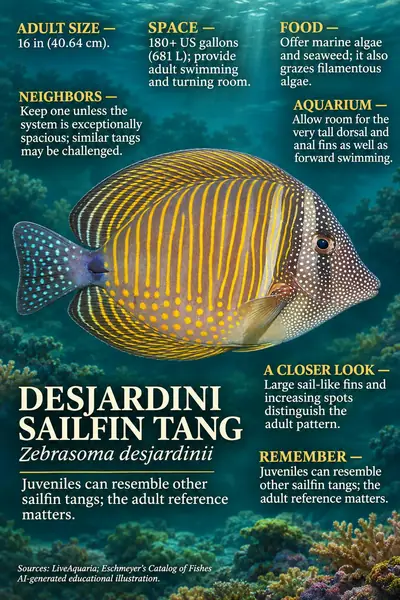
Desjardini sailfin tang
Zebrasoma desjardinii
Juveniles can resemble other sailfin tangs; the adult reference matters.
Meet this fish →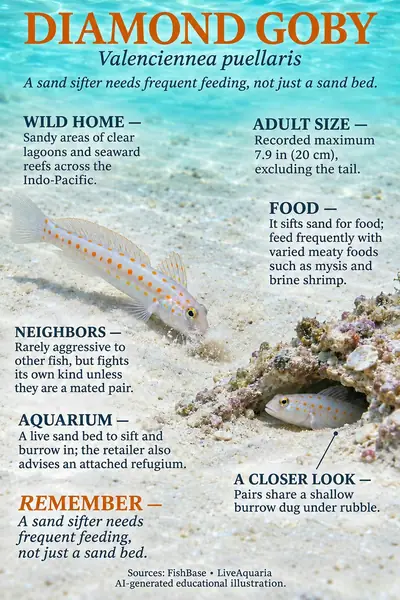
Diamond goby
Valenciennea puellaris
A sand sifter needs frequent feeding, not just a sand bed.
Meet this fish →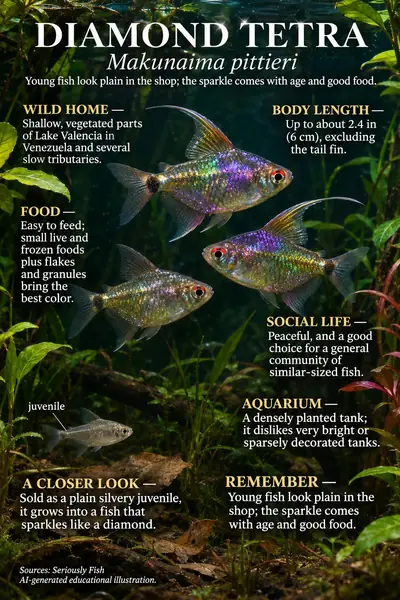
Diamond tetra
Makunaima pittieri
Young fish look plain in the shop; the sparkle comes with age and good food.
Meet this fish →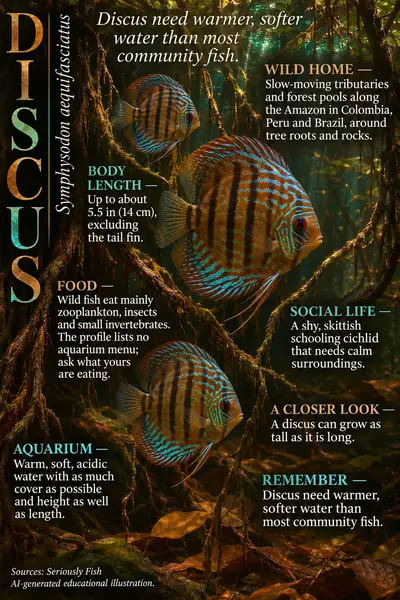
Discus
Symphysodon aequifasciatus
Discus need warmer, softer water than most community fish.
Meet this fish →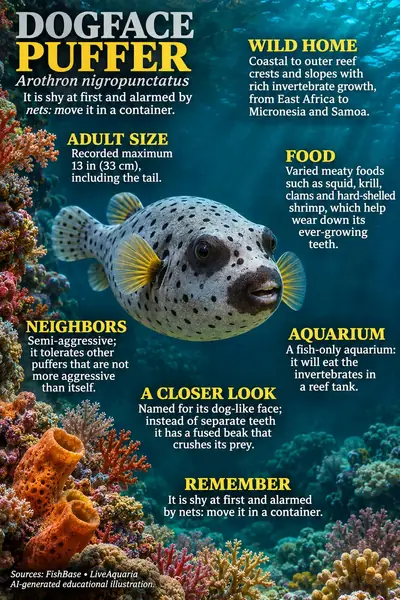
Dogface puffer
Arothron nigropunctatus
It is shy at first and alarmed by nets: move it in a container.
Meet this fish →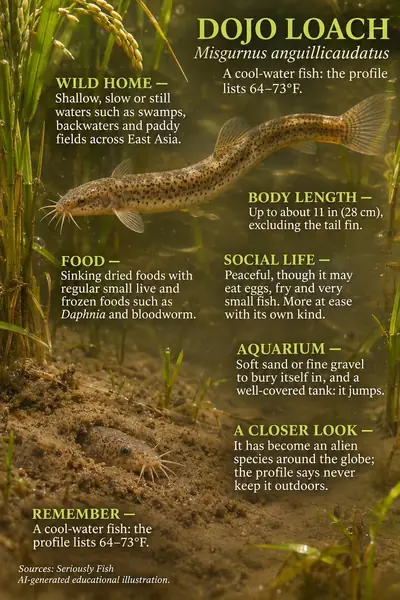
Dojo loach
Misgurnus anguillicaudatus
A cool-water fish: the profile lists 64–73°F.
Meet this fish →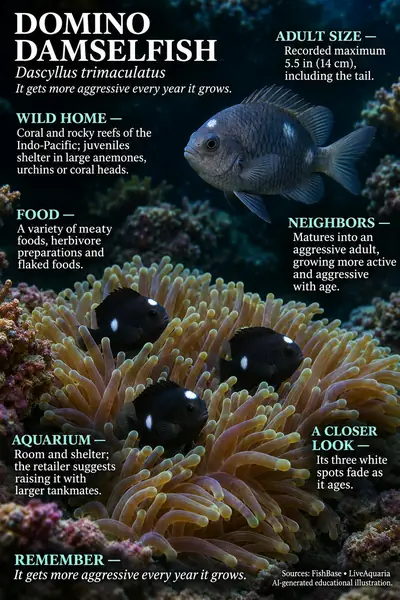
Domino damselfish
Dascyllus trimaculatus
It gets more aggressive every year it grows.
Meet this fish →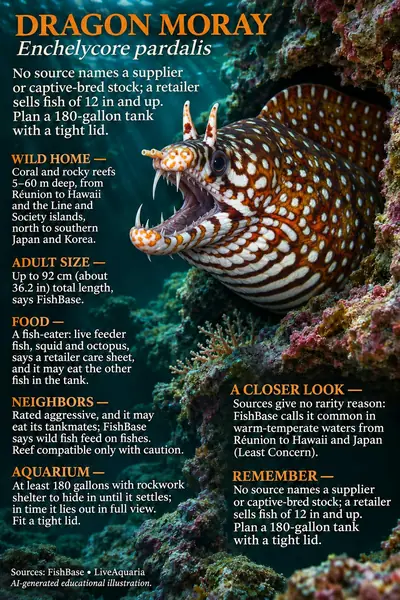
Dragon moray
Enchelycore pardalis
No source names a supplier or captive-bred stock; a retailer sells fish of 12 in and up. Plan a 180-gallon tank with a tight lid.
Meet this fish →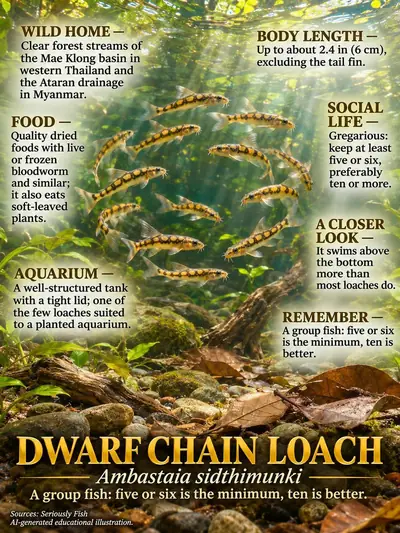
Dwarf chain loach
Ambastaia sidthimunki
A group fish: five or six is the minimum, ten is better.
Meet this fish →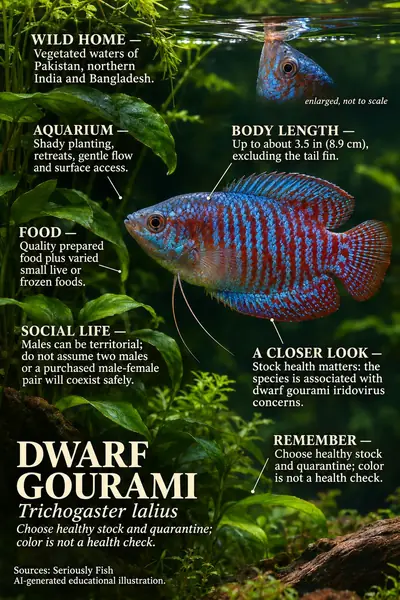
Dwarf gourami
Trichogaster lalius
Choose healthy stock and quarantine; color is not a health check.
Meet this fish →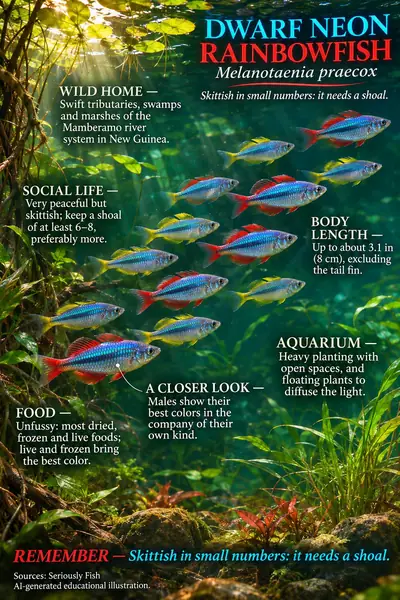
Dwarf neon rainbowfish
Melanotaenia praecox
Skittish in small numbers: it needs a shoal.
Meet this fish →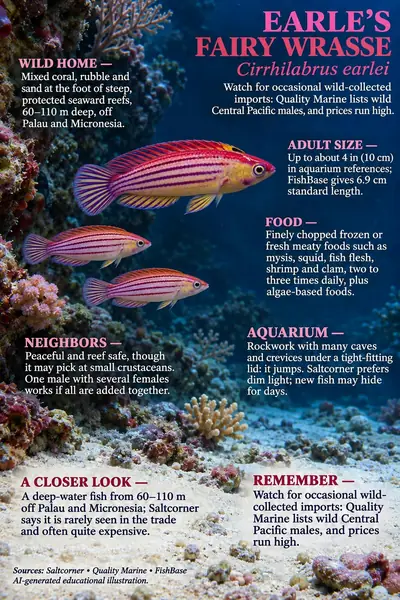
Earle’s fairy wrasse
Cirrhilabrus earlei
Watch for occasional wild-collected imports: Quality Marine lists wild Central Pacific males, and prices run high.
Meet this fish →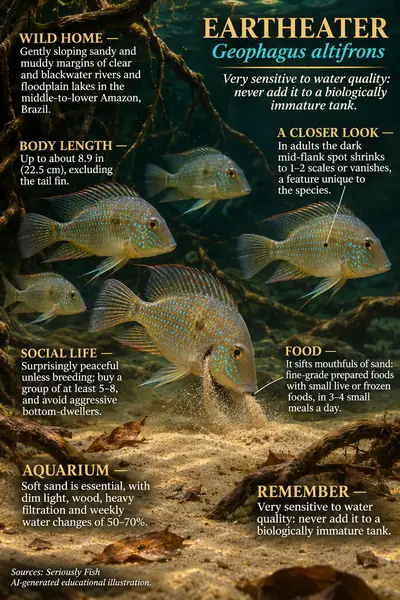
Eartheater
Geophagus altifrons
Very sensitive to water quality: never add it to a biologically immature tank.
Meet this fish →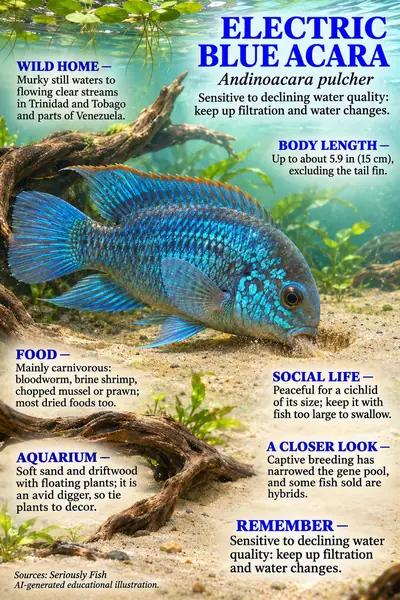
Electric blue acara
Andinoacara pulcher
Sensitive to declining water quality: keep up filtration and water changes.
Meet this fish →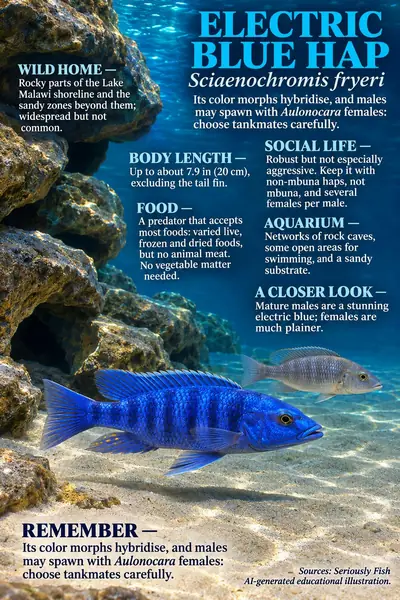
Electric blue hap
Sciaenochromis fryeri
Its color morphs hybridise, and males may spawn with Aulonocara females: choose tankmates carefully.
Meet this fish →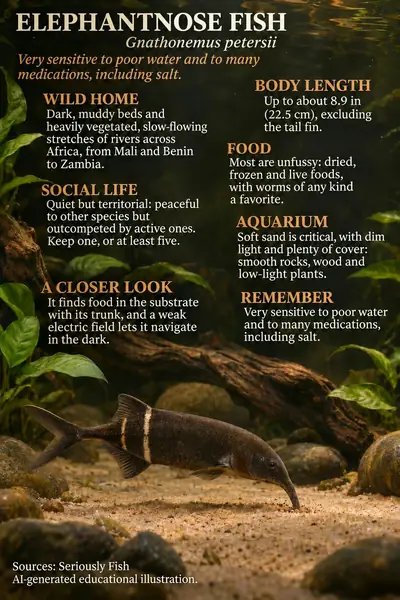
Elephantnose fish
Gnathonemus petersii
Very sensitive to poor water and to many medications, including salt.
Meet this fish →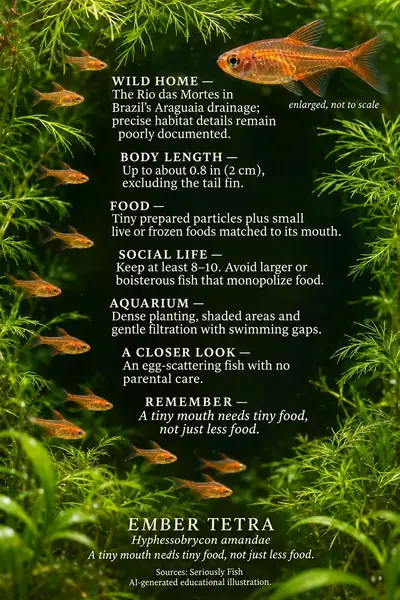
Ember tetra
Hyphessobrycon amandae
A tiny mouth needs tiny food, not just less food.
Meet this fish →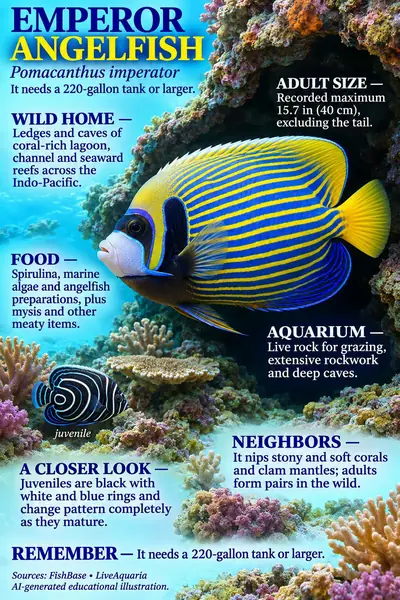
Emperor angelfish
Pomacanthus imperator
It needs a 220-gallon tank or larger.
Meet this fish →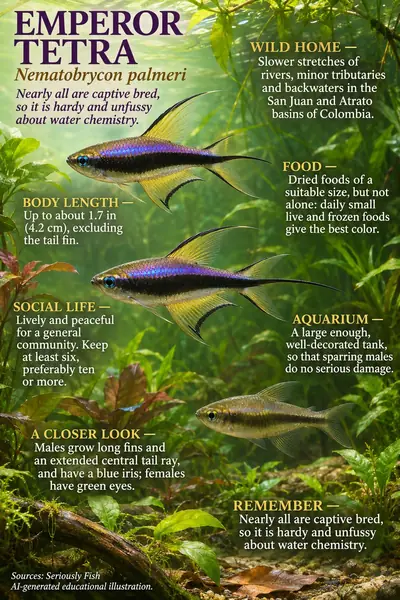
Emperor tetra
Nematobrycon palmeri
Nearly all are captive bred, so it is hardy and unfussy about water chemistry.
Meet this fish →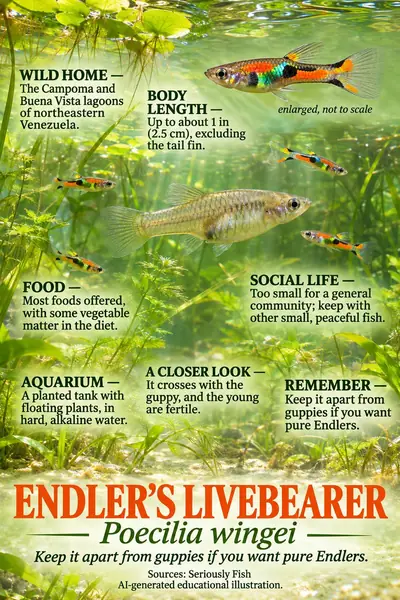
Endler’s livebearer
Poecilia wingei
Keep it apart from guppies if you want pure Endlers.
Meet this fish →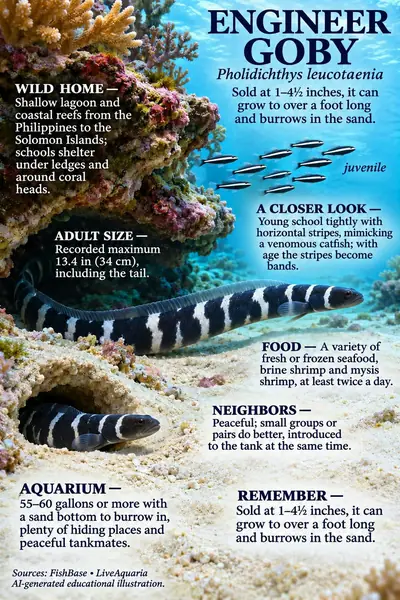
Engineer goby
Pholidichthys leucotaenia
Sold at 1–4½ inches, it can grow to over a foot long and burrows in the sand.
Meet this fish →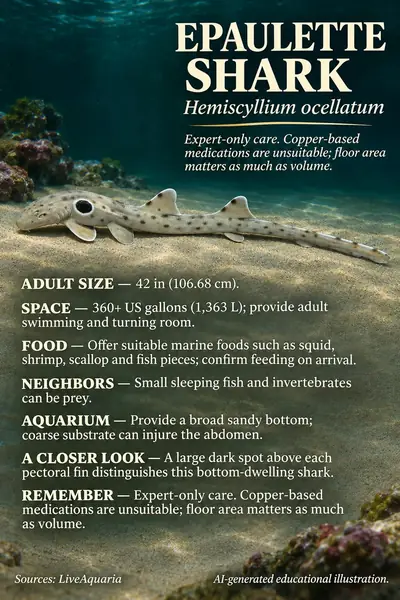
Epaulette shark
Hemiscyllium ocellatum
Expert-only care. Copper-based medications are unsuitable; floor area matters as much as volume.
Meet this fish →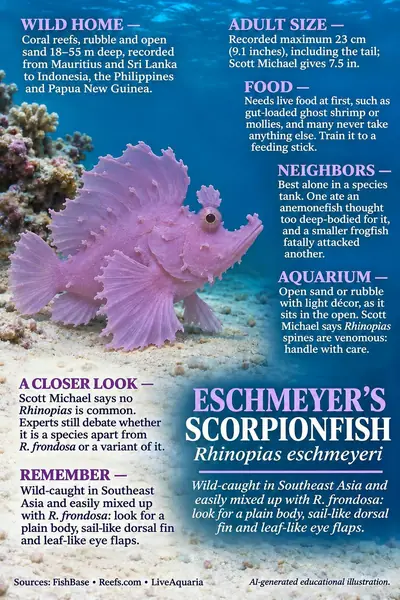
Eschmeyer’s scorpionfish
Rhinopias eschmeyeri
Wild-caught in Southeast Asia and easily mixed up with R. frondosa: look for a plain body, sail-like dorsal fin and leaf-like eye flaps.
Meet this fish →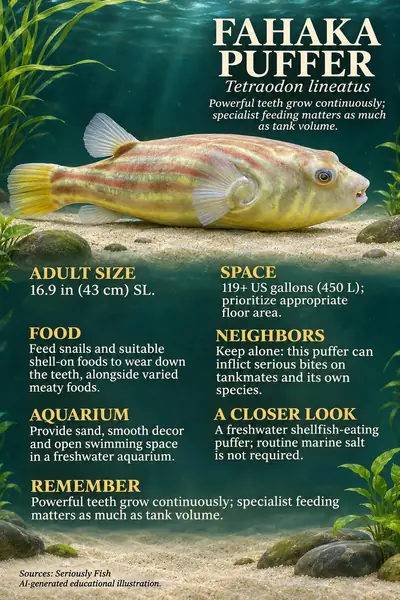
Fahaka puffer
Tetraodon lineatus
Powerful teeth grow continuously; specialist feeding matters as much as tank volume.
Meet this fish →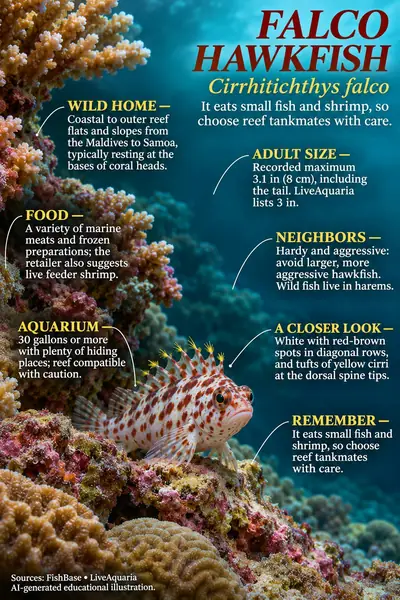
Falco hawkfish
Cirrhitichthys falco
It eats small fish and shrimp, so choose reef tankmates with care.
Meet this fish →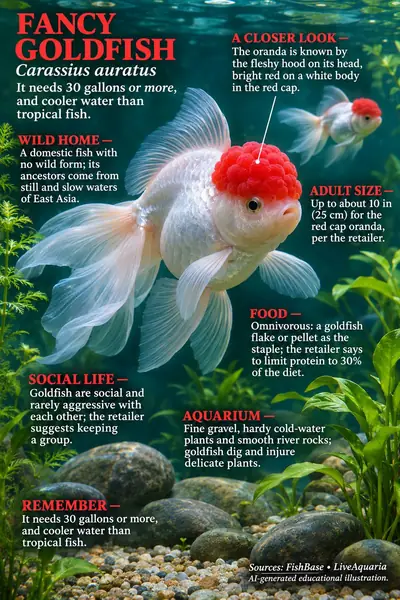
Fancy goldfish
Carassius auratus
It needs 30 gallons or more, and cooler water than tropical fish.
Meet this fish →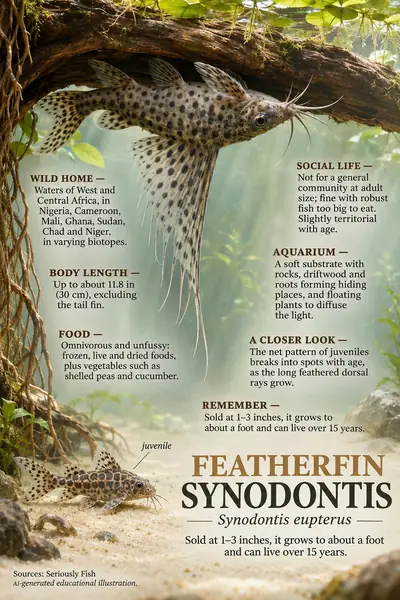
Featherfin synodontis
Synodontis eupterus
Sold at 1–3 inches, it grows to about a foot and can live over 15 years.
Meet this fish →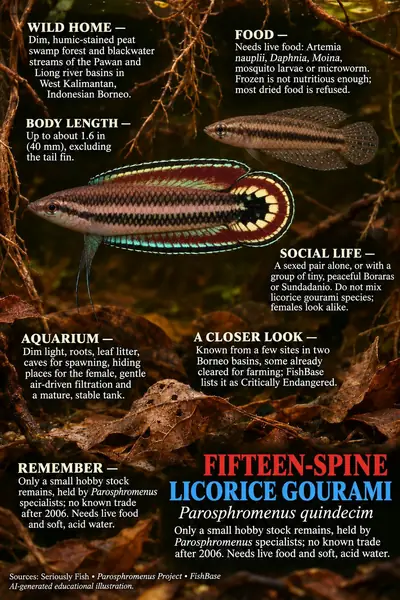
Fifteen-spine licorice gourami
Parosphromenus quindecim
Only a small hobby stock remains, held by Parosphromenus specialists; no known trade after 2006. Needs live food and soft, acid water.
Meet this fish →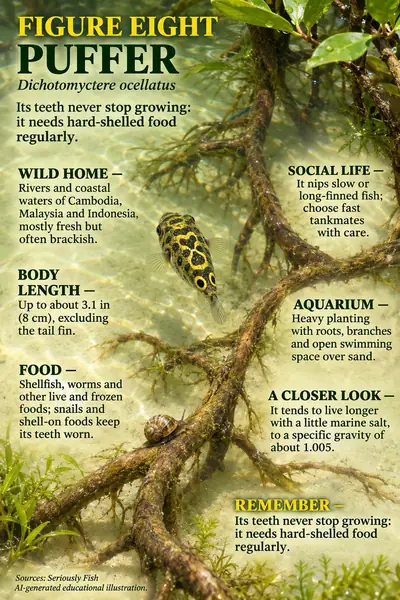
Figure eight puffer
Dichotomyctere ocellatus
Its teeth never stop growing: it needs hard-shelled food regularly.
Meet this fish →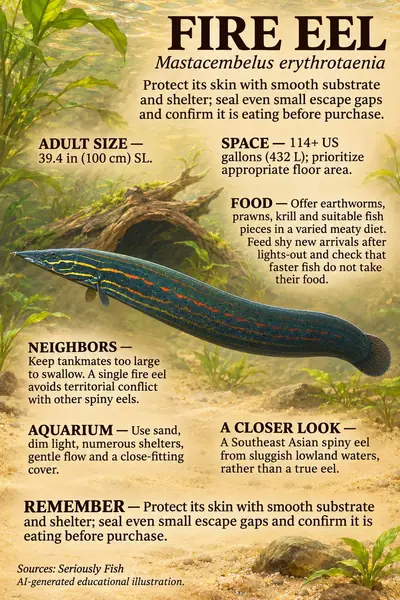
Fire eel
Mastacembelus erythrotaenia
Protect its skin with smooth substrate and shelter; seal even small escape gaps and confirm it is eating before purchase.
Meet this fish →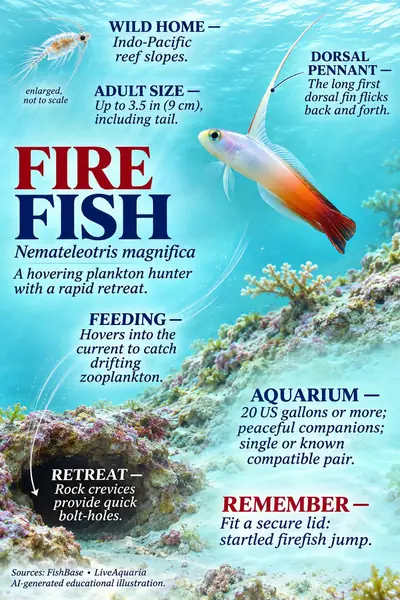
Firefish
Nemateleotris magnifica
A hovering plankton hunter with a rapid retreat
Meet this fish →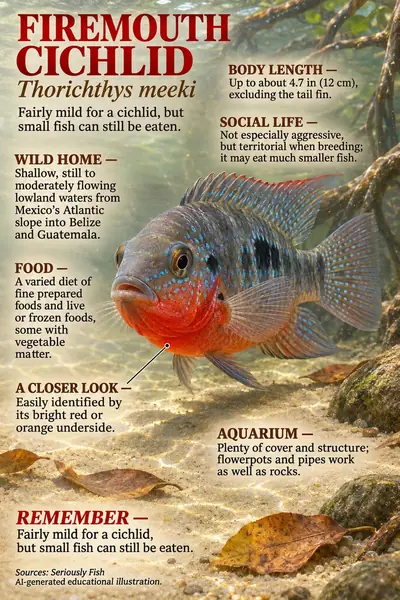
Firemouth cichlid
Thorichthys meeki
Fairly mild for a cichlid, but small fish can still be eaten.
Meet this fish →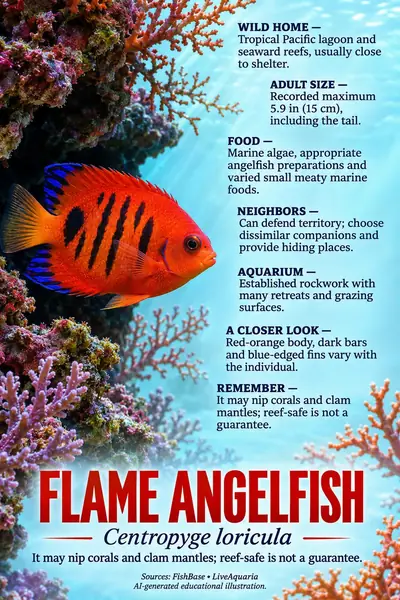
Flame angelfish
Centropyge loricula
It may nip corals and clam mantles; reef-safe is not a guarantee.
Meet this fish →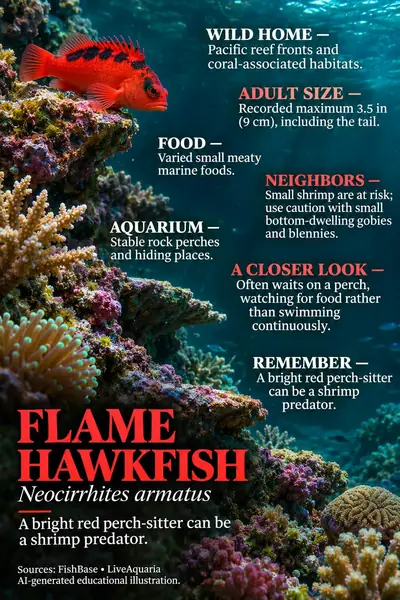
Flame hawkfish
Neocirrhites armatus
A bright red perch-sitter can be a shrimp predator.
Meet this fish →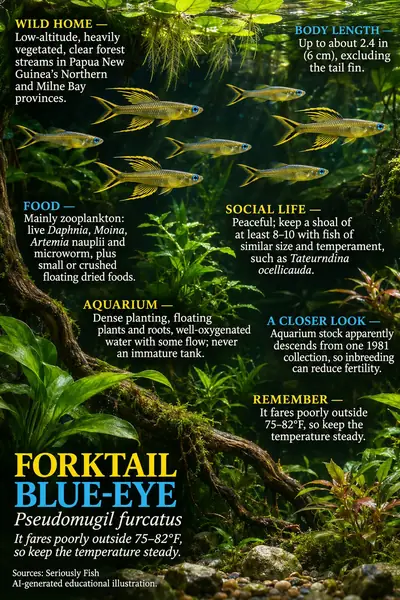
Forktail blue-eye
Pseudomugil furcatus
It fares poorly outside 75–82°F, so keep the temperature steady.
Meet this fish →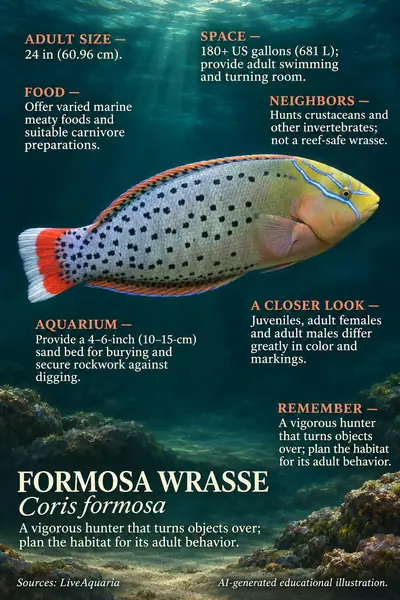
Formosa wrasse
Coris formosa
A vigorous hunter that turns objects over; plan the habitat for its adult behavior.
Meet this fish →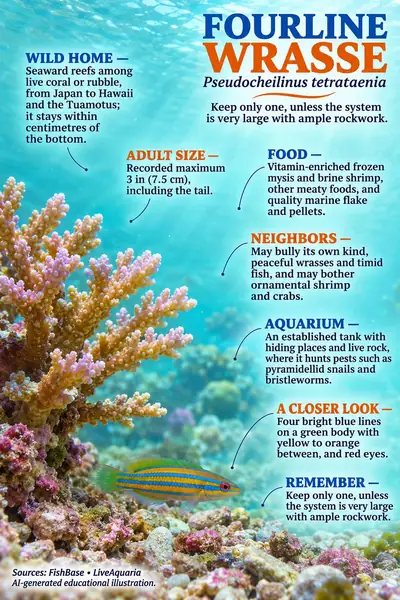
Fourline wrasse
Pseudocheilinus tetrataenia
Keep only one, unless the system is very large with ample rockwork.
Meet this fish →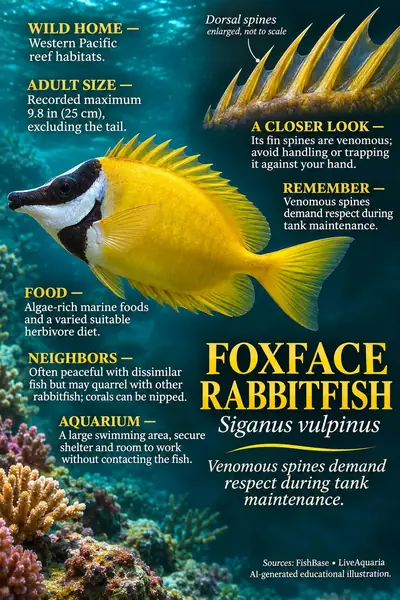
Foxface rabbitfish
Siganus vulpinus
Venomous spines demand respect during tank maintenance.
Meet this fish →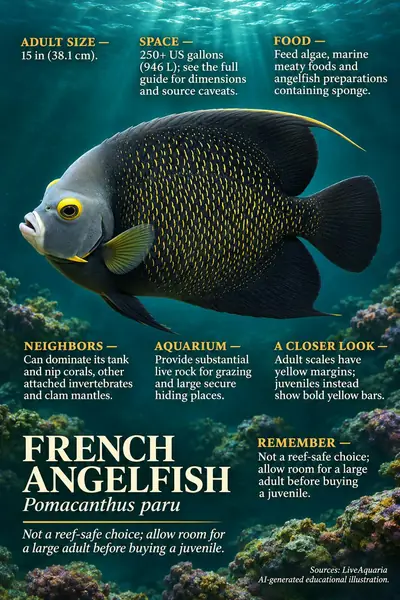
French angelfish
Pomacanthus paru
Not a reef-safe choice; allow room for a large adult before buying a juvenile.
Meet this fish →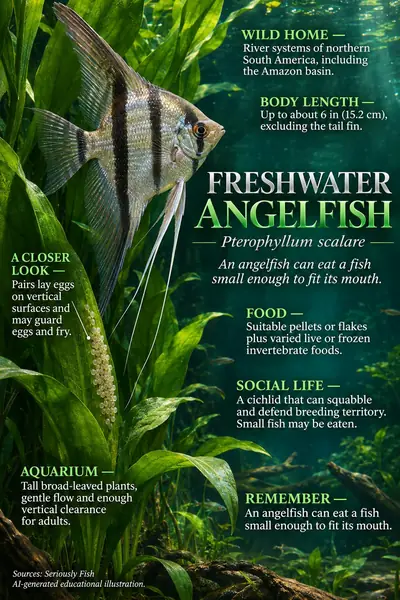
Freshwater angelfish
Pterophyllum scalare
An angelfish can eat a fish small enough to fit its mouth.
Meet this fish →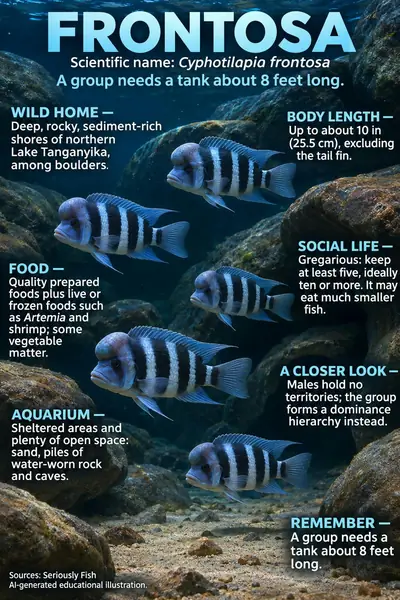
Frontosa
Cyphotilapia frontosa
A group needs a tank about 8 feet long.
Meet this fish →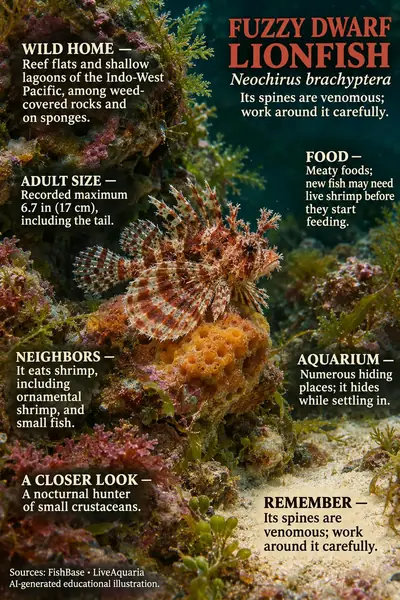
Fuzzy dwarf lionfish
Neochirus brachyptera
Its spines are venomous; work around it carefully.
Meet this fish →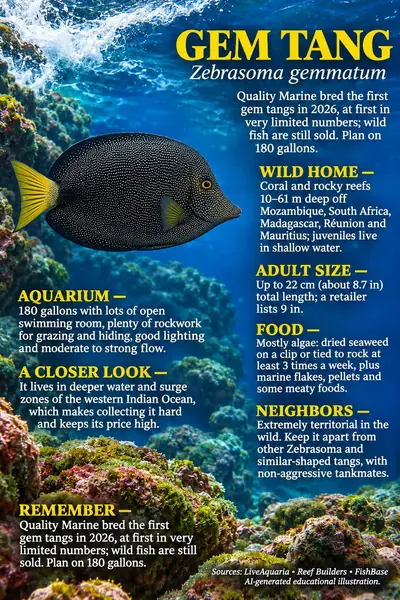
Gem tang
Zebrasoma gemmatum
Quality Marine bred the first gem tangs in 2026, at first in very limited numbers; wild fish are still sold. Plan on 180 gallons.
Meet this fish →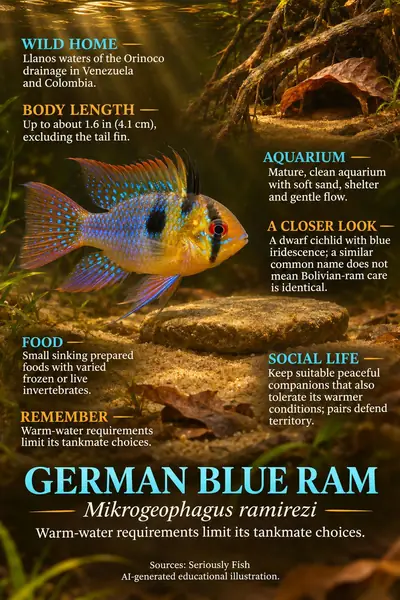
German blue ram
Mikrogeophagus ramirezi
Warm-water requirements limit its tankmate choices.
Meet this fish →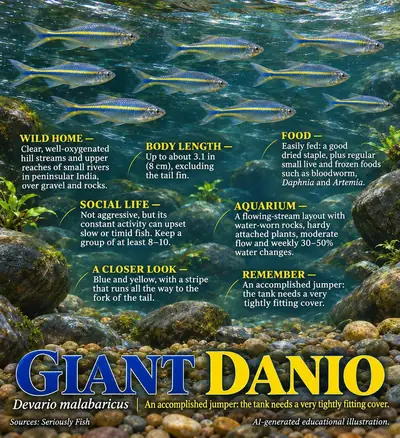
Giant danio
Devario malabaricus
An accomplished jumper: the tank needs a very tightly fitting cover.
Meet this fish →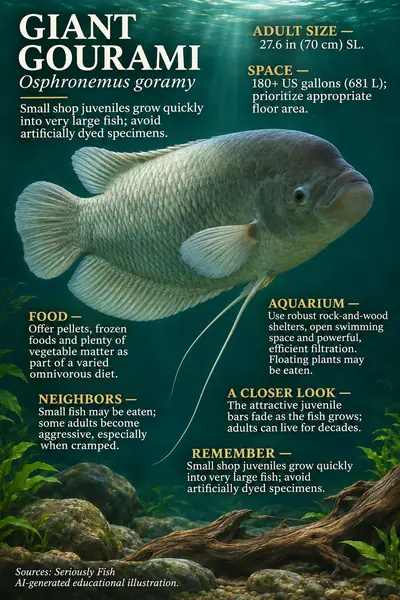
Giant gourami
Osphronemus goramy
Small shop juveniles grow quickly into very large fish; avoid artificially dyed specimens.
Meet this fish →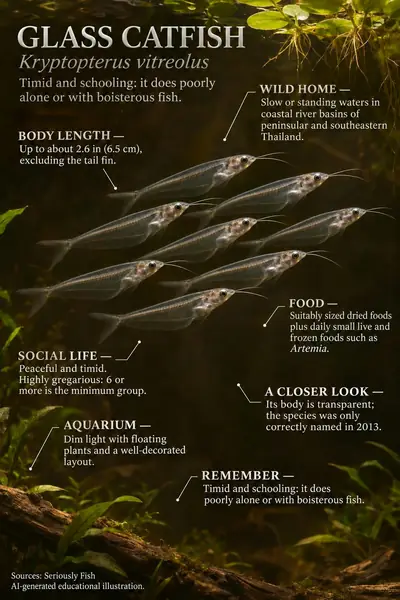
Glass catfish
Kryptopterus vitreolus
Timid and schooling: it does poorly alone or with boisterous fish.
Meet this fish →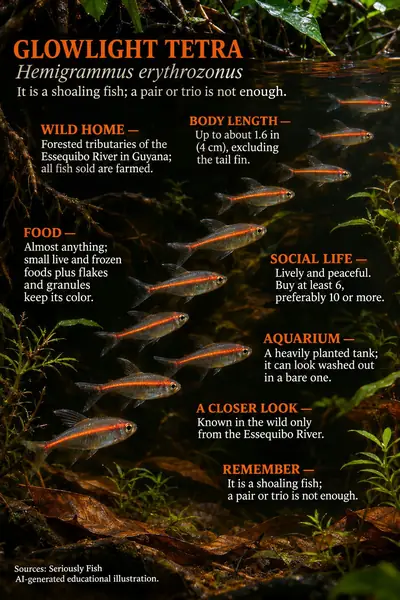
Glowlight tetra
Hemigrammus erythrozonus
It is a shoaling fish; a pair or trio is not enough.
Meet this fish →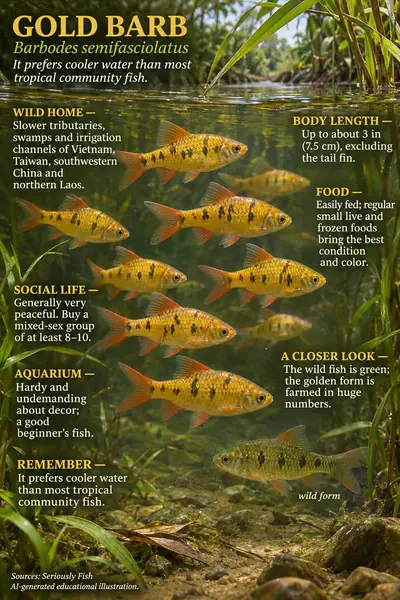
Gold barb
Barbodes semifasciolatus
It prefers cooler water than most tropical community fish.
Meet this fish →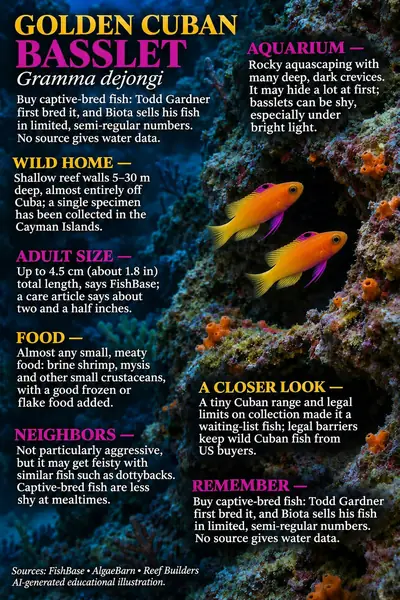
Golden Cuban basslet
Gramma dejongi
Buy captive-bred fish: Todd Gardner first bred it, and Biota sells his fish in limited, semi-regular numbers. No source gives water data.
Meet this fish →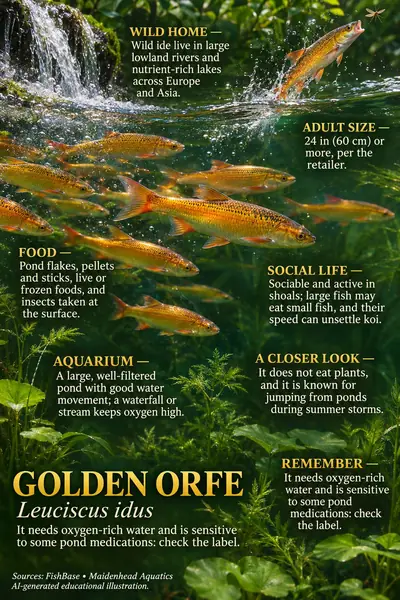
Golden orfe
Leuciscus idus
It needs oxygen-rich water and is sensitive to some pond medications: check the label.
Meet this fish →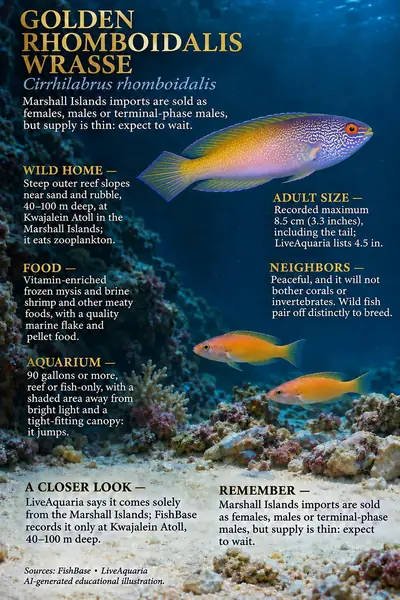
Golden rhomboidalis wrasse
Cirrhilabrus rhomboidalis
Marshall Islands imports are sold as females, males or terminal-phase males, but supply is thin: expect to wait.
Meet this fish →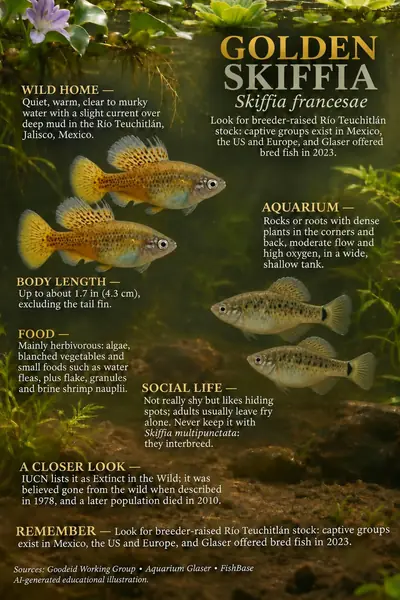
Golden skiffia
Skiffia francesae
Look for breeder-raised Río Teuchitlán stock: captive groups exist in Mexico, the US and Europe, and Glaser offered bred fish in 2023.
Meet this fish →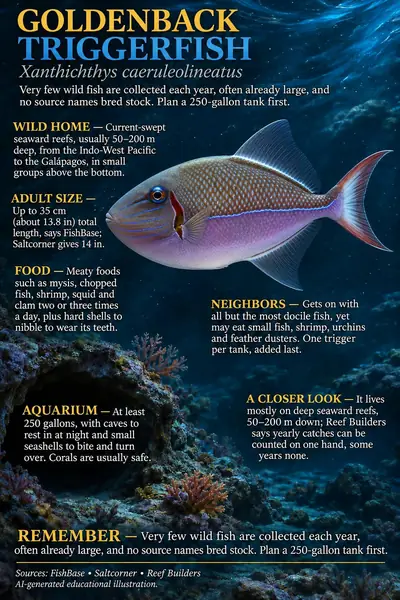
Goldenback triggerfish
Xanthichthys caeruleolineatus
Very few wild fish are collected each year, often already large, and no source names bred stock. Plan a 250-gallon tank first.
Meet this fish →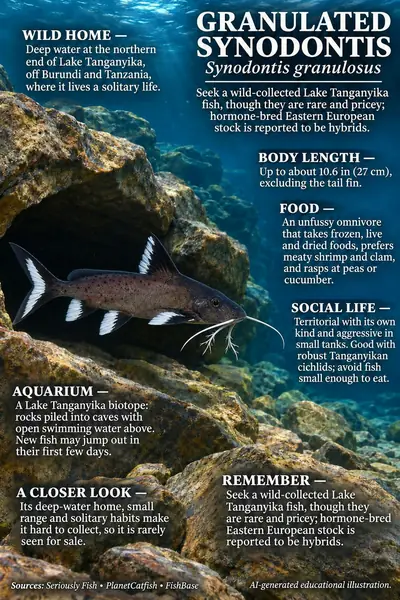
Granulated synodontis
Synodontis granulosus
Seek a wild-collected Lake Tanganyika fish, though they are rare and pricey; hormone-bred Eastern European stock is reported to be hybrids.
Meet this fish →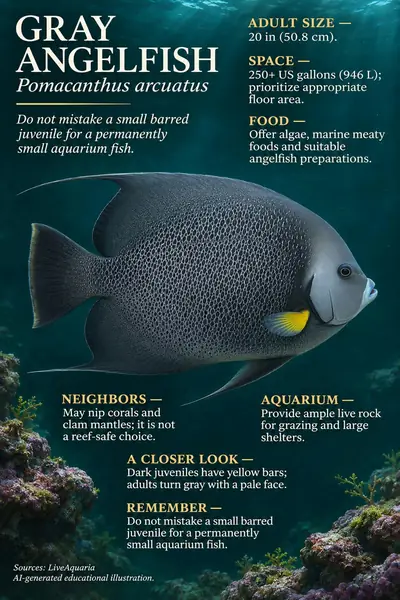
Gray angelfish
Pomacanthus arcuatus
Do not mistake a small barred juvenile for a permanently small aquarium fish.
Meet this fish →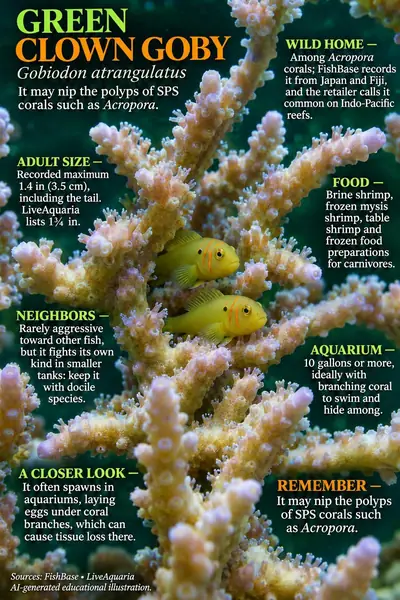
Green clown goby
Gobiodon atrangulatus
It may nip the polyps of SPS corals such as Acropora.
Meet this fish →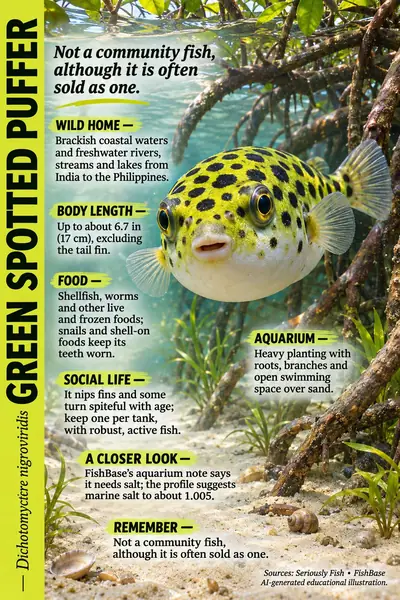
Green spotted puffer
Dichotomyctere nigroviridis
Not a community fish, although it is often sold as one.
Meet this fish →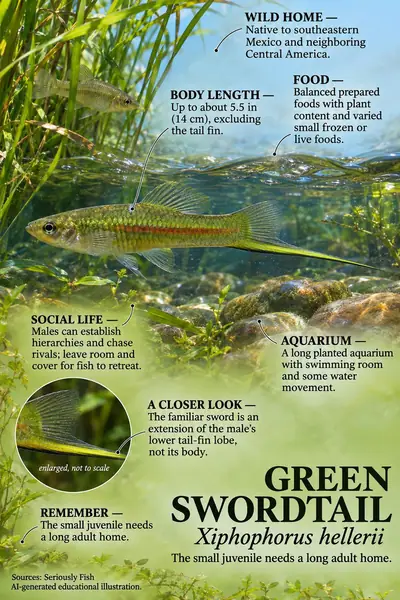
Green swordtail
Xiphophorus hellerii
The small juvenile needs a long adult home.
Meet this fish →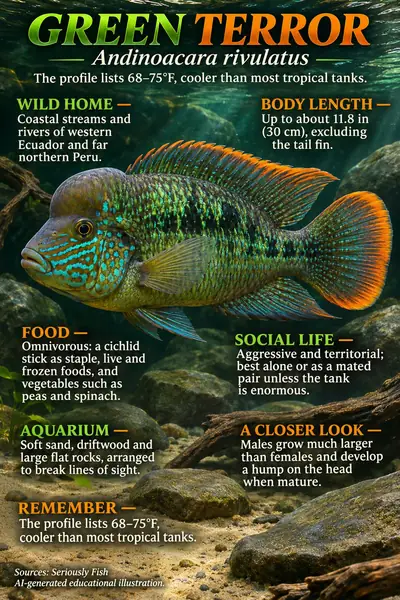
Green terror
Andinoacara rivulatus
The profile lists 68–75°F, cooler than most tropical tanks.
Meet this fish →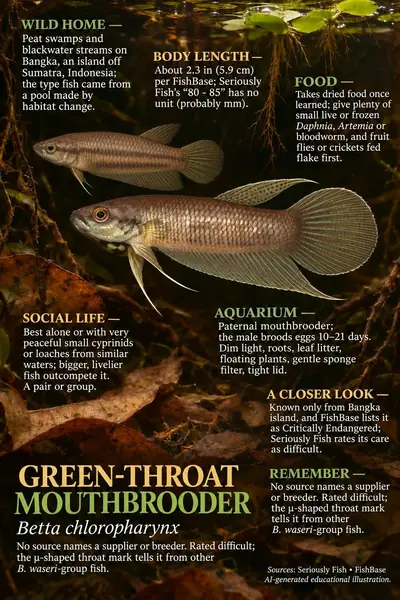
Green-throat mouthbrooder
Betta chloropharynx
No source names a supplier or breeder. Rated difficult; the μ-shaped throat mark tells it from other B. waseri-group fish.
Meet this fish →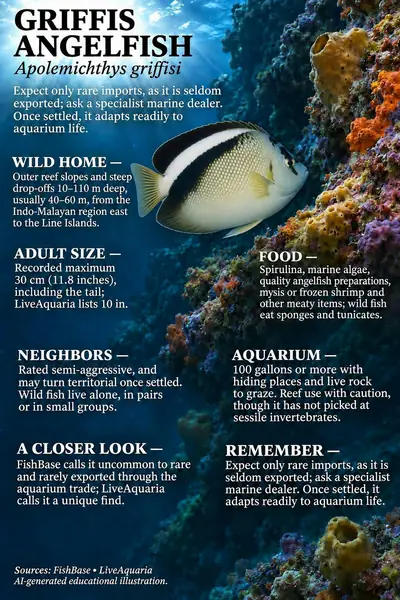
Griffis angelfish
Apolemichthys griffisi
Expect only rare imports, as it is seldom exported; ask a specialist marine dealer. Once settled, it adapts readily to aquarium life.
Meet this fish →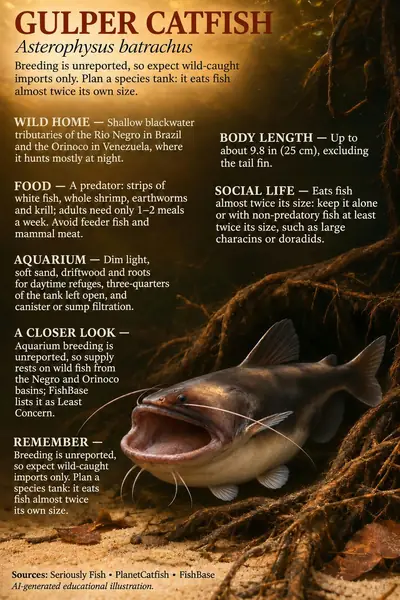
Gulper catfish
Asterophysus batrachus
Breeding is unreported, so expect wild-caught imports only. Plan a species tank: it eats fish almost twice its own size.
Meet this fish →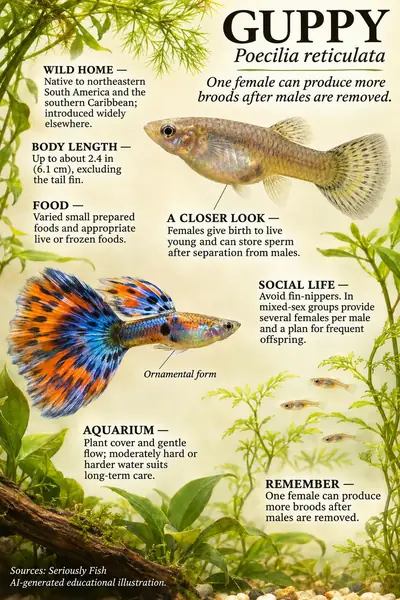
Guppy
Poecilia reticulata
One female can produce more broods after males are removed.
Meet this fish →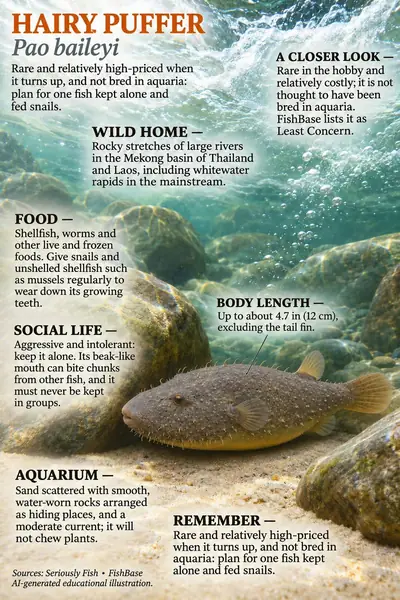
Hairy puffer
Pao baileyi
Rare and relatively high-priced when it turns up, and not bred in aquaria: plan for one fish kept alone and fed snails.
Meet this fish →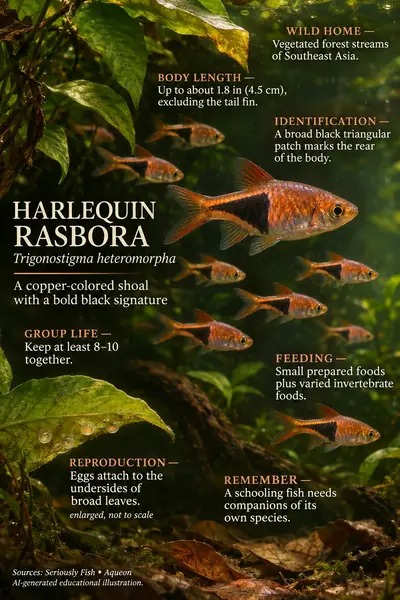
Harlequin rasbora
Trigonostigma heteromorpha
A copper-colored shoal with a bold black signature
Meet this fish →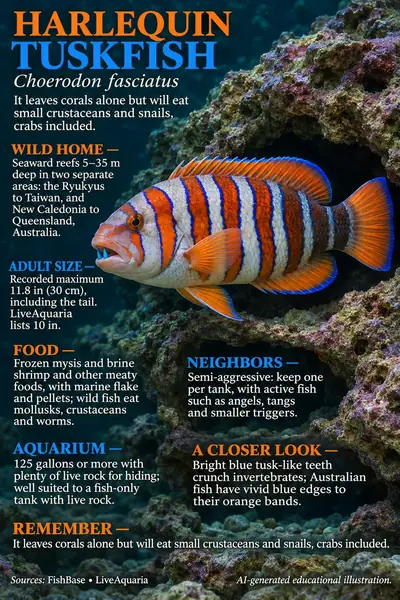
Harlequin tuskfish
Choerodon fasciatus
It leaves corals alone but will eat small crustaceans and snails, crabs included.
Meet this fish →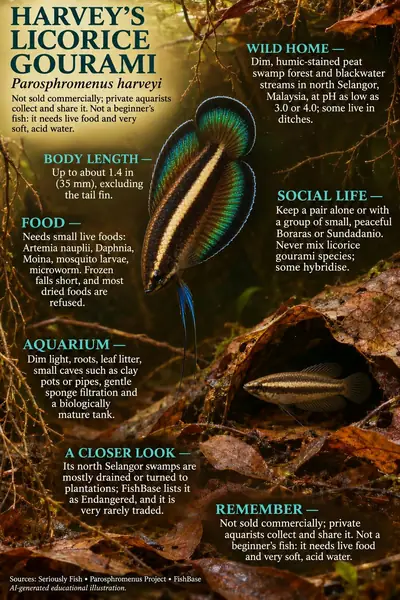
Harvey’s licorice gourami
Parosphromenus harveyi
Not sold commercially; private aquarists collect and share it. Not a beginner’s fish: it needs live food and very soft, acid water.
Meet this fish →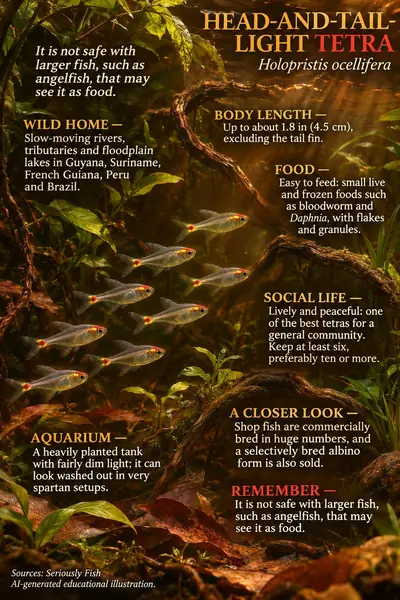
Head-and-tail-light tetra
Holopristis ocellifera
It is not safe with larger fish, such as angelfish, that may see it as food.
Meet this fish →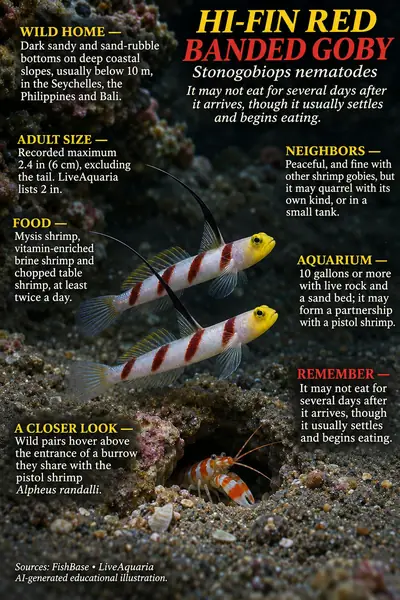
Hi-fin red banded goby
Stonogobiops nematodes
It may not eat for several days after it arrives, though it usually settles and begins eating.
Meet this fish →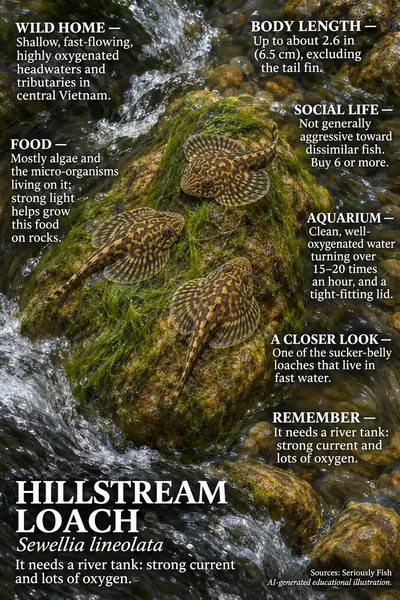
Hillstream loach
Sewellia lineolata
It needs a river tank: strong current and lots of oxygen.
Meet this fish →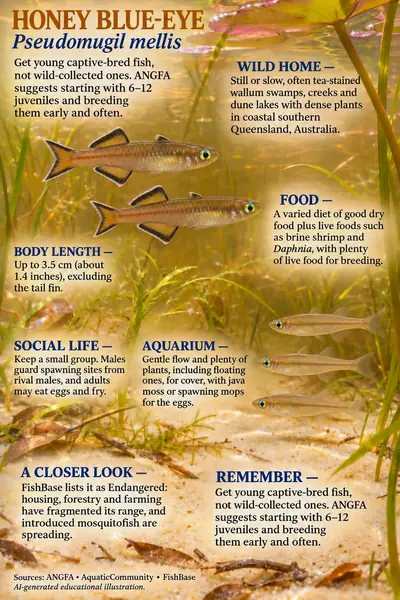
Honey blue-eye
Pseudomugil mellis
Get young captive-bred fish, not wild-collected ones. ANGFA suggests starting with 6–12 juveniles and breeding them early and often.
Meet this fish →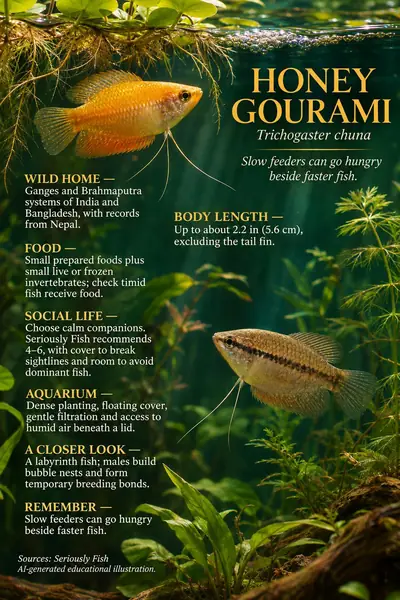
Honey gourami
Trichogaster chuna
Slow feeders can go hungry beside faster fish.
Meet this fish →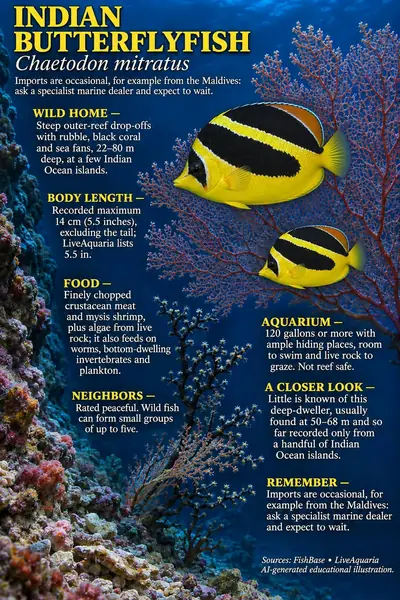
Indian butterflyfish
Chaetodon mitratus
Imports are occasional, for example from the Maldives: ask a specialist marine dealer and expect to wait.
Meet this fish →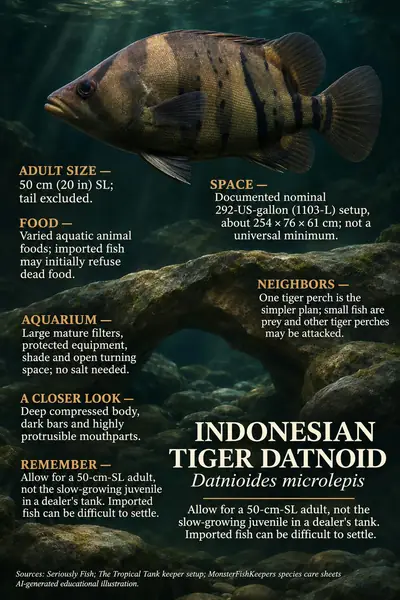
Indonesian tiger datnoid
Datnioides microlepis
Allow for a 50-cm-SL adult, not the slow-growing juvenile in a dealer's tank. Imported fish can be difficult to settle.
Meet this fish →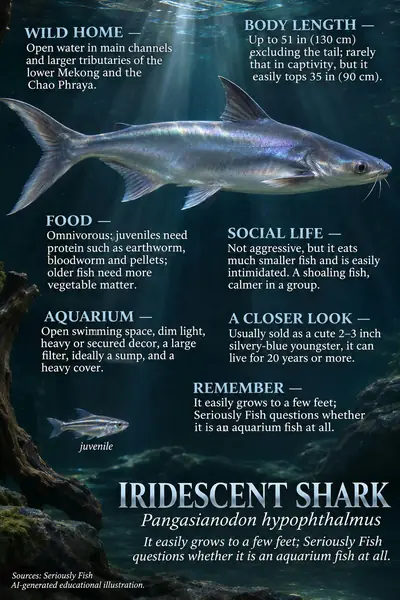
Iridescent shark
Pangasianodon hypophthalmus
It easily grows to a few feet; Seriously Fish questions whether it is an aquarium fish at all.
Meet this fish →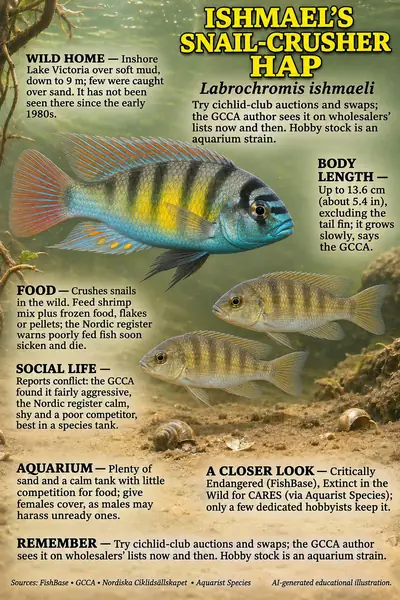
Ishmael’s snail-crusher hap
Labrochromis ishmaeli
Try cichlid-club auctions and swaps; the GCCA author sees it on wholesalers’ lists now and then. Hobby stock is an aquarium strain.
Meet this fish →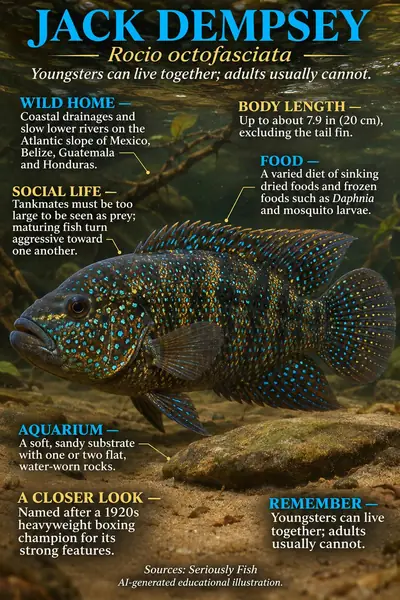
Jack Dempsey
Rocio octofasciata
Youngsters can live together; adults usually cannot.
Meet this fish →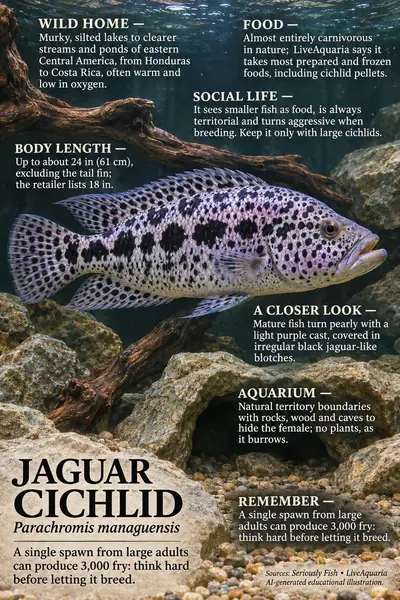
Jaguar cichlid
Parachromis managuensis
A single spawn from large adults can produce 3,000 fry: think hard before letting it breed.
Meet this fish →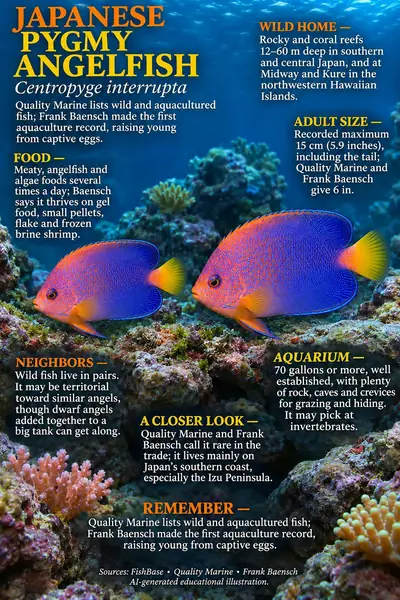
Japanese pygmy angelfish
Centropyge interrupta
Quality Marine lists wild and aquacultured fish; Frank Baensch made the first aquaculture record, raising young from captive eggs.
Meet this fish →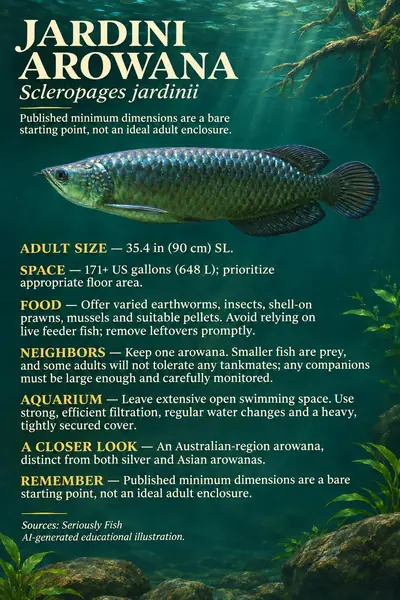
Jardini arowana
Scleropages jardinii
Published minimum dimensions are a bare starting point, not an ideal adult enclosure.
Meet this fish →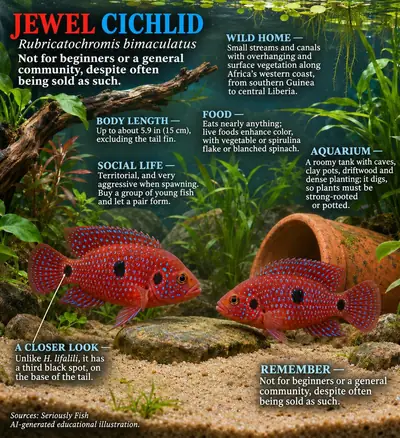
Jewel cichlid
Rubricatochromis bimaculatus
Not for beginners or a general community, despite often being sold as such.
Meet this fish →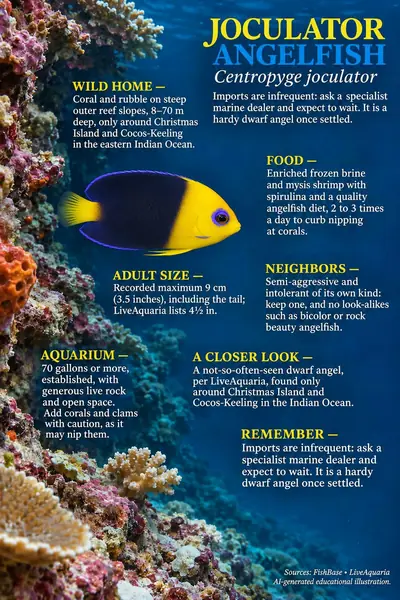
Joculator angelfish
Centropyge joculator
Imports are infrequent: ask a specialist marine dealer and expect to wait. It is a hardy dwarf angel once settled.
Meet this fish →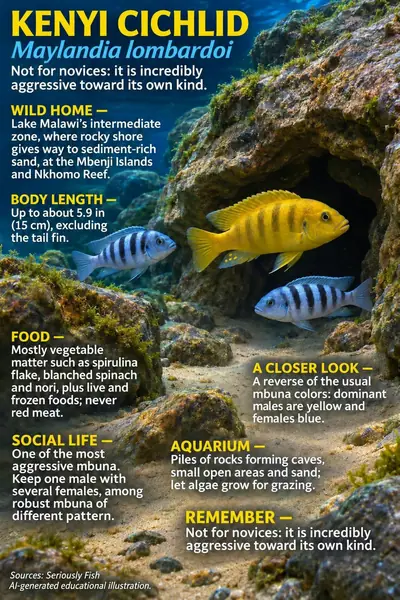
Kenyi cichlid
Maylandia lombardoi
Not for novices: it is incredibly aggressive toward its own kind.
Meet this fish →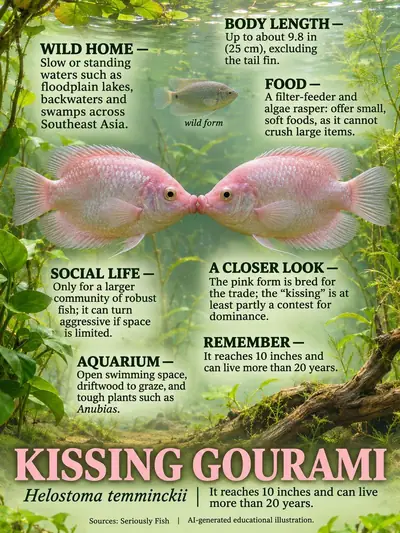
Kissing gourami
Helostoma temminckii
It reaches 10 inches and can live more than 20 years.
Meet this fish →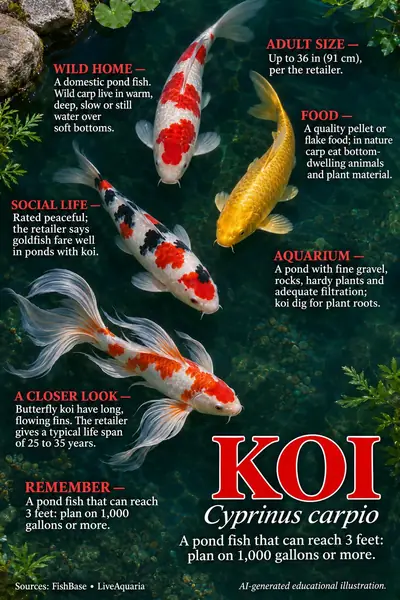
Koi
Cyprinus carpio
A pond fish that can reach 3 feet: plan on 1,000 gallons or more.
Meet this fish →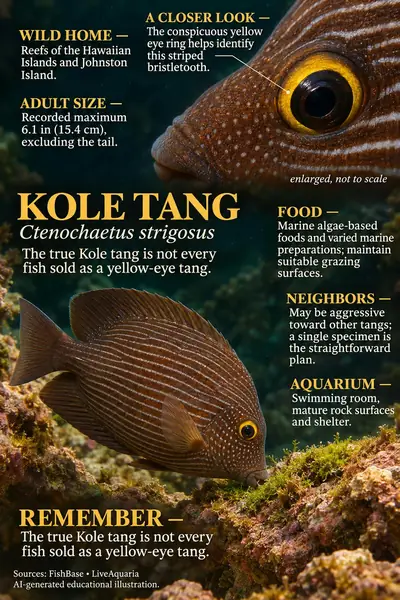
Kole tang
Ctenochaetus strigosus
The true Kole tang is not every fish sold as a yellow-eye tang.
Meet this fish →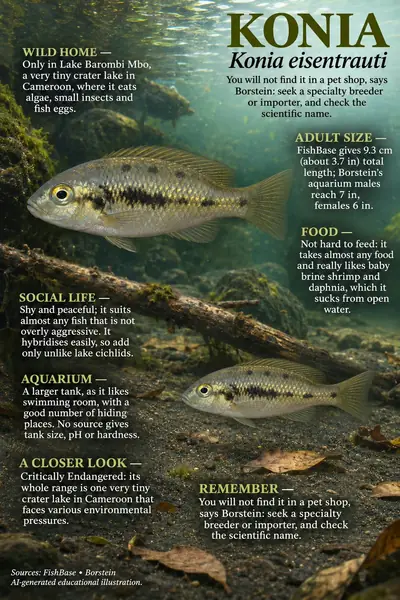
Konia
Konia eisentrauti
You will not find it in a pet shop, says Borstein: seek a specialty breeder or importer, and check the scientific name.
Meet this fish →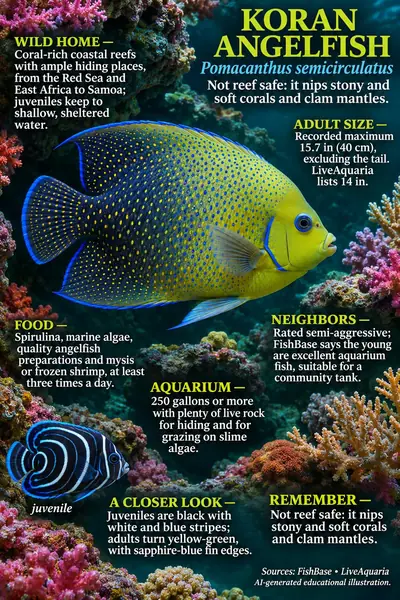
Koran angelfish
Pomacanthus semicirculatus
Not reef safe: it nips stony and soft corals and clam mantles.
Meet this fish →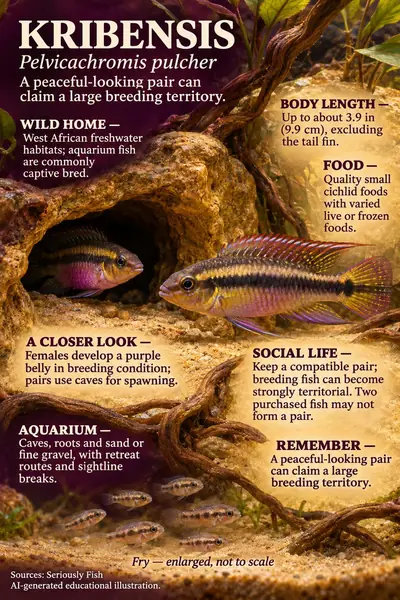
Kribensis
Pelvicachromis pulcher
A peaceful-looking pair can claim a large breeding territory.
Meet this fish →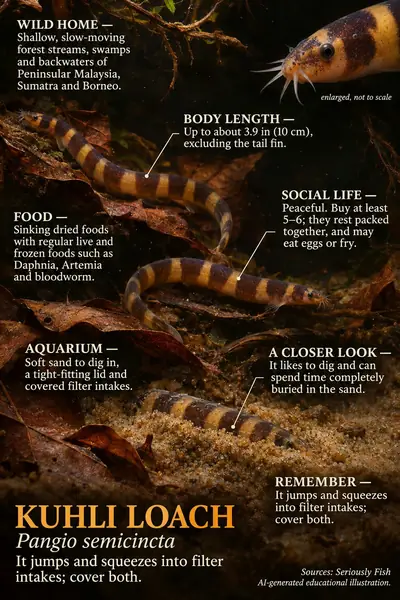
Kuhli loach
Pangio semicincta
It jumps and squeezes into filter intakes; cover both.
Meet this fish →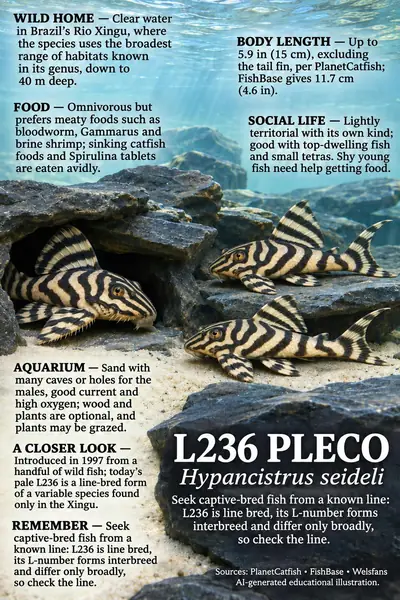
L236 pleco
Hypancistrus seideli
Seek captive-bred fish from a known line: L236 is line bred, its L-number forms interbreed and differ only broadly, so check the line.
Meet this fish →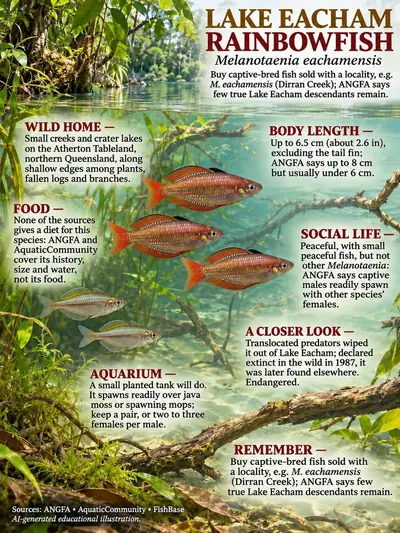
Lake Eacham rainbowfish
Melanotaenia eachamensis
Buy captive-bred fish sold with a locality, e.g. M. eachamensis (Dirran Creek); ANGFA says few true Lake Eacham descendants remain.
Meet this fish →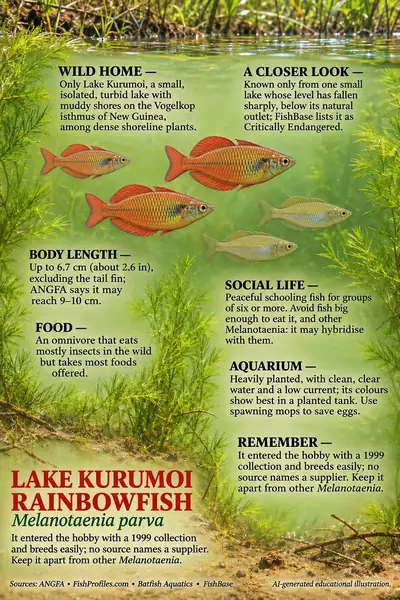
Lake Kurumoi rainbowfish
Melanotaenia parva
It entered the hobby with a 1999 collection and breeds easily; no source names a supplier. Keep it apart from other Melanotaenia.
Meet this fish →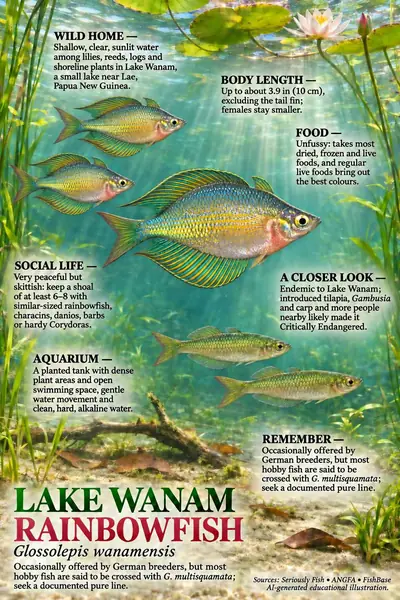
Lake Wanam rainbowfish
Glossolepis wanamensis
Occasionally offered by German breeders, but most hobby fish are said to be crossed with G. multisquamata; seek a documented pure line.
Meet this fish →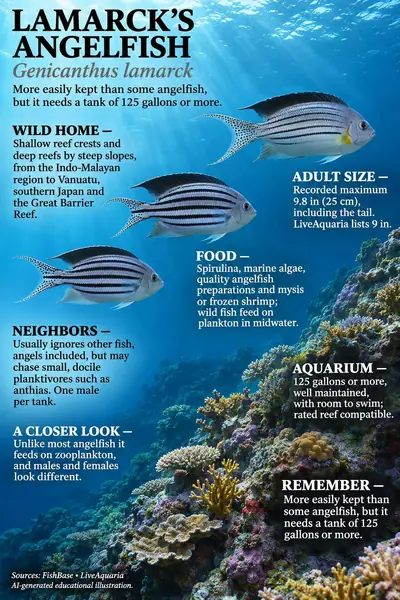
Lamarck’s angelfish
Genicanthus lamarck
More easily kept than some angelfish, but it needs a tank of 125 gallons or more.
Meet this fish →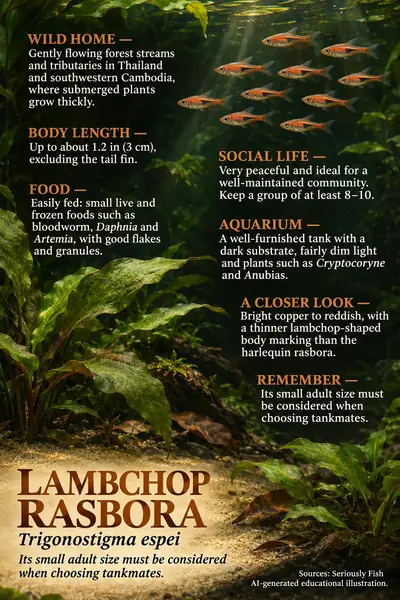
Lambchop rasbora
Trigonostigma espei
Its small adult size must be considered when choosing tankmates.
Meet this fish →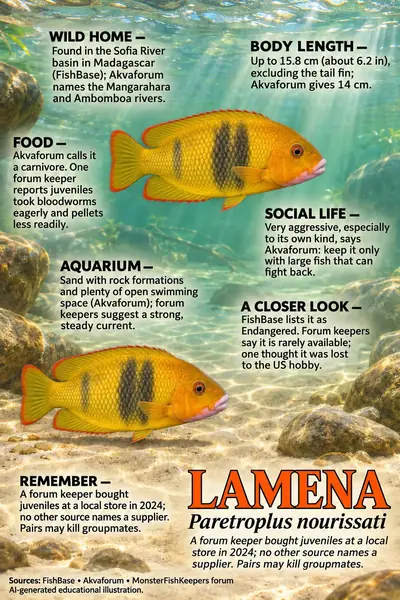
Lamena
Paretroplus nourissati
A forum keeper bought juveniles at a local store in 2024; no other source names a supplier. Pairs may kill groupmates.
Meet this fish →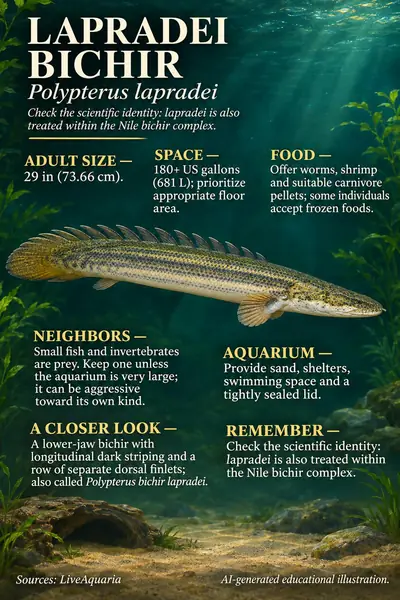
Lapradei bichir
Polypterus lapradei
Check the scientific identity: lapradei is also treated within the Nile bichir complex.
Meet this fish →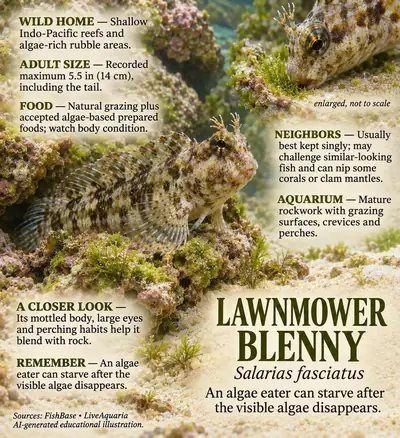
Lawnmower blenny
Salarias fasciatus
An algae eater can starve after the visible algae disappears.
Meet this fish →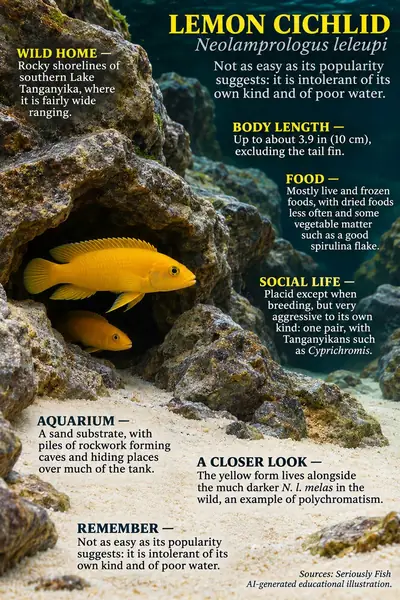
Lemon cichlid
Neolamprologus leleupi
Not as easy as its popularity suggests: it is intolerant of its own kind and of poor water.
Meet this fish →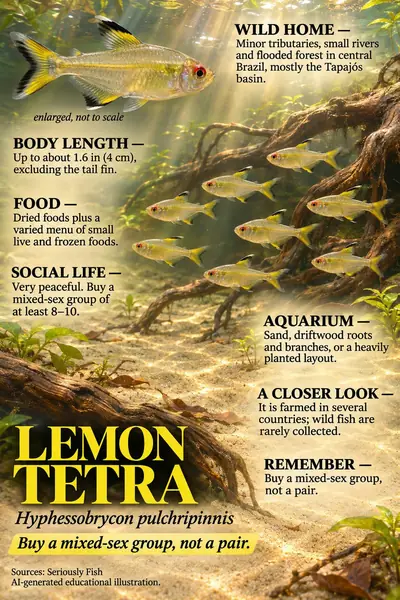
Lemon tetra
Hyphessobrycon pulchripinnis
Buy a mixed-sex group, not a pair.
Meet this fish →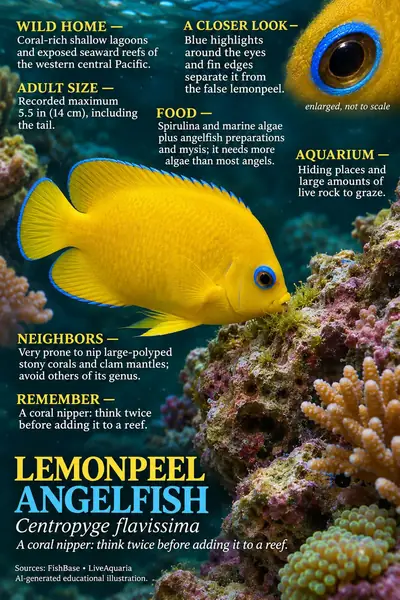
Lemonpeel angelfish
Centropyge flavissima
A coral nipper: think twice before adding it to a reef.
Meet this fish →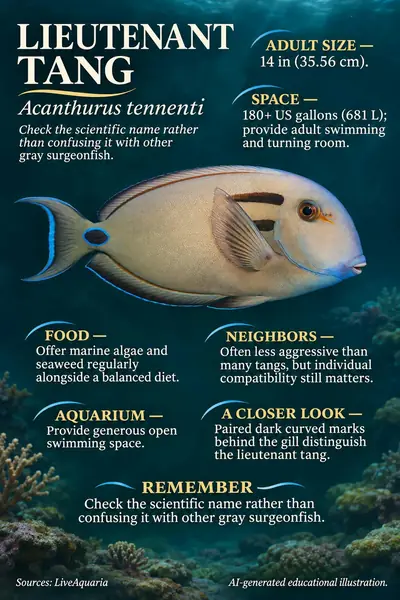
Lieutenant tang
Acanthurus tennenti
Check the scientific name rather than confusing it with other gray surgeonfish.
Meet this fish →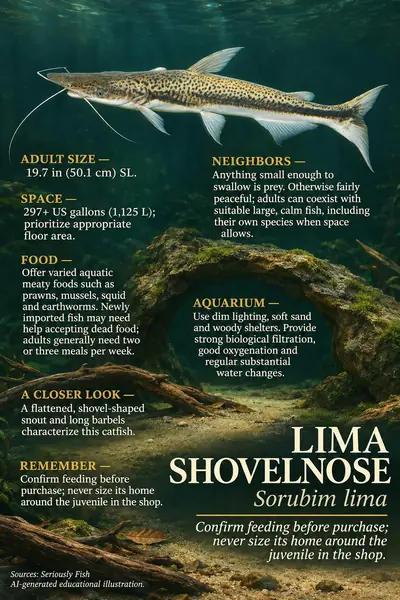
Lima shovelnose
Sorubim lima
Confirm feeding before purchase; never size its home around the juvenile in the shop.
Meet this fish →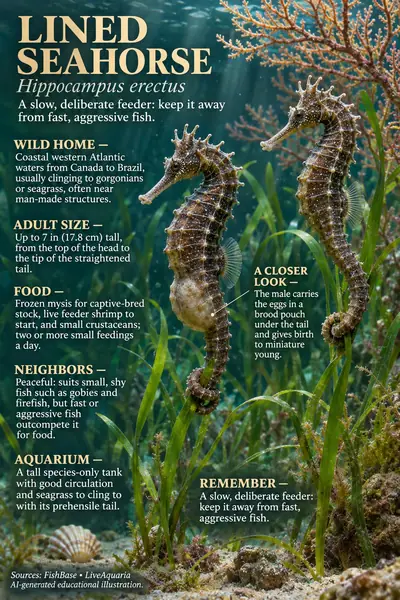
Lined seahorse
Hippocampus erectus
A slow, deliberate feeder: keep it away from fast, aggressive fish.
Meet this fish →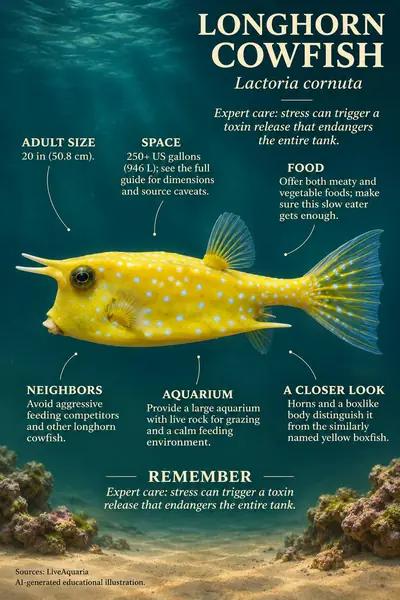
Longhorn cowfish
Lactoria cornuta
Expert care: stress can trigger a toxin release that endangers the entire tank.
Meet this fish →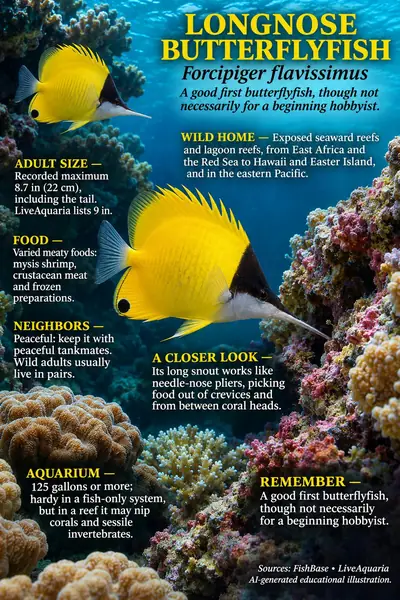
Longnose butterflyfish
Forcipiger flavissimus
A good first butterflyfish, though not necessarily for a beginning hobbyist.
Meet this fish →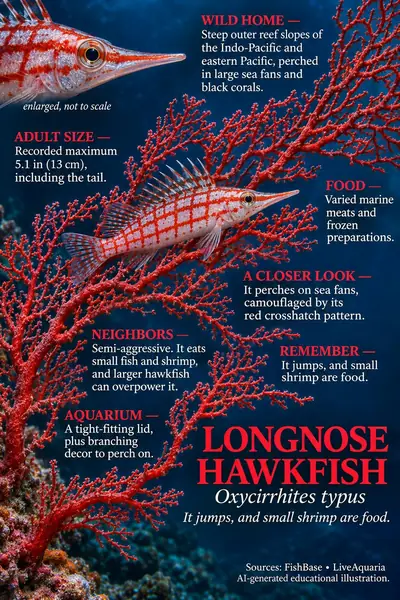
Longnose hawkfish
Oxycirrhites typus
It jumps, and small shrimp are food.
Meet this fish →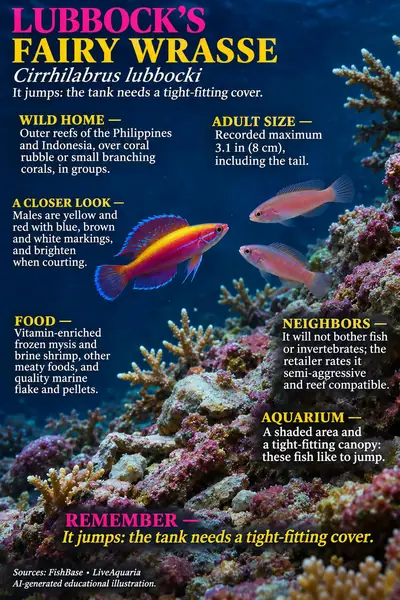
Lubbock’s fairy wrasse
Cirrhilabrus lubbocki
It jumps: the tank needs a tight-fitting cover.
Meet this fish →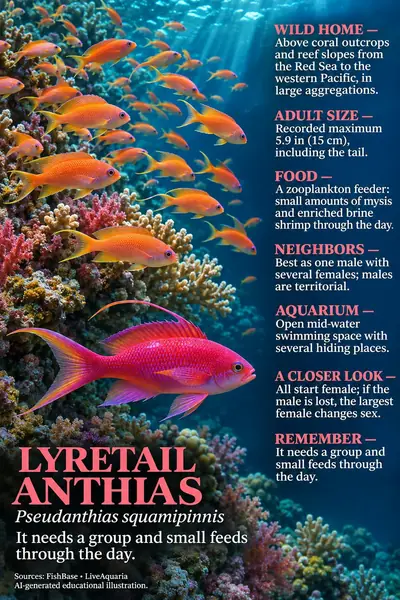
Lyretail anthias
Pseudanthias squamipinnis
It needs a group and small feeds through the day.
Meet this fish →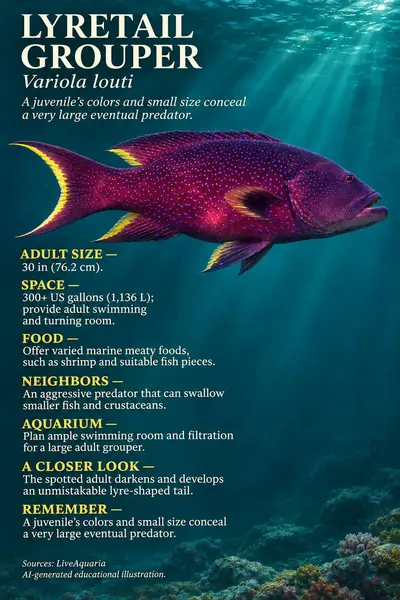
Lyretail grouper
Variola louti
A juvenile's colors and small size conceal a very large eventual predator.
Meet this fish →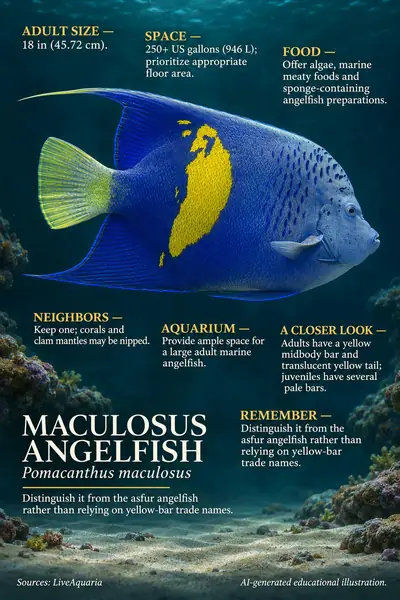
Maculosus angelfish
Pomacanthus maculosus
Distinguish it from the asfur angelfish rather than relying on yellow-bar trade names.
Meet this fish →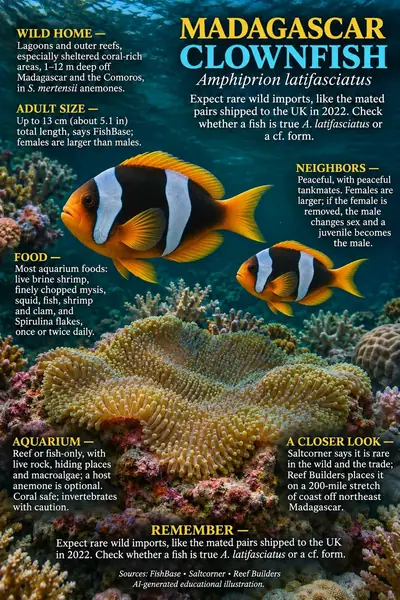
Madagascar clownfish
Amphiprion latifasciatus
Expect rare wild imports, like the mated pairs shipped to the UK in 2022. Check whether a fish is true A. latifasciatus or a cf. form.
Meet this fish →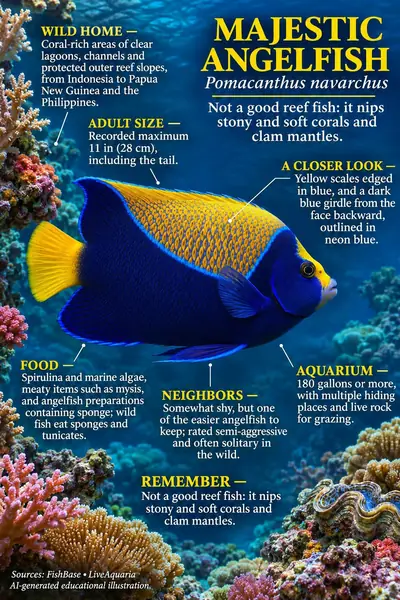
Majestic angelfish
Pomacanthus navarchus
Not a good reef fish: it nips stony and soft corals and clam mantles.
Meet this fish →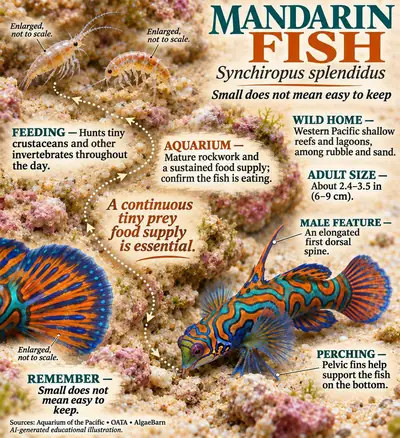
Mandarinfish
Synchiropus splendidus
Small does not mean easy to keep
Meet this fish →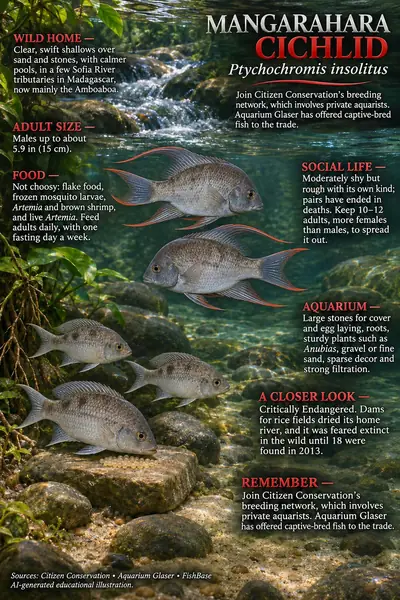
Mangarahara cichlid
Ptychochromis insolitus
Join Citizen Conservation’s breeding network, which involves private aquarists. Aquarium Glaser has offered captive-bred fish to the trade.
Meet this fish →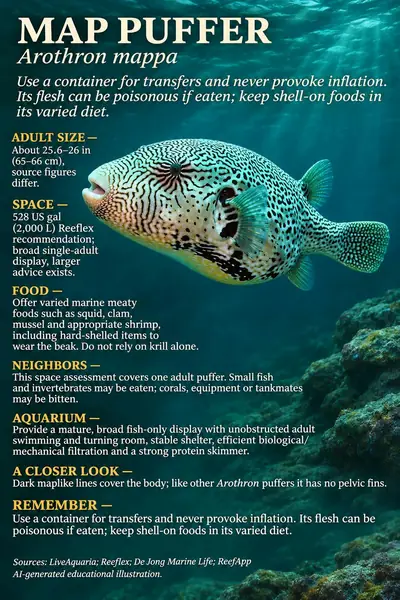
Map puffer
Arothron mappa
Use a container for transfers and never provoke inflation. Its flesh can be poisonous if eaten; keep shell-on foods in its varied diet.
Meet this fish →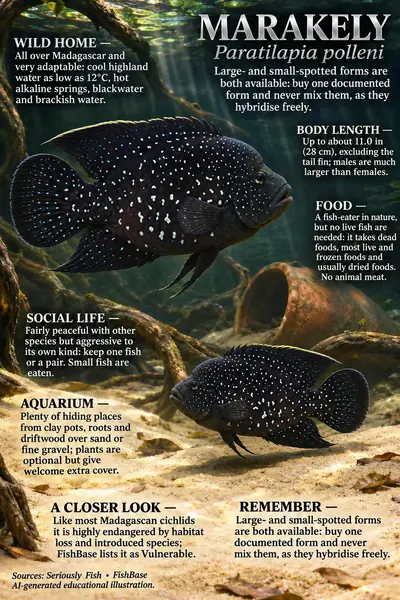
Marakely
Paratilapia polleni
Large- and small-spotted forms are both available: buy one documented form and never mix them, as they hybridise freely.
Meet this fish →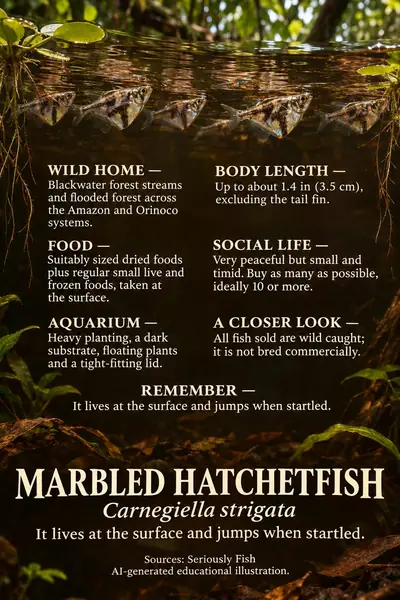
Marbled hatchetfish
Carnegiella strigata
It lives at the surface and jumps when startled.
Meet this fish →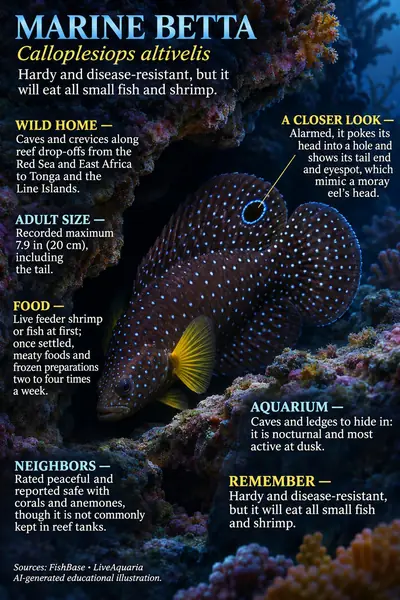
Marine betta
Calloplesiops altivelis
Hardy and disease-resistant, but it will eat all small fish and shrimp.
Meet this fish →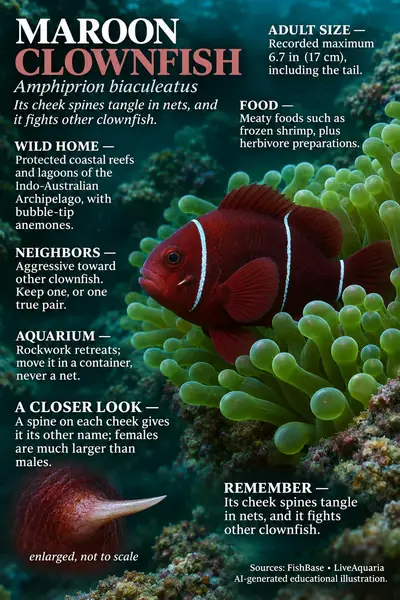
Maroon clownfish
Amphiprion biaculeatus
Its cheek spines tangle in nets, and it fights other clownfish.
Meet this fish →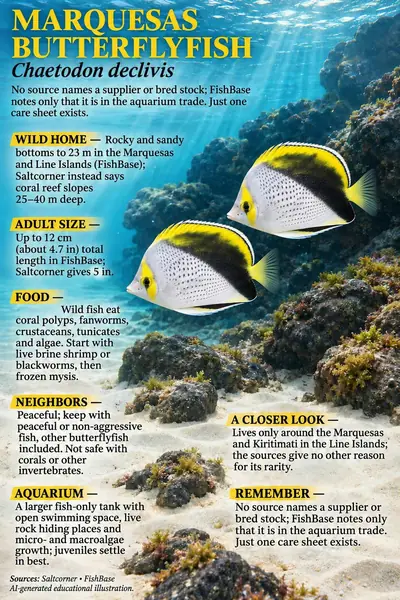
Marquesas butterflyfish
Chaetodon declivis
No source names a supplier or bred stock; FishBase notes only that it is in the aquarium trade. Just one care sheet exists.
Meet this fish →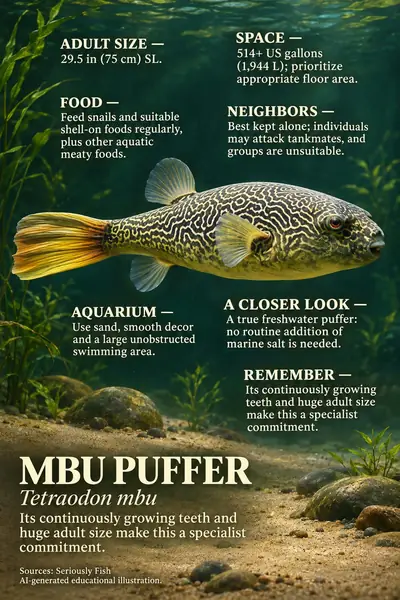
Mbu puffer
Tetraodon mbu
Its continuously growing teeth and huge adult size make this a specialist commitment.
Meet this fish →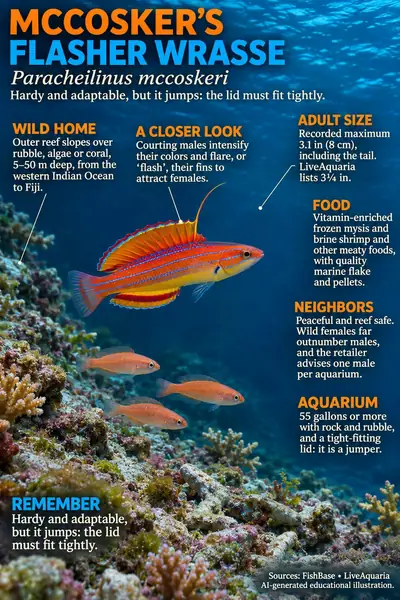
McCosker’s flasher wrasse
Paracheilinus mccoskeri
Hardy and adaptable, but it jumps: the lid must fit tightly.
Meet this fish →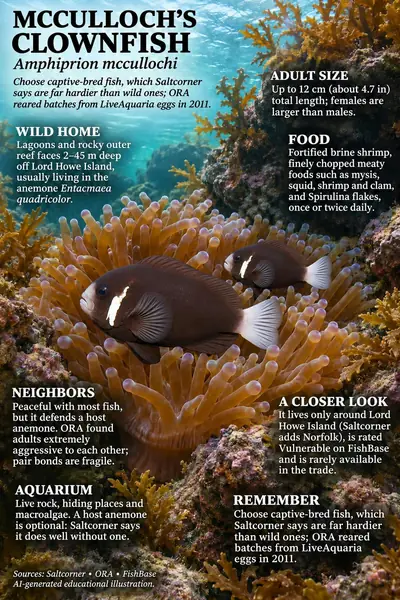
McCulloch’s clownfish
Amphiprion mccullochi
Choose captive-bred fish, which Saltcorner says are far hardier than wild ones; ORA reared batches from LiveAquaria eggs in 2011.
Meet this fish →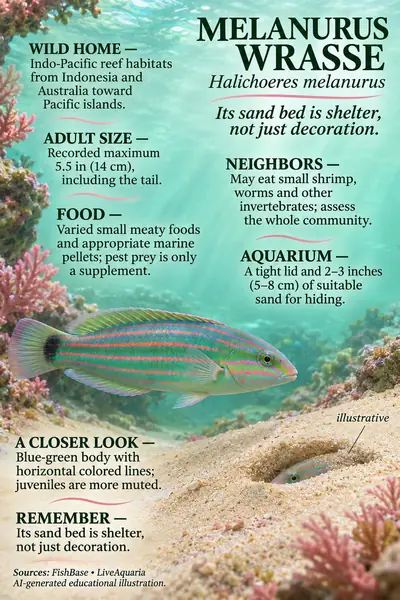
Melanurus wrasse
Halichoeres melanurus
Its sand bed is shelter, not just decoration.
Meet this fish →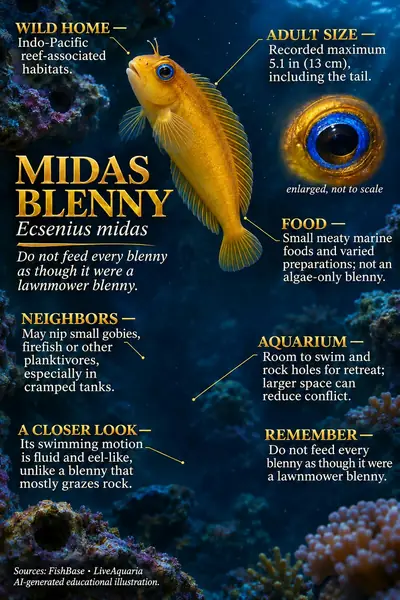
Midas blenny
Ecsenius midas
Do not feed every blenny as though it were a lawnmower blenny.
Meet this fish →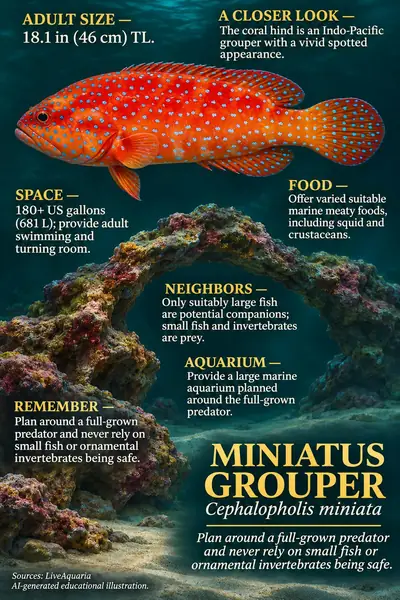
Miniatus grouper
Cephalopholis miniata
Plan around a full-grown predator and never rely on small fish or ornamental invertebrates being safe.
Meet this fish →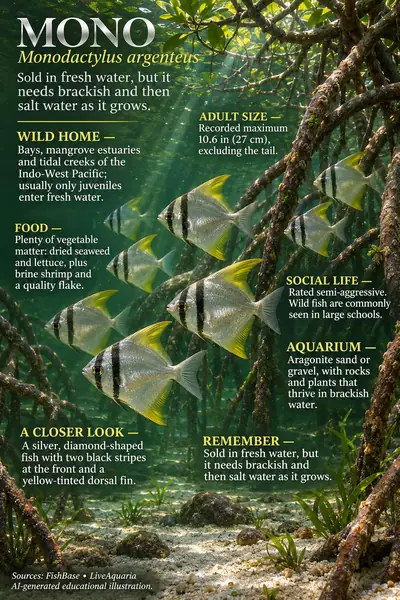
Mono
Monodactylus argenteus
Sold in fresh water, but it needs brackish and then salt water as it grows.
Meet this fish →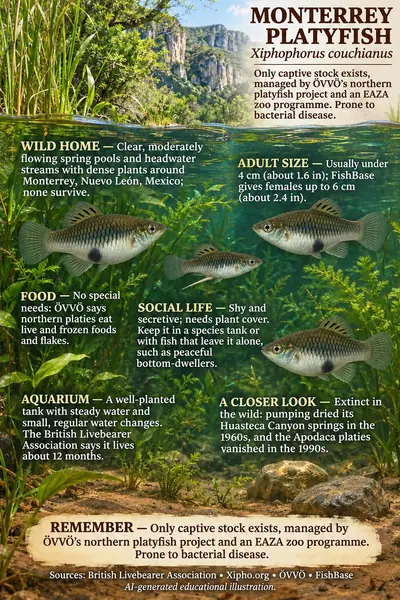
Monterrey platyfish
Xiphophorus couchianus
Only captive stock exists, managed by ÖVVÖ’s northern platyfish project and an EAZA zoo programme. Prone to bacterial disease.
Meet this fish →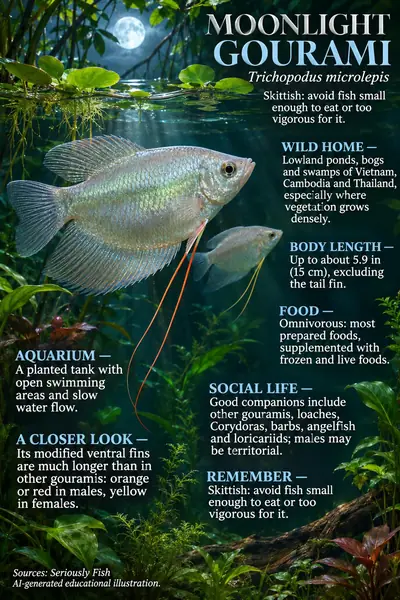
Moonlight gourami
Trichopodus microlepis
Skittish: avoid fish small enough to eat or too vigorous for it.
Meet this fish →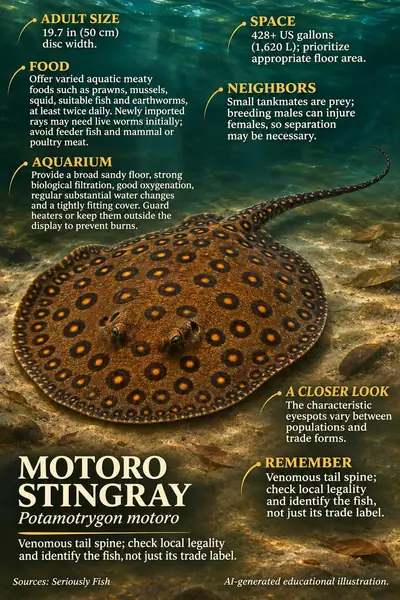
Motoro stingray
Potamotrygon motoro
Venomous tail spine; check local legality and identify the fish, not just its trade label.
Meet this fish →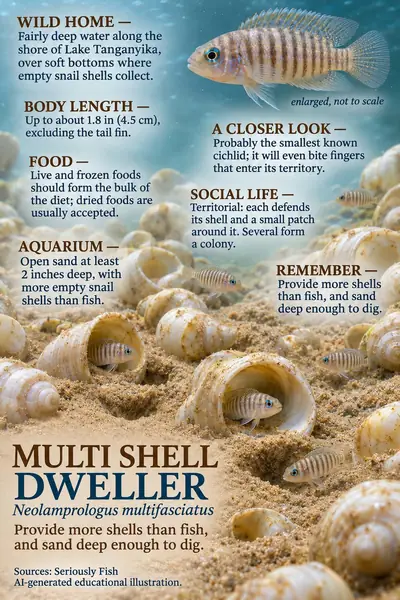
Multi shell dweller
Neolamprologus multifasciatus
Provide more shells than fish, and sand deep enough to dig.
Meet this fish →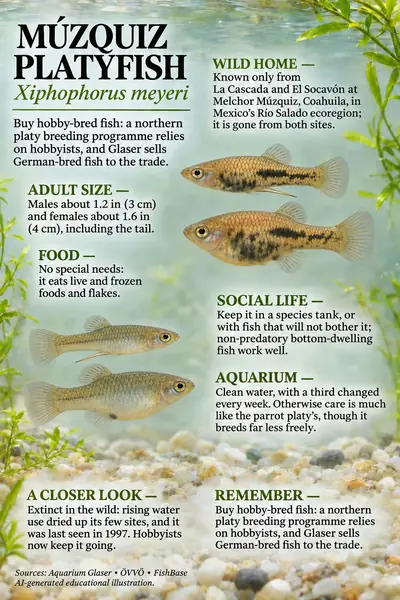
Múzquiz platyfish
Xiphophorus meyeri
Buy hobby-bred fish: a northern platy breeding programme relies on hobbyists, and Glaser sells German-bred fish to the trade.
Meet this fish →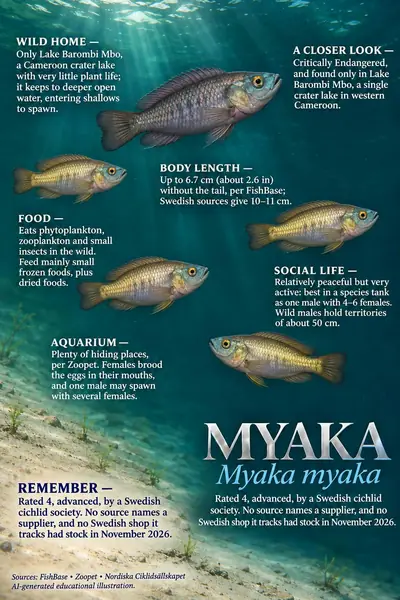
Myaka
Myaka myaka
Rated 4, advanced, by a Swedish cichlid society. No source names a supplier, and no Swedish shop it tracks had stock in November 2026.
Meet this fish →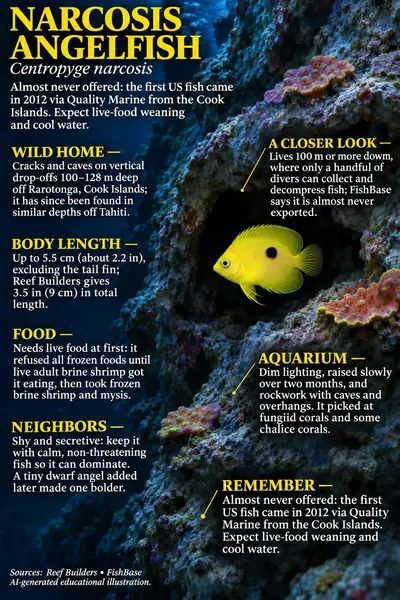
Narcosis angelfish
Centropyge narcosis
Almost never offered: the first US fish came in 2012 via Quality Marine from the Cook Islands. Expect live-food weaning and cool water.
Meet this fish →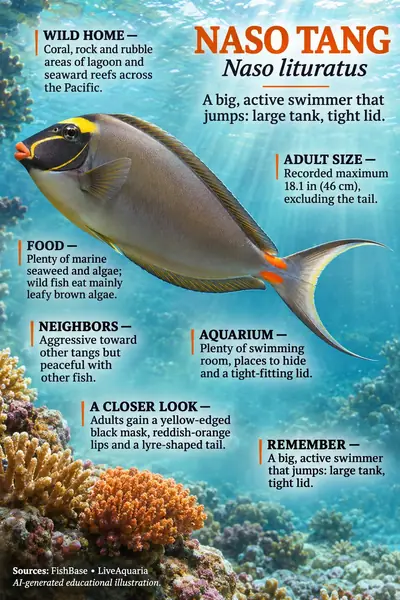
Naso tang
Naso lituratus
A big, active swimmer that jumps: large tank, tight lid.
Meet this fish →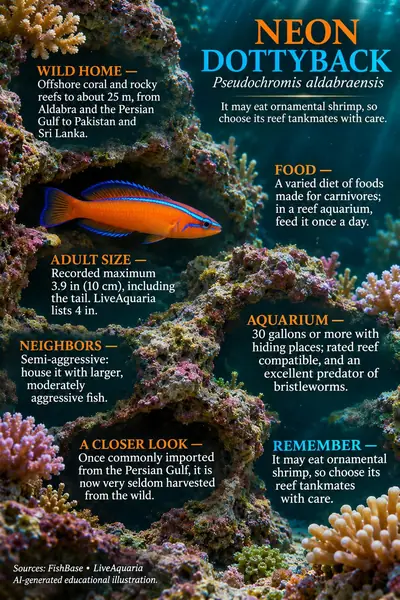
Neon dottyback
Pseudochromis aldabraensis
It may eat ornamental shrimp, so choose its reef tankmates with care.
Meet this fish →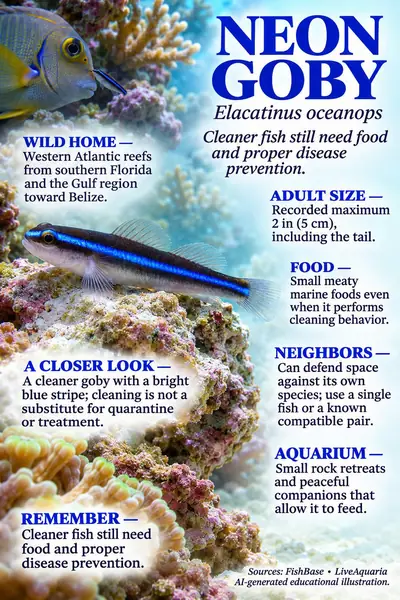
Neon goby
Elacatinus oceanops
Cleaner fish still need food and proper disease prevention.
Meet this fish →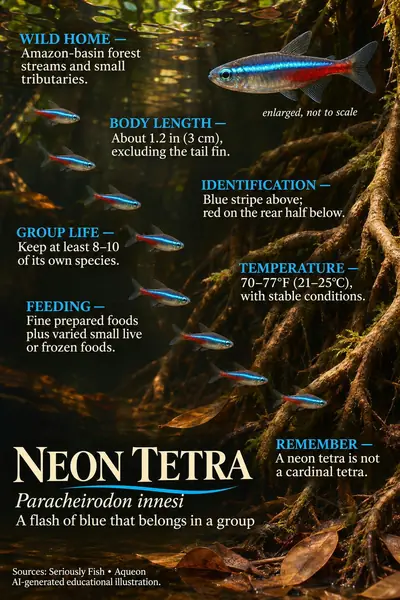
Neon tetra
Paracheirodon innesi
A flash of blue that belongs in a group
Meet this fish →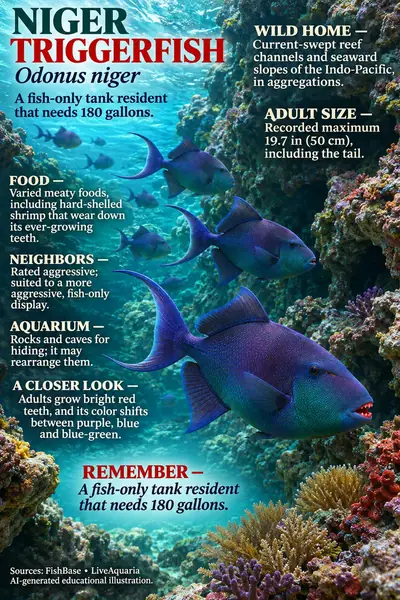
Niger triggerfish
Odonus niger
A fish-only tank resident that needs 180 gallons.
Meet this fish →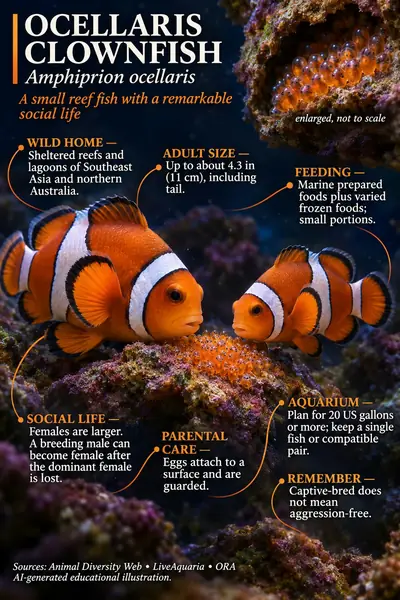
Ocellaris clownfish
Amphiprion ocellaris
A small reef fish with a remarkable social life
Meet this fish →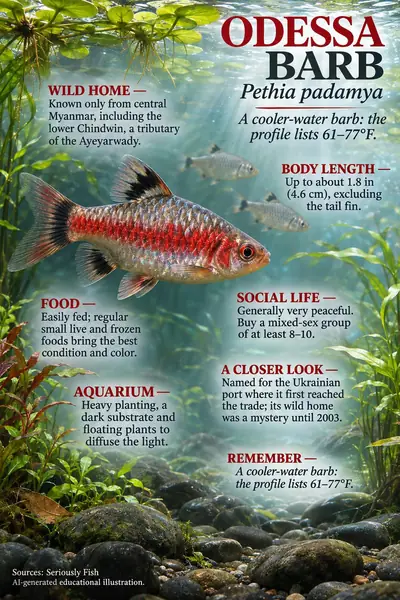
Odessa barb
Pethia padamya
A cooler-water barb: the profile lists 61–77°F.
Meet this fish →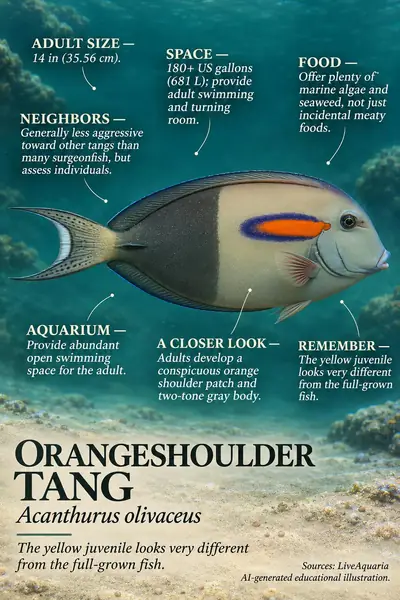
Orangeshoulder tang
Acanthurus olivaceus
The yellow juvenile looks very different from the full-grown fish.
Meet this fish →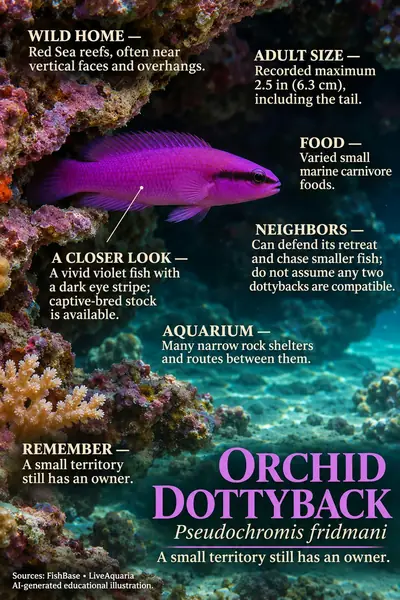
Orchid dottyback
Pseudochromis fridmani
A small territory still has an owner.
Meet this fish →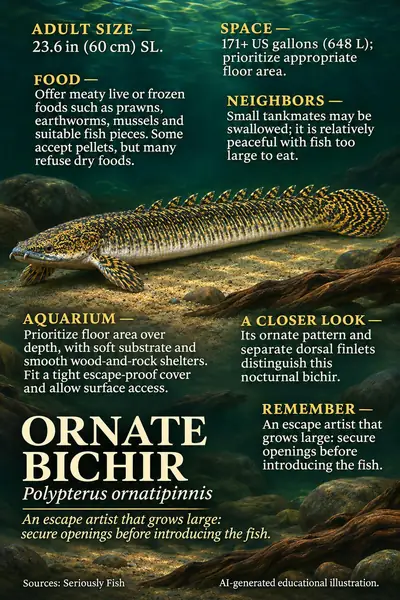
Ornate bichir
Polypterus ornatipinnis
An escape artist that grows large: secure openings before introducing the fish.
Meet this fish →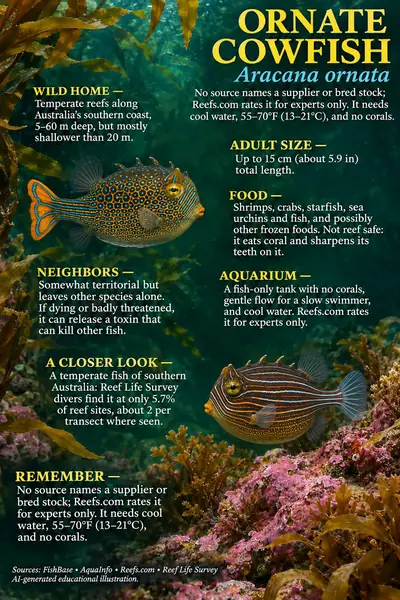
Ornate cowfish
Aracana ornata
No source names a supplier or bred stock; Reefs.com rates it for experts only. It needs cool water, 55–70°F (13–21°C), and no corals.
Meet this fish →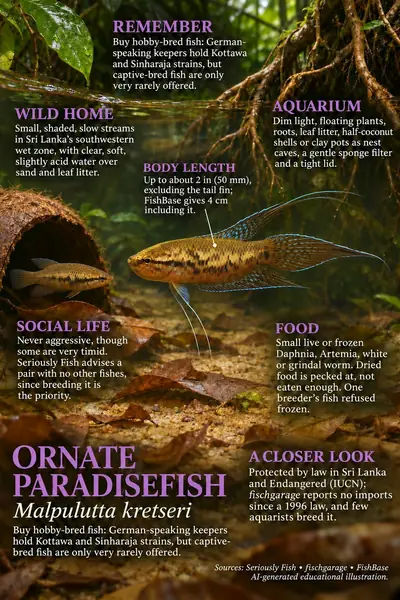
Ornate paradisefish
Malpulutta kretseri
Buy hobby-bred fish: German-speaking keepers hold Kottawa and Sinharaja strains, but captive-bred fish are only very rarely offered.
Meet this fish →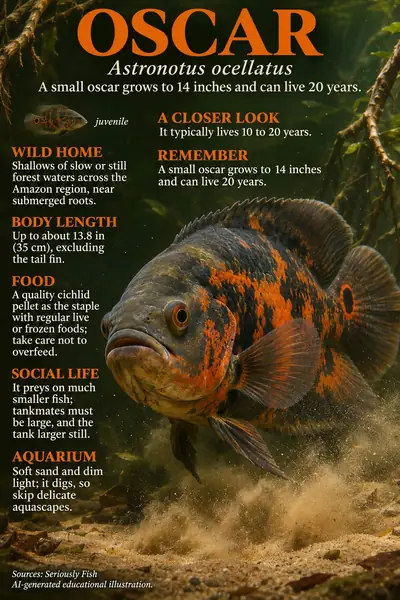
Oscar
Astronotus ocellatus
A small oscar grows to 14 inches and can live 20 years.
Meet this fish →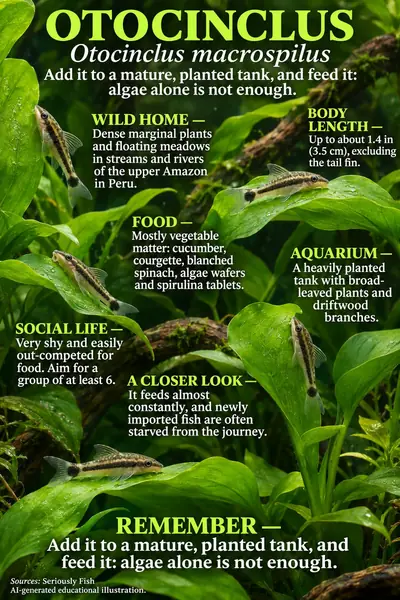
Otocinclus
Otocinclus macrospilus
Add it to a mature, planted tank, and feed it: algae alone is not enough.
Meet this fish →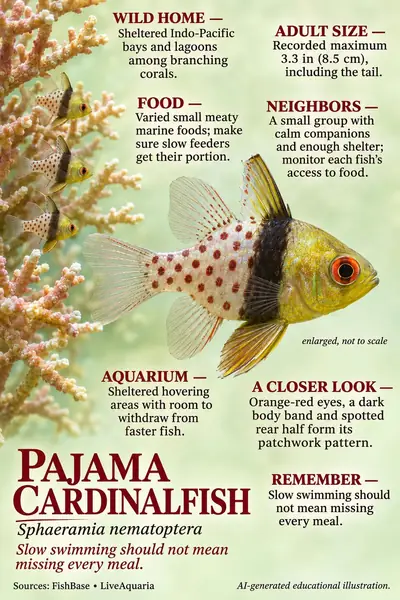
Pajama cardinalfish
Sphaeramia nematoptera
Slow swimming should not mean missing every meal.
Meet this fish →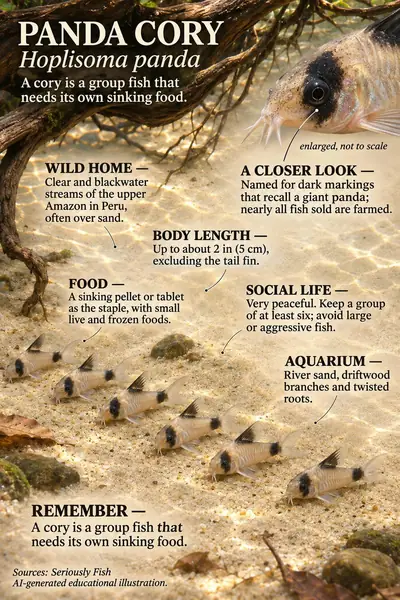
Panda cory
Hoplisoma panda
A cory is a group fish that needs its own sinking food.
Meet this fish →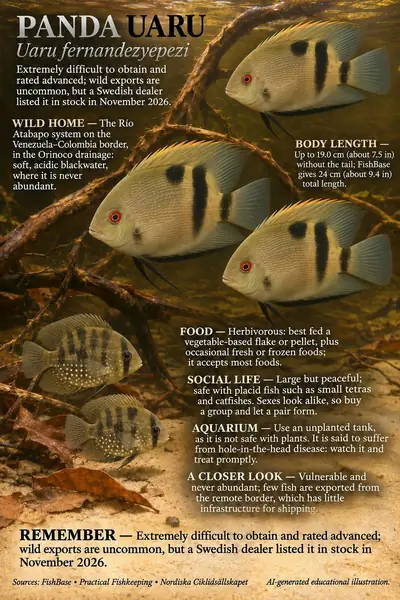
Panda uaru
Uaru fernandezyepezi
Extremely difficult to obtain and rated advanced; wild exports are uncommon, but a Swedish dealer listed it in stock in November 2026.
Meet this fish →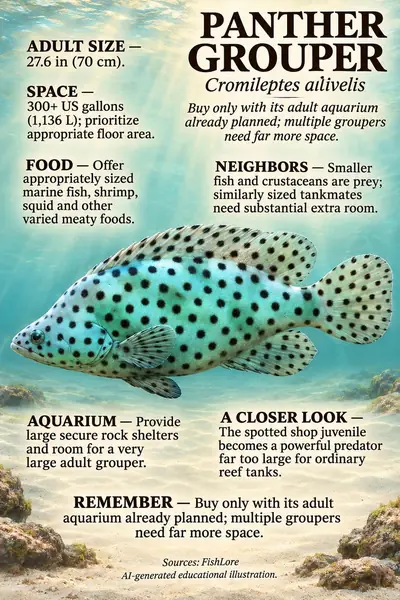
Panther grouper
Cromileptes altivelis
Buy only with its adult aquarium already planned; multiple groupers need far more space.
Meet this fish →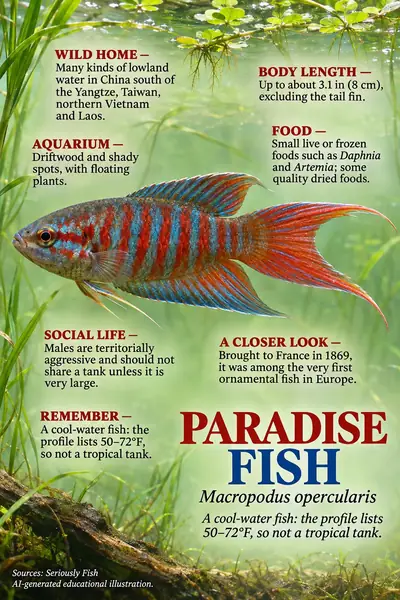
Paradise fish
Macropodus opercularis
A cool-water fish: the profile lists 50–72°F, so not a tropical tank.
Meet this fish →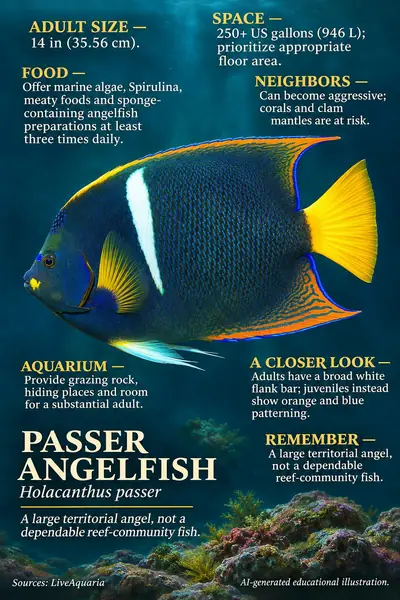
Passer angelfish
Holacanthus passer
A large territorial angel, not a dependable reef-community fish.
Meet this fish →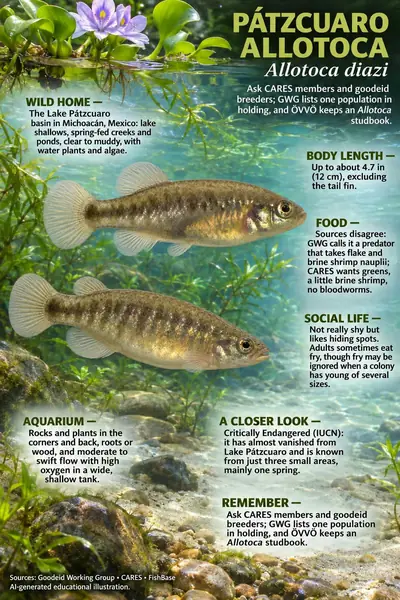
Pátzcuaro allotoca
Allotoca diazi
Ask CARES members and goodeid breeders; GWG lists one population in holding, and ÖVVÖ keeps an Allotoca studbook.
Meet this fish →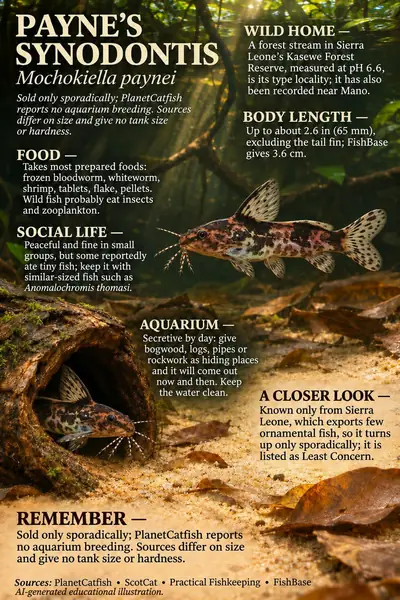
Payne’s synodontis
Mochokiella paynei
Sold only sporadically; PlanetCatfish reports no aquarium breeding. Sources differ on size and give no tank size or hardness.
Meet this fish →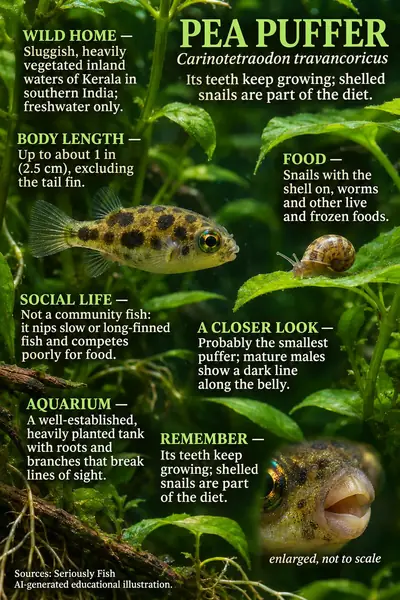
Pea puffer
Carinotetraodon travancoricus
Its teeth keep growing; shelled snails are part of the diet.
Meet this fish →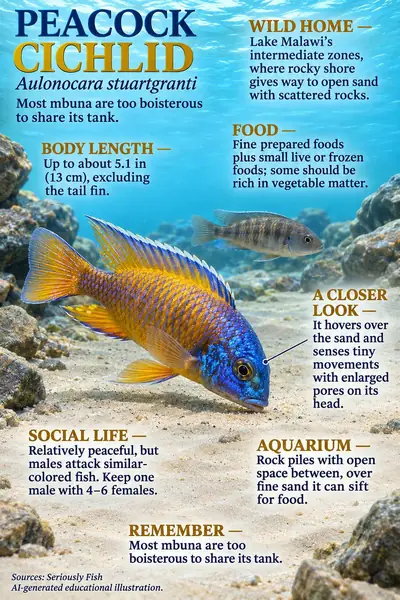
Peacock cichlid
Aulonocara stuartgranti
Most mbuna are too boisterous to share its tank.
Meet this fish →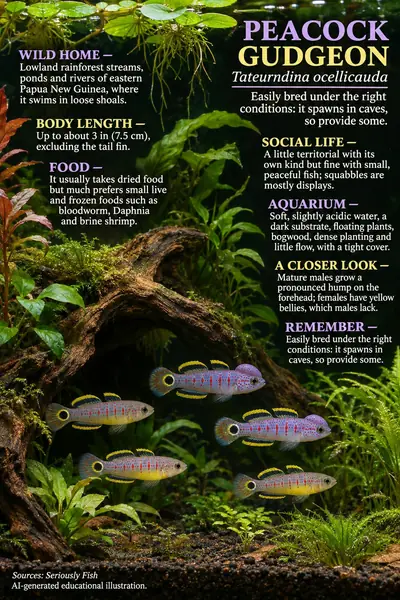
Peacock gudgeon
Tateurndina ocellicauda
Easily bred under the right conditions: it spawns in caves, so provide some.
Meet this fish →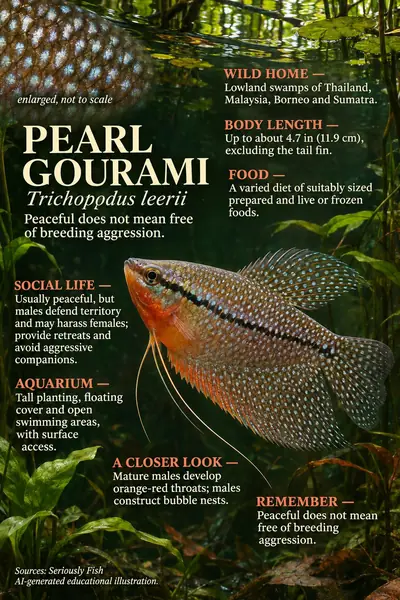
Pearl gourami
Trichopodus leerii
Peaceful does not mean free of breeding aggression.
Meet this fish →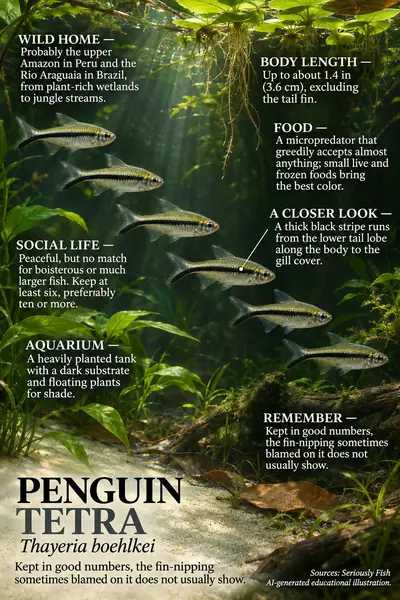
Penguin tetra
Thayeria boehlkei
Kept in good numbers, the fin-nipping sometimes blamed on it does not usually show.
Meet this fish →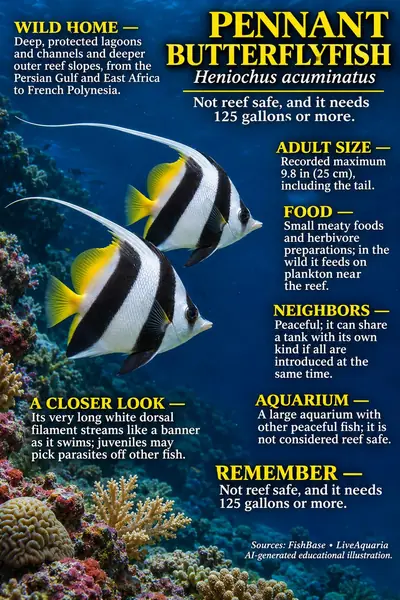
Pennant butterflyfish
Heniochus acuminatus
Not reef safe, and it needs 125 gallons or more.
Meet this fish →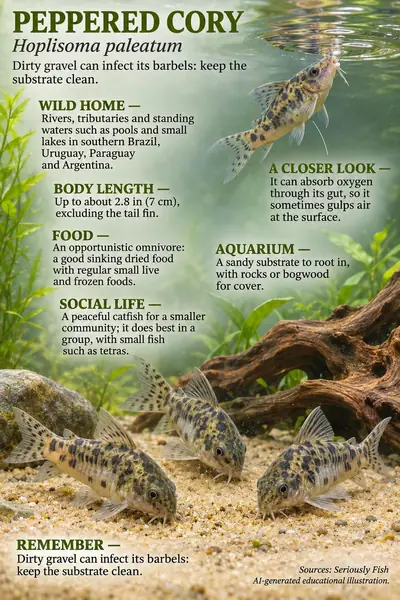
Peppered cory
Hoplisoma paleatum
Dirty gravel can infect its barbels: keep the substrate clean.
Meet this fish →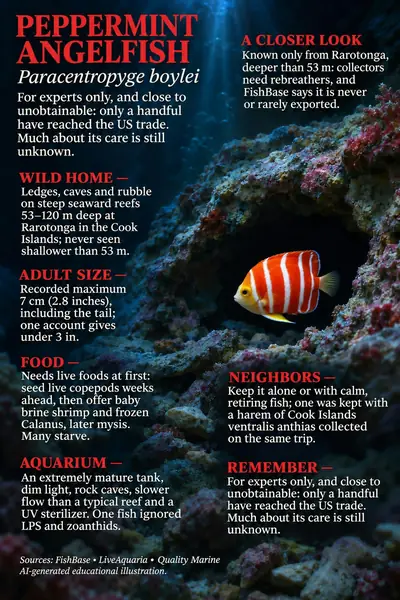
Peppermint angelfish
Paracentropyge boylei
For experts only, and close to unobtainable: only a handful have reached the US trade. Much about its care is still unknown.
Meet this fish →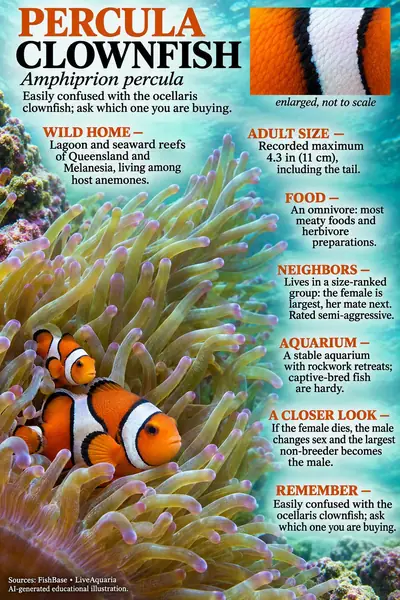
Percula clownfish
Amphiprion percula
Easily confused with the ocellaris clownfish; ask which one you are buying.
Meet this fish →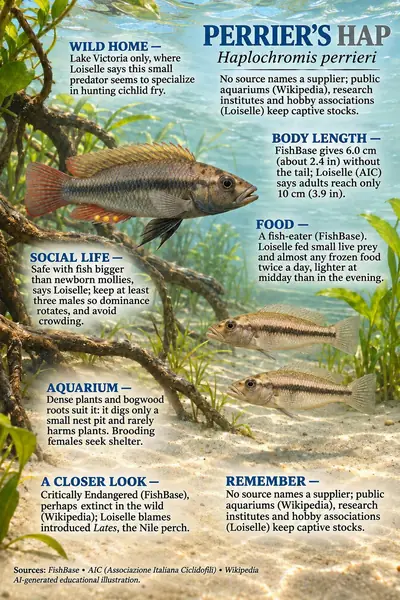
Perrier’s hap
Haplochromis perrieri
No source names a supplier; public aquariums (Wikipedia), research institutes and hobby associations (Loiselle) keep captive stocks.
Meet this fish →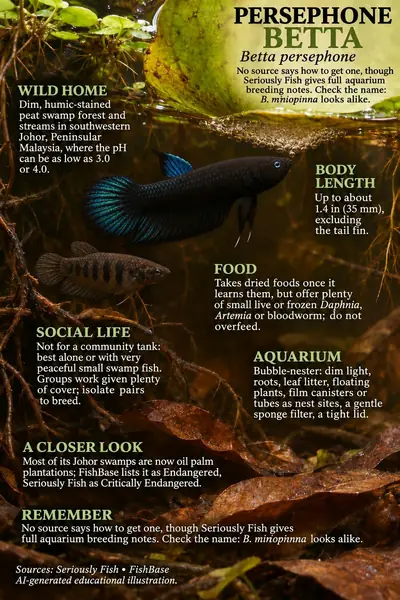
Persephone betta
Betta persephone
No source says how to get one, though Seriously Fish gives full aquarium breeding notes. Check the name: B. miniopinna looks alike.
Meet this fish →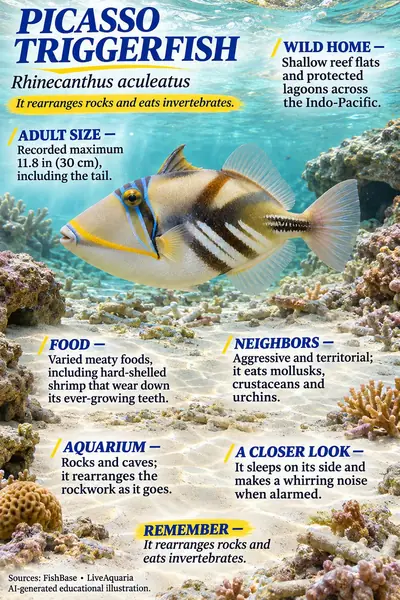
Picasso triggerfish
Rhinecanthus aculeatus
It rearranges rocks and eats invertebrates.
Meet this fish →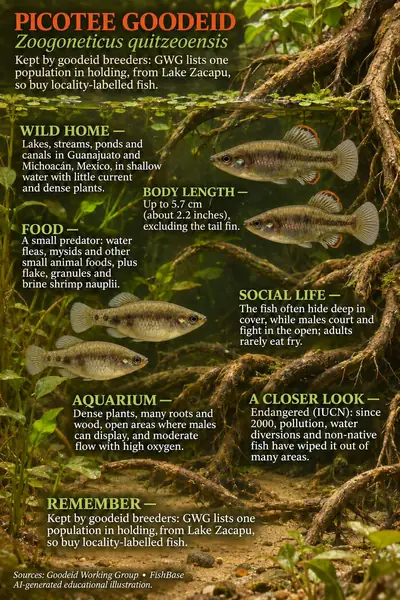
Picotee goodeid
Zoogoneticus quitzeoensis
Kept by goodeid breeders: GWG lists one population in holding, from Lake Zacapu, so buy locality-labelled fish.
Meet this fish →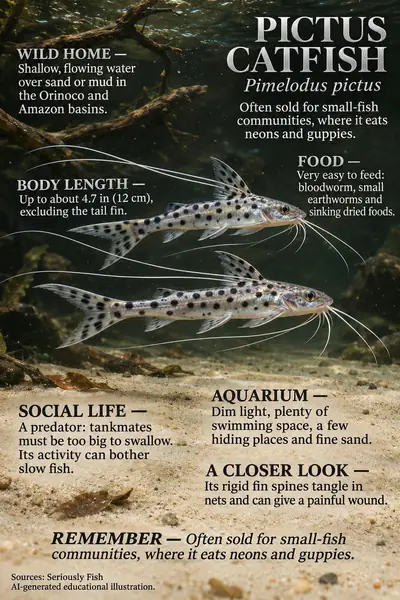
Pictus catfish
Pimelodus pictus
Often sold for small-fish communities, where it eats neons and guppies.
Meet this fish →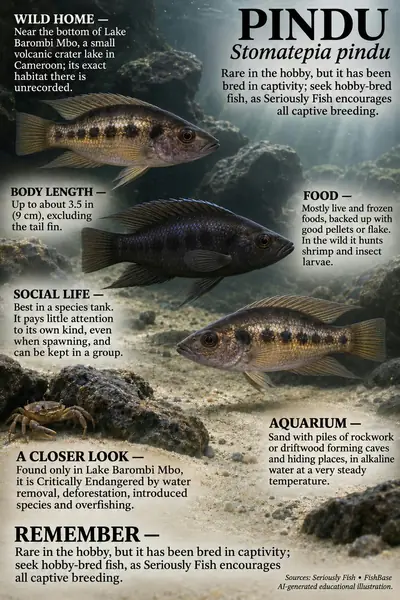
Pindu
Stomatepia pindu
Rare in the hobby, but it has been bred in captivity; seek hobby-bred fish, as Seriously Fish encourages all captive breeding.
Meet this fish →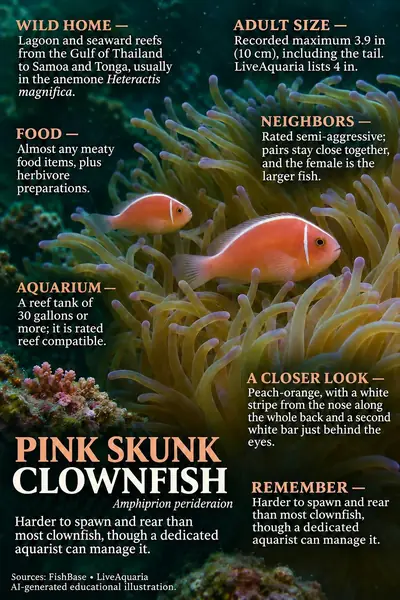
Pink skunk clownfish
Amphiprion perideraion
Harder to spawn and rear than most clownfish, though a dedicated aquarist can manage it.
Meet this fish →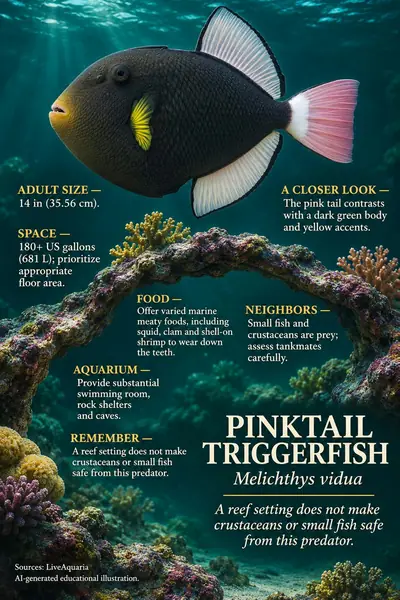
Pinktail triggerfish
Melichthys vidua
A reef setting does not make crustaceans or small fish safe from this predator.
Meet this fish →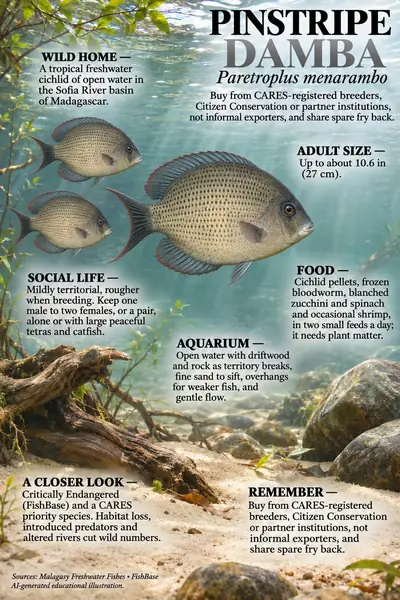
Pinstripe damba
Paretroplus menarambo
Buy from CARES-registered breeders, Citizen Conservation or partner institutions, not informal exporters, and share spare fry back.
Meet this fish →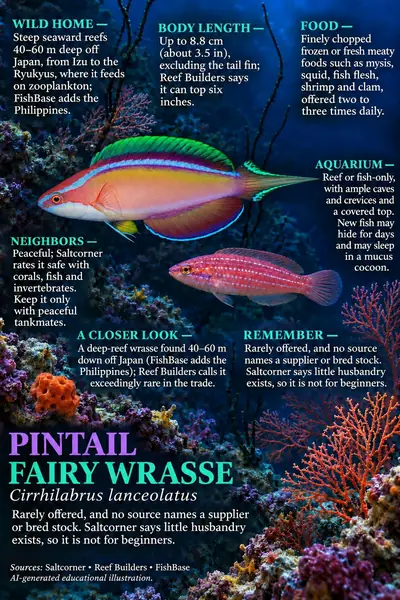
Pintail fairy wrasse
Cirrhilabrus lanceolatus
Rarely offered, and no source names a supplier or bred stock. Saltcorner says little husbandry exists, so it is not for beginners.
Meet this fish →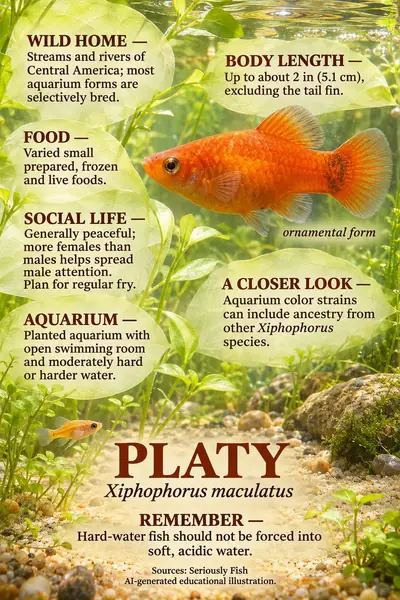
Platy
Xiphophorus maculatus
Hard-water fish should not be forced into soft, acidic water.
Meet this fish →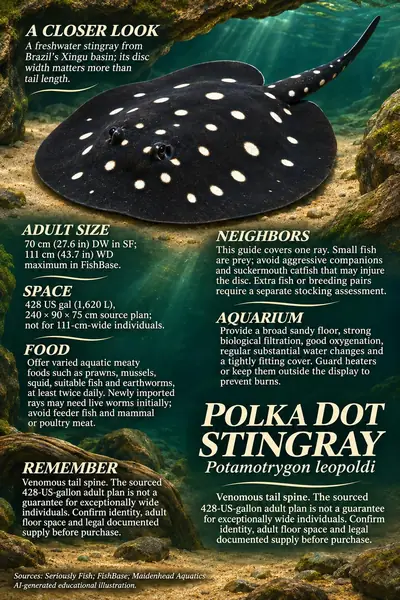
Polka dot stingray
Potamotrygon leopoldi
Venomous tail spine. The sourced 428-US-gallon adult plan is not a guarantee for exceptionally wide individuals. Confirm identity, adult floor space and legal documented supply before purchase.
Meet this fish →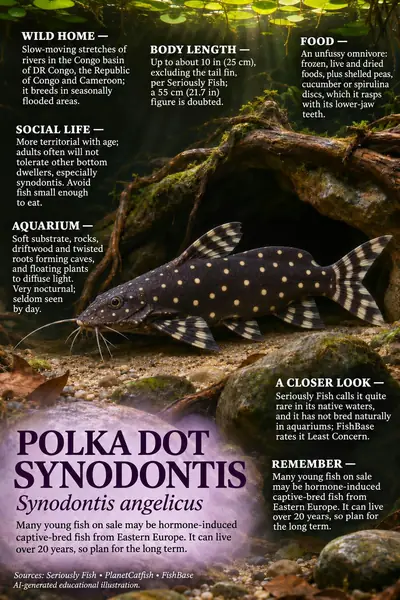
Polka dot synodontis
Synodontis angelicus
Many young fish on sale may be hormone-induced captive-bred fish from Eastern Europe. It can live over 20 years, so plan for the long term.
Meet this fish →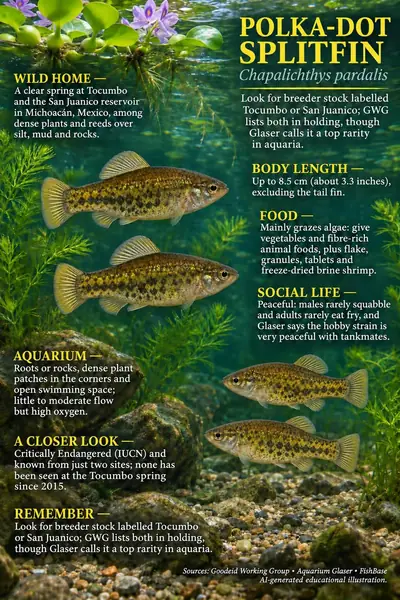
Polka-dot splitfin
Chapalichthys pardalis
Look for breeder stock labelled Tocumbo or San Juanico; GWG lists both in holding, though Glaser calls it a top rarity in aquaria.
Meet this fish →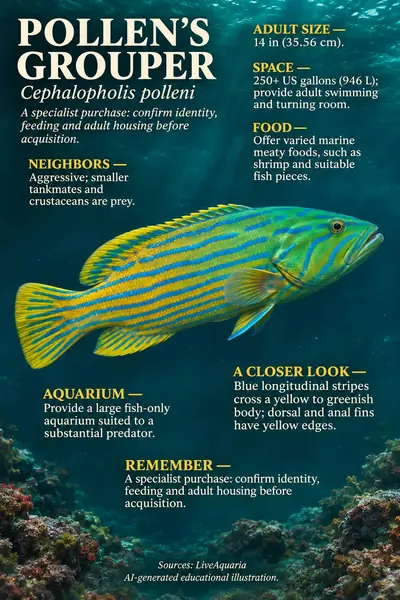
Pollen’s grouper
Cephalopholis polleni
A specialist purchase: confirm identity, feeding and adult housing before acquisition.
Meet this fish →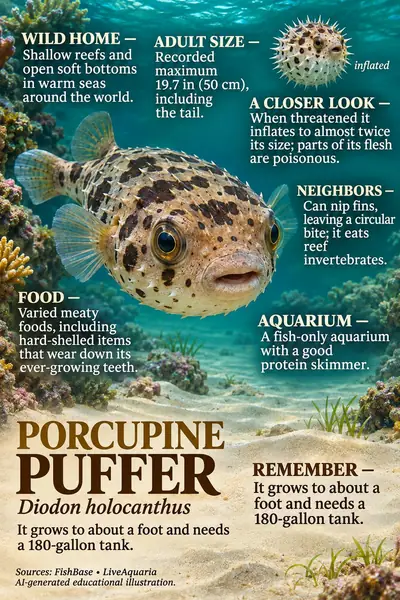
Porcupine puffer
Diodon holocanthus
It grows to about a foot and needs a 180-gallon tank.
Meet this fish →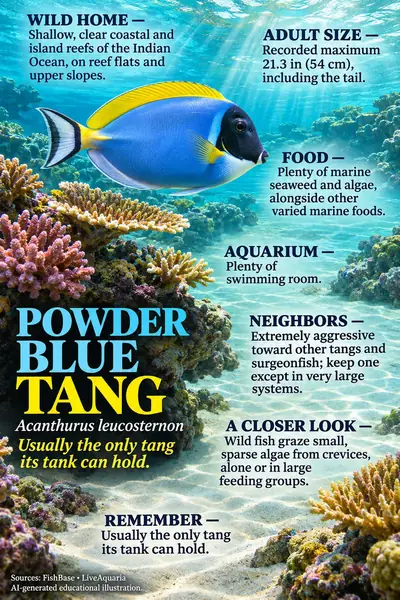
Powder blue tang
Acanthurus leucosternon
Usually the only tang its tank can hold.
Meet this fish →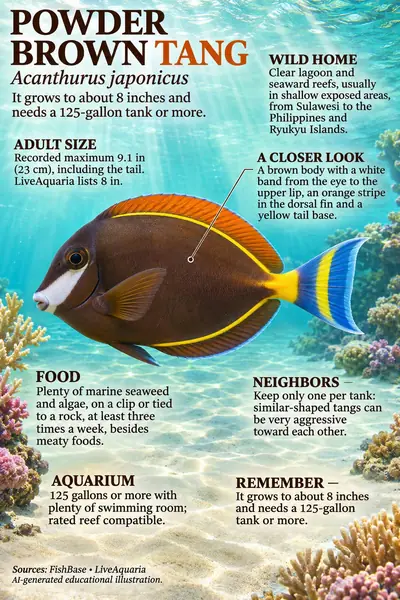
Powder brown tang
Acanthurus japonicus
It grows to about 8 inches and needs a 125-gallon tank or more.
Meet this fish →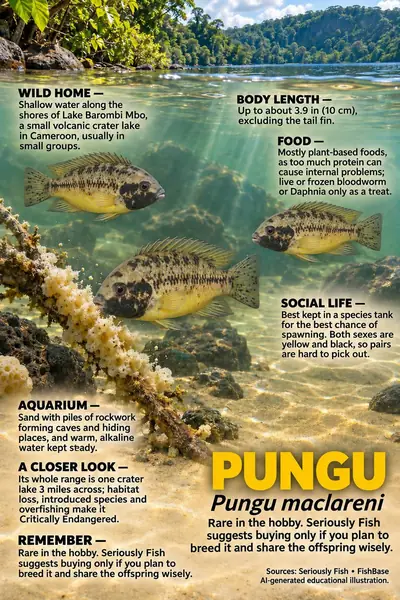
Pungu
Pungu maclareni
Rare in the hobby. Seriously Fish suggests buying only if you plan to breed it and share the offspring wisely.
Meet this fish →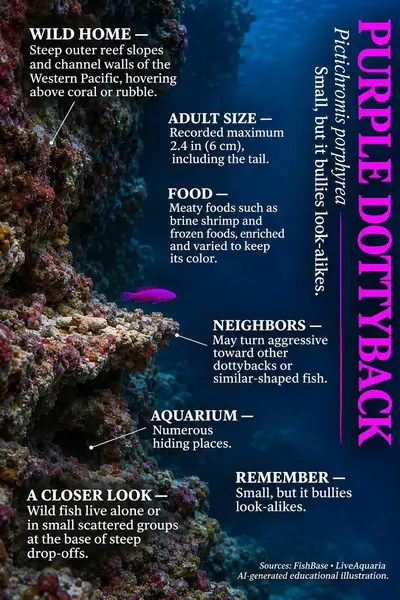
Purple dottyback
Pictichromis porphyrea
Small, but it bullies look-alikes.
Meet this fish →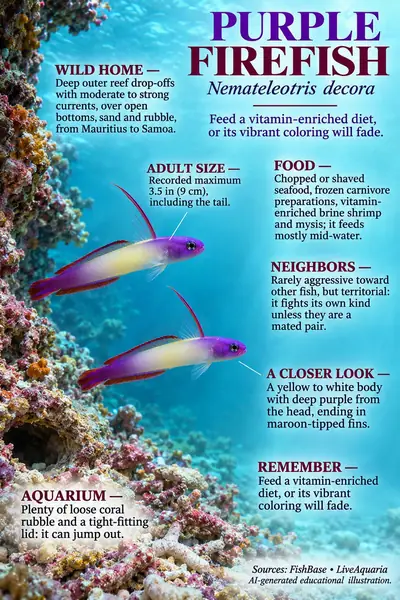
Purple firefish
Nemateleotris decora
Feed a vitamin-enriched diet, or its vibrant coloring will fade.
Meet this fish →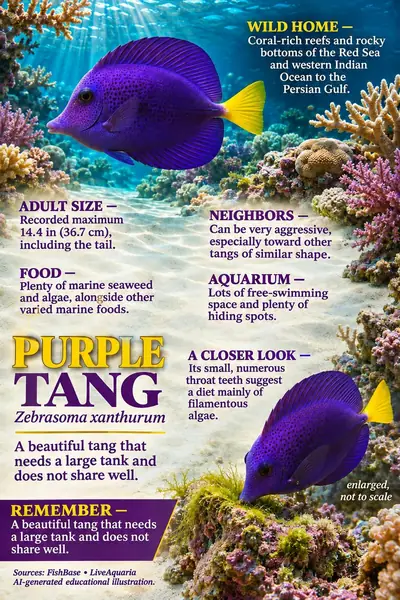
Purple tang
Zebrasoma xanthurum
A beautiful tang that needs a large tank and does not share well.
Meet this fish →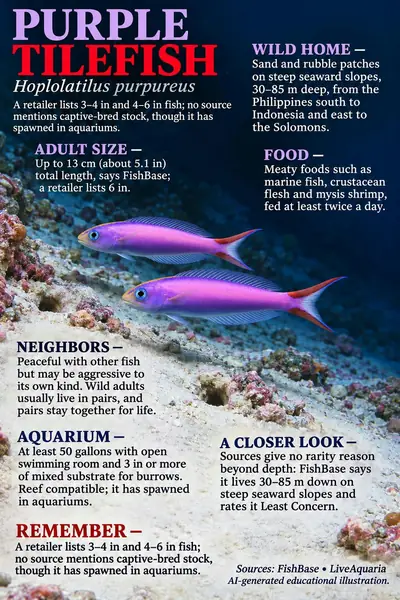
Purple tilefish
Hoplolatilus purpureus
A retailer lists 3–4 in and 4–6 in fish; no source mentions captive-bred stock, though it has spawned in aquariums.
Meet this fish →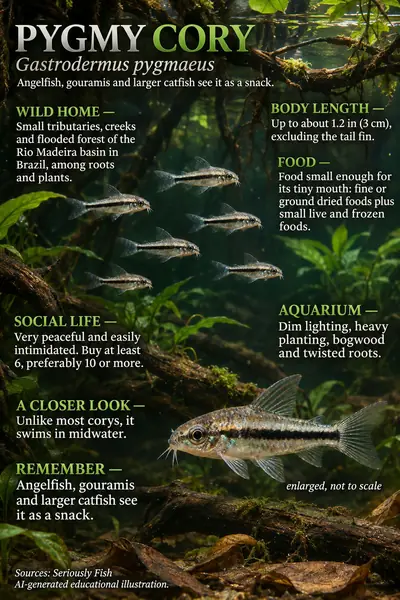
Pygmy cory
Gastrodermus pygmaeus
Angelfish, gouramis and larger catfish see it as a snack.
Meet this fish →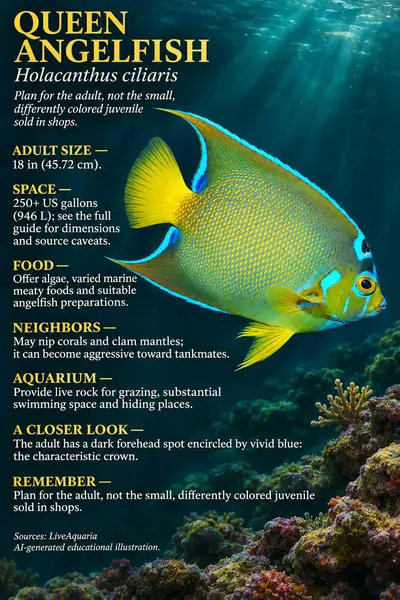
Queen angelfish
Holacanthus ciliaris
Plan for the adult, not the small, differently colored juvenile sold in shops.
Meet this fish →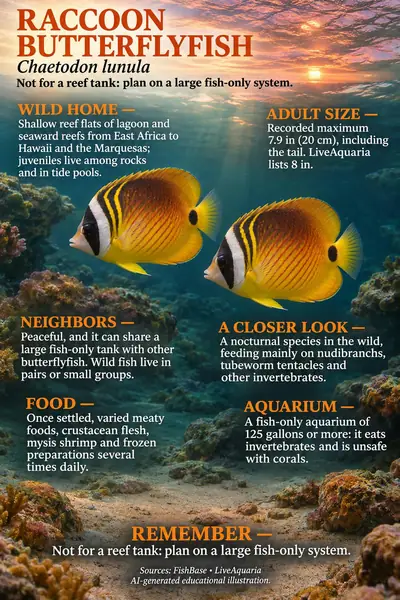
Raccoon butterflyfish
Chaetodon lunula
Not for a reef tank: plan on a large fish-only system.
Meet this fish →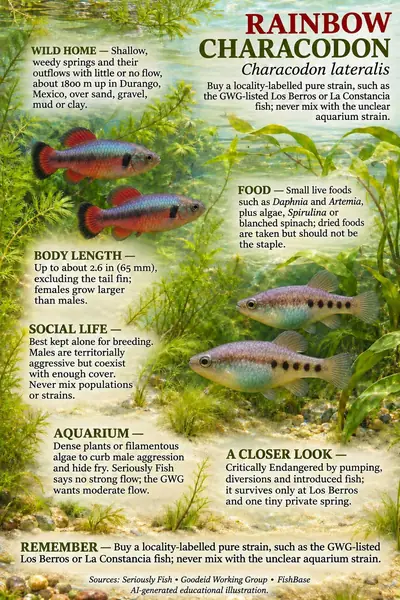
Rainbow characodon
Characodon lateralis
Buy a locality-labelled pure strain, such as the GWG-listed Los Berros or La Constancia fish; never mix with the unclear aquarium strain.
Meet this fish →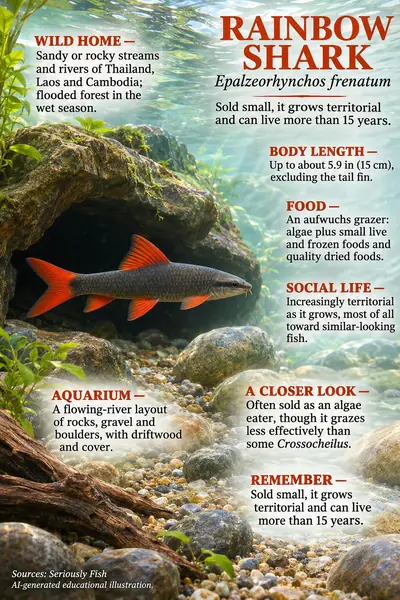
Rainbow shark
Epalzeorhynchos frenatum
Sold small, it grows territorial and can live more than 15 years.
Meet this fish →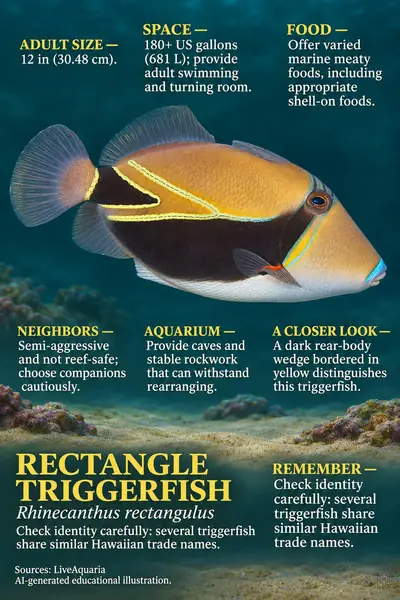
Rectangle triggerfish
Rhinecanthus rectangulus
Check identity carefully: several triggerfish share similar Hawaiian trade names.
Meet this fish →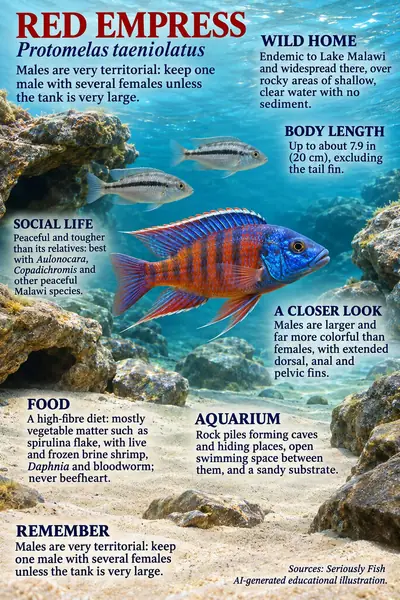
Red empress
Protomelas taeniolatus
Males are very territorial: keep one male with several females unless the tank is very large.
Meet this fish →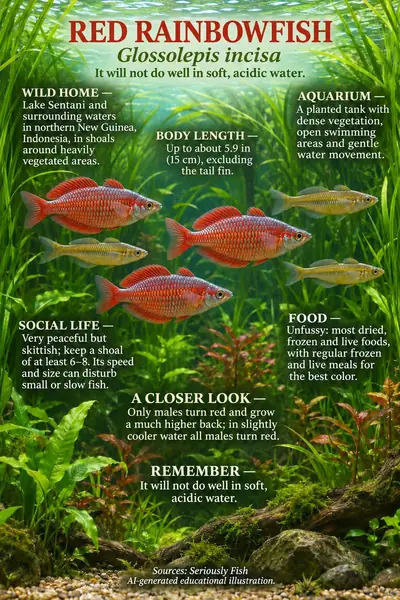
Red rainbowfish
Glossolepis incisa
It will not do well in soft, acidic water.
Meet this fish →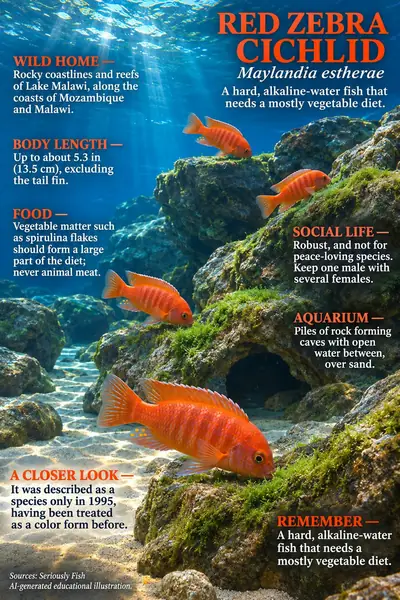
Red zebra cichlid
Maylandia estherae
A hard, alkaline-water fish that needs a mostly vegetable diet.
Meet this fish →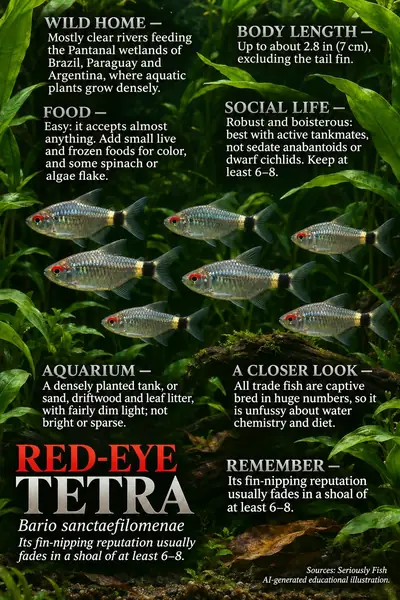
Red-eye tetra
Bario sanctaefilomenae
Its fin-nipping reputation usually fades in a shoal of at least 6–8.
Meet this fish →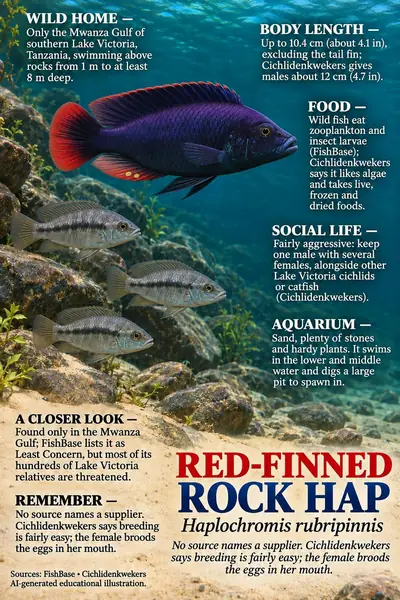
Red-finned rock hap
Haplochromis rubripinnis
No source names a supplier. Cichlidenkwekers says breeding is fairly easy; the female broods the eggs in her mouth.
Meet this fish →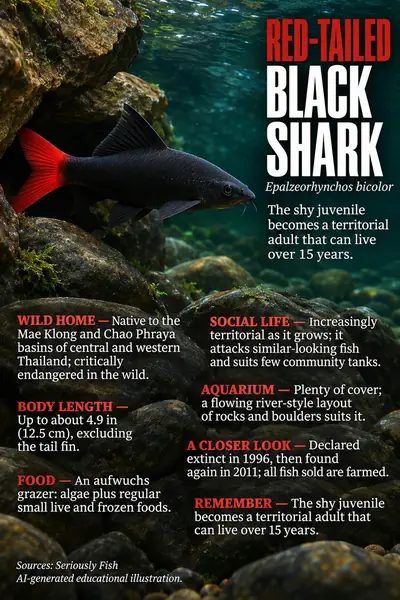
Red-tailed black shark
Epalzeorhynchos bicolor
The shy juvenile becomes a territorial adult that can live over 15 years.
Meet this fish →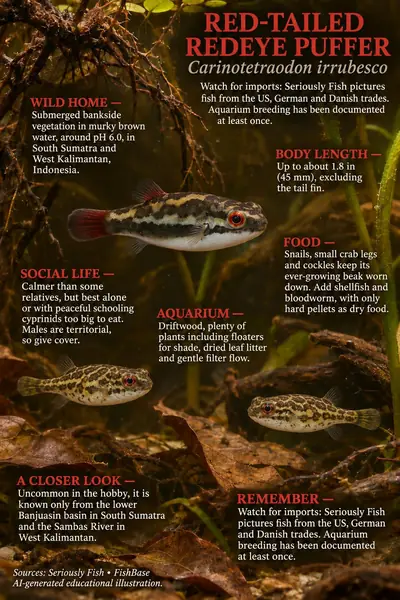
Red-tailed redeye puffer
Carinotetraodon irrubesco
Watch for imports: Seriously Fish pictures fish from the US, German and Danish trades. Aquarium breeding has been documented at least once.
Meet this fish →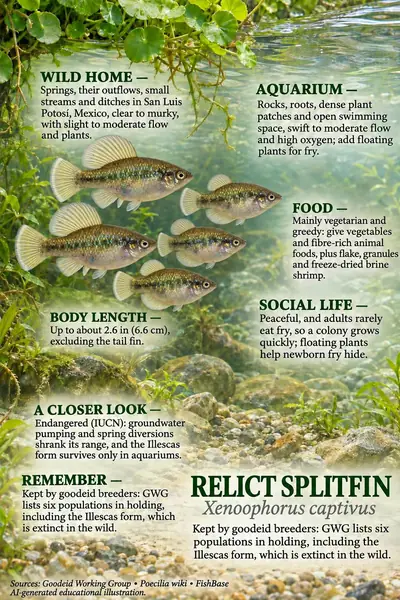
Relict splitfin
Xenoophorus captivus
Kept by goodeid breeders: GWG lists six populations in holding, including the Illescas form, which is extinct in the wild.
Meet this fish →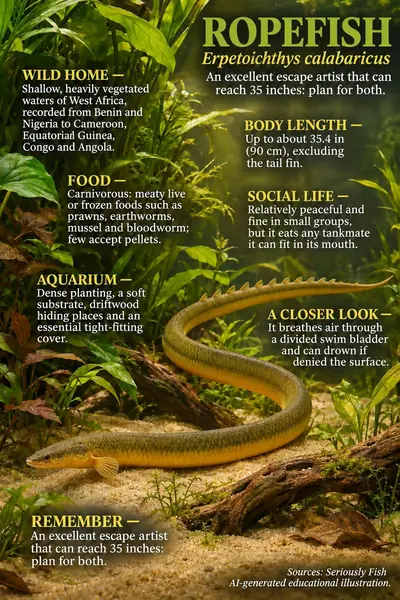
Ropefish
Erpetoichthys calabaricus
An excellent escape artist that can reach 35 inches: plan for both.
Meet this fish →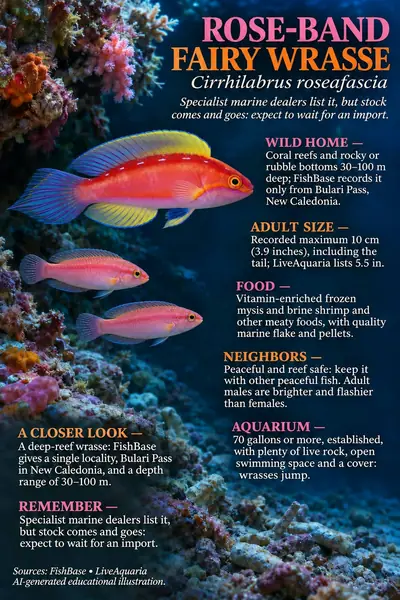
Rose-band fairy wrasse
Cirrhilabrus roseafascia
Specialist marine dealers list it, but stock comes and goes: expect to wait for an import.
Meet this fish →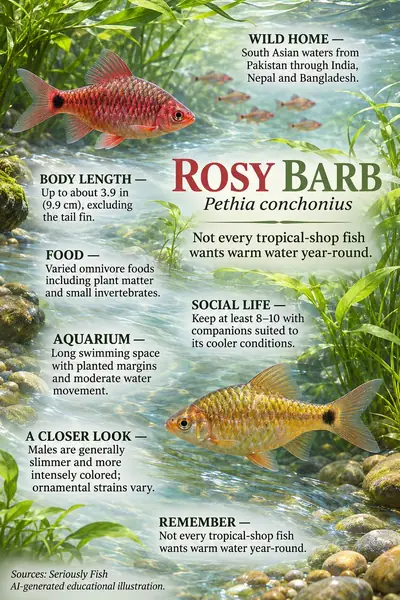
Rosy barb
Pethia conchonius
Not every tropical-shop fish wants warm water year-round.
Meet this fish →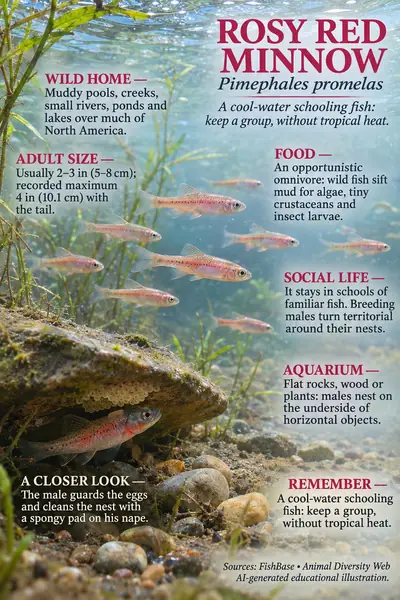
Rosy red minnow
Pimephales promelas
A cool-water schooling fish: keep a group, without tropical heat.
Meet this fish →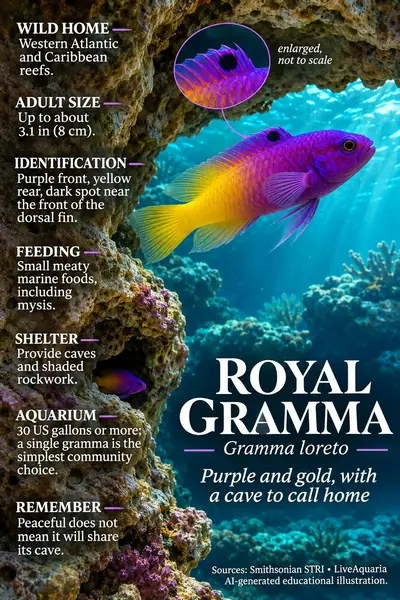
Royal gramma
Gramma loreto
Purple and gold, with a cave to call home
Meet this fish →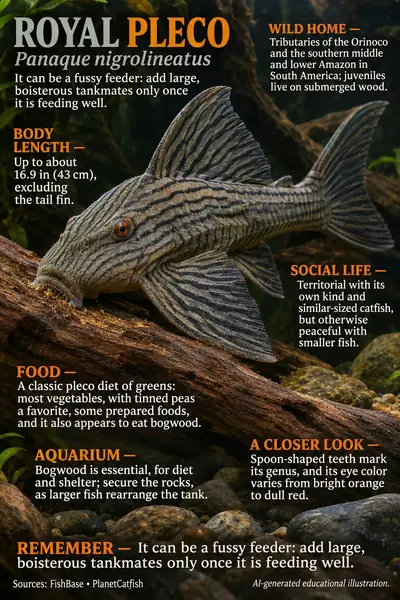
Royal pleco
Panaque nigrolineatus
It can be a fussy feeder: add large, boisterous tankmates only once it is feeding well.
Meet this fish →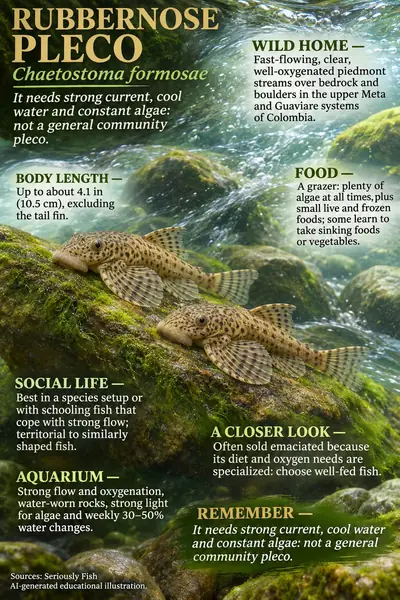
Rubbernose pleco
Chaetostoma formosae
It needs strong current, cool water and constant algae: not a general community pleco.
Meet this fish →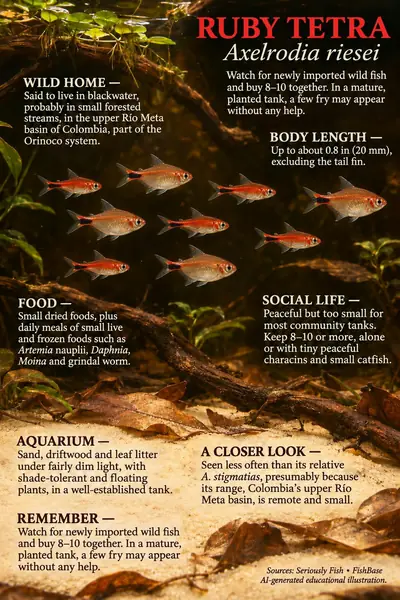
Ruby tetra
Axelrodia riesei
Watch for newly imported wild fish and buy 8–10 together. In a mature, planted tank, a few fry may appear without any help.
Meet this fish →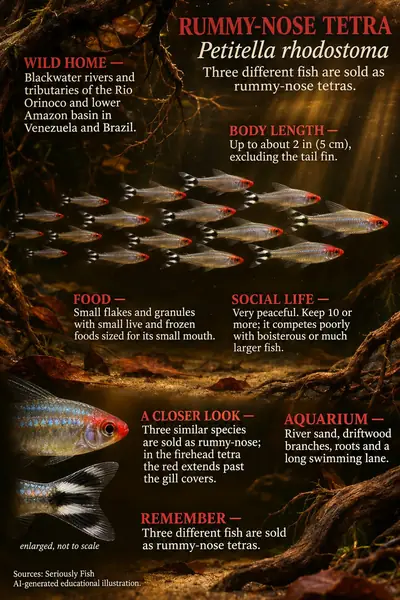
Rummy-nose tetra
Petitella rhodostoma
Three different fish are sold as rummy-nose tetras.
Meet this fish →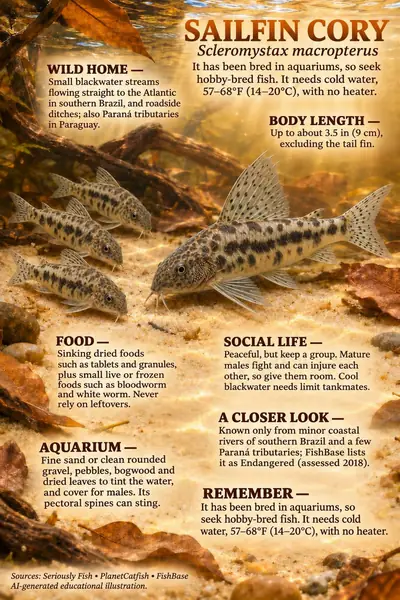
Sailfin cory
Scleromystax macropterus
It has been bred in aquariums, so seek hobby-bred fish. It needs cold water, 57–68°F (14–20°C), with no heater.
Meet this fish →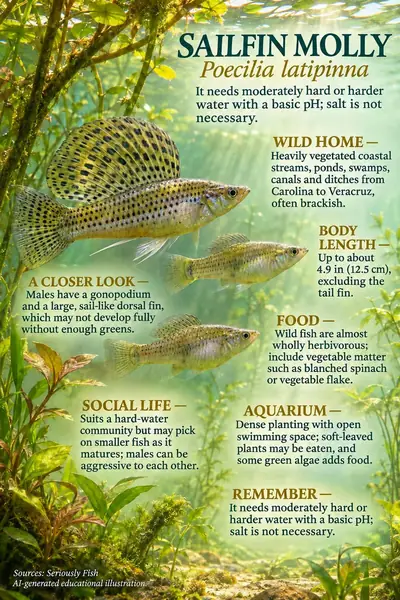
Sailfin molly
Poecilia latipinna
It needs moderately hard or harder water with a basic pH; salt is not necessary.
Meet this fish →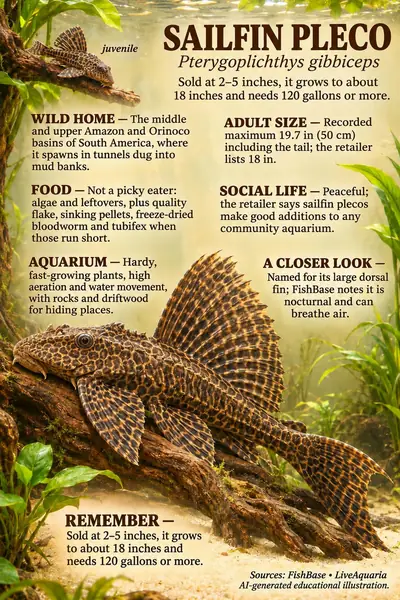
Sailfin pleco
Pterygoplichthys gibbiceps
Sold at 2–5 inches, it grows to about 18 inches and needs 120 gallons or more.
Meet this fish →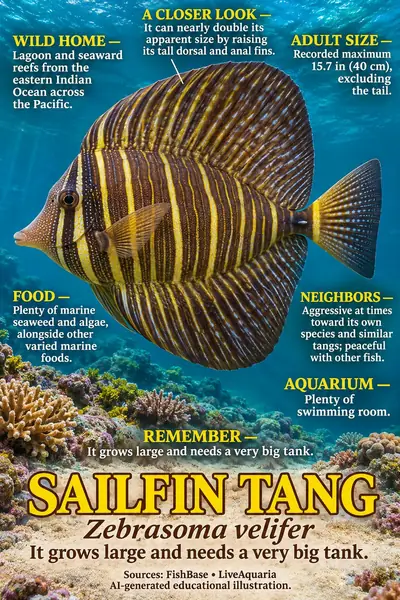
Sailfin tang
Zebrasoma velifer
It grows large and needs a very big tank.
Meet this fish →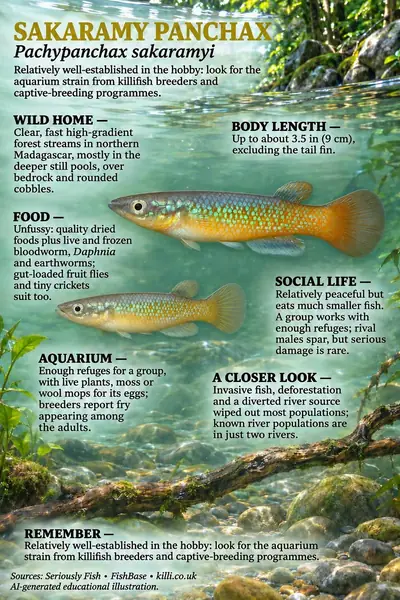
Sakaramy panchax
Pachypanchax sakaramyi
Relatively well-established in the hobby: look for the aquarium strain from killifish breeders and captive-breeding programmes.
Meet this fish →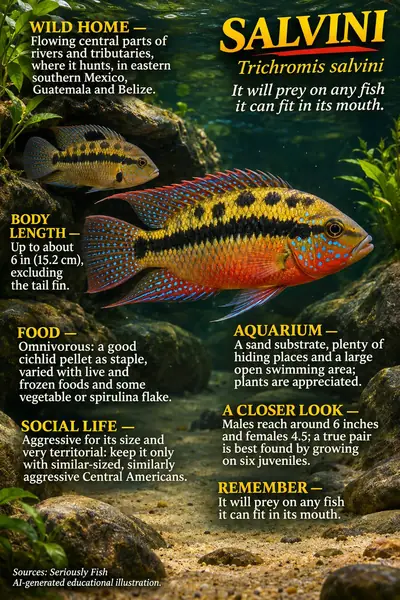
Salvini
Trichromis salvini
It will prey on any fish it can fit in its mouth.
Meet this fish →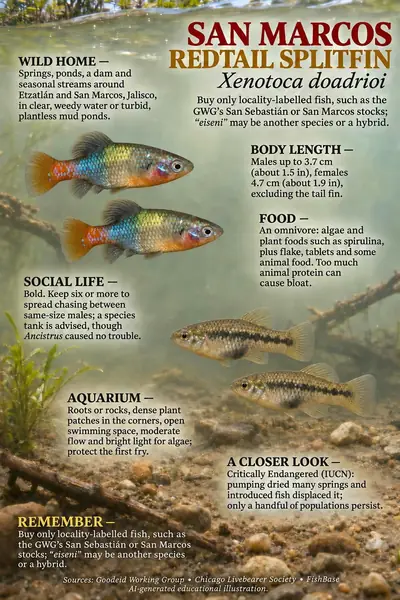
San Marcos redtail splitfin
Xenotoca doadrioi
Buy only locality-labelled fish, such as the GWG’s San Sebastián or San Marcos stocks; “eiseni” may be another species or a hybrid.
Meet this fish →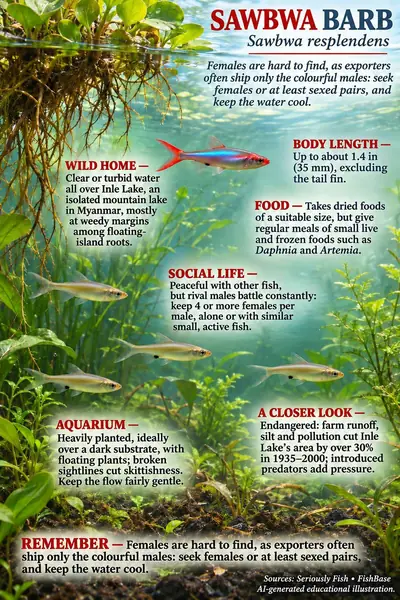
Sawbwa barb
Sawbwa resplendens
Females are hard to find, as exporters often ship only the colourful males: seek females or at least sexed pairs, and keep the water cool.
Meet this fish →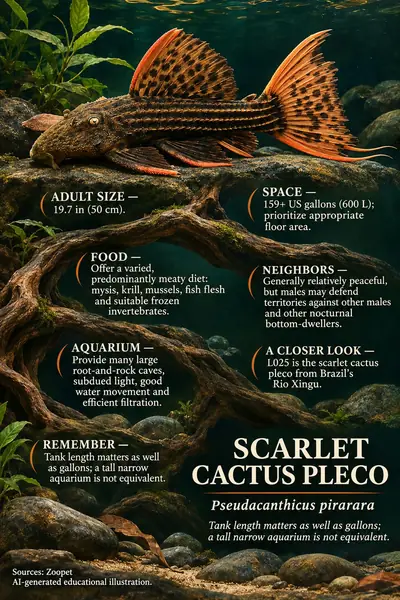
Scarlet cactus pleco
Pseudacanthicus pirarara
Tank length matters as well as gallons; a tall narrow aquarium is not equivalent.
Meet this fish →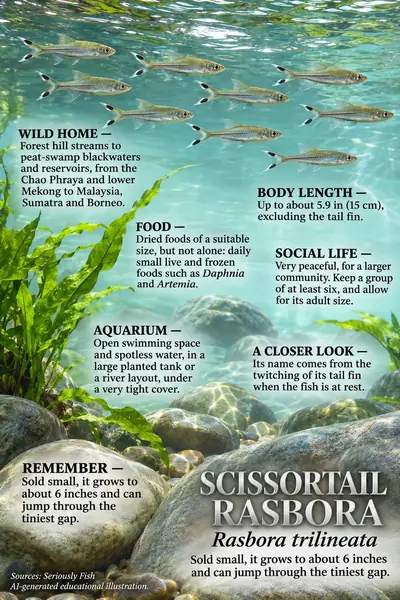
Scissortail rasbora
Rasbora trilineata
Sold small, it grows to about 6 inches and can jump through the tiniest gap.
Meet this fish →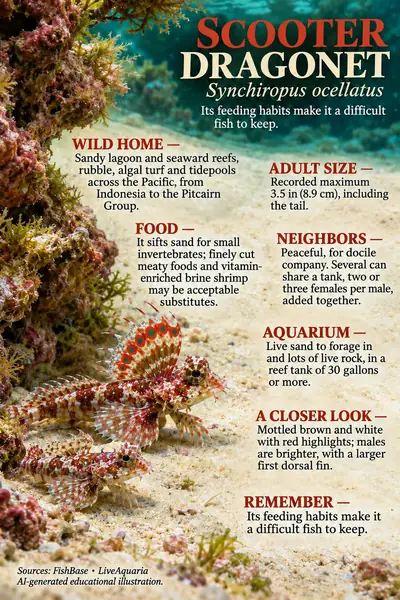
Scooter dragonet
Synchiropus ocellatus
Its feeding habits make it a difficult fish to keep.
Meet this fish →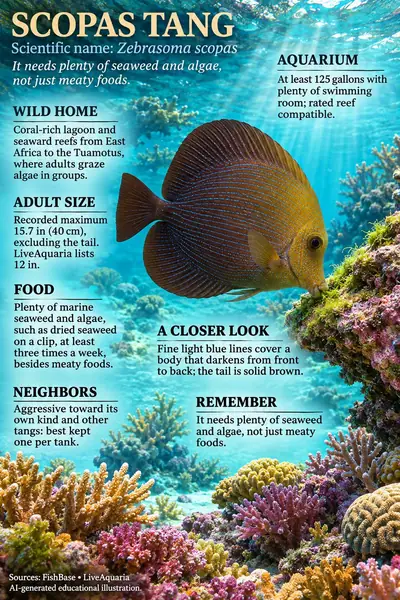
Scopas tang
Zebrasoma scopas
It needs plenty of seaweed and algae, not just meaty foods.
Meet this fish →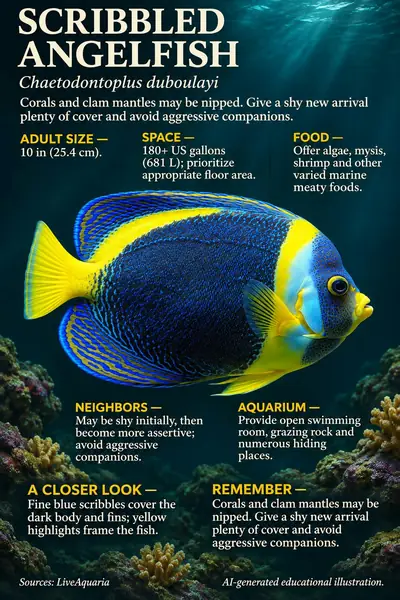
Scribbled angelfish
Chaetodontoplus duboulayi
Corals and clam mantles may be nipped. Give a shy new arrival plenty of cover and avoid aggressive companions.
Meet this fish →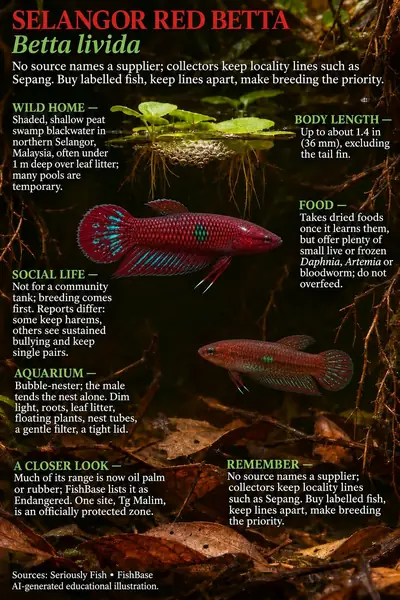
Selangor red betta
Betta livida
No source names a supplier; collectors keep locality lines such as Sepang. Buy labelled fish, keep lines apart, make breeding the priority.
Meet this fish →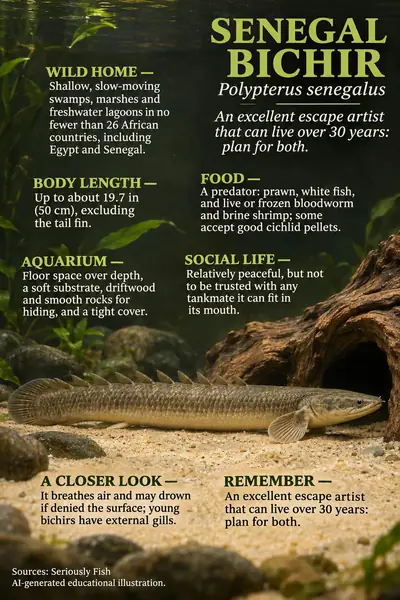
Senegal bichir
Polypterus senegalus
An excellent escape artist that can live over 30 years: plan for both.
Meet this fish →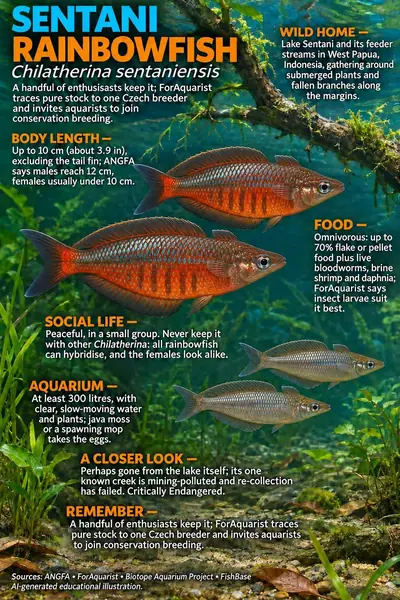
Sentani rainbowfish
Chilatherina sentaniensis
A handful of enthusiasts keep it; ForAquarist traces pure stock to one Czech breeder and invites aquarists to join conservation breeding.
Meet this fish →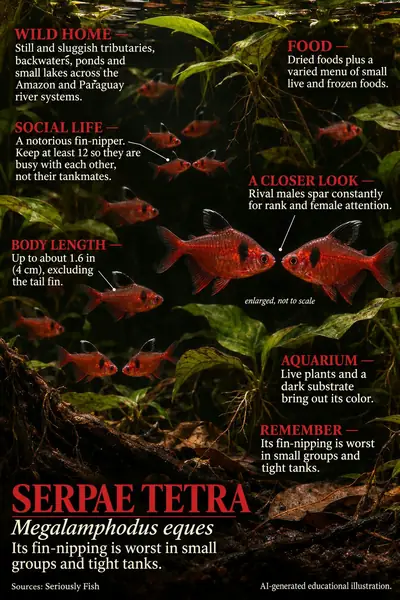
Serpae tetra
Megalamphodus eques
Its fin-nipping is worst in small groups and tight tanks.
Meet this fish →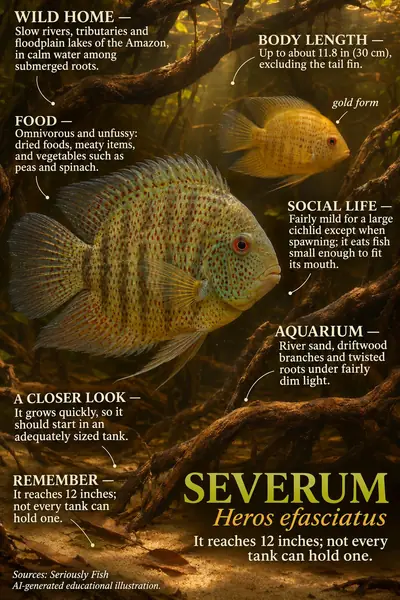
Severum
Heros efasciatus
It reaches 12 inches; not every tank can hold one.
Meet this fish →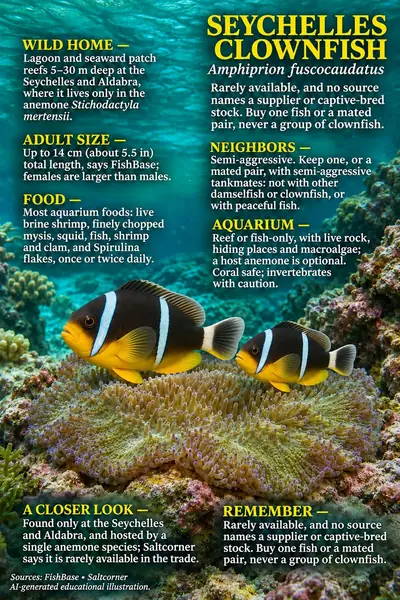
Seychelles clownfish
Amphiprion fuscocaudatus
Rarely available, and no source names a supplier or captive-bred stock. Buy one fish or a mated pair, never a group of clownfish.
Meet this fish →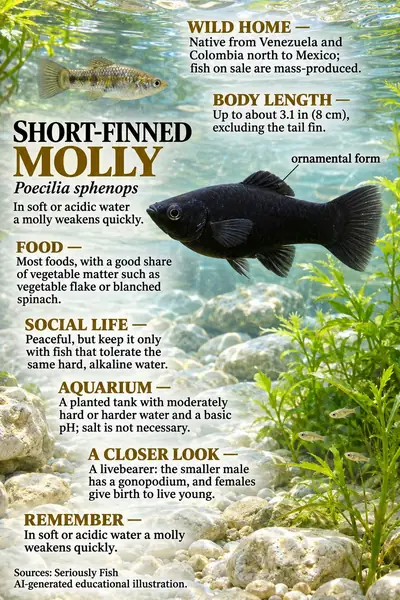
Short-finned molly
Poecilia sphenops
In soft or acidic water a molly weakens quickly.
Meet this fish →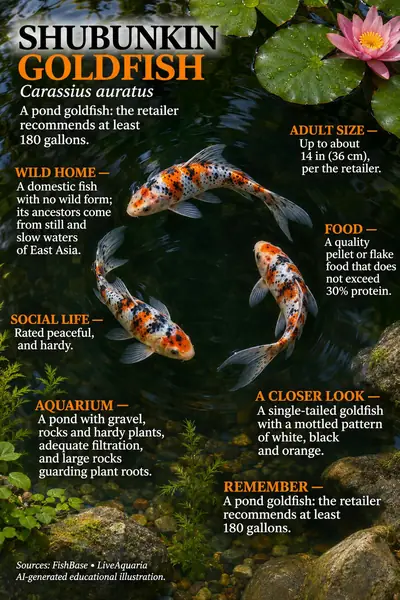
Shubunkin goldfish
Carassius auratus
A pond goldfish: the retailer recommends at least 180 gallons.
Meet this fish →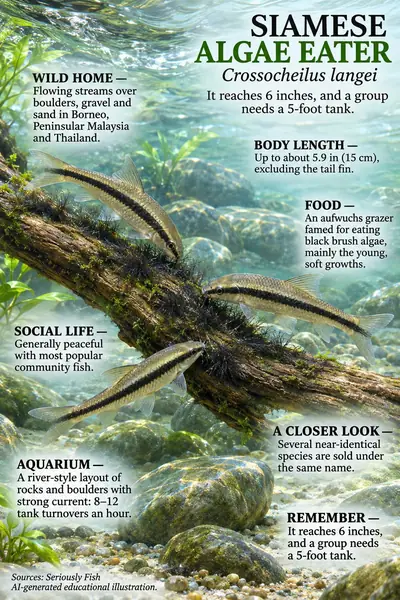
Siamese algae eater
Crossocheilus langei
It reaches 6 inches, and a group needs a 5-foot tank.
Meet this fish →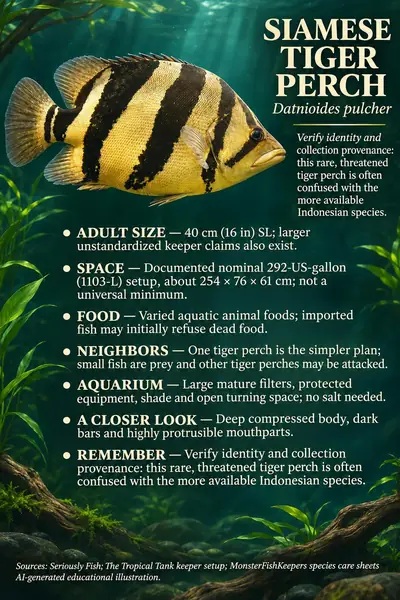
Siamese tiger perch
Datnioides pulcher
Verify identity and collection provenance: this rare, threatened tiger perch is often confused with the more available Indonesian species.
Meet this fish →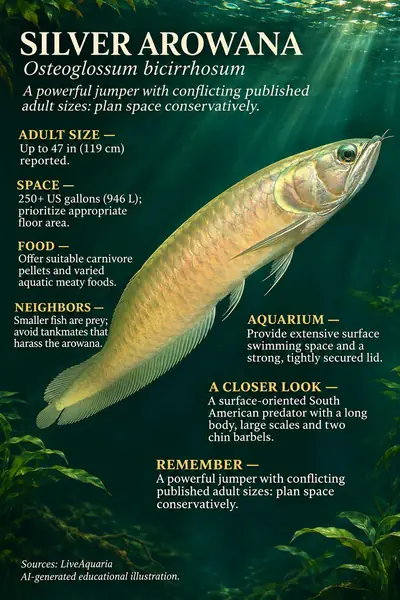
Silver arowana
Osteoglossum bicirrhosum
A powerful jumper with conflicting published adult sizes: plan space conservatively.
Meet this fish →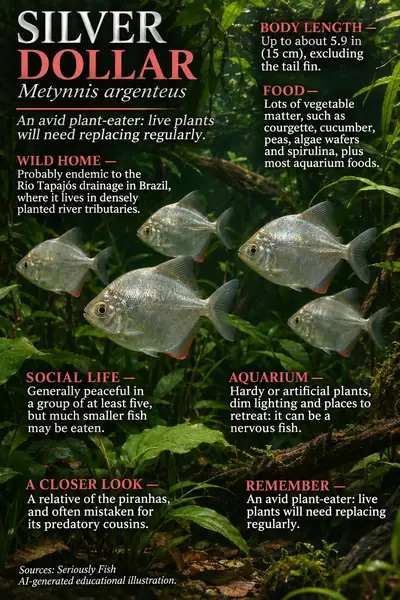
Silver dollar
Metynnis argenteus
An avid plant-eater: live plants will need replacing regularly.
Meet this fish →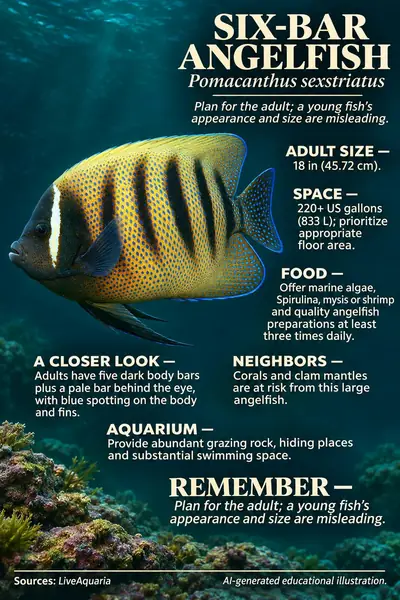
Six-bar angelfish
Pomacanthus sexstriatus
Plan for the adult; a young fish's appearance and size are misleading.
Meet this fish →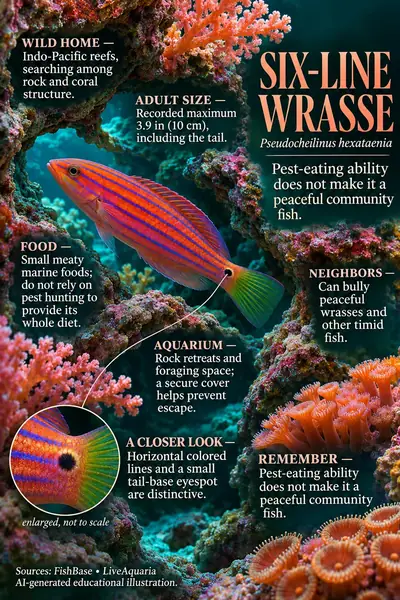
Six-line wrasse
Pseudocheilinus hexataenia
Pest-eating ability does not make it a peaceful community fish.
Meet this fish →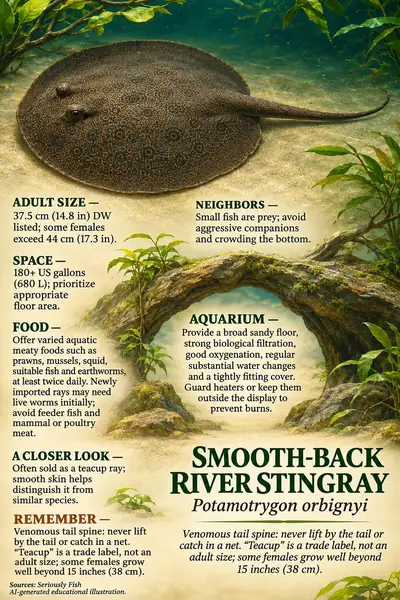
Smooth-back river stingray
Potamotrygon orbignyi
Venomous tail spine: never lift by the tail or catch in a net. “Teacup” is a trade label, not an adult size; some females grow well beyond 15 inches (38 cm).
Meet this fish →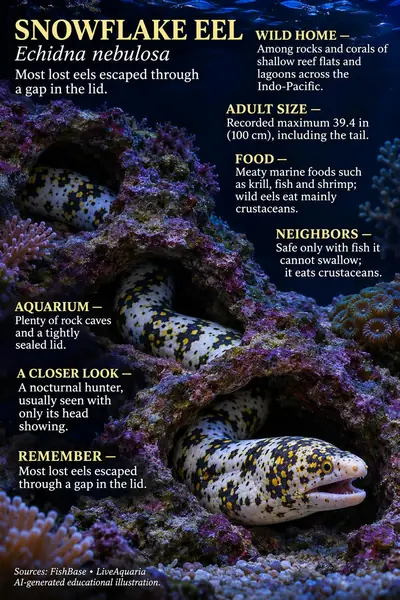
Snowflake eel
Echidna nebulosa
Most lost eels escaped through a gap in the lid.
Meet this fish →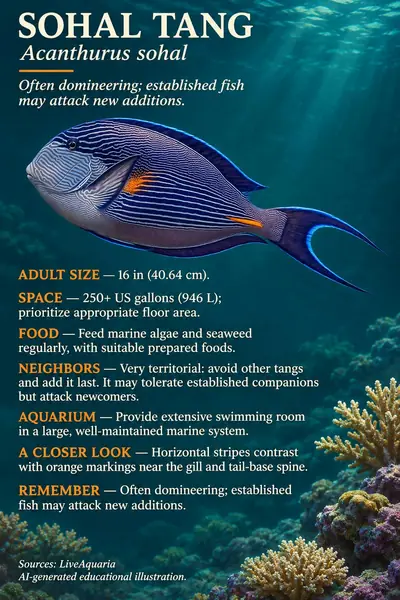
Sohal tang
Acanthurus sohal
Often domineering; established fish may attack new additions.
Meet this fish →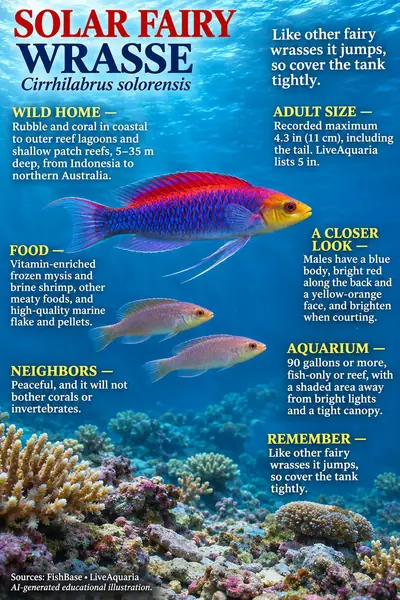
Solar fairy wrasse
Cirrhilabrus solorensis
Like other fairy wrasses it jumps, so cover the tank tightly.
Meet this fish →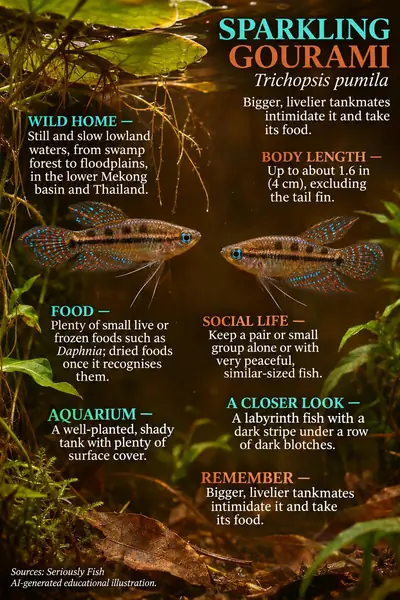
Sparkling gourami
Trichopsis pumila
Bigger, livelier tankmates intimidate it and take its food.
Meet this fish →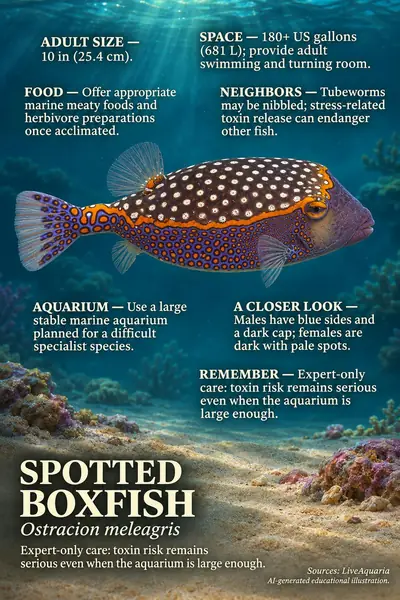
Spotted boxfish
Ostracion meleagris
Expert-only care: toxin risk remains serious even when the aquarium is large enough.
Meet this fish →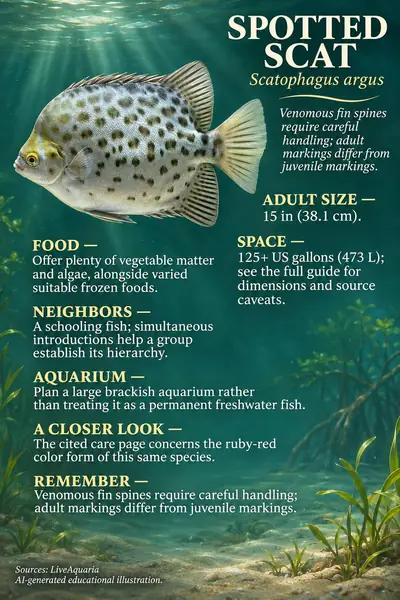
Spotted scat
Scatophagus argus
Venomous fin spines require careful handling; adult markings differ from juvenile markings.
Meet this fish →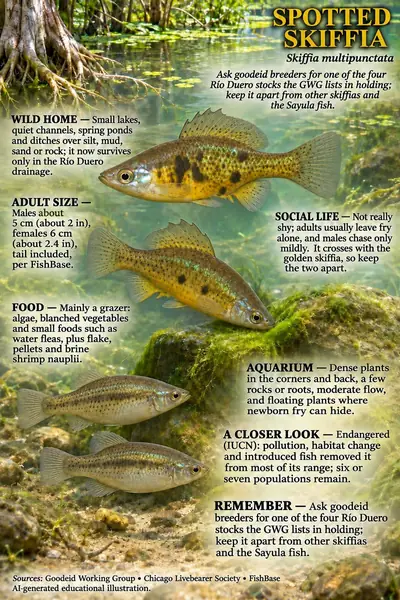
Spotted skiffia
Skiffia multipunctata
Ask goodeid breeders for one of the four Río Duero stocks the GWG lists in holding; keep it apart from other skiffias and the Sayula fish.
Meet this fish →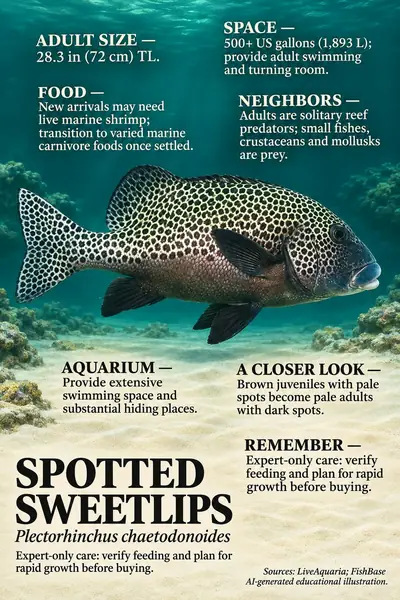
Spotted sweetlips
Plectorhinchus chaetodonoides
Expert-only care: verify feeding and plan for rapid growth before buying.
Meet this fish →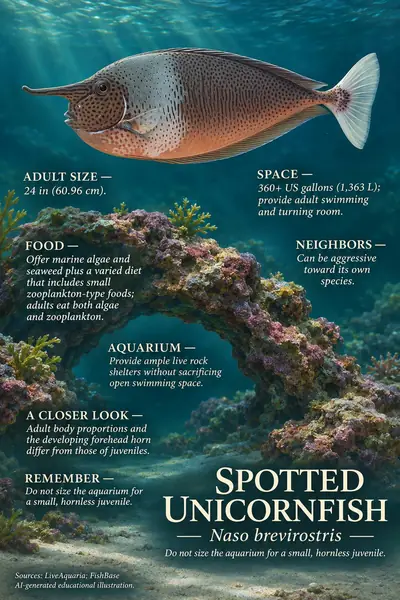
Spotted unicornfish
Naso brevirostris
Do not size the aquarium for a small, hornless juvenile.
Meet this fish →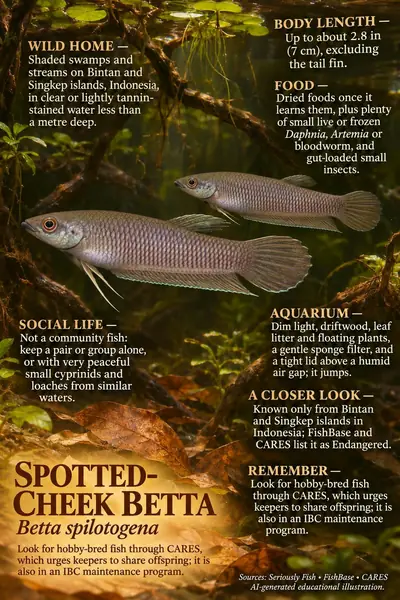
Spotted-cheek betta
Betta spilotogena
Look for hobby-bred fish through CARES, which urges keepers to share offspring; it is also in an IBC maintenance program.
Meet this fish →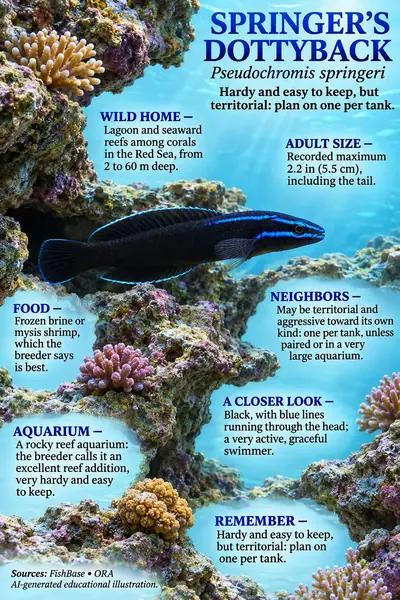
Springer’s dottyback
Pseudochromis springeri
Hardy and easy to keep, but territorial: plan on one per tank.
Meet this fish →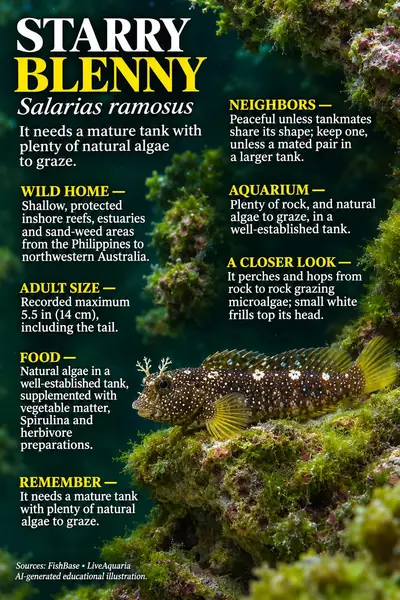
Starry blenny
Salarias ramosus
It needs a mature tank with plenty of natural algae to graze.
Meet this fish →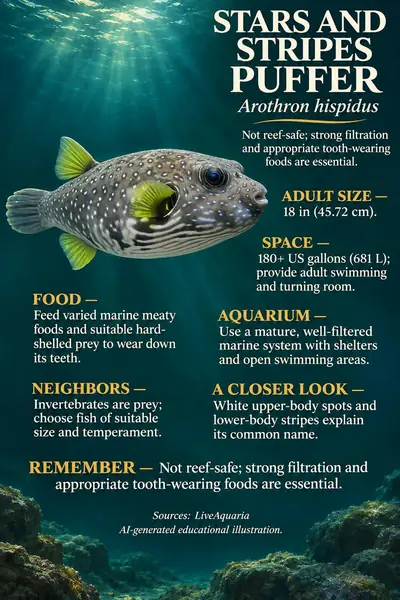
Stars and stripes puffer
Arothron hispidus
Not reef-safe; strong filtration and appropriate tooth-wearing foods are essential.
Meet this fish →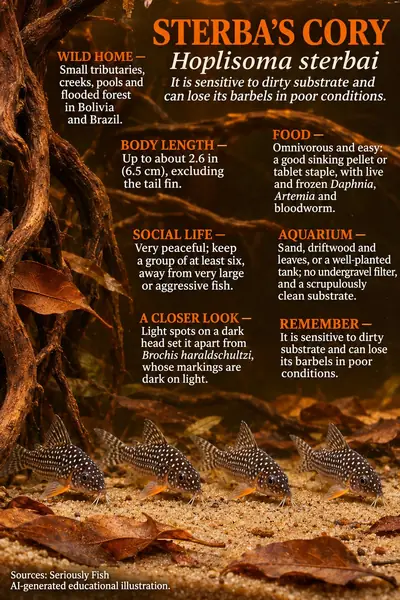
Sterba’s cory
Hoplisoma sterbai
It is sensitive to dirty substrate and can lose its barbels in poor conditions.
Meet this fish →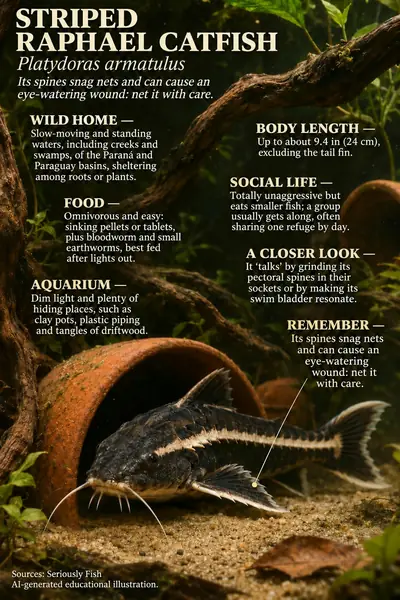
Striped Raphael catfish
Platydoras armatulus
Its spines snag nets and can cause an eye-watering wound: net it with care.
Meet this fish →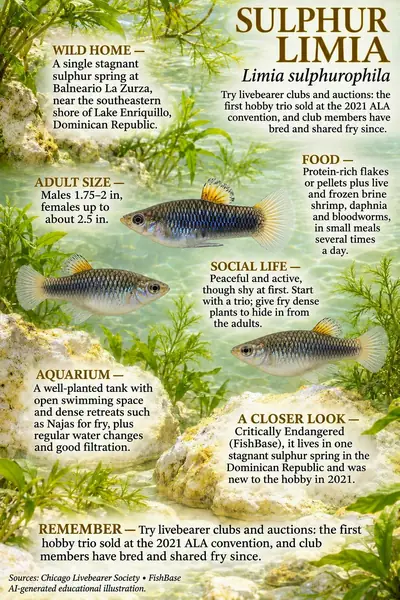
Sulphur limia
Limia sulphurophila
Try livebearer clubs and auctions: the first hobby trio sold at the 2021 ALA convention, and club members have bred and shared fry since.
Meet this fish →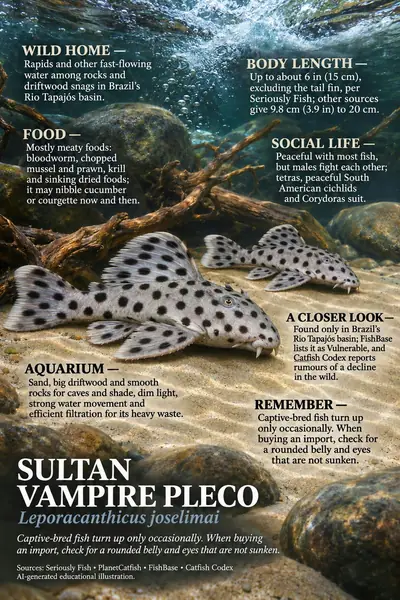
Sultan vampire pleco
Leporacanthicus joselimai
Captive-bred fish turn up only occasionally. When buying an import, check for a rounded belly and eyes that are not sunken.
Meet this fish →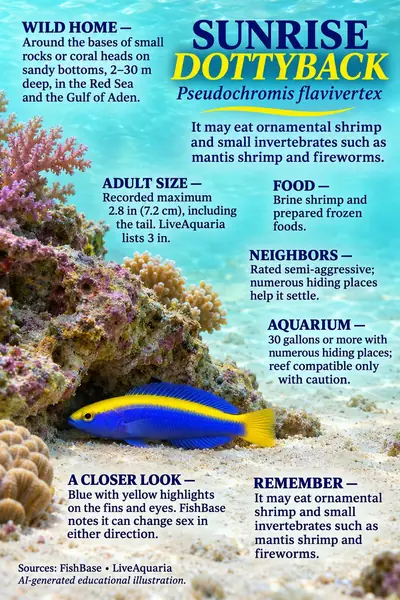
Sunrise dottyback
Pseudochromis flavivertex
It may eat ornamental shrimp and small invertebrates such as mantis shrimp and fireworms.
Meet this fish →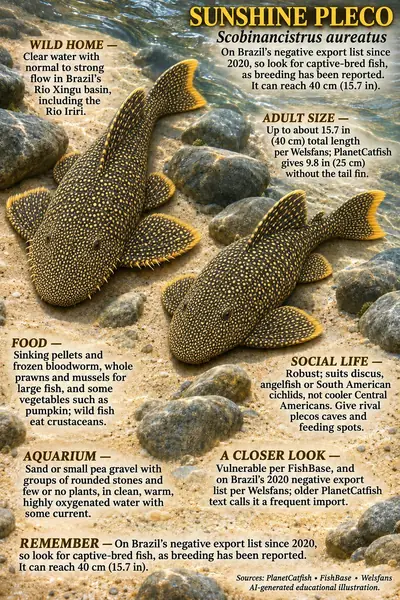
Sunshine pleco
Scobinancistrus aureatus
On Brazil’s negative export list since 2020, so look for captive-bred fish, as breeding has been reported. It can reach 40 cm (15.7 in).
Meet this fish →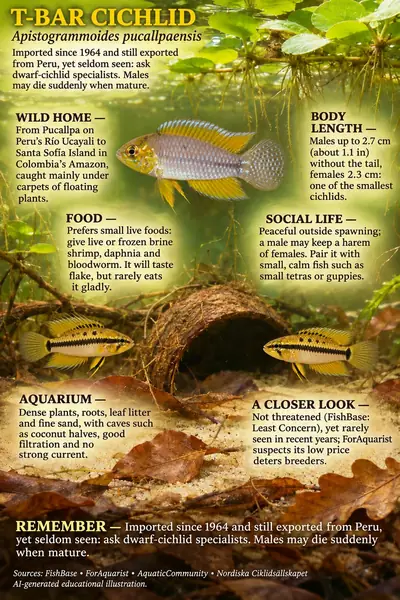
T-bar cichlid
Apistogrammoides pucallpaensis
Imported since 1964 and still exported from Peru, yet seldom seen: ask dwarf-cichlid specialists. Males may die suddenly when mature.
Meet this fish →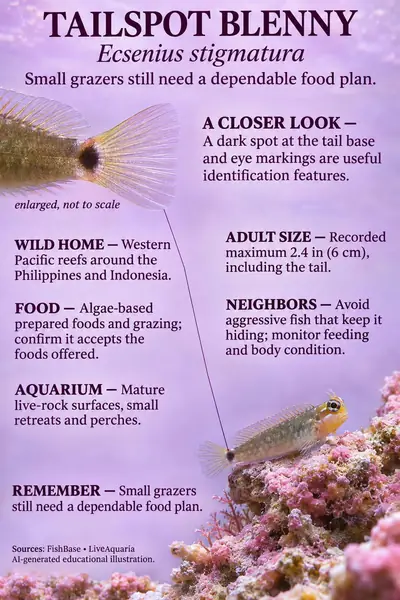
Tailspot blenny
Ecsenius stigmatura
Small grazers still need a dependable food plan.
Meet this fish →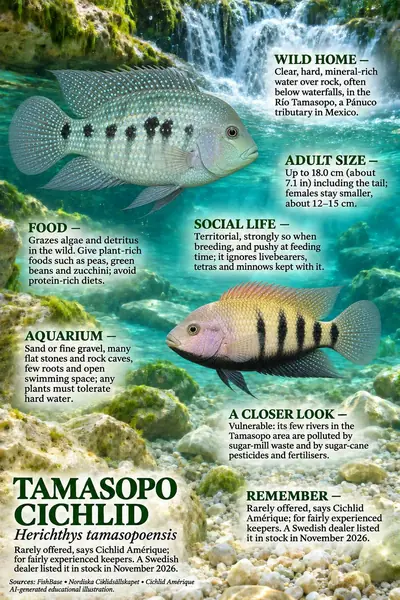
Tamasopo cichlid
Herichthys tamasopoensis
Rarely offered, says Cichlid Amérique; for fairly experienced keepers. A Swedish dealer listed it in stock in November 2026.
Meet this fish →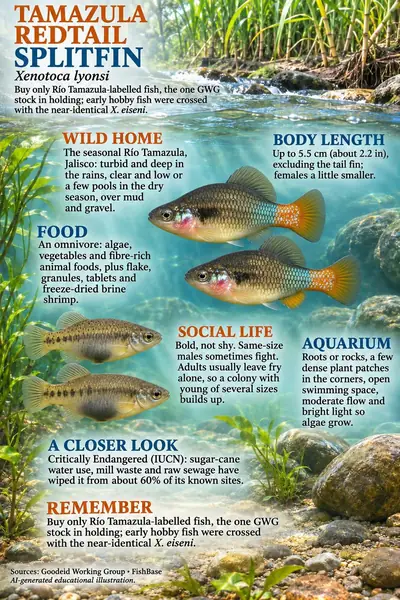
Tamazula redtail splitfin
Xenotoca lyonsi
Buy only Río Tamazula-labelled fish, the one GWG stock in holding; early hobby fish were crossed with the near-identical X. eiseni.
Meet this fish →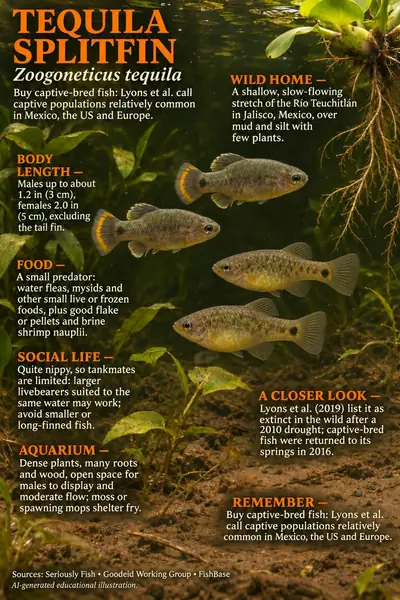
Tequila splitfin
Zoogoneticus tequila
Buy captive-bred fish: Lyons et al. call captive populations relatively common in Mexico, the US and Europe.
Meet this fish →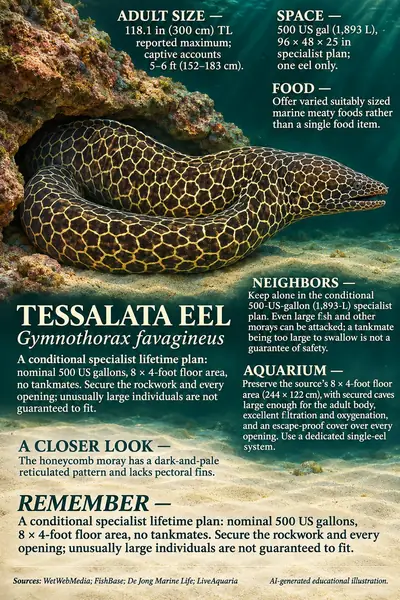
Tessalata eel
Gymnothorax favagineus
A conditional specialist lifetime plan: nominal 500 US gallons, 8 × 4-foot floor area, no tankmates. Secure the rockwork and every opening; unusually large individuals are not guaranteed to fit.
Meet this fish →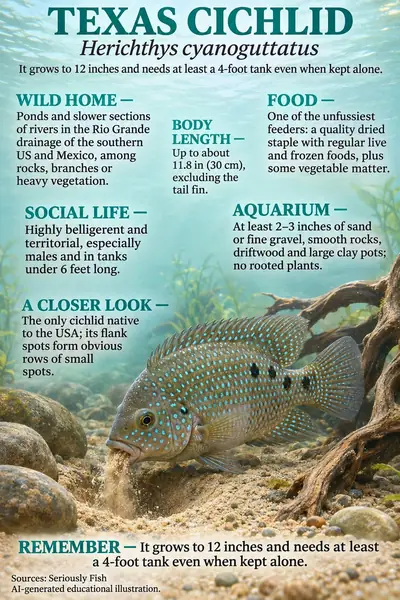
Texas cichlid
Herichthys cyanoguttatus
It grows to 12 inches and needs at least a 4-foot tank even when kept alone.
Meet this fish →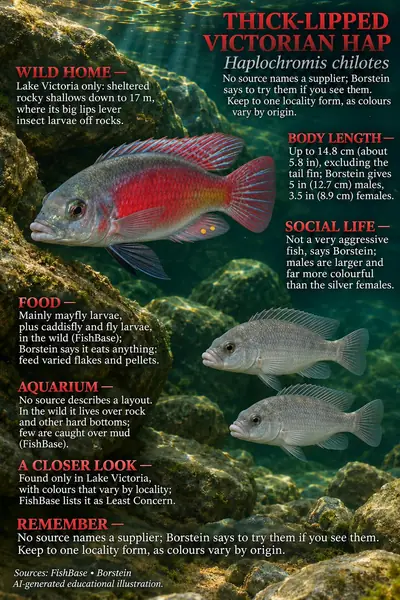
Thick-lipped Victorian hap
Haplochromis chilotes
No source names a supplier; Borstein says to try them if you see them. Keep to one locality form, as colours vary by origin.
Meet this fish →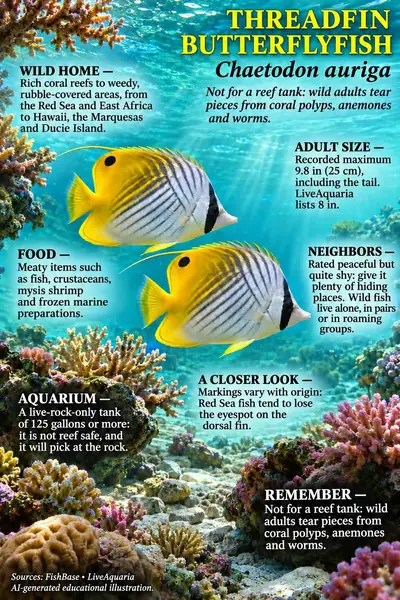
Threadfin butterflyfish
Chaetodon auriga
Not for a reef tank: wild adults tear pieces from coral polyps, anemones and worms.
Meet this fish →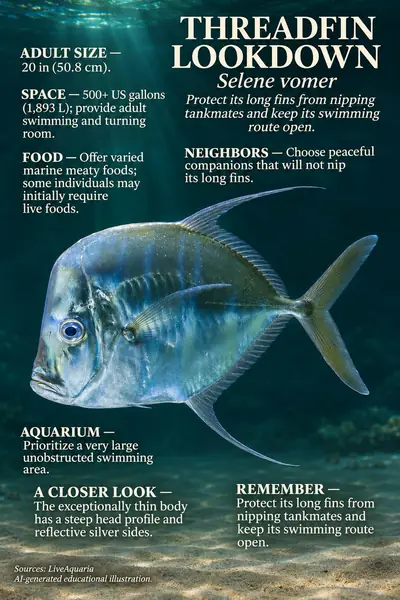
Threadfin lookdown
Selene vomer
Protect its long fins from nipping tankmates and keep its swimming route open.
Meet this fish →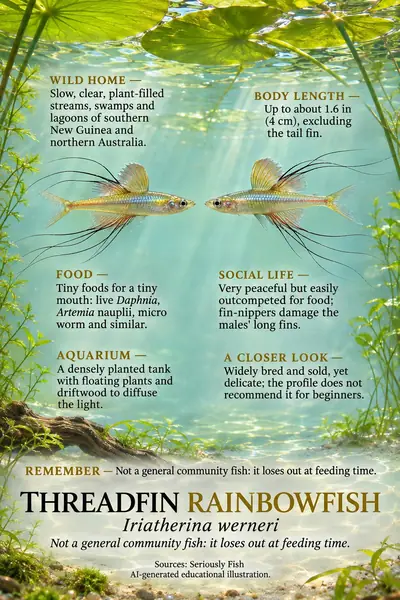
Threadfin rainbowfish
Iriatherina werneri
Not a general community fish: it loses out at feeding time.
Meet this fish →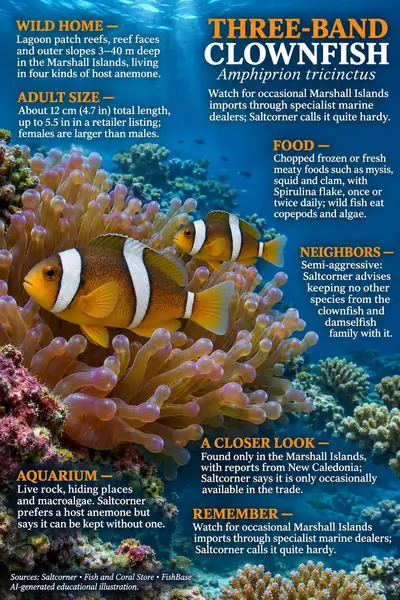
Three-band clownfish
Amphiprion tricinctus
Watch for occasional Marshall Islands imports through specialist marine dealers; Saltcorner calls it quite hardy.
Meet this fish →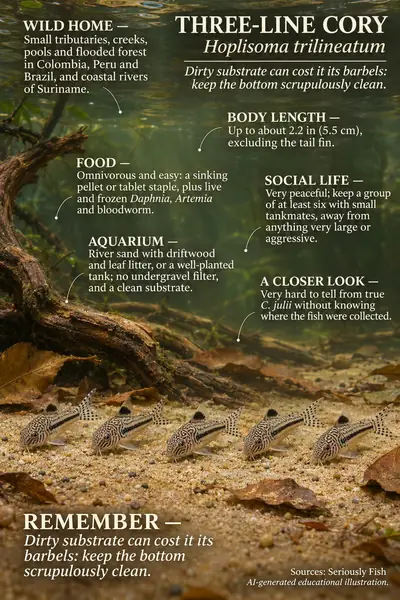
Three-line cory
Hoplisoma trilineatum
Dirty substrate can cost it its barbels: keep the bottom scrupulously clean.
Meet this fish →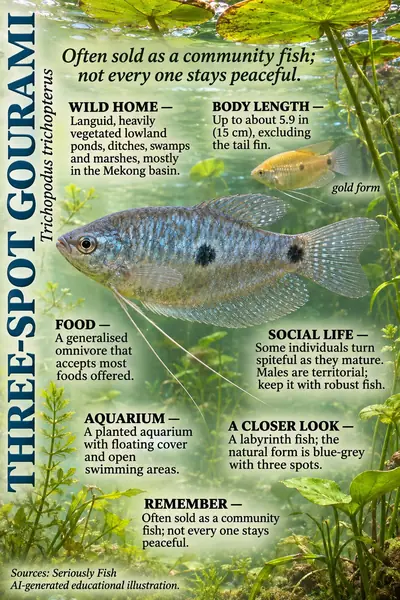
Three-spot gourami
Trichopodus trichopterus
Often sold as a community fish; not every one stays peaceful.
Meet this fish →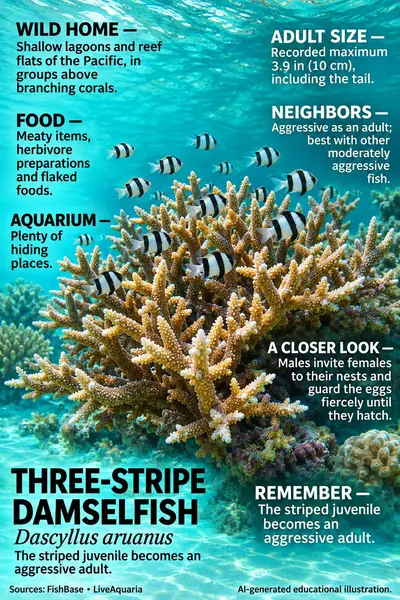
Three-stripe damselfish
Dascyllus aruanus
The striped juvenile becomes an aggressive adult.
Meet this fish →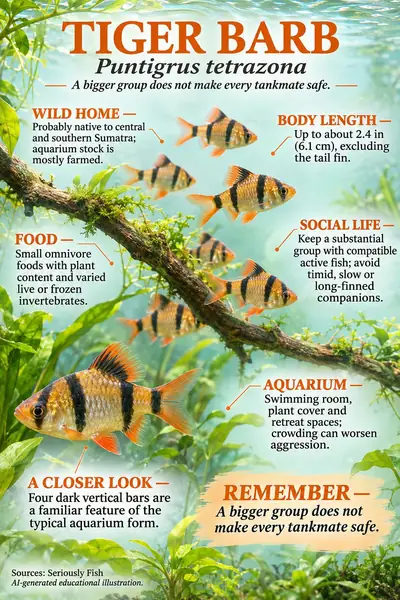
Tiger barb
Puntigrus tetrazona
A bigger group does not make every tankmate safe.
Meet this fish →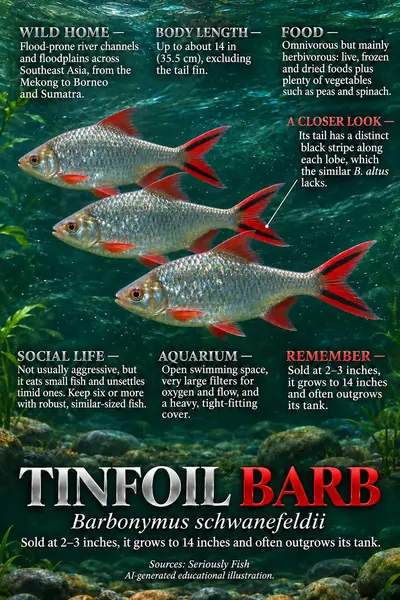
Tinfoil barb
Barbonymus schwanefeldii
Sold at 2–3 inches, it grows to 14 inches and often outgrows its tank.
Meet this fish →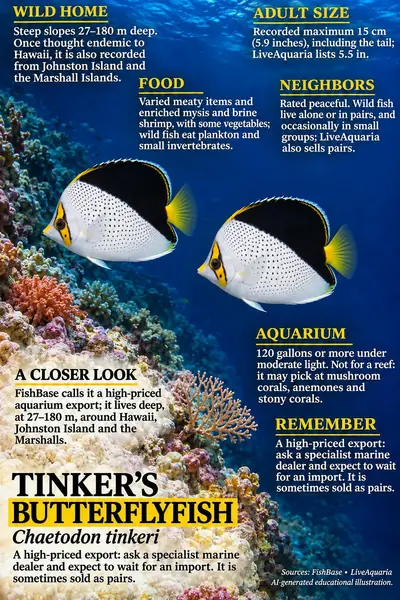
Tinker’s butterflyfish
Chaetodon tinkeri
A high-priced export: ask a specialist marine dealer and expect to wait for an import. It is sometimes sold as pairs.
Meet this fish →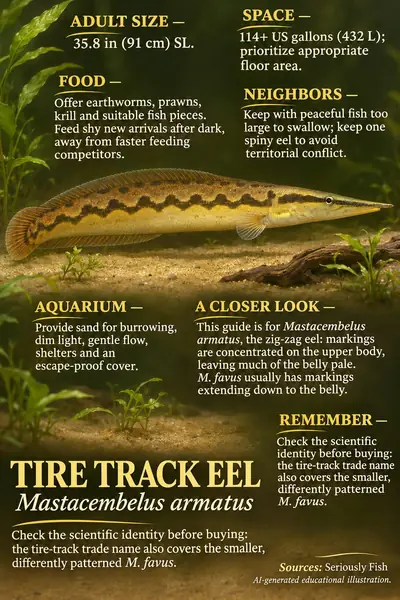
Tire track eel
Mastacembelus armatus
Check the scientific identity before buying: the tire-track trade name also covers the smaller, differently patterned M. favus.
Meet this fish →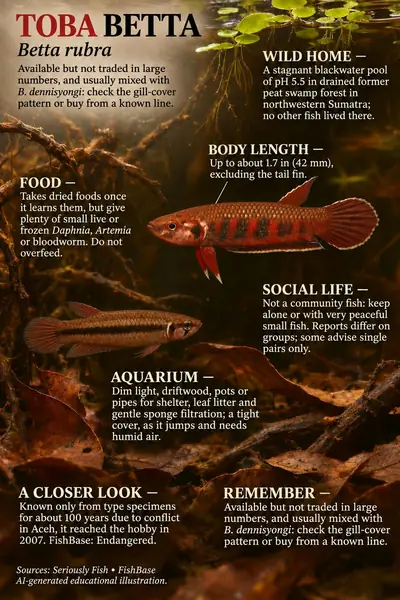
Toba betta
Betta rubra
Available but not traded in large numbers, and usually mixed with B. dennisyongi: check the gill-cover pattern or buy from a known line.
Meet this fish →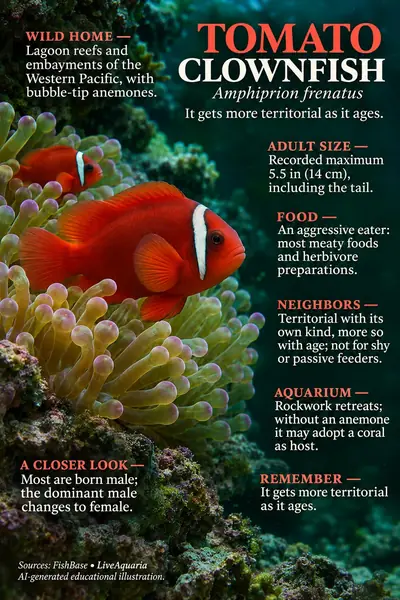
Tomato clownfish
Amphiprion frenatus
It gets more territorial as it ages.
Meet this fish →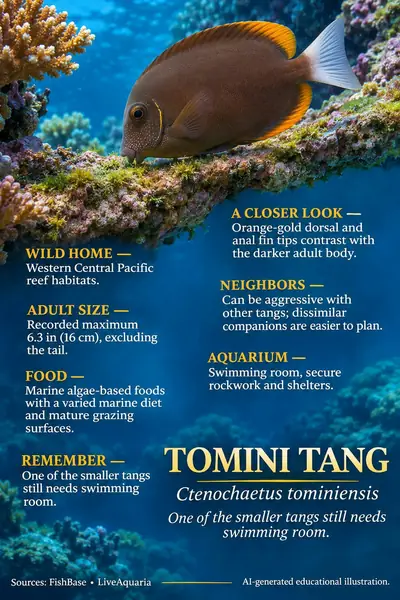
Tomini tang
Ctenochaetus tominiensis
One of the smaller tangs still needs swimming room.
Meet this fish →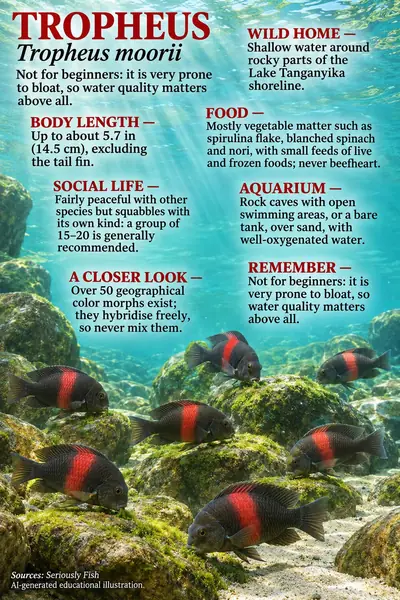
Tropheus
Tropheus moorii
Not for beginners: it is very prone to bloat, so water quality matters above all.
Meet this fish →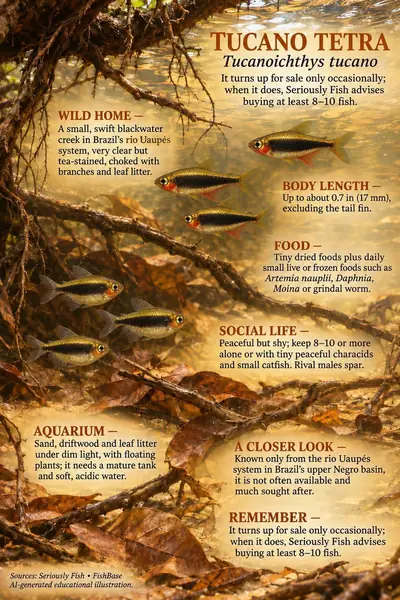
Tucano tetra
Tucanoichthys tucano
It turns up for sale only occasionally; when it does, Seriously Fish advises buying at least 8–10 fish.
Meet this fish →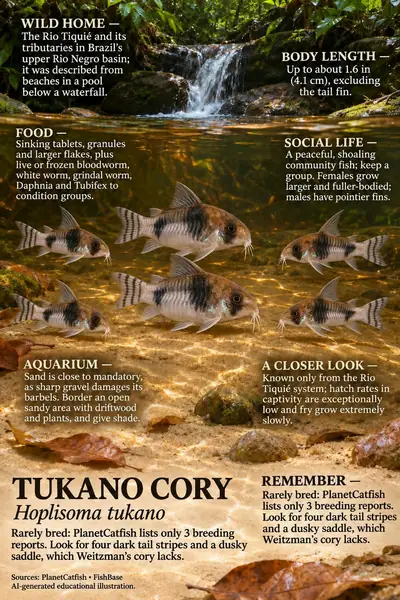
Tukano cory
Hoplisoma tukano
Rarely bred: PlanetCatfish lists only 3 breeding reports. Look for four dark tail stripes and a dusky saddle, which Weitzman’s cory lacks.
Meet this fish →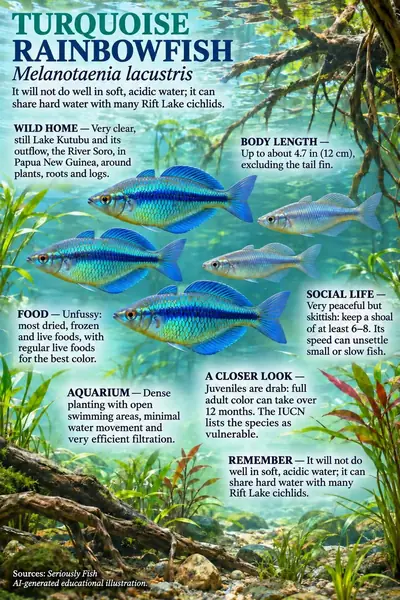
Turquoise rainbowfish
Melanotaenia lacustris
It will not do well in soft, acidic water; it can share hard water with many Rift Lake cichlids.
Meet this fish →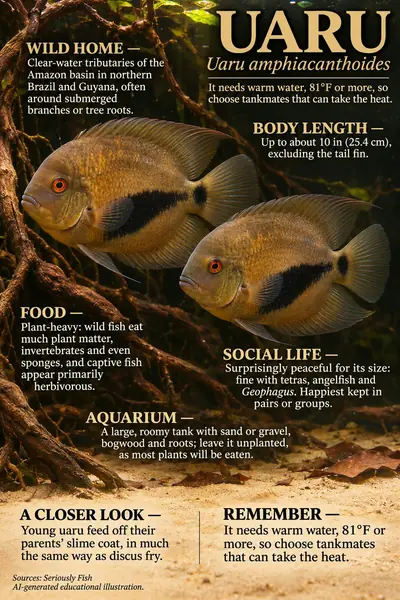
Uaru
Uaru amphiacanthoides
It needs warm water, 81°F or more, so choose tankmates that can take the heat.
Meet this fish →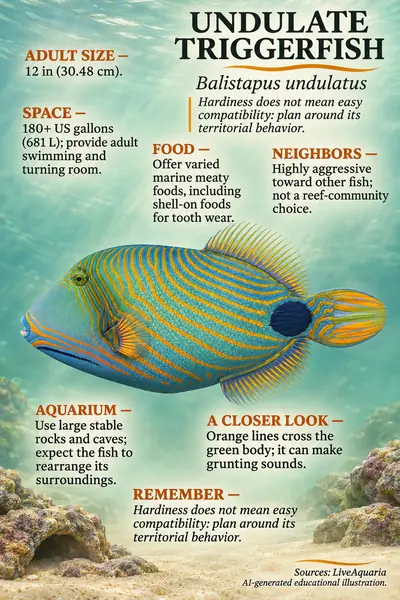
Undulate triggerfish
Balistapus undulatus
Hardiness does not mean easy compatibility: plan around its territorial behavior.
Meet this fish →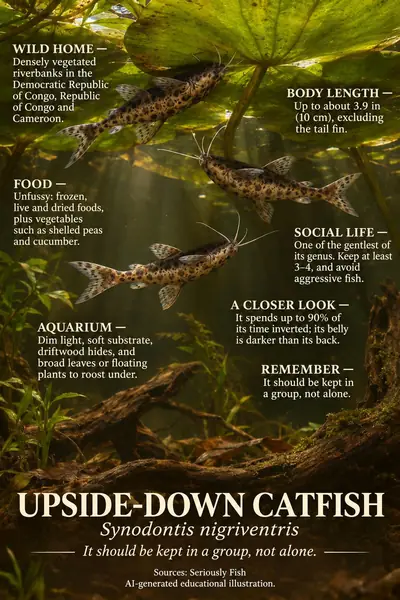
Upside-down catfish
Synodontis nigriventris
It should be kept in a group, not alone.
Meet this fish →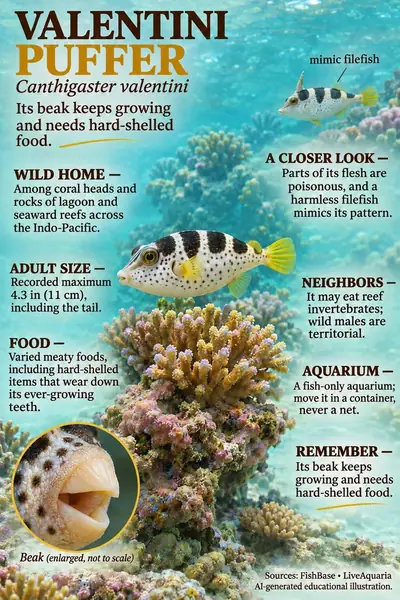
Valentini puffer
Canthigaster valentini
Its beak keeps growing and needs hard-shelled food.
Meet this fish →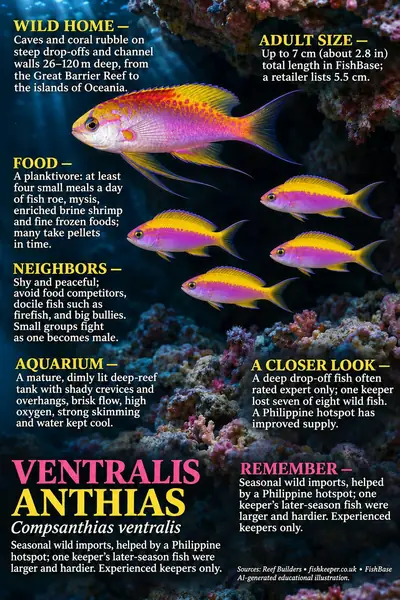
Ventralis anthias
Compsanthias ventralis
Seasonal wild imports, helped by a Philippine hotspot; one keeper’s later-season fish were larger and hardier. Experienced keepers only.
Meet this fish →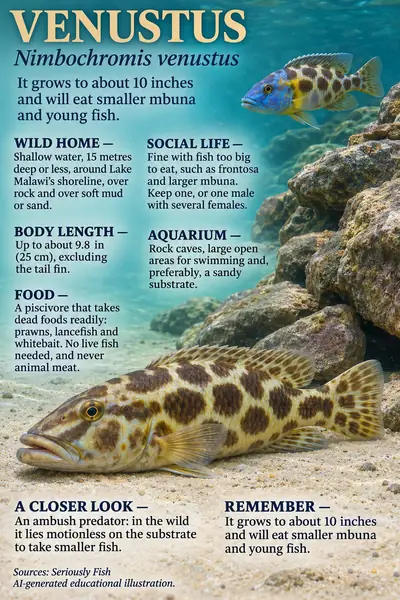
Venustus
Nimbochromis venustus
It grows to about 10 inches and will eat smaller mbuna and young fish.
Meet this fish →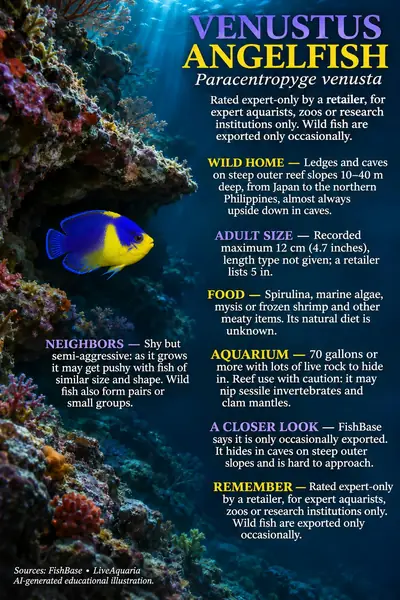
Venustus angelfish
Paracentropyge venusta
Rated expert-only by a retailer, for expert aquarists, zoos or research institutions only. Wild fish are exported only occasionally.
Meet this fish →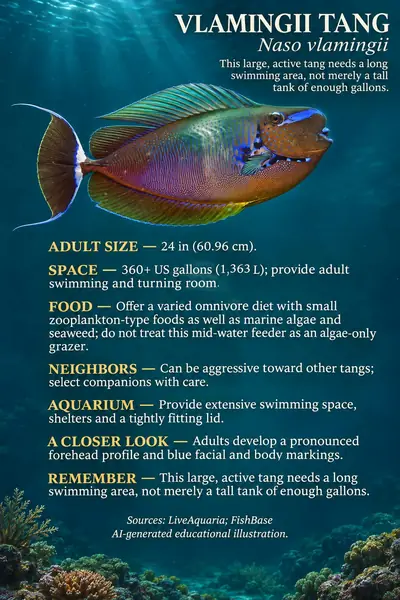
Vlamingii tang
Naso vlamingii
This large, active tang needs a long swimming area, not merely a tall tank of enough gallons.
Meet this fish →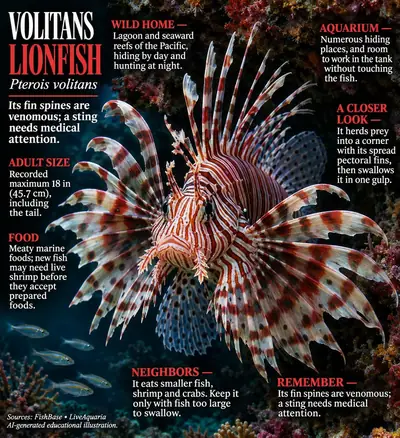
Volitans lionfish
Pterois volitans
Its fin spines are venomous; a sting needs medical attention.
Meet this fish →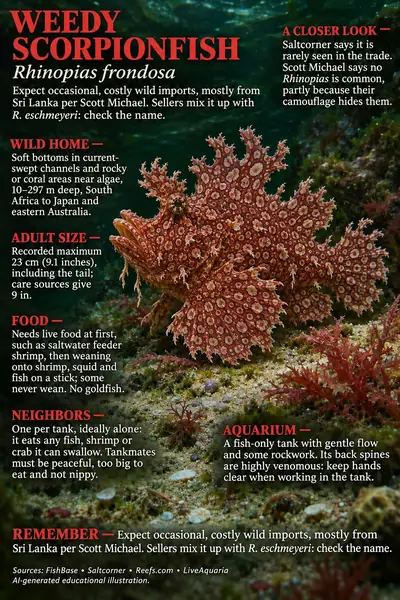
Weedy scorpionfish
Rhinopias frondosa
Expect occasional, costly wild imports, mostly from Sri Lanka per Scott Michael. Sellers mix it up with R. eschmeyeri: check the name.
Meet this fish →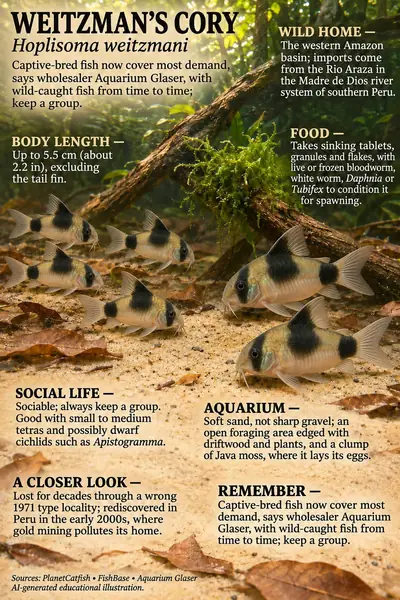
Weitzman’s cory
Hoplisoma weitzmani
Captive-bred fish now cover most demand, says wholesaler Aquarium Glaser, with wild-caught fish from time to time; keep a group.
Meet this fish →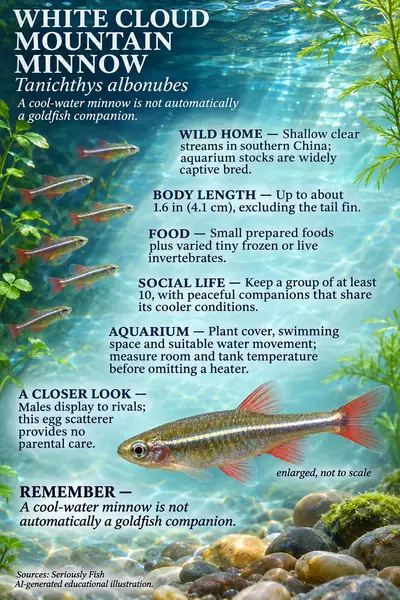
White Cloud Mountain minnow
Tanichthys albonubes
A cool-water minnow is not automatically a goldfish companion.
Meet this fish →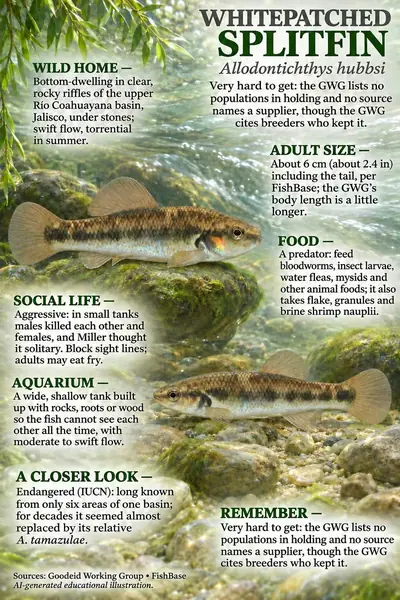
Whitepatched splitfin
Allodontichthys hubbsi
Very hard to get: the GWG lists no populations in holding and no source names a supplier, though the GWG cites breeders who kept it.
Meet this fish →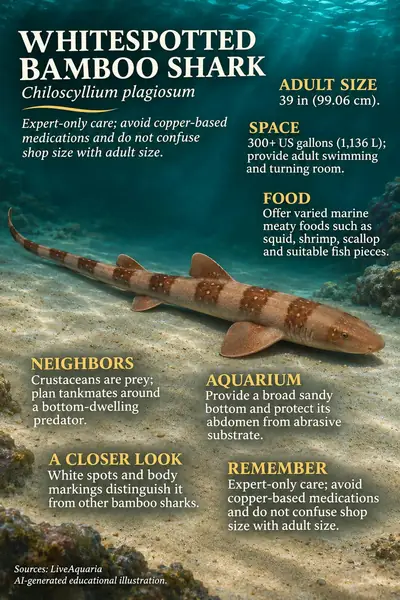
Whitespotted bamboo shark
Chiloscyllium plagiosum
Expert-only care; avoid copper-based medications and do not confuse shop size with adult size.
Meet this fish →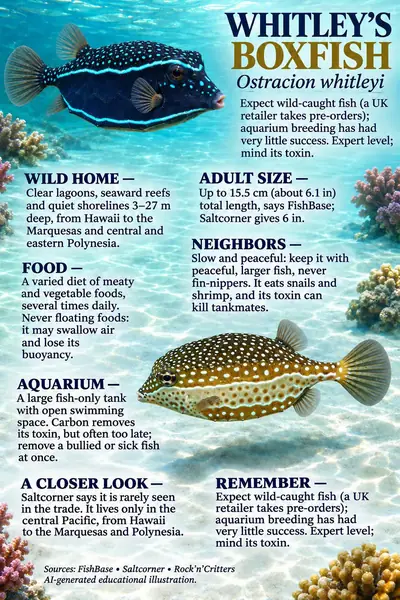
Whitley’s boxfish
Ostracion whitleyi
Expect wild-caught fish (a UK retailer takes pre-orders); aquarium breeding has had very little success. Expert level; mind its toxin.
Meet this fish →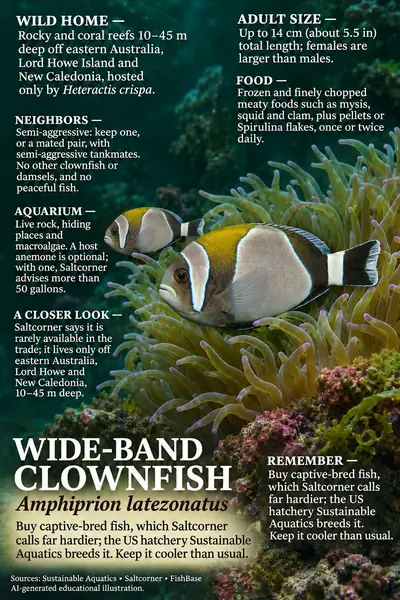
Wide-band clownfish
Amphiprion latezonatus
Buy captive-bred fish, which Saltcorner calls far hardier; the US hatchery Sustainable Aquatics breeds it. Keep it cooler than usual.
Meet this fish →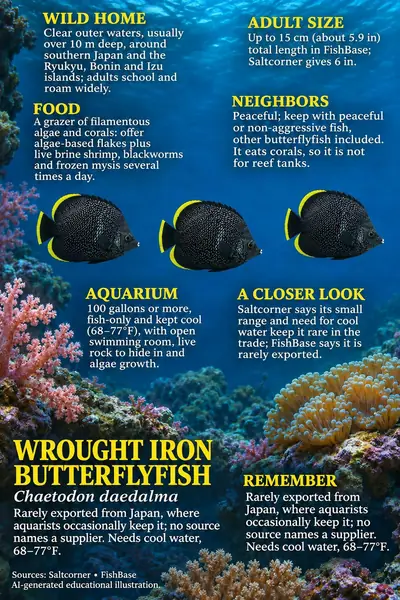
Wrought iron butterflyfish
Chaetodon daedalma
Rarely exported from Japan, where aquarists occasionally keep it; no source names a supplier. Needs cool water, 68–77°F.
Meet this fish →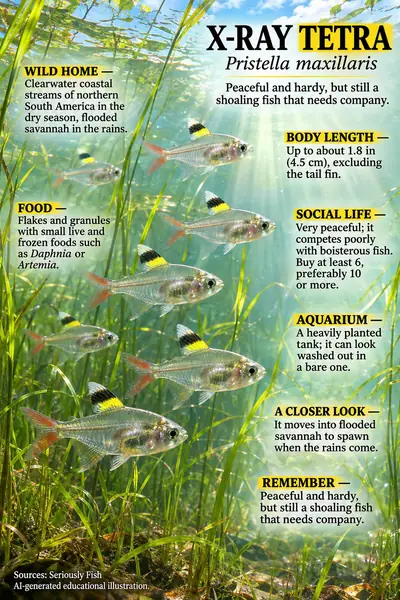
X-ray tetra
Pristella maxillaris
Peaceful and hardy, but still a shoaling fish that needs company.
Meet this fish →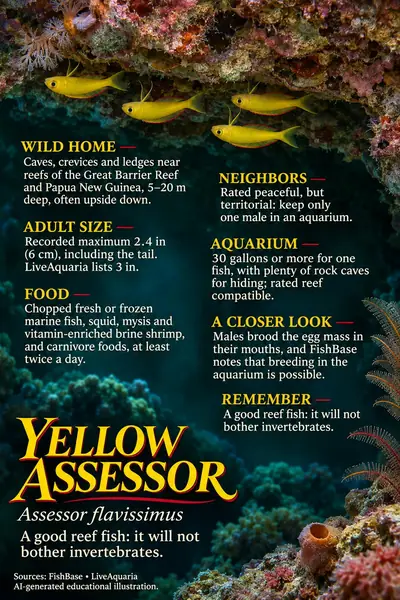
Yellow assessor
Assessor flavissimus
A good reef fish: it will not bother invertebrates.
Meet this fish →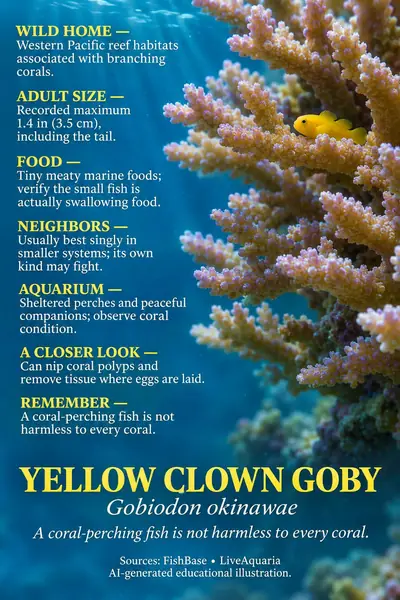
Yellow clown goby
Gobiodon okinawae
A coral-perching fish is not harmless to every coral.
Meet this fish →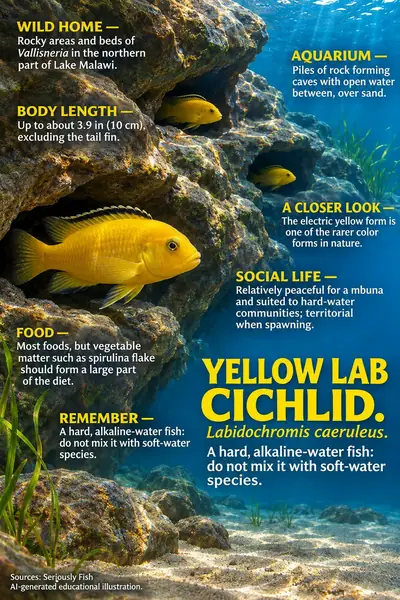
Yellow lab cichlid
Labidochromis caeruleus
A hard, alkaline-water fish: do not mix it with soft-water species.
Meet this fish →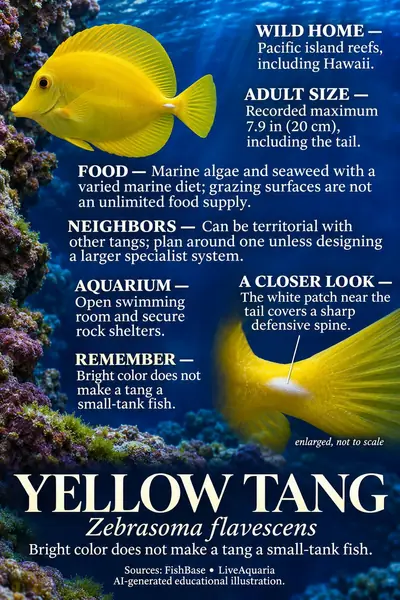
Yellow tang
Zebrasoma flavescens
Bright color does not make a tang a small-tank fish.
Meet this fish →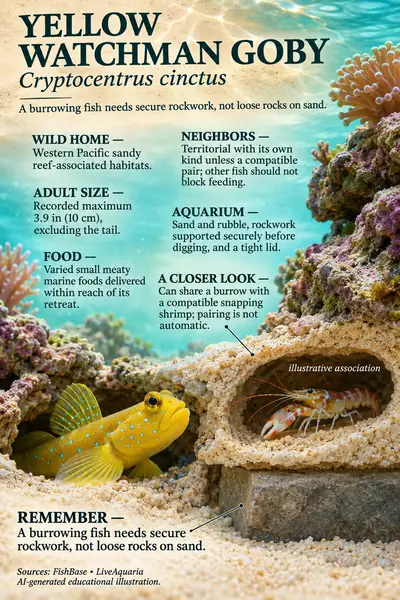
Yellow watchman goby
Cryptocentrus cinctus
A burrowing fish needs secure rockwork, not loose rocks on sand.
Meet this fish →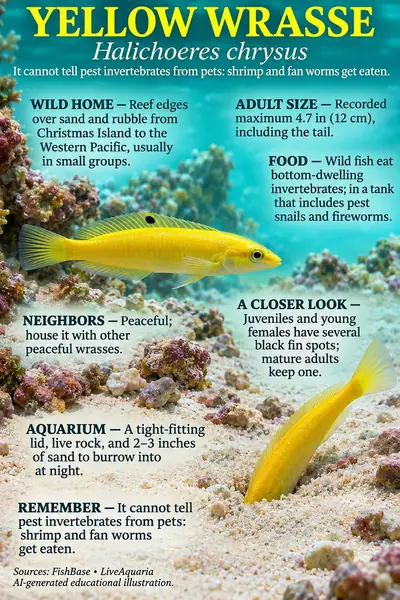
Yellow wrasse
Halichoeres chrysus
It cannot tell pest invertebrates from pets: shrimp and fan worms get eaten.
Meet this fish →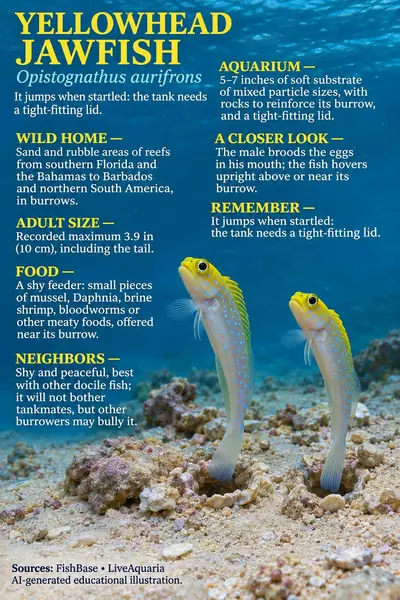
Yellowhead jawfish
Opistognathus aurifrons
It jumps when startled: the tank needs a tight-fitting lid.
Meet this fish →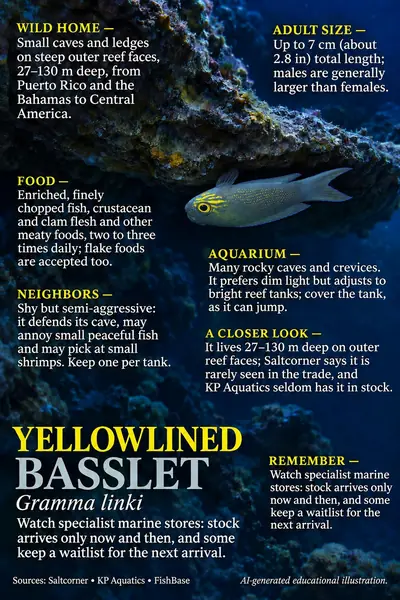
Yellowlined basslet
Gramma linki
Watch specialist marine stores: stock arrives only now and then, and some keep a waitlist for the next arrival.
Meet this fish →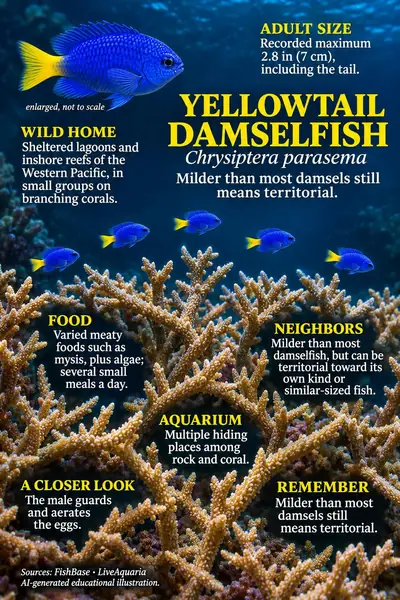
Yellowtail damselfish
Chrysiptera parasema
Milder than most damsels still means territorial.
Meet this fish →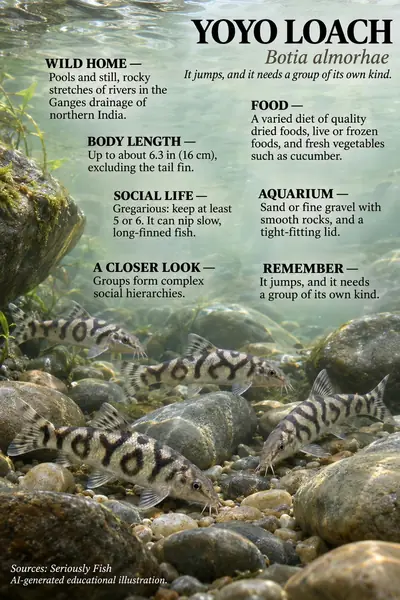
Yoyo loach
Botia almorhae
It jumps, and it needs a group of its own kind.
Meet this fish →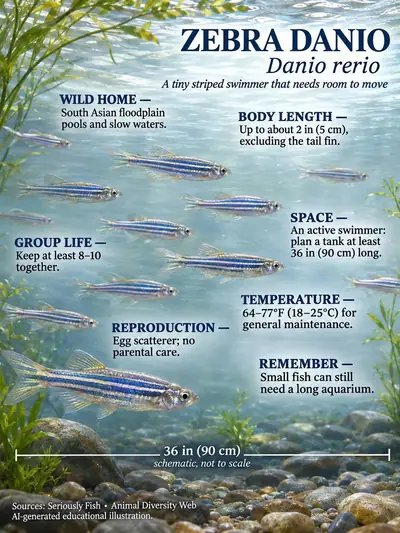
Zebra danio
Danio rerio
A tiny striped swimmer that needs room to move
Meet this fish →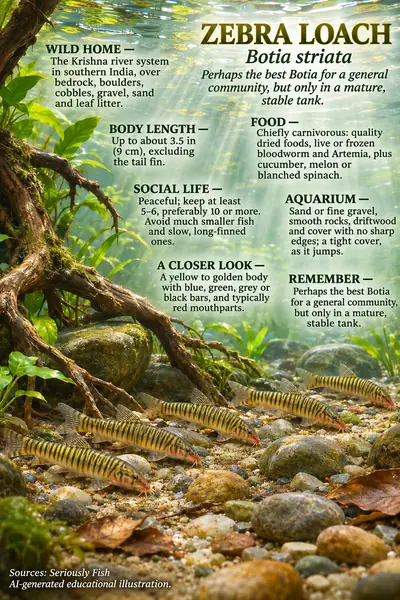
Zebra loach
Botia striata
Perhaps the best Botia for a general community, but only in a mature, stable tank.
Meet this fish →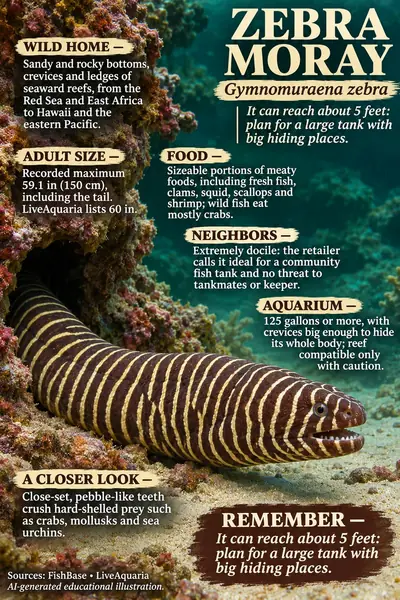
Zebra moray
Gymnomuraena zebra
It can reach about 5 feet: plan for a large tank with big hiding places.
Meet this fish →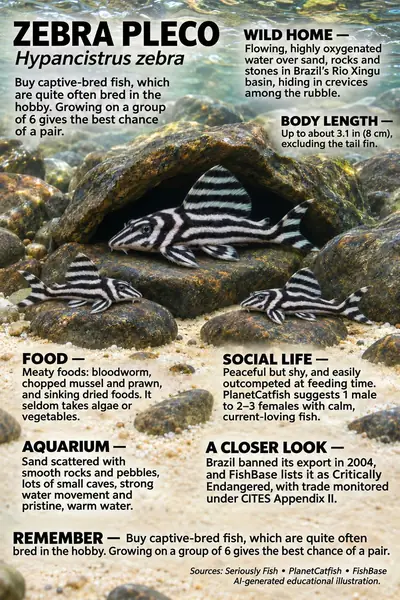
Zebra pleco
Hypancistrus zebra
Buy captive-bred fish, which are quite often bred in the hobby. Growing on a group of 6 gives the best chance of a pair.
Meet this fish →No matching fish in this first collection.
Source-checked November 12, 2026. AI-generated educational illustrations, not documentary photographs. Care recommendations are guidance, not guarantees. Ask about your specific aquarium before buying.