
At a glance
- Adult size
- About 2.8 in body length
- Space
- 24 × 12 in base for a pair; larger for a group
- Social needs
- Relatively non-aggressive and fine in a group. Seriously Fish prefers it alone, but hard-water goodeids, Xiphophorus or Poecilia suit.
Starting guidance, not a universal minimum. See the care details and sources below.
Adult size
Seriously Fish gives a maximum standard length of 70 mm (2.8 inches), excluding the tail fin; FishBase gives 8 cm total length.
Aquarium space
Seriously Fish calls a 24 × 12 in (60 × 30 cm) base, about 54 litres (14 US gallons), just about acceptable for a single pair; like most pupfish it does best as a group in a larger tank.
Water conditions
Seriously Fish lists 68–86°F (20–30°C), pH 7.5–8.5 and 45–53 dGH. Very hard water is the key to breeding: adults may survive soft water, but egg development suffers, and its best results came with chunks of pure gypsum rock dissolving in the water. FishBase gives 28–30°C. These are maintenance ranges, not targets to swing between; avoid abrupt changes.
Natural home
Shallow margins of crystal-clear, very hard, spring-fed pools in Mexico’s Río Verde valley, including the Media Luna lagoon.
Food and feeding
Dried foods plus regular small live or frozen Artemia, Daphnia or bloodworm, and algae or an algae-rich dried food.
Tankmates and behavior
Relatively non-aggressive and fine in a group. Seriously Fish prefers it alone, but hard-water goodeids, Xiphophorus or Poecilia suit.
Setting up the habitat
Plenty of plants or wool mops for cover and broken sightlines, air-powered sponge filtration, and filamentous algae if possible.
A closer look
Found only in a handful of springs in Mexico’s Río Verde valley; FishBase and CARES list it as Vulnerable, and it is rarely available.
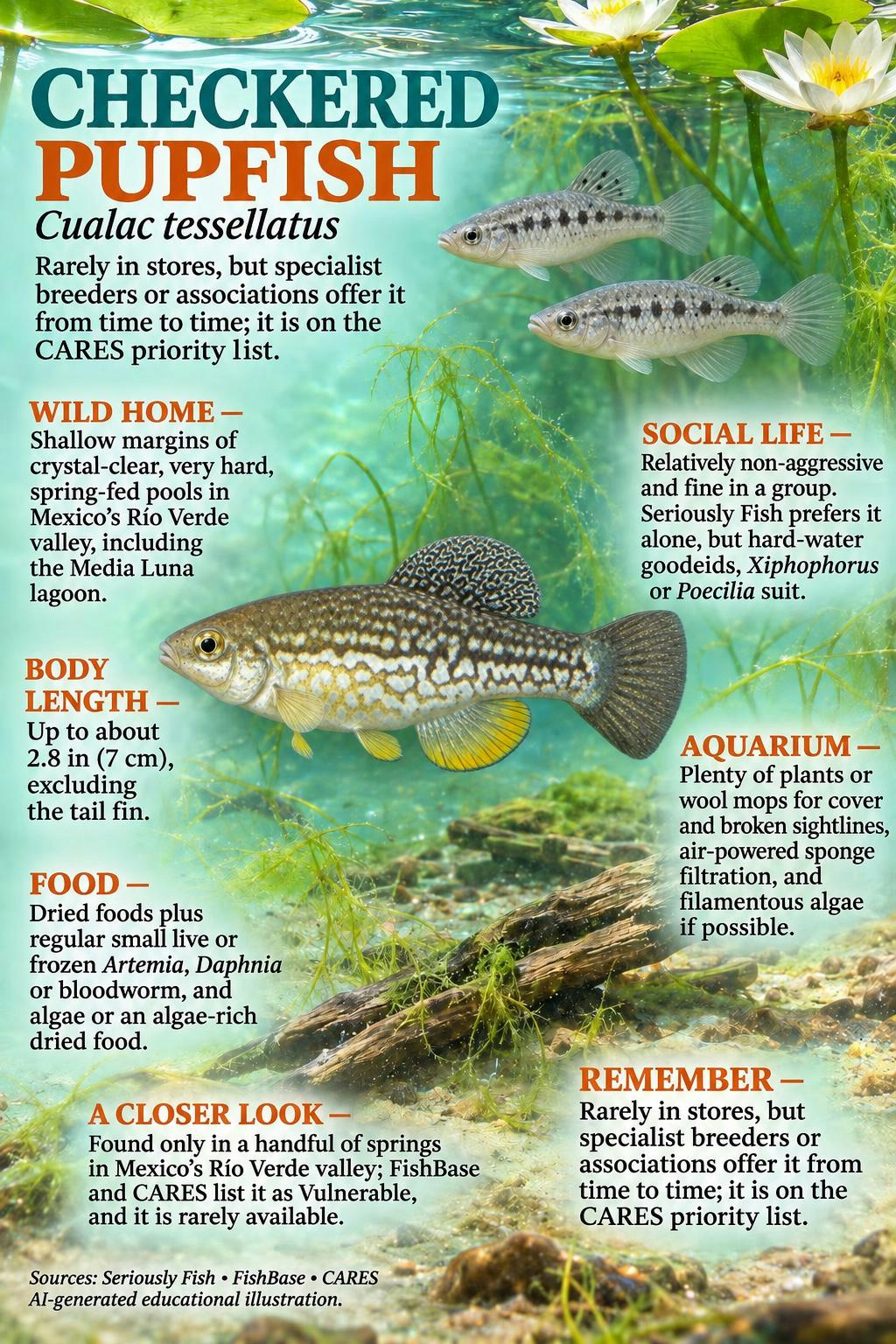
Read the infographic as text
- WILD HOME — Shallow margins of crystal-clear, very hard, spring-fed pools in Mexico’s Río Verde valley, including the Media Luna lagoon.
- BODY LENGTH — Up to about 2.8 in (7 cm), excluding the tail fin.
- FOOD — Dried foods plus regular small live or frozen Artemia, Daphnia or bloodworm, and algae or an algae-rich dried food.
- SOCIAL LIFE — Relatively non-aggressive and fine in a group. Seriously Fish prefers it alone, but hard-water goodeids, Xiphophorus or Poecilia suit.
- AQUARIUM — Plenty of plants or wool mops for cover and broken sightlines, air-powered sponge filtration, and filamentous algae if possible.
- A CLOSER LOOK — Found only in a handful of springs in Mexico’s Río Verde valley; FishBase and CARES list it as Vulnerable, and it is rarely available.
- REMEMBER — Rarely in stores, but specialist breeders or associations offer it from time to time; it is on the CARES priority list.
How to use these figures
Published care ranges and suggested tank sizes are starting points, not guarantees. Tank footprint, group size, filtration, feeding, companions and the individual fish all matter. Standard length excludes the tail fin. Do not abruptly change established water conditions to match a number on a page.
Use a cycled aquarium, monitor water quality and quarantine new arrivals using a suitable species-specific plan. Persistent appetite loss, rapid breathing or weight loss warrants investigation.
Common questions
What should I know before choosing this fish?
Rarely in stores, but specialist breeders or associations offer it from time to time; it is on the CARES priority list. Relatively non-aggressive and fine in a group. Seriously Fish prefers it alone, but hard-water goodeids, Xiphophorus or Poecilia suit.
What should I feed it?
Dried foods plus regular small live or frozen Artemia, Daphnia or bloodworm, and algae or an algae-rich dried food.
Why is it rare?
Found only in a handful of springs in Mexico’s Río Verde valley; FishBase and CARES list it as Vulnerable, and it is rarely available.
Sources & review
Checked November 12, 2026. Retailer care guidance is not a universal biological minimum.