
At a glance
- Adult size
- About 2 in body length
- Space
- 24 × 12 in base for a pair; larger for a group
- Social needs
- Aggressive to each other (Citizen Conservation): keep extra females in a well-structured tank. Killis Pratique: fine in a group.
Starting guidance, not a universal minimum. See the care details and sources below.
Adult size
Seriously Fish reports a maximum standard length of 50 mm (about 2.0 inches), excluding the tail fin; FishBase gives 5.5 cm total length, Citizen Conservation no more than five and a half centimetres, and Killis Pratique 5 cm.
Aquarium space
Citizen Conservation keeps larger groups, with extra females, in tanks at least 80 cm (about 31.5 inches) long, and breeds pairs or trios in tanks 40 cm (about 15.7 inches) long. Seriously Fish calls a 24 × 12 in (60 × 30 cm) base, about 54 litres (14 US gallons), just about acceptable for one pair. Citizen Conservation says outdoor tubs work from April to October; Killis Pratique says outdoor ponds suit it as long as they do not freeze.
Water conditions
Seriously Fish records no temperature, pH or hardness. Citizen Conservation asks for very hard, alkaline water above pH 7.5. Killis Pratique gives hard to very hard water of 2000–3000 microsiemens/cm (it says tap water with some salt water added can be used), a tolerance of 4–35°C (39–95°F) and breeding from 14°C (57°F). No source gives an ideal temperature range; the wild spring ran at about 19–20°C (66–68°F). Treat these as limits, not targets; avoid abrupt changes.
Natural home
One cool, crystal-clear desert spring in Nuevo León, Mexico, about 1,600 m up, with hornwort and pondweed; it dried up in the 1990s.
Food and feeding
Only Killis Pratique gives a diet: live, frozen and dried foods, plant-based dried food indoors, and filamentous algae to graze outdoors.
Tankmates and behavior
Aggressive to each other (Citizen Conservation): keep extra females in a well-structured tank. Killis Pratique: fine in a group.
Setting up the habitat
Plenty of plants or wool mops to break sightlines, filamentous algae, and air-driven sponge filters that will not harm eggs or fry.
A closer look
Groundwater pumping for farming dried its only spring in the 1990s; it is Extinct in the Wild and survives only in aquariums.
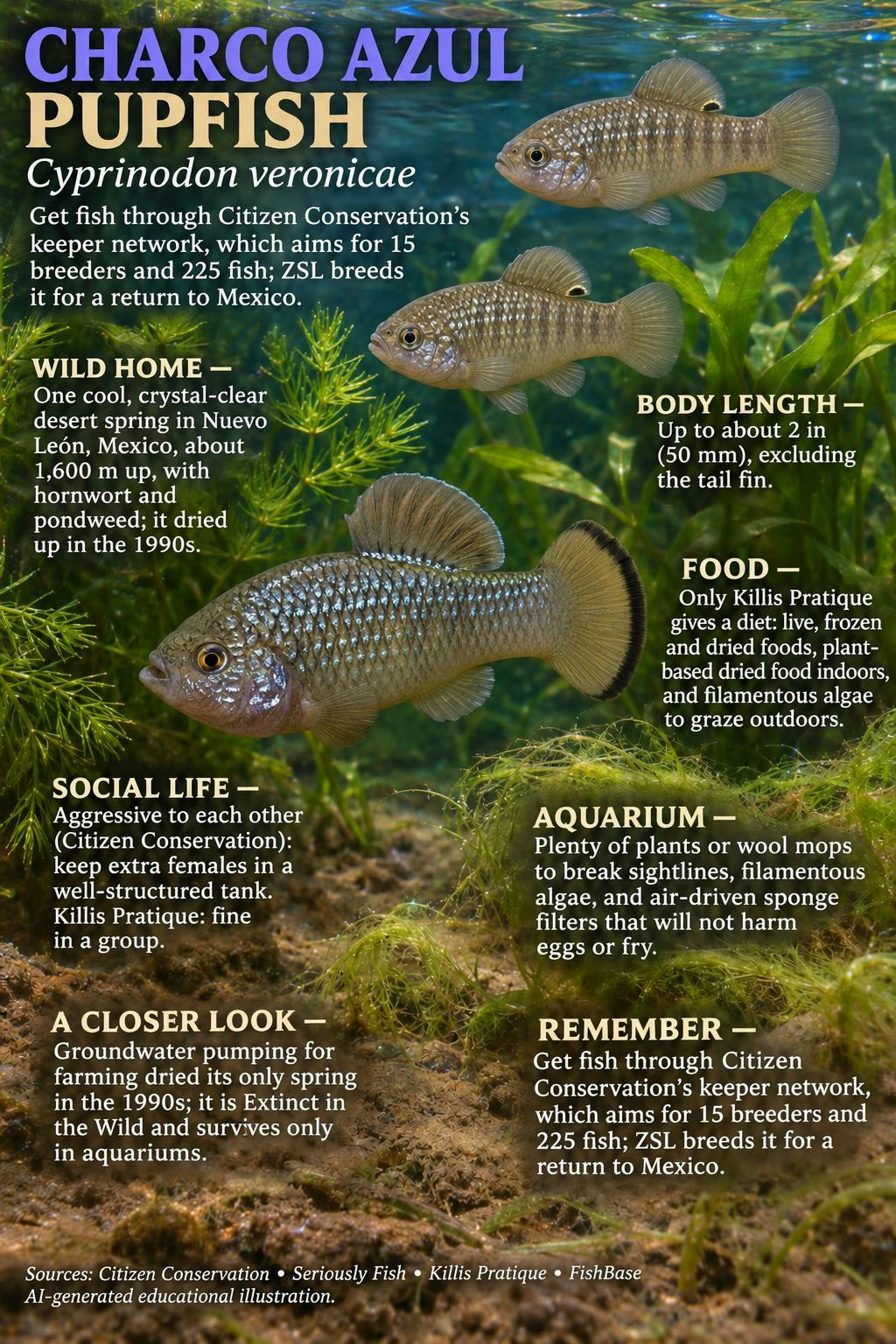
Read the infographic as text
- WILD HOME — One cool, crystal-clear desert spring in Nuevo León, Mexico, about 1,600 m up, with hornwort and pondweed; it dried up in the 1990s.
- BODY LENGTH — Up to about 2 in (50 mm), excluding the tail fin.
- FOOD — Only Killis Pratique gives a diet: live, frozen and dried foods, plant-based dried food indoors, and filamentous algae to graze outdoors.
- SOCIAL LIFE — Aggressive to each other (Citizen Conservation): keep extra females in a well-structured tank. Killis Pratique: fine in a group.
- AQUARIUM — Plenty of plants or wool mops to break sightlines, filamentous algae, and air-driven sponge filters that will not harm eggs or fry.
- A CLOSER LOOK — Groundwater pumping for farming dried its only spring in the 1990s; it is Extinct in the Wild and survives only in aquariums.
- REMEMBER — Get fish through Citizen Conservation’s keeper network, which aims for 15 breeders and 225 fish; ZSL breeds it for a return to Mexico.
How to use these figures
Published care ranges and suggested tank sizes are starting points, not guarantees. Tank footprint, group size, filtration, feeding, companions and the individual fish all matter. Standard length excludes the tail fin. Do not abruptly change established water conditions to match a number on a page.
Use a cycled aquarium, monitor water quality and quarantine new arrivals using a suitable species-specific plan. Persistent appetite loss, rapid breathing or weight loss warrants investigation.
Common questions
What should I know before choosing this fish?
Get fish through Citizen Conservation’s keeper network, which aims for 15 breeders and 225 fish; ZSL breeds it for a return to Mexico. Aggressive to each other (Citizen Conservation): keep extra females in a well-structured tank. Killis Pratique: fine in a group.
What should I feed it?
Only Killis Pratique gives a diet: live, frozen and dried foods, plant-based dried food indoors, and filamentous algae to graze outdoors.
Why is it rare?
Groundwater pumping for farming dried its only spring in the 1990s; it is Extinct in the Wild and survives only in aquariums.
Sources & review
Checked November 12, 2026. Retailer care guidance is not a universal biological minimum.