
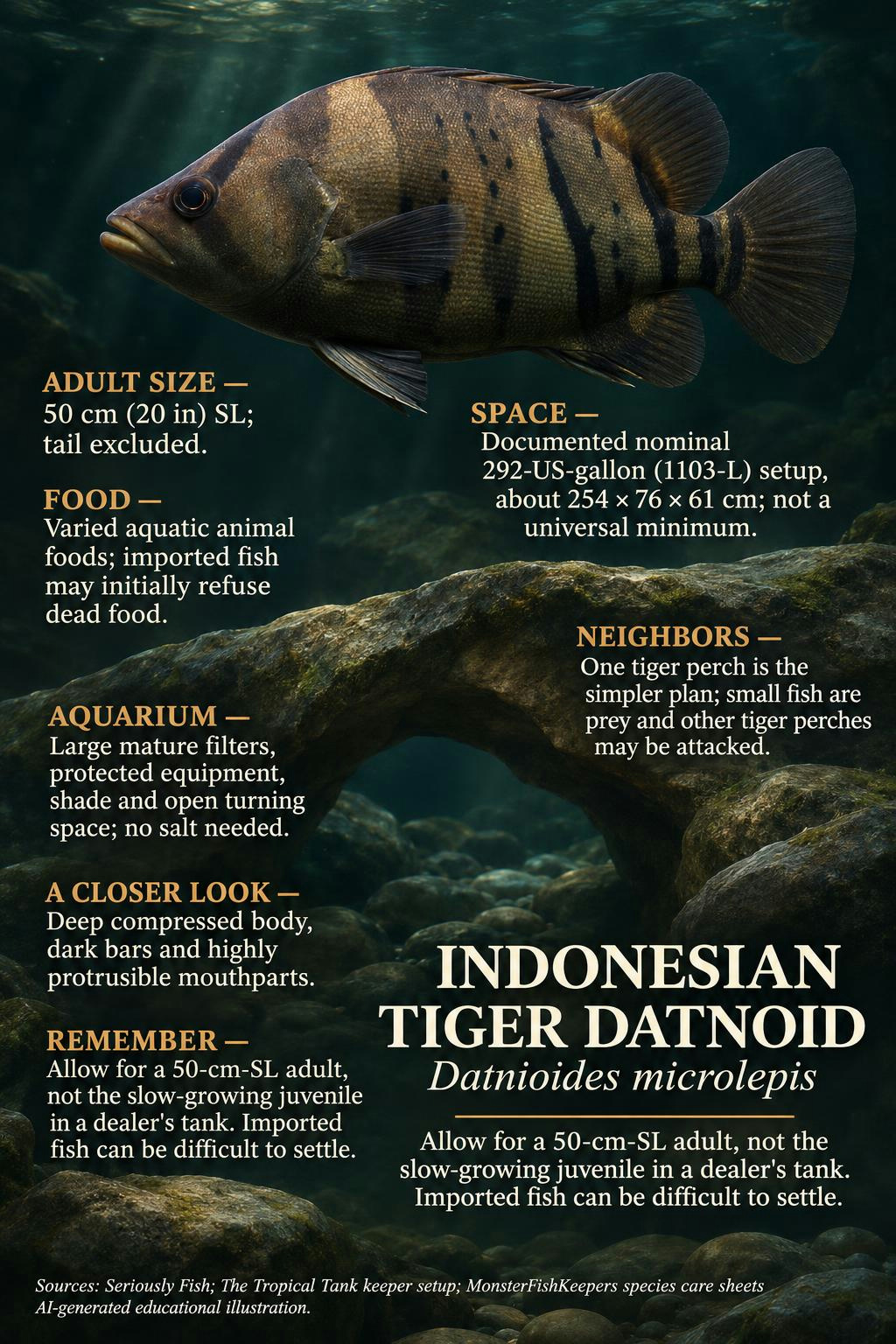
At a glance
- Adult size
- 50 cm (20 in) SL
- Space
- Keeper example: nominal 292 US gal (1103 L), approx 254 × 76 × 61 cm; see caveats
- Social needs
- One tiger perch; predatory and potentially aggressive toward similar fish
Starting guidance, not a universal minimum. See the care details and sources below.
Adult size
50 cm (20 in) standard length in Seriously Fish; this excludes the tail. Do not budget only for the smaller sizes usually seen for sale.
Aquarium space
A documented multi-year tiger-perch setup is nominally 292 US gallons (1103 L), approximately 8 ft 4 in × 2.5 ft × 2 ft (254 × 76 × 61 cm). It held D. microlepis from 8 to 16 inches. Treat this as a keeper example with an explicit footprint, not a universal minimum or proof of maximum-size lifelong success. The listed dimensions give about 311 US gallons (1178 L) gross, so the source's nominal capacity and geometry are not identical. Use a long, broad enclosure with unobstructed turning room and substantial filtration; reassess clearance as the fish grows.
Water conditions
Seriously Fish gives 68–82°F (20–28°C), pH 5.5–7.5 and 2–15 dGH. The documented keeper system ran at 79°F (26°C), pH 7.0–7.4 and 3 dGH. Prioritize stable, clean, well-oxygenated water.
Natural home
Large, deep lowland freshwater rivers of Peninsular Malaysia, Sumatra and Indonesian Borneo, including the Perak, Selangor, Batang Hari, Musi and Kapuas systems. It also uses seasonally flooded forest.
Food and feeding
Offer varied fish flesh, prawns, mussels, river shrimp and earthworms. Newly imported fish may refuse unfamiliar food; establish feeding before purchase and work toward appropriate non-live foods. Established adults generally need two or three meals a week, not constant feeding. Avoid beef heart, poultry and routine feeder goldfish.
Tankmates and behavior
For a single-specimen guide, keep one tiger perch. Adults can fight their own kind and similarly shaped fish; small fish are prey. Comparably sized, non-bullying tankmates may work with enough space, but the historical mixed-group example is not a stocking prescription.
Setting up the habitat
Provide shaded retreats and some overhead cover while leaving the main swimming area open. Use large mature external filters or a sump, strong oxygenation, regular water changes and protected heaters. This is a freshwater fish: marine salt is unnecessary at every life stage.
A closer look
Its fine scales, deep compressed body and protrusible mouth suit an ambush predator. Body bars can fade into dark margins or spots with stress or at night. Indonesian populations vary in banding; do not label every three-bar fish D. pulcher.
Read the infographic as text
- ADULT SIZE — 50 cm (20 in) SL; tail excluded.
- SPACE — Documented nominal 292-US-gallon (1103-L) setup, about 254 × 76 × 61 cm; not a universal minimum.
- FOOD — Varied aquatic animal foods; imported fish may initially refuse dead food.
- NEIGHBORS — One tiger perch is the simpler plan; small fish are prey and other tiger perches may be attacked.
- AQUARIUM — Large mature filters, protected equipment, shade and open turning space; no salt needed.
- A CLOSER LOOK — Deep compressed body, dark bars and highly protrusible mouthparts.
- REMEMBER — Allow for a 50-cm-SL adult, not the slow-growing juvenile in a dealer's tank. Imported fish can be difficult to settle.
How to use these figures
Published care ranges and suggested tank sizes are starting points, not guarantees. Tank footprint, group size, filtration, feeding, companions and the individual fish all matter. Standard length excludes the tail fin. Do not abruptly change established water conditions to match a number on a page.
Use a cycled aquarium, monitor water quality and quarantine new arrivals using a suitable species-specific plan. Persistent appetite loss, rapid breathing or weight loss warrants investigation.
Common questions
How much space does an adult need?
A documented multi-year tiger-perch setup is nominally 292 US gallons (1103 L), approximately 8 ft 4 in × 2.5 ft × 2 ft (254 × 76 × 61 cm). It held D. microlepis from 8 to 16 inches. Treat this as a keeper example with an explicit footprint, not a universal minimum or proof of maximum-size lifelong success. The listed dimensions give about 311 US gallons (1178 L) gross, so the source's nominal capacity and geometry are not identical. Use a long, broad enclosure with unobstructed turning room and substantial filtration; reassess clearance as the fish grows.
Does it need brackish water?
No. Both the specialist profile and the documented keeper setup treat this species as freshwater; marine salt is unnecessary.
Can I keep several tiger perches together?
For a single-specimen guide, keep one tiger perch. Adults can fight their own kind and similarly shaped fish; small fish are prey. Comparably sized, non-bullying tankmates may work with enough space, but the historical mixed-group example is not a stocking prescription.
What should I feed it?
Offer varied fish flesh, prawns, mussels, river shrimp and earthworms. Newly imported fish may refuse unfamiliar food; establish feeding before purchase and work toward appropriate non-live foods. Established adults generally need two or three meals a week, not constant feeding. Avoid beef heart, poultry and routine feeder goldfish.
Sources & review
Checked November 12, 2026. Retailer care guidance is not a universal biological minimum.