
At a glance
- Adult size
- Usually under 6 cm SL; up to 6.5–8 cm
- Space
- 35 litres (about 9 US gallons) for 8–10 fish
- Social needs
- Peaceful, with small peaceful fish, but not other Melanotaenia: ANGFA says captive males readily spawn with other species’ females.
Starting guidance, not a universal minimum. See the care details and sources below.
Adult size
FishBase records a maximum standard length of 6.5 cm (about 2.6 inches), excluding the tail fin. ANGFA says it may reach 8 cm SL but is usually under 6 cm; AquaticCommunity gives 6.5 cm.
Aquarium space
AquaticCommunity says 35 litres (about 9 US gallons) can comfortably house 8–10 fish; it prints this as 10 gallons. No other source gives a tank size.
Water conditions
AquaticCommunity lists 23–27°C (73–81°F) and pH 7.0–7.4, neutral to slightly alkaline, matching FishBase’s wild figures. No source gives a hardness; ANGFA records 18–28°C in Lake Eacham. These are maintenance ranges, not targets to swing between; avoid abrupt changes.
Natural home
Small creeks and crater lakes on the Atherton Tableland, northern Queensland, along shallow edges among plants, fallen logs and branches.
Food and feeding
None of the sources gives a diet for this species: ANGFA and AquaticCommunity cover its history, size and water, not its food.
Tankmates and behavior
Peaceful, with small peaceful fish, but not other Melanotaenia: ANGFA says captive males readily spawn with other species’ females.
Setting up the habitat
A small planted tank will do. It spawns readily over java moss or spawning mops; keep a pair, or two to three females per male.
A closer look
Translocated predators wiped it out of Lake Eacham; declared extinct in the wild in 1987, it was later found elsewhere. Endangered.
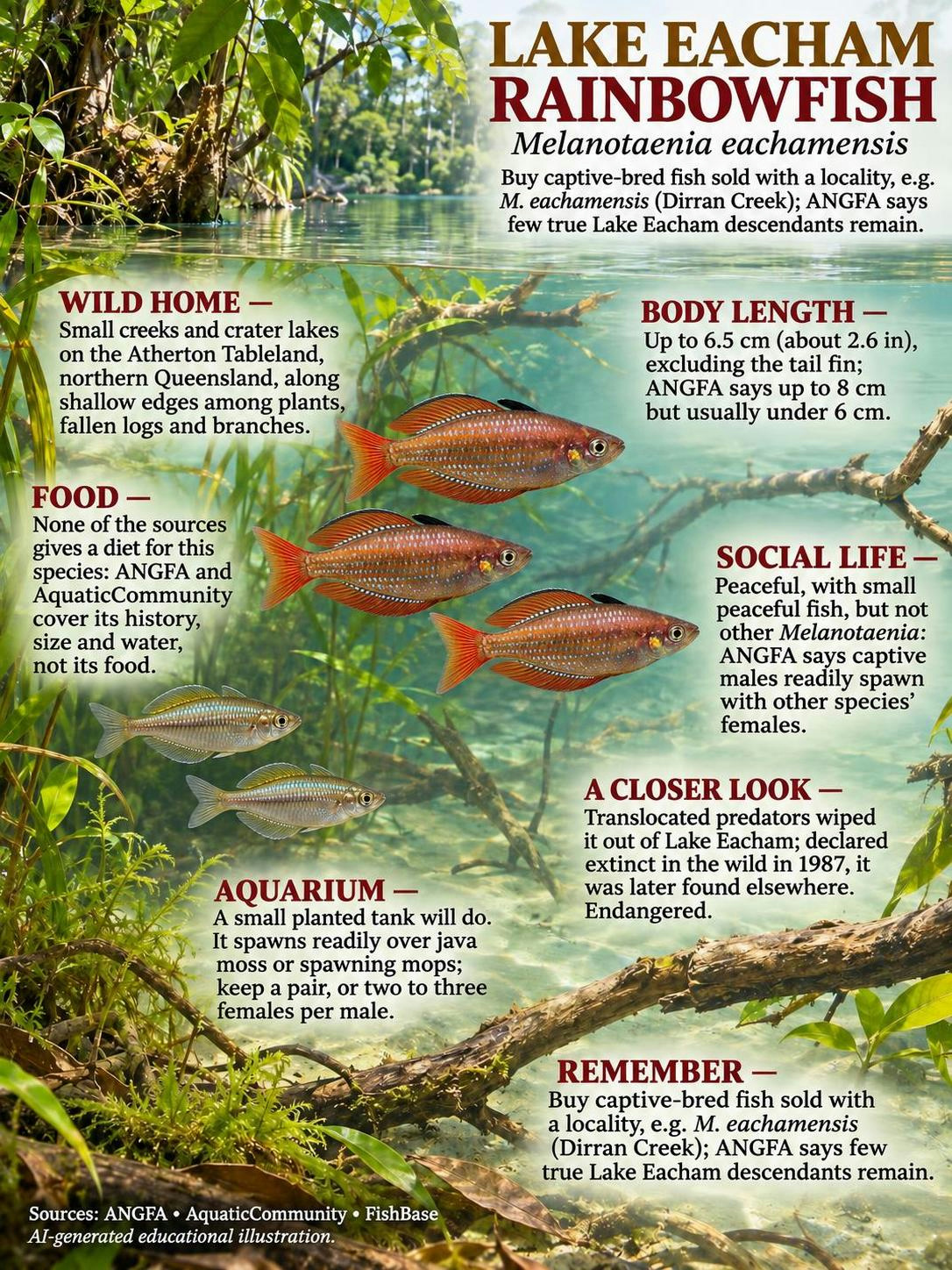
Read the infographic as text
- WILD HOME — Small creeks and crater lakes on the Atherton Tableland, northern Queensland, along shallow edges among plants, fallen logs and branches.
- BODY LENGTH — Up to 6.5 cm (about 2.6 in), excluding the tail fin; ANGFA says up to 8 cm but usually under 6 cm.
- FOOD — None of the sources gives a diet for this species: ANGFA and AquaticCommunity cover its history, size and water, not its food.
- SOCIAL LIFE — Peaceful, with small peaceful fish, but not other Melanotaenia: ANGFA says captive males readily spawn with other species’ females.
- AQUARIUM — A small planted tank will do. It spawns readily over java moss or spawning mops; keep a pair, or two to three females per male.
- A CLOSER LOOK — Translocated predators wiped it out of Lake Eacham; declared extinct in the wild in 1987, it was later found elsewhere. Endangered.
- REMEMBER — Buy captive-bred fish sold with a locality, e.g. M. eachamensis (Dirran Creek); ANGFA says few true Lake Eacham descendants remain.
How to use these figures
Published care ranges and suggested tank sizes are starting points, not guarantees. Tank footprint, group size, filtration, feeding, companions and the individual fish all matter. Standard length excludes the tail fin. Do not abruptly change established water conditions to match a number on a page.
Use a cycled aquarium, monitor water quality and quarantine new arrivals using a suitable species-specific plan. Persistent appetite loss, rapid breathing or weight loss warrants investigation.
Common questions
What should I know before choosing this fish?
Buy captive-bred fish sold with a locality, e.g. M. eachamensis (Dirran Creek); ANGFA says few true Lake Eacham descendants remain. Peaceful, with small peaceful fish, but not other Melanotaenia: ANGFA says captive males readily spawn with other species’ females.
What should I feed it?
None of the sources gives a diet for this species: ANGFA and AquaticCommunity cover its history, size and water, not its food.
Why is it rare?
Translocated predators wiped it out of Lake Eacham; declared extinct in the wild in 1987, it was later found elsewhere. Endangered.
Sources & review
Checked November 12, 2026. Retailer care guidance is not a universal biological minimum.