
At a glance
- Adult size
- 35.4 in (90 cm) SL
- Space
- 171+ US gallons (648 L)
- Social needs
- Keep one arowana. Smaller fish are prey, and some adults will not tolerate any tankmates; any companions must be large enough and carefully monitored.
Starting guidance, not a universal minimum. See the care details and sources below.
Adult size
Reported size: up to 35.4 in (90 cm), standard length, excluding the tail.
Aquarium space
Seriously Fish gives 171+ US gallons (648 L). The source calls 72 × 24 × 24 inches an absolute bare minimum; its metric figures are approximate.
Water conditions
75–84°F (24–29°C); pH 6.8–7.5; hardness 8–15 dGH. Keep conditions stable.
Natural home
Slow-moving or still streams, billabongs and swamps in northern Australia and New Guinea, often near surface cover.
Food and feeding
Offer varied earthworms, insects, shell-on prawns, mussels and suitable pellets. Avoid relying on live feeder fish; remove leftovers promptly.
Tankmates and behavior
Keep one arowana. Smaller fish are prey, and some adults will not tolerate any tankmates; any companions must be large enough and carefully monitored.
Setting up the habitat
Leave extensive open swimming space. Use strong, efficient filtration, regular water changes and a heavy, tightly secured cover.
A closer look
An Australian-region arowana, distinct from both silver and Asian arowanas.
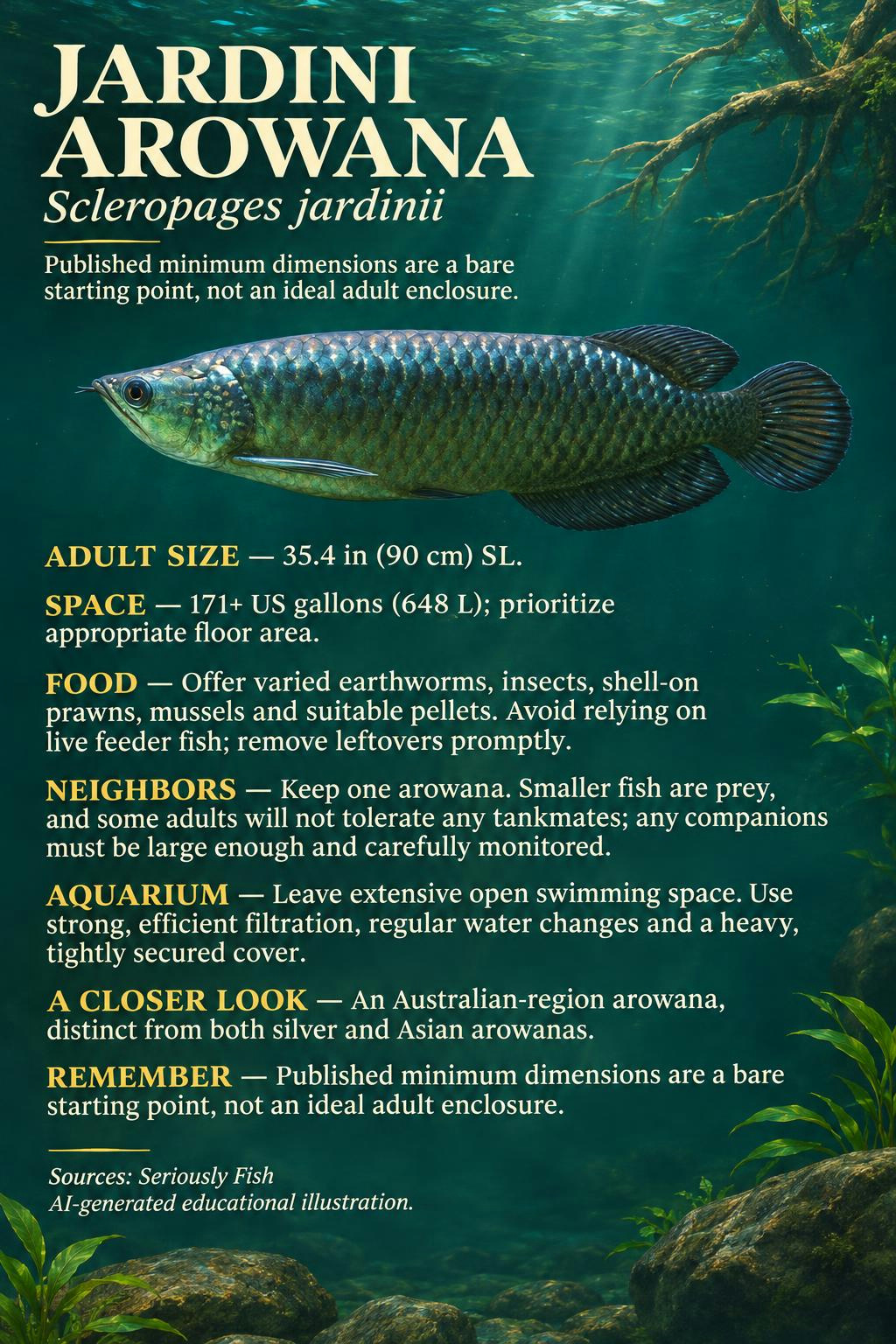
Read the infographic as text
- ADULT SIZE — 35.4 in (90 cm) SL.
- SPACE — 171+ US gallons (648 L); prioritize appropriate floor area.
- FOOD — Offer varied earthworms, insects, shell-on prawns, mussels and suitable pellets. Avoid relying on live feeder fish; remove leftovers promptly.
- NEIGHBORS — Keep one arowana. Smaller fish are prey, and some adults will not tolerate any tankmates; any companions must be large enough and carefully monitored.
- AQUARIUM — Leave extensive open swimming space. Use strong, efficient filtration, regular water changes and a heavy, tightly secured cover.
- A CLOSER LOOK — An Australian-region arowana, distinct from both silver and Asian arowanas.
- REMEMBER — Published minimum dimensions are a bare starting point, not an ideal adult enclosure.
How to use these figures
Published care ranges and suggested tank sizes are starting points, not guarantees. Tank footprint, group size, filtration, feeding, companions and the individual fish all matter. Standard length excludes the tail fin. Do not abruptly change established water conditions to match a number on a page.
Use a cycled aquarium, monitor water quality and quarantine new arrivals using a suitable species-specific plan. Persistent appetite loss, rapid breathing or weight loss warrants investigation.
Common questions
What should I know before choosing this fish?
Published minimum dimensions are a bare starting point, not an ideal adult enclosure. Keep one arowana. Smaller fish are prey, and some adults will not tolerate any tankmates; any companions must be large enough and carefully monitored.
What should I feed it?
Offer varied earthworms, insects, shell-on prawns, mussels and suitable pellets. Avoid relying on live feeder fish; remove leftovers promptly.
How much space does an adult need?
Seriously Fish gives 171+ US gallons (648 L). The source calls 72 × 24 × 24 inches an absolute bare minimum; its metric figures are approximate.
Sources & review
Checked November 12, 2026. Retailer care guidance is not a universal biological minimum.