
At a glance
- Adult size
- About 10.4 cm (4.1 in) body length
- Space
- At least 1 metre long; no volume given
- Social needs
- Fairly aggressive: keep one male with several females, alongside other Lake Victoria cichlids or catfish (Cichlidenkwekers).
Starting guidance, not a universal minimum. See the care details and sources below.
Adult size
FishBase gives a maximum standard length of 10.4 cm (about 4.1 inches), excluding the tail fin. Cichlidenkwekers says males reach about 12 cm (about 4.7 inches) and females stay slightly smaller and less colourful.
Aquarium space
Cichlidenkwekers says it needs a tank at least 1 metre long; no source gives a volume.
Water conditions
Cichlidenkwekers gives 24–28°C (75–82°F), pH 7.5–8.5 and 16–20 GH, which is hard, alkaline water. FishBase gives no water figures. These are maintenance ranges, not targets to swing between; avoid abrupt changes.
Natural home
Only the Mwanza Gulf of southern Lake Victoria, Tanzania, swimming above rocks from 1 m to at least 8 m deep.
Food and feeding
Wild fish eat zooplankton and insect larvae (FishBase); Cichlidenkwekers says it likes algae and takes live, frozen and dried foods.
Tankmates and behavior
Fairly aggressive: keep one male with several females, alongside other Lake Victoria cichlids or catfish (Cichlidenkwekers).
Setting up the habitat
Sand, plenty of stones and hardy plants. It swims in the lower and middle water and digs a large pit to spawn in.
A closer look
Found only in the Mwanza Gulf; FishBase lists it as Least Concern, but most of its hundreds of Lake Victoria relatives are threatened.
Read the infographic as text
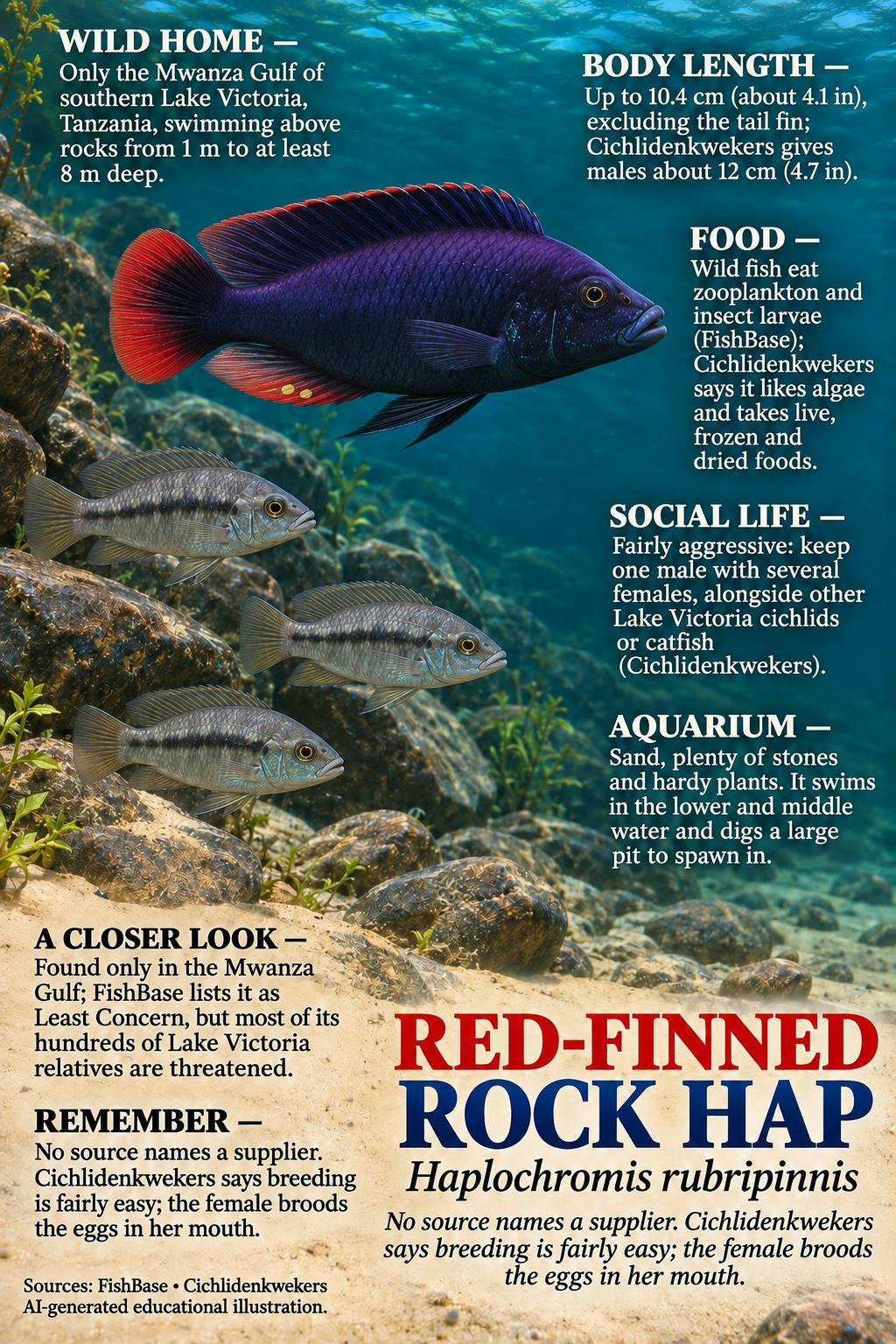
- WILD HOME — Only the Mwanza Gulf of southern Lake Victoria, Tanzania, swimming above rocks from 1 m to at least 8 m deep.
- BODY LENGTH — Up to 10.4 cm (about 4.1 in), excluding the tail fin; Cichlidenkwekers gives males about 12 cm (4.7 in).
- FOOD — Wild fish eat zooplankton and insect larvae (FishBase); Cichlidenkwekers says it likes algae and takes live, frozen and dried foods.
- SOCIAL LIFE — Fairly aggressive: keep one male with several females, alongside other Lake Victoria cichlids or catfish (Cichlidenkwekers).
- AQUARIUM — Sand, plenty of stones and hardy plants. It swims in the lower and middle water and digs a large pit to spawn in.
- A CLOSER LOOK — Found only in the Mwanza Gulf; FishBase lists it as Least Concern, but most of its hundreds of Lake Victoria relatives are threatened.
- REMEMBER — No source names a supplier. Cichlidenkwekers says breeding is fairly easy; the female broods the eggs in her mouth.
How to use these figures
Published care ranges and suggested tank sizes are starting points, not guarantees. Tank footprint, group size, filtration, feeding, companions and the individual fish all matter. Standard length excludes the tail fin. Do not abruptly change established water conditions to match a number on a page.
Use a cycled aquarium, monitor water quality and quarantine new arrivals using a suitable species-specific plan. Persistent appetite loss, rapid breathing or weight loss warrants investigation.
Common questions
What should I know before choosing this fish?
No source names a supplier. Cichlidenkwekers says breeding is fairly easy; the female broods the eggs in her mouth. Fairly aggressive: keep one male with several females, alongside other Lake Victoria cichlids or catfish (Cichlidenkwekers).
What should I feed it?
Wild fish eat zooplankton and insect larvae (FishBase); Cichlidenkwekers says it likes algae and takes live, frozen and dried foods.
Why is it rare?
Found only in the Mwanza Gulf; FishBase lists it as Least Concern, but most of its hundreds of Lake Victoria relatives are threatened.
Sources & review
Checked November 12, 2026. Retailer care guidance is not a universal biological minimum.