
At a glance
- Adult size
- Usually under 1.6 in
- Space
- 60+ litres (16+ US gallons)
- Social needs
- Shy and secretive; needs plant cover. Keep it in a species tank or with fish that leave it alone, such as peaceful bottom-dwellers.
Starting guidance, not a universal minimum. See the care details and sources below.
Adult size
The British Livebearer Association gives males 30 mm and females 40 mm, and Xipho.org says mostly under 4 cm. FishBase lists total lengths of 4 cm (about 1.6 inches) for males and 6 cm (about 2.4 inches) for females.
Aquarium space
ÖVVÖ says northern platies need an aquarium of 60 litres (about 16 US gallons) or more, bigger to allow a bigger colony. The British Livebearer Association asks for a well-planted tank.
Water conditions
ÖVVÖ says northern platies do best at 23–26°C (73–79°F) and take normal room temperature, about 20°C in winter and 28°C in summer. The British Livebearer Association keeps it at 24°C (75°F) and says it tolerates most water, but a sudden pH change will kill it. No source gives a pH or hardness range; FishBase lists 27–30°C (81–86°F), warmer than both. ÖVVÖ asks for clean water, with a third changed every week. These are maintenance ranges, not targets to swing between; avoid abrupt changes.
Natural home
Clear, moderately flowing spring pools and headwater streams with dense plants around Monterrey, Nuevo León, Mexico; none survive.
Food and feeding
No special needs: ÖVVÖ says northern platies eat live and frozen foods and flakes.
Tankmates and behavior
Shy and secretive; needs plant cover. Keep it in a species tank or with fish that leave it alone, such as peaceful bottom-dwellers.
Setting up the habitat
A well-planted tank with steady water and small, regular water changes. The British Livebearer Association says it lives about 12 months.
A closer look
Extinct in the wild: pumping dried its Huasteca Canyon springs in the 1960s, and the Apodaca platies vanished in the 1990s.
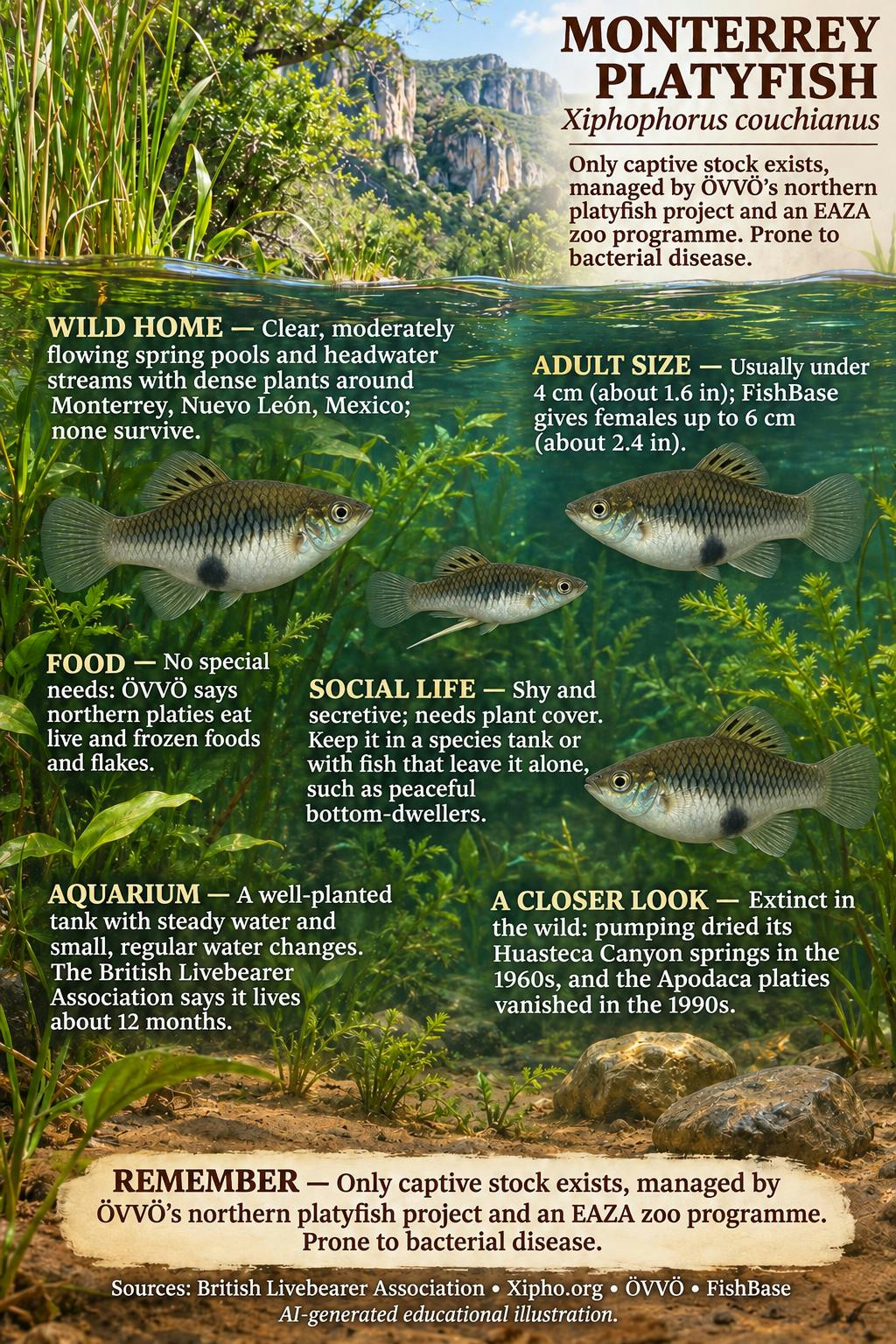
Read the infographic as text
- WILD HOME — Clear, moderately flowing spring pools and headwater streams with dense plants around Monterrey, Nuevo León, Mexico; none survive.
- ADULT SIZE — Usually under 4 cm (about 1.6 in); FishBase gives females up to 6 cm (about 2.4 in).
- FOOD — No special needs: ÖVVÖ says northern platies eat live and frozen foods and flakes.
- SOCIAL LIFE — Shy and secretive; needs plant cover. Keep it in a species tank or with fish that leave it alone, such as peaceful bottom-dwellers.
- AQUARIUM — A well-planted tank with steady water and small, regular water changes. The British Livebearer Association says it lives about 12 months.
- A CLOSER LOOK — Extinct in the wild: pumping dried its Huasteca Canyon springs in the 1960s, and the Apodaca platies vanished in the 1990s.
- REMEMBER — Only captive stock exists, managed by ÖVVÖ’s northern platyfish project and an EAZA zoo programme. Prone to bacterial disease.
How to use these figures
Published care ranges and suggested tank sizes are starting points, not guarantees. Tank footprint, group size, filtration, feeding, companions and the individual fish all matter. Standard length excludes the tail fin. Do not abruptly change established water conditions to match a number on a page.
Use a cycled aquarium, monitor water quality and quarantine new arrivals using a suitable species-specific plan. Persistent appetite loss, rapid breathing or weight loss warrants investigation.
Common questions
What should I know before choosing this fish?
Only captive stock exists, managed by ÖVVÖ’s northern platyfish project and an EAZA zoo programme. Prone to bacterial disease. Shy and secretive; needs plant cover. Keep it in a species tank or with fish that leave it alone, such as peaceful bottom-dwellers.
What should I feed it?
No special needs: ÖVVÖ says northern platies eat live and frozen foods and flakes.
Why is it rare?
Extinct in the wild: pumping dried its Huasteca Canyon springs in the 1960s, and the Apodaca platies vanished in the 1990s.
Sources & review
Checked November 12, 2026. Retailer care guidance is not a universal biological minimum.