
At a glance
- Adult size
- FishBase records 23 cm TL; care sources give 9 in
- Space
- 60+ US gallons; sources range from 30 to 70
- Social needs
- One per tank, ideally alone: it eats any fish, shrimp or crab it can swallow. Tankmates must be peaceful, too big to eat and not nippy.
Starting guidance, not a universal minimum. See the care details and sources below.
Adult size
FishBase reports a maximum recorded length of 23 cm (9.1 inches), including the tail. A recorded maximum is not a promise of typical aquarium size. Saltcorner and Scott Michael both give 9 inches.
Aquarium space
Saltcorner gives a minimum of 60 US gallons (227 litres). A retailer’s panel says 40 US gallons (151 litres), but its text says 70 US gallons (265 litres); Scott Michael says adults of this inactive genus do fine in 30 US gallons (114 litres).
Water conditions
Saltcorner lists 72–82°F (22–28°C), pH 8.0–8.5 and specific gravity 1.020–1.026; a retailer’s panel lists 72–78°F (22–26°C), pH 8.1–8.4 and dKH 8–12. These are maintenance ranges, not targets to swing between; avoid abrupt changes.
Natural home
Soft bottoms in current-swept channels and rocky or coral areas near algae, 10–297 m deep, South Africa to Japan and eastern Australia.
Food and feeding
Needs live food at first, such as saltwater feeder shrimp, then weaning onto shrimp, squid and fish on a stick; some never wean. No goldfish.
Tankmates and behavior
One per tank, ideally alone: it eats any fish, shrimp or crab it can swallow. Tankmates must be peaceful, too big to eat and not nippy.
Setting up the habitat
A fish-only tank with gentle flow and some rockwork. Its back spines are highly venomous: keep hands clear when working in the tank.
A closer look
Saltcorner says it is rarely seen in the trade. Scott Michael says no Rhinopias is common, partly because their camouflage hides them.
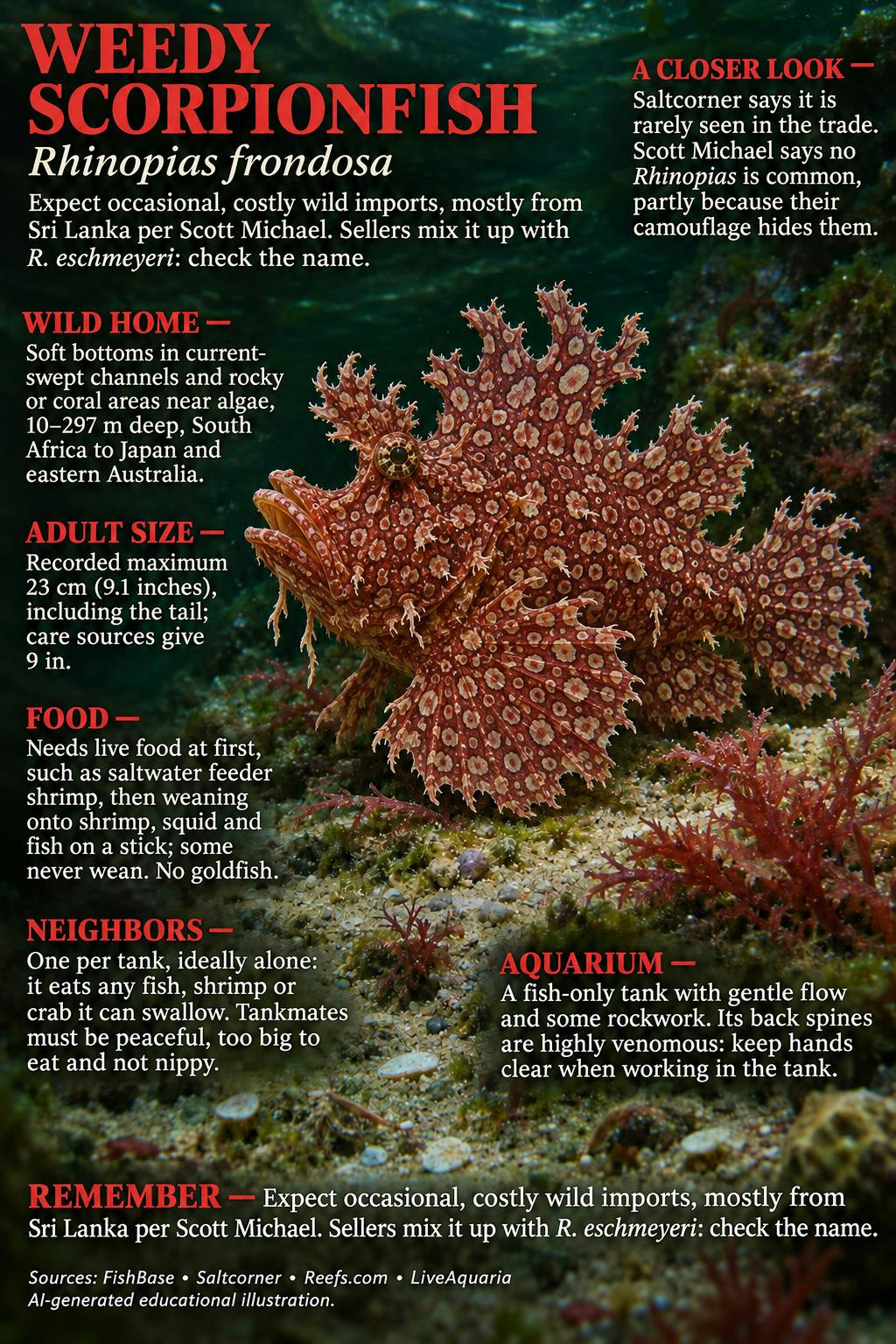
Read the infographic as text
- WILD HOME — Soft bottoms in current-swept channels and rocky or coral areas near algae, 10–297 m deep, South Africa to Japan and eastern Australia.
- ADULT SIZE — Recorded maximum 23 cm (9.1 inches), including the tail; care sources give 9 in.
- FOOD — Needs live food at first, such as saltwater feeder shrimp, then weaning onto shrimp, squid and fish on a stick; some never wean. No goldfish.
- NEIGHBORS — One per tank, ideally alone: it eats any fish, shrimp or crab it can swallow. Tankmates must be peaceful, too big to eat and not nippy.
- AQUARIUM — A fish-only tank with gentle flow and some rockwork. Its back spines are highly venomous: keep hands clear when working in the tank.
- A CLOSER LOOK — Saltcorner says it is rarely seen in the trade. Scott Michael says no Rhinopias is common, partly because their camouflage hides them.
- REMEMBER — Expect occasional, costly wild imports, mostly from Sri Lanka per Scott Michael. Sellers mix it up with R. eschmeyeri: check the name.
How to use these figures
Published care ranges and suggested tank sizes are starting points, not guarantees. Tank footprint, group size, filtration, feeding, companions and the individual fish all matter. Standard length excludes the tail fin. Do not abruptly change established water conditions to match a number on a page.
Use a cycled aquarium, monitor water quality and quarantine new arrivals using a suitable species-specific plan. Persistent appetite loss, rapid breathing or weight loss warrants investigation.
Common questions
What should I know before choosing this fish?
Expect occasional, costly wild imports, mostly from Sri Lanka per Scott Michael. Sellers mix it up with R. eschmeyeri: check the name. One per tank, ideally alone: it eats any fish, shrimp or crab it can swallow. Tankmates must be peaceful, too big to eat and not nippy.
What should I feed it?
Needs live food at first, such as saltwater feeder shrimp, then weaning onto shrimp, squid and fish on a stick; some never wean. No goldfish.
Why is it rare?
Saltcorner says it is rarely seen in the trade. Scott Michael says no Rhinopias is common, partly because their camouflage hides them.
Sources & review
Checked November 12, 2026. Retailer care guidance is not a universal biological minimum.
- FishBase — Rhinopias frondosa species account
- Saltcorner — Rhinopias frondosa (Weedy Scorpionfish) species account
- Reefs.com — Scott Michael, The Rhinopias spp.: the ultimate scorpionfishes
- LiveAquaria — Rhinopias Scorpionfish (Rhinopias frondosa) care profile — reviewed care reference