
At a glance
- Adult size
- About 6 in
- Space
- 100+ US gallons; see details
- Social needs
- Slow and peaceful: keep it with peaceful, larger fish, never fin-nippers. It eats snails and shrimp, and its toxin can kill tankmates.
Starting guidance, not a universal minimum. See the care details and sources below.
Adult size
FishBase records a maximum of 15.5 cm (about 6.1 inches) total length, including the tail; Saltcorner gives 6 inches.
Aquarium space
Saltcorner gives a minimum of 100 US gallons (379 litres), fish-only, with wide-open swimming areas; a UK retailer lists 600 litres (about 159 US gallons).
Water conditions
Saltcorner lists 72–82°F (22–28°C), specific gravity 1.020–1.026 and pH 8.0–8.5; FishBase gives no water figures, only that it is tropical. These are maintenance ranges, not targets to swing between; avoid abrupt changes.
Natural home
Clear lagoons, seaward reefs and quiet shorelines 3–27 m deep, from Hawaii to the Marquesas and central and eastern Polynesia.
Food and feeding
A varied diet of meaty and vegetable foods, several times daily. Never floating foods: it may swallow air and lose its buoyancy.
Tankmates and behavior
Slow and peaceful: keep it with peaceful, larger fish, never fin-nippers. It eats snails and shrimp, and its toxin can kill tankmates.
Setting up the habitat
A large fish-only tank with open swimming space. Carbon removes its toxin, but often too late; remove a bullied or sick fish at once.
A closer look
Saltcorner says it is rarely seen in the trade. It lives only in the central Pacific, from Hawaii to the Marquesas and Polynesia.
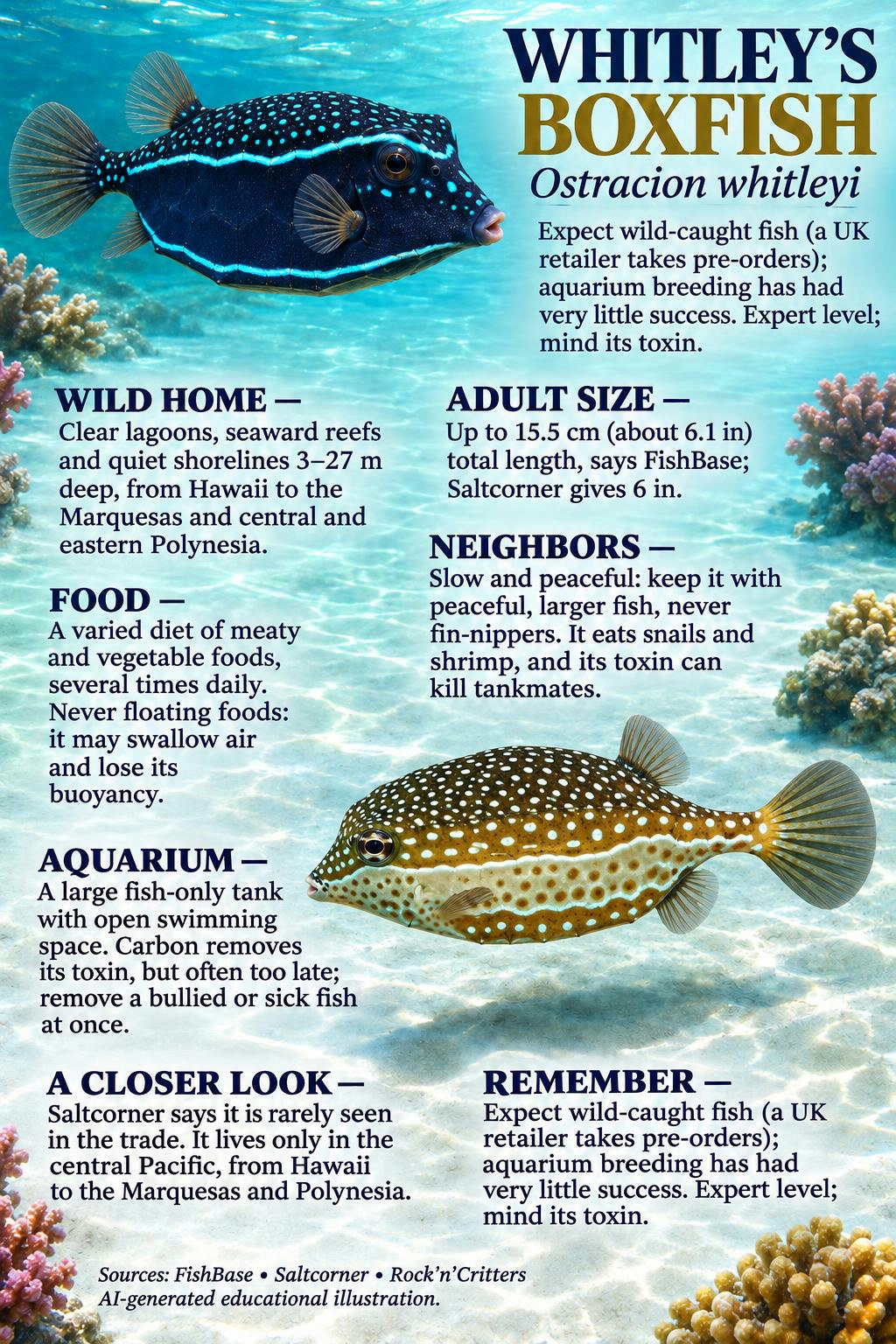
Read the infographic as text
- WILD HOME — Clear lagoons, seaward reefs and quiet shorelines 3–27 m deep, from Hawaii to the Marquesas and central and eastern Polynesia.
- ADULT SIZE — Up to 15.5 cm (about 6.1 in) total length, says FishBase; Saltcorner gives 6 in.
- FOOD — A varied diet of meaty and vegetable foods, several times daily. Never floating foods: it may swallow air and lose its buoyancy.
- NEIGHBORS — Slow and peaceful: keep it with peaceful, larger fish, never fin-nippers. It eats snails and shrimp, and its toxin can kill tankmates.
- AQUARIUM — A large fish-only tank with open swimming space. Carbon removes its toxin, but often too late; remove a bullied or sick fish at once.
- A CLOSER LOOK — Saltcorner says it is rarely seen in the trade. It lives only in the central Pacific, from Hawaii to the Marquesas and Polynesia.
- REMEMBER — Expect wild-caught fish (a UK retailer takes pre-orders); aquarium breeding has had very little success. Expert level; mind its toxin.
How to use these figures
Published care ranges and suggested tank sizes are starting points, not guarantees. Tank footprint, group size, filtration, feeding, companions and the individual fish all matter. Standard length excludes the tail fin. Do not abruptly change established water conditions to match a number on a page.
Use a cycled aquarium, monitor water quality and quarantine new arrivals using a suitable species-specific plan. Persistent appetite loss, rapid breathing or weight loss warrants investigation.
Common questions
What should I know before choosing this fish?
Expect wild-caught fish (a UK retailer takes pre-orders); aquarium breeding has had very little success. Expert level; mind its toxin. Slow and peaceful: keep it with peaceful, larger fish, never fin-nippers. It eats snails and shrimp, and its toxin can kill tankmates.
What should I feed it?
A varied diet of meaty and vegetable foods, several times daily. Never floating foods: it may swallow air and lose its buoyancy.
Why is it rare?
Saltcorner says it is rarely seen in the trade. It lives only in the central Pacific, from Hawaii to the Marquesas and Polynesia.
Sources & review
Checked November 12, 2026. Retailer care guidance is not a universal biological minimum.
- FishBase — Ostracion whitleyi species account
- Saltcorner — Ostracion whitleyi species page
- Rock’n’Critters — Whitley’s Boxfish species information — reviewed care reference