
At a glance
- Adult size
- About 3.7 in (FishBase) to 7 in (Borstein)
- Space
- No source gives a size; a larger tank with swimming room
- Social needs
- Shy and peaceful; it suits almost any fish that is not overly aggressive. It hybridises easily, so add only unlike lake cichlids.
Starting guidance, not a universal minimum. See the care details and sources below.
Adult size
The sources conflict. FishBase gives a maximum total length of 9.3 cm (about 3.7 inches); Borstein reports aquarium males of 7 inches (17.8 cm) and females of 6 inches (15.2 cm), maturing at 4 inches. Males are larger than females.
Aquarium space
No source gives a tank size. Borstein says only that it should have a larger tank, because it likes swimming room, with a good number of hiding places.
Water conditions
FishBase gives 25–27°C (77–81°F). No source gives a pH or hardness range. These are maintenance ranges, not targets to swing between; avoid abrupt changes.
Natural home
Only in Lake Barombi Mbo, a very tiny crater lake in Cameroon, where it eats algae, small insects and fish eggs.
Food and feeding
Not hard to feed: it takes almost any food and really likes baby brine shrimp and daphnia, which it sucks from open water.
Tankmates and behavior
Shy and peaceful; it suits almost any fish that is not overly aggressive. It hybridises easily, so add only unlike lake cichlids.
Setting up the habitat
A larger tank, as it likes swimming room, with a good number of hiding places. No source gives tank size, pH or hardness.
A closer look
Critically Endangered: its whole range is one very tiny crater lake in Cameroon that faces various environmental pressures.
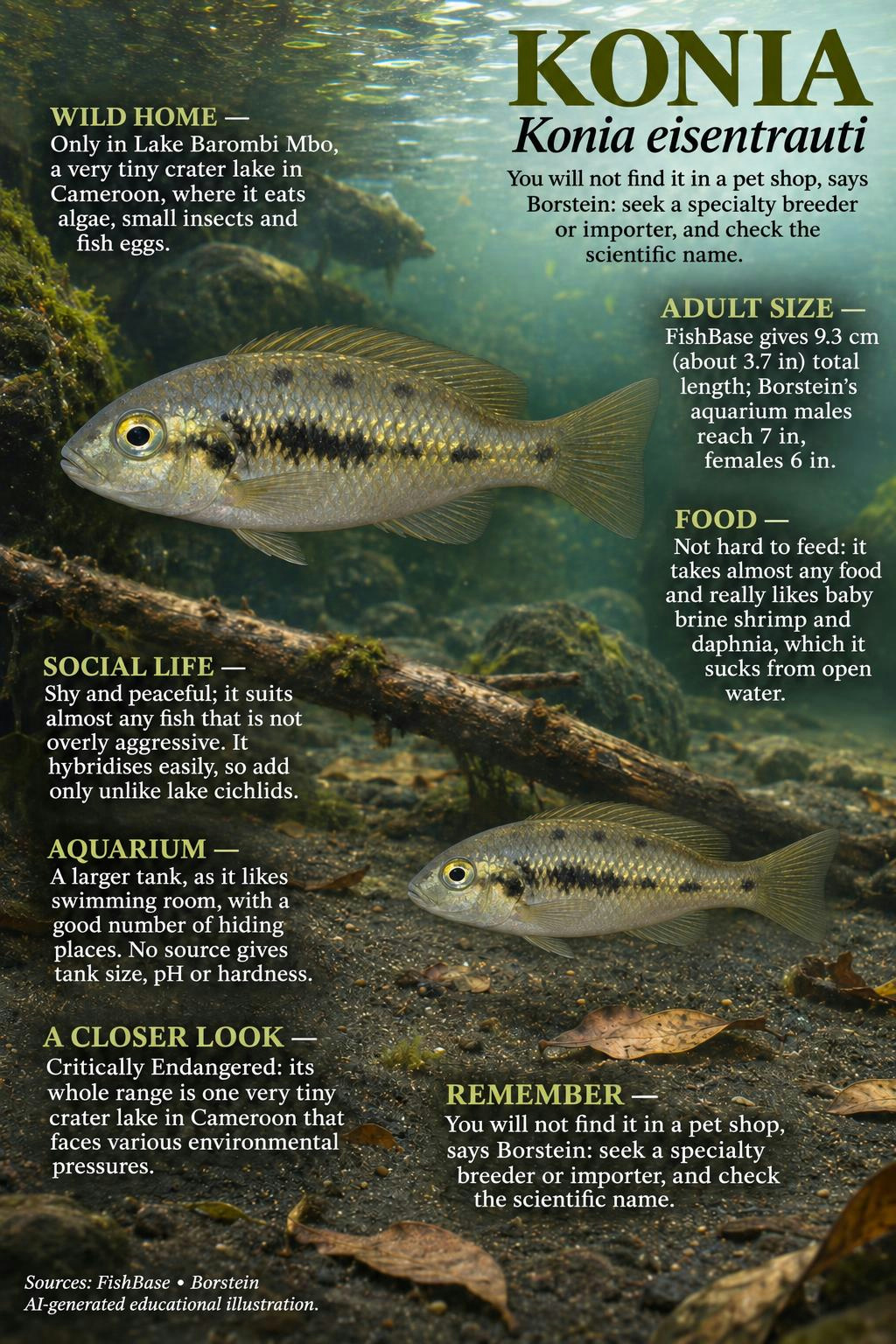
Read the infographic as text
- WILD HOME — Only in Lake Barombi Mbo, a very tiny crater lake in Cameroon, where it eats algae, small insects and fish eggs.
- ADULT SIZE — FishBase gives 9.3 cm (about 3.7 in) total length; Borstein’s aquarium males reach 7 in, females 6 in.
- FOOD — Not hard to feed: it takes almost any food and really likes baby brine shrimp and daphnia, which it sucks from open water.
- SOCIAL LIFE — Shy and peaceful; it suits almost any fish that is not overly aggressive. It hybridises easily, so add only unlike lake cichlids.
- AQUARIUM — A larger tank, as it likes swimming room, with a good number of hiding places. No source gives tank size, pH or hardness.
- A CLOSER LOOK — Critically Endangered: its whole range is one very tiny crater lake in Cameroon that faces various environmental pressures.
- REMEMBER — You will not find it in a pet shop, says Borstein: seek a specialty breeder or importer, and check the scientific name.
How to use these figures
Published care ranges and suggested tank sizes are starting points, not guarantees. Tank footprint, group size, filtration, feeding, companions and the individual fish all matter. Standard length excludes the tail fin. Do not abruptly change established water conditions to match a number on a page.
Use a cycled aquarium, monitor water quality and quarantine new arrivals using a suitable species-specific plan. Persistent appetite loss, rapid breathing or weight loss warrants investigation.
Common questions
What should I know before choosing this fish?
You will not find it in a pet shop, says Borstein: seek a specialty breeder or importer, and check the scientific name. Shy and peaceful; it suits almost any fish that is not overly aggressive. It hybridises easily, so add only unlike lake cichlids.
What should I feed it?
Not hard to feed: it takes almost any food and really likes baby brine shrimp and daphnia, which it sucks from open water.
Why is it rare?
Critically Endangered: its whole range is one very tiny crater lake in Cameroon that faces various environmental pressures.
Sources & review
Checked November 12, 2026. Retailer care guidance is not a universal biological minimum.