
At a glance
- Adult size
- About 11 in body length
- Space
- 48 × 18 in base for one pair; see details
- Social needs
- Fairly peaceful with other species but aggressive to its own kind: keep one fish or a pair. Small fish are eaten.
Starting guidance, not a universal minimum. See the care details and sources below.
Adult size
Seriously Fish gives a maximum standard length of 28 cm (about 11.0 inches), excluding the tail fin; FishBase gives 28 cm as total length, so the two sources measure differently. Adult males are much larger than females.
Aquarium space
Seriously Fish says 120 × 45 × 38 cm (48 × 18 × 15 in), about 205 litres (54 US gallons), suits a single compatible pair. For breeding it wants a tank at least 48 in long, preferably 60 in or more, and warns that a large pair can claim over 3 feet of tank length.
Water conditions
Seriously Fish lists 63–82°F (17–28°C), pH 6.5–8.0 and 8–25 dGH, and suggests aiming for 72–80°F (22–27°C) in the aquarium; FishBase gives 24–28°C. It is very sensitive to changes in water chemistry, so change small amounts of water regularly and often rather than making large changes. These are maintenance ranges, not targets to swing between; avoid abrupt changes.
Natural home
All over Madagascar and very adaptable: cool highland water as low as 12°C, hot alkaline springs, blackwater and brackish water.
Food and feeding
A fish-eater in nature, but no live fish are needed: it takes dead foods, most live and frozen foods and usually dried foods. No animal meat.
Tankmates and behavior
Fairly peaceful with other species but aggressive to its own kind: keep one fish or a pair. Small fish are eaten.
Setting up the habitat
Plenty of hiding places from clay pots, roots and driftwood over sand or fine gravel; plants are optional but give welcome extra cover.
A closer look
Like most Madagascan cichlids it is highly endangered by habitat loss and introduced species; FishBase lists it as Vulnerable.
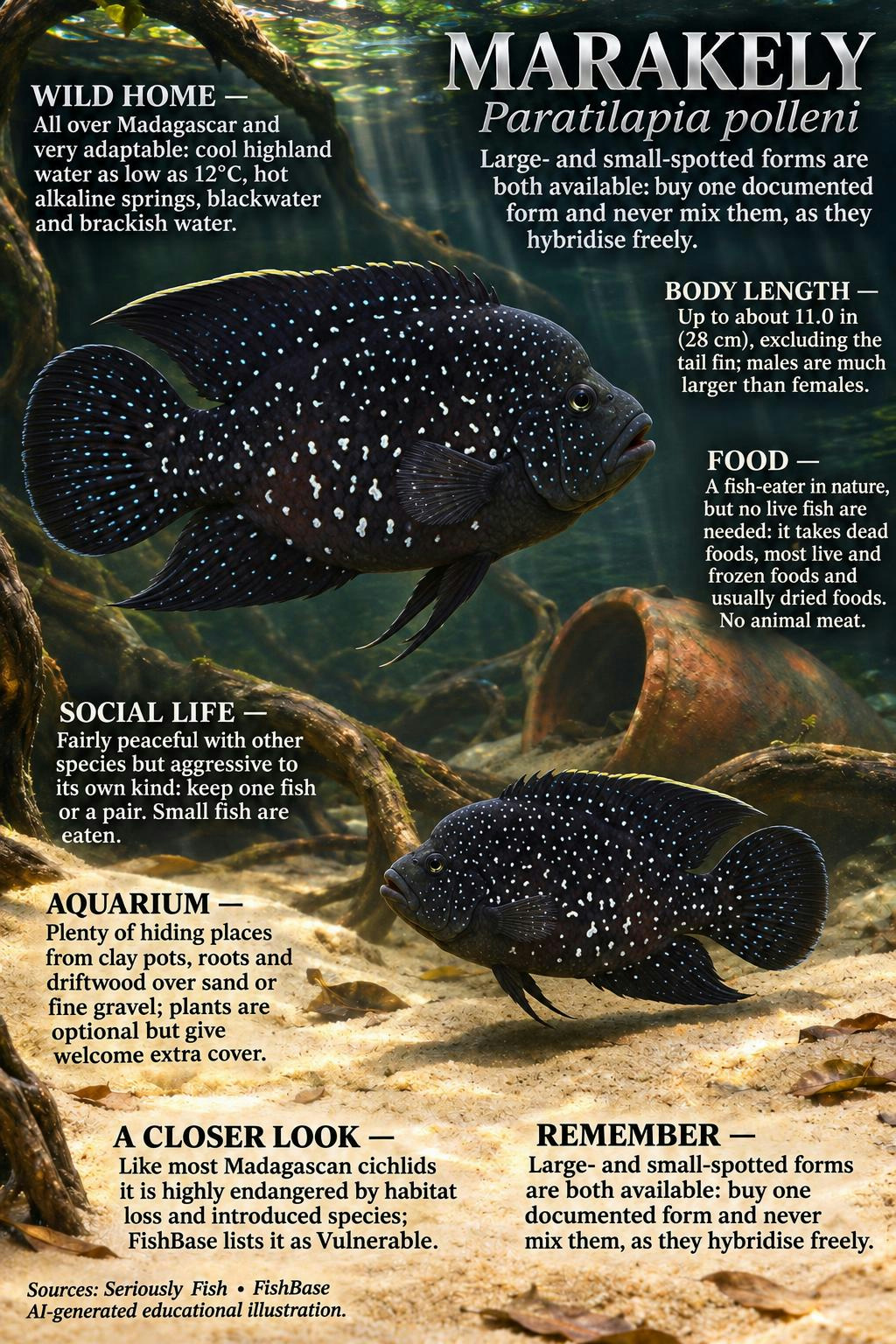
Read the infographic as text
- WILD HOME — All over Madagascar and very adaptable: cool highland water as low as 12°C, hot alkaline springs, blackwater and brackish water.
- BODY LENGTH — Up to about 11.0 in (28 cm), excluding the tail fin; males are much larger than females.
- FOOD — A fish-eater in nature, but no live fish are needed: it takes dead foods, most live and frozen foods and usually dried foods. No animal meat.
- SOCIAL LIFE — Fairly peaceful with other species but aggressive to its own kind: keep one fish or a pair. Small fish are eaten.
- AQUARIUM — Plenty of hiding places from clay pots, roots and driftwood over sand or fine gravel; plants are optional but give welcome extra cover.
- A CLOSER LOOK — Like most Madagascan cichlids it is highly endangered by habitat loss and introduced species; FishBase lists it as Vulnerable.
- REMEMBER — Large- and small-spotted forms are both available: buy one documented form and never mix them, as they hybridise freely.
How to use these figures
Published care ranges and suggested tank sizes are starting points, not guarantees. Tank footprint, group size, filtration, feeding, companions and the individual fish all matter. Standard length excludes the tail fin. Do not abruptly change established water conditions to match a number on a page.
Use a cycled aquarium, monitor water quality and quarantine new arrivals using a suitable species-specific plan. Persistent appetite loss, rapid breathing or weight loss warrants investigation.
Common questions
What should I know before choosing this fish?
Large- and small-spotted forms are both available: buy one documented form and never mix them, as they hybridise freely. Fairly peaceful with other species but aggressive to its own kind: keep one fish or a pair. Small fish are eaten.
What should I feed it?
A fish-eater in nature, but no live fish are needed: it takes dead foods, most live and frozen foods and usually dried foods. No animal meat.
Why is it rare?
Like most Madagascan cichlids it is highly endangered by habitat loss and introduced species; FishBase lists it as Vulnerable.
Sources & review
Checked November 12, 2026. Retailer care guidance is not a universal biological minimum.