
At a glance
- Adult size
- About 10 cm (3.9 in) per Loiselle; FishBase 6.0 cm (2.4 in) SL
- Space
- No minimum given; Loiselle used a two-metre tank
- Social needs
- Safe with fish bigger than newborn mollies, says Loiselle; keep at least three males so dominance rotates, and avoid crowding.
Starting guidance, not a universal minimum. See the care details and sources below.
Adult size
FishBase gives a maximum standard length of 6.0 cm (about 2.4 inches), excluding the tail fin. Paul Loiselle (AIC) calls it one of the smallest Lake Victoria predators at only 10 cm (about 3.9 inches) long, so the sources differ.
Aquarium space
No source gives a minimum tank size. Loiselle kept three pairs in a densely planted tank two metres long; they still cleared out every livebearer fry within 24 hours of birth. He says adults dislike crowding.
Water conditions
Loiselle says it is not demanding about pH or hardness, as Lake Victoria’s water varies widely, but the water must be clean and well oxygenated, with an efficient filter and regular partial changes. He gives 22–25°C (72–77°F) as ideal: it tolerates brief cooler spells but not heat, which makes brooding females swell and release their young early. No source gives pH or hardness figures. These are maintenance ranges, not targets to swing between; avoid abrupt changes.
Natural home
Lake Victoria only, where Loiselle says this small predator seems to specialize in hunting cichlid fry.
Food and feeding
A fish-eater (FishBase). Loiselle fed small live prey and almost any frozen food twice a day, lighter at midday than in the evening.
Tankmates and behavior
Safe with fish bigger than newborn mollies, says Loiselle; keep at least three males so dominance rotates, and avoid crowding.
Setting up the habitat
Dense plants and bogwood roots suit it: it digs only a small nest pit and rarely harms plants. Brooding females seek shelter.
A closer look
Critically Endangered (FishBase), perhaps extinct in the wild (Wikipedia); Loiselle blames introduced Lates, the Nile perch.
Read the infographic as text
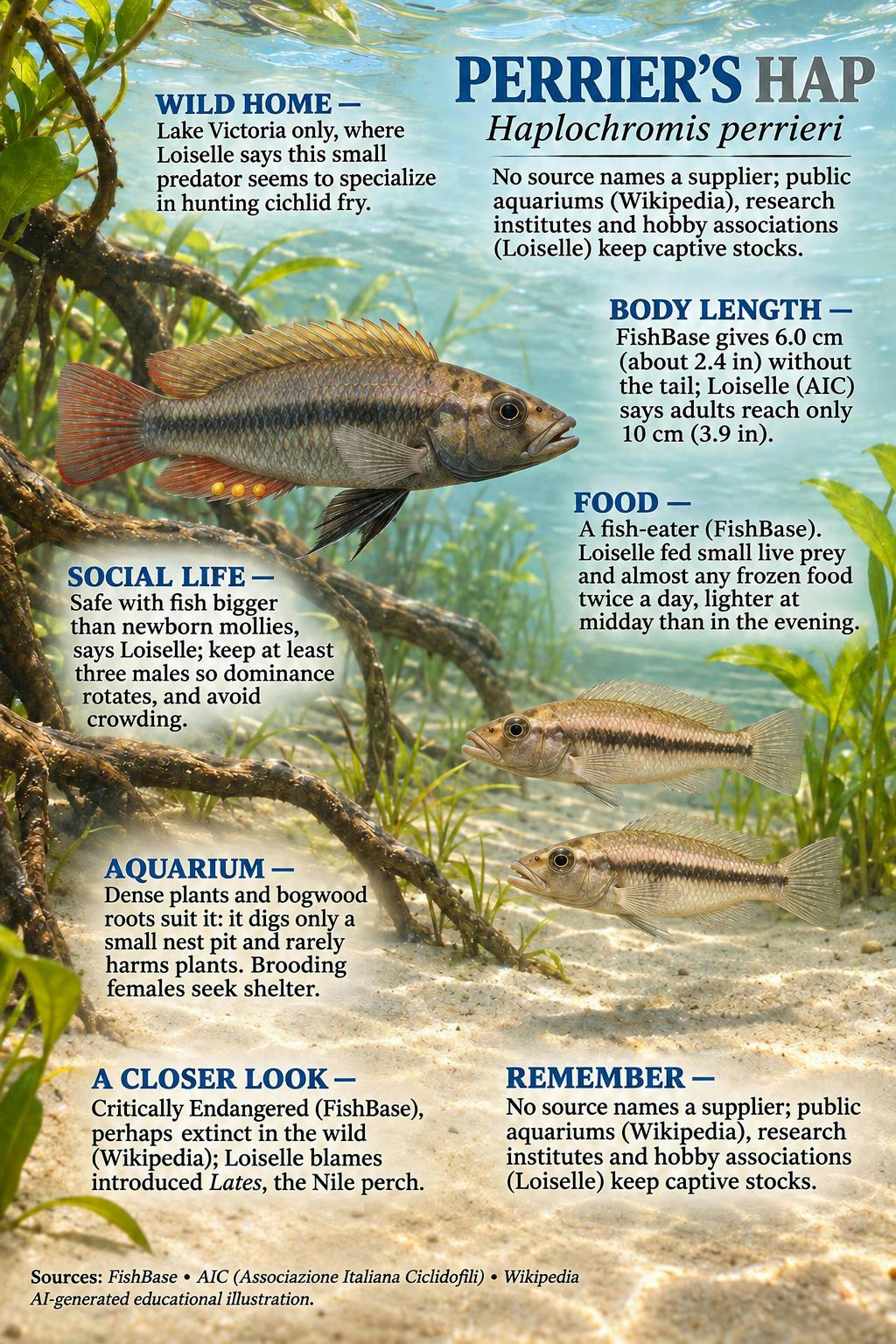
- WILD HOME — Lake Victoria only, where Loiselle says this small predator seems to specialize in hunting cichlid fry.
- BODY LENGTH — FishBase gives 6.0 cm (about 2.4 in) without the tail; Loiselle (AIC) says adults reach only 10 cm (3.9 in).
- FOOD — A fish-eater (FishBase). Loiselle fed small live prey and almost any frozen food twice a day, lighter at midday than in the evening.
- SOCIAL LIFE — Safe with fish bigger than newborn mollies, says Loiselle; keep at least three males so dominance rotates, and avoid crowding.
- AQUARIUM — Dense plants and bogwood roots suit it: it digs only a small nest pit and rarely harms plants. Brooding females seek shelter.
- A CLOSER LOOK — Critically Endangered (FishBase), perhaps extinct in the wild (Wikipedia); Loiselle blames introduced Lates, the Nile perch.
- REMEMBER — No source names a supplier; public aquariums (Wikipedia), research institutes and hobby associations (Loiselle) keep captive stocks.
How to use these figures
Published care ranges and suggested tank sizes are starting points, not guarantees. Tank footprint, group size, filtration, feeding, companions and the individual fish all matter. Standard length excludes the tail fin. Do not abruptly change established water conditions to match a number on a page.
Use a cycled aquarium, monitor water quality and quarantine new arrivals using a suitable species-specific plan. Persistent appetite loss, rapid breathing or weight loss warrants investigation.
Common questions
What should I know before choosing this fish?
No source names a supplier; public aquariums (Wikipedia), research institutes and hobby associations (Loiselle) keep captive stocks. Safe with fish bigger than newborn mollies, says Loiselle; keep at least three males so dominance rotates, and avoid crowding.
What should I feed it?
A fish-eater (FishBase). Loiselle fed small live prey and almost any frozen food twice a day, lighter at midday than in the evening.
Why is it rare?
Critically Endangered (FishBase), perhaps extinct in the wild (Wikipedia); Loiselle blames introduced Lates, the Nile perch.
Sources & review
Checked November 12, 2026. Retailer care guidance is not a universal biological minimum.