
At a glance
- Adult size
- Up to about 10.6 in
- Space
- 400 litres (106 US gallons) or more
- Social needs
- Mildly territorial, rougher when breeding. Keep one male to two females, or a pair, alone or with large peaceful tetras and catfish.
Starting guidance, not a universal minimum. See the care details and sources below.
Adult size
Malagasy Freshwater Fishes rates it a large cichlid, up to about 27 cm (10.6 in); FishBase gives a maximum standard length of 16.7 cm (about 6.6 inches). Growth is slow.
Aquarium space
Malagasy Freshwater Fishes gives a minimum of 400 litres (about 106 US gallons) and recommends a species tank.
Water conditions
Malagasy Freshwater Fishes lists 22–27°C (72–81°F), pH 6.8–7.8, 4–12 dGH and 2–6 dKH, with gentle flow, and says stable soft-to-medium water is required. These are maintenance ranges, not targets to swing between; avoid abrupt changes.
Natural home
A tropical freshwater cichlid of open water in the Sofia River basin of Madagascar.
Food and feeding
Cichlid pellets, frozen bloodworm, blanched zucchini and spinach and occasional shrimp, in two small feeds a day; it needs plant matter.
Tankmates and behavior
Mildly territorial, rougher when breeding. Keep one male to two females, or a pair, alone or with large peaceful tetras and catfish.
Setting up the habitat
Open water with driftwood and rock as territory breaks, fine sand to sift, overhangs for weaker fish, and gentle flow.
A closer look
Critically Endangered (FishBase) and a CARES priority species. Habitat loss, introduced predators and altered rivers cut wild numbers.
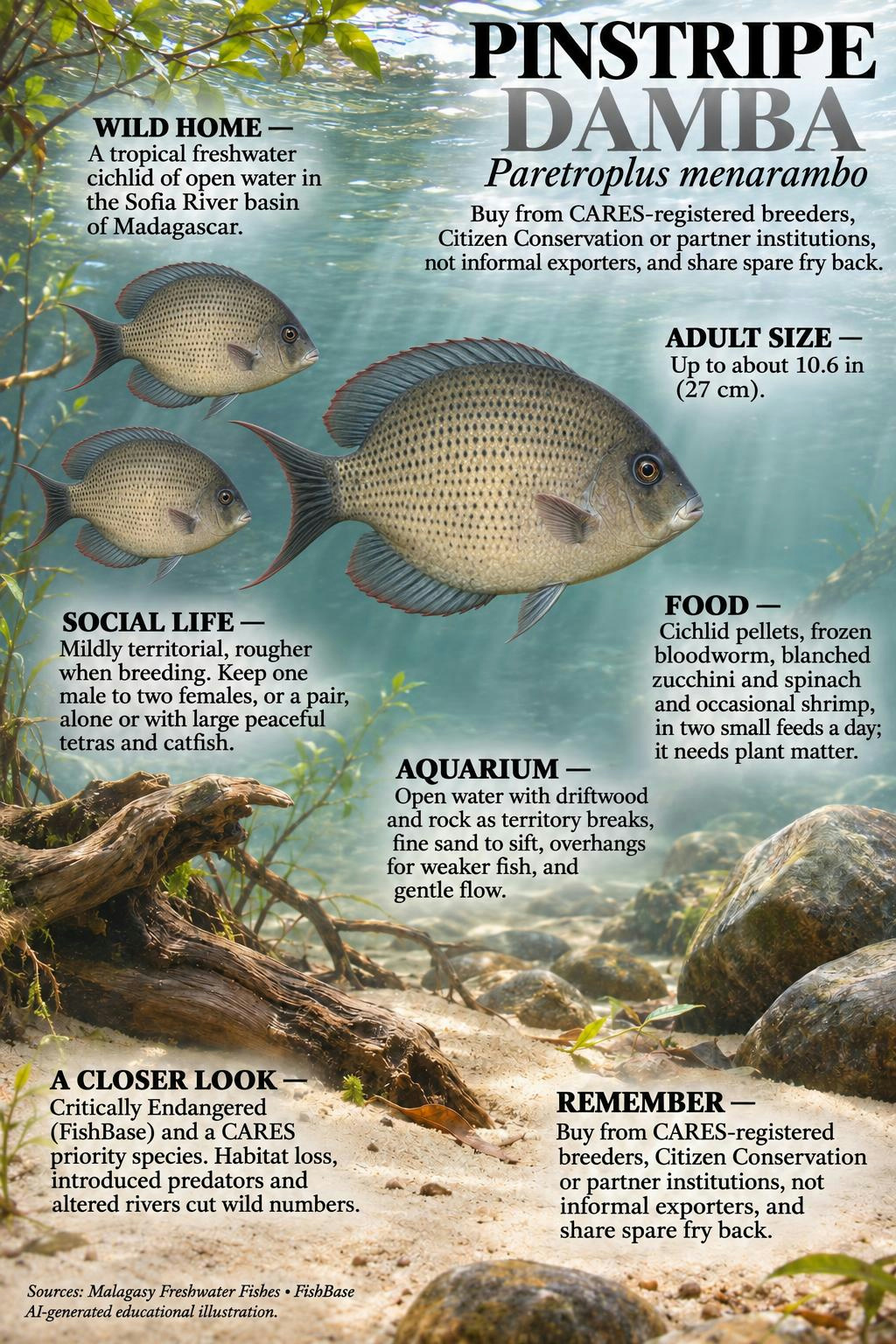
Read the infographic as text
- WILD HOME — A tropical freshwater cichlid of open water in the Sofia River basin of Madagascar.
- ADULT SIZE — Up to about 10.6 in (27 cm).
- FOOD — Cichlid pellets, frozen bloodworm, blanched zucchini and spinach and occasional shrimp, in two small feeds a day; it needs plant matter.
- SOCIAL LIFE — Mildly territorial, rougher when breeding. Keep one male to two females, or a pair, alone or with large peaceful tetras and catfish.
- AQUARIUM — Open water with driftwood and rock as territory breaks, fine sand to sift, overhangs for weaker fish, and gentle flow.
- A CLOSER LOOK — Critically Endangered (FishBase) and a CARES priority species. Habitat loss, introduced predators and altered rivers cut wild numbers.
- REMEMBER — Buy from CARES-registered breeders, Citizen Conservation or partner institutions, not informal exporters, and share spare fry back.
How to use these figures
Published care ranges and suggested tank sizes are starting points, not guarantees. Tank footprint, group size, filtration, feeding, companions and the individual fish all matter. Standard length excludes the tail fin. Do not abruptly change established water conditions to match a number on a page.
Use a cycled aquarium, monitor water quality and quarantine new arrivals using a suitable species-specific plan. Persistent appetite loss, rapid breathing or weight loss warrants investigation.
Common questions
What should I know before choosing this fish?
Buy from CARES-registered breeders, Citizen Conservation or partner institutions, not informal exporters, and share spare fry back. Mildly territorial, rougher when breeding. Keep one male to two females, or a pair, alone or with large peaceful tetras and catfish.
What should I feed it?
Cichlid pellets, frozen bloodworm, blanched zucchini and spinach and occasional shrimp, in two small feeds a day; it needs plant matter.
Why is it rare?
Critically Endangered (FishBase) and a CARES priority species. Habitat loss, introduced predators and altered rivers cut wild numbers.
Sources & review
Checked November 12, 2026. Retailer care guidance is not a universal biological minimum.