
At a glance
- Adult size
- About 3.5 in body length
- Space
- 30 × 12 in base or larger; see details
- Social needs
- Best in a species tank. It pays little attention to its own kind, even when spawning, and can be kept in a group.
Starting guidance, not a universal minimum. See the care details and sources below.
Adult size
Seriously Fish gives a maximum standard length of 90 mm (3.5 inches), excluding the tail fin; FishBase gives 9.1 cm SL.
Aquarium space
Seriously Fish lists 30 × 12 × 12 inches (75 × 30 × 30 cm), about 68 litres (18 US gallons), and recommends a species tank for the best chance of spawning.
Water conditions
Seriously Fish lists 77–81°F (25–27°C), pH 7.5–8.5 and 4–12 dGH, and says it needs a very steady temperature; FishBase also gives 25–27°C. These are maintenance ranges, not targets to swing between; avoid abrupt changes.
Natural home
Near the bottom of Lake Barombi Mbo, a small volcanic crater lake in Cameroon; its exact habitat there is unrecorded.
Food and feeding
Mostly live and frozen foods, backed up with good pellets or flake. In the wild it hunts shrimp and insect larvae.
Tankmates and behavior
Best in a species tank. It pays little attention to its own kind, even when spawning, and can be kept in a group.
Setting up the habitat
Sand with piles of rockwork or driftwood forming caves and hiding places, in alkaline water at a very steady temperature.
A closer look
Found only in Lake Barombi Mbo, it is Critically Endangered by water removal, deforestation, introduced species and overfishing.
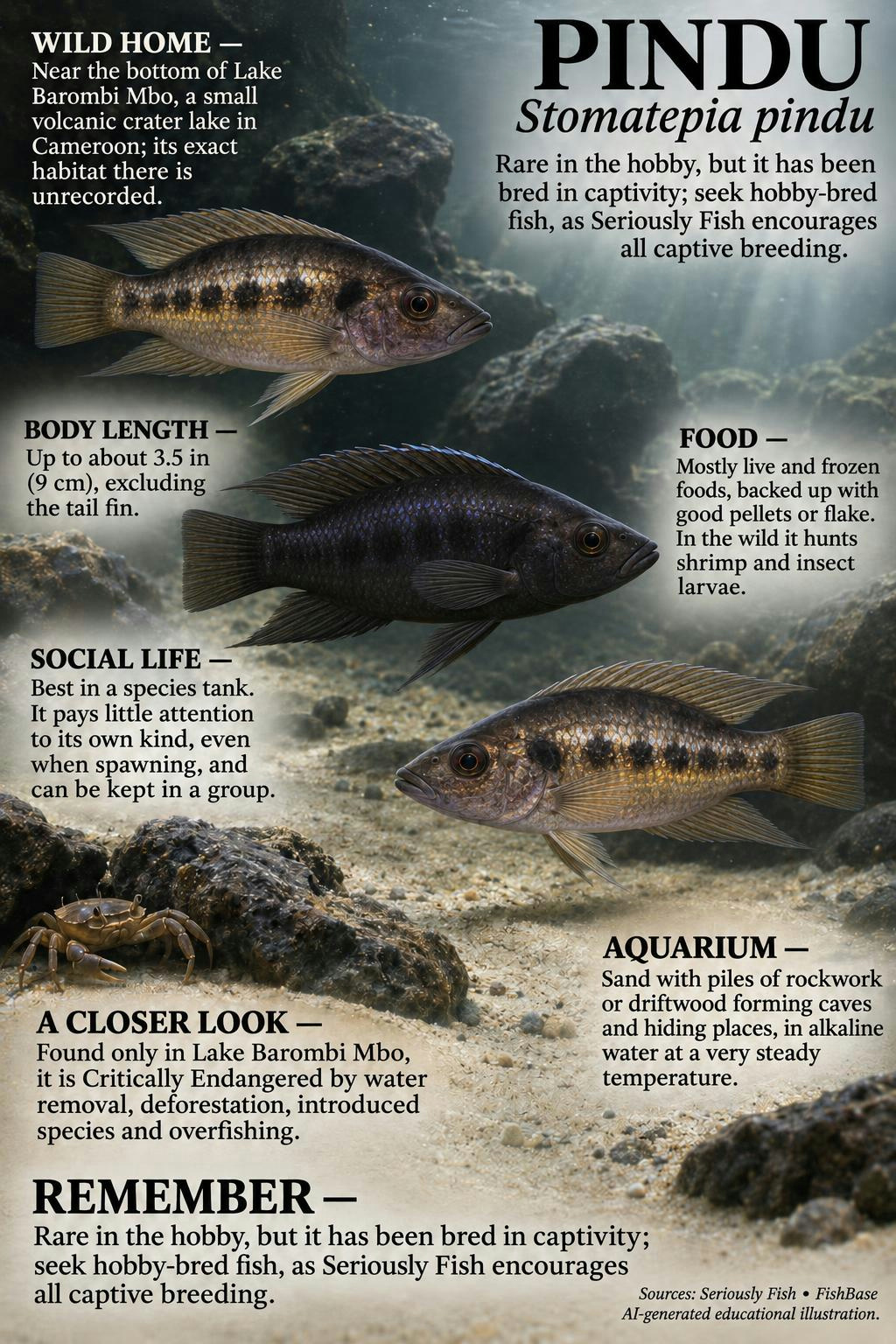
Read the infographic as text
- WILD HOME — Near the bottom of Lake Barombi Mbo, a small volcanic crater lake in Cameroon; its exact habitat there is unrecorded.
- BODY LENGTH — Up to about 3.5 in (9 cm), excluding the tail fin.
- FOOD — Mostly live and frozen foods, backed up with good pellets or flake. In the wild it hunts shrimp and insect larvae.
- SOCIAL LIFE — Best in a species tank. It pays little attention to its own kind, even when spawning, and can be kept in a group.
- AQUARIUM — Sand with piles of rockwork or driftwood forming caves and hiding places, in alkaline water at a very steady temperature.
- A CLOSER LOOK — Found only in Lake Barombi Mbo, it is Critically Endangered by water removal, deforestation, introduced species and overfishing.
- REMEMBER — Rare in the hobby, but it has been bred in captivity; seek hobby-bred fish, as Seriously Fish encourages all captive breeding.
How to use these figures
Published care ranges and suggested tank sizes are starting points, not guarantees. Tank footprint, group size, filtration, feeding, companions and the individual fish all matter. Standard length excludes the tail fin. Do not abruptly change established water conditions to match a number on a page.
Use a cycled aquarium, monitor water quality and quarantine new arrivals using a suitable species-specific plan. Persistent appetite loss, rapid breathing or weight loss warrants investigation.
Common questions
What should I know before choosing this fish?
Rare in the hobby, but it has been bred in captivity; seek hobby-bred fish, as Seriously Fish encourages all captive breeding. Best in a species tank. It pays little attention to its own kind, even when spawning, and can be kept in a group.
What should I feed it?
Mostly live and frozen foods, backed up with good pellets or flake. In the wild it hunts shrimp and insect larvae.
Why is it rare?
Found only in Lake Barombi Mbo, it is Critically Endangered by water removal, deforestation, introduced species and overfishing.
Sources & review
Checked November 12, 2026. Retailer care guidance is not a universal biological minimum.