
At a glance
- Adult size
- About 5.9 in (males)
- Space
- 500 litres (132 US gallons) or more
- Social needs
- Moderately shy but rough with its own kind; pairs have ended in deaths. Keep 10–12 adults, more females than males, to spread it out.
Starting guidance, not a universal minimum. See the care details and sources below.
Adult size
Citizen Conservation gives males up to 15 cm (about 5.9 inches) total length, and Aquarium Glaser about 15 cm; FishBase lists a maximum of 24.5 cm (about 9.6 inches) TL.
Aquarium space
Citizen Conservation recommends at least 500 litres (about 132 US gallons), in a tank at least 1.5 m long, for a group of 10–12 adults with more females than males.
Water conditions
Citizen Conservation reports good results at 24–25°C (75–77°F), KH 3–6, GH 5–10 and pH 7.5–7.8, and calls it tolerant of different water values. Change 30–50% weekly. These are maintenance ranges, not targets to swing between; avoid abrupt changes.
Natural home
Clear, swift shallows over sand and stones, with calmer pools, in a few Sofia River tributaries in Madagascar, now mainly the Amboaboa.
Food and feeding
Not choosy: flake food, frozen mosquito larvae, Artemia and brown shrimp, and live Artemia. Feed adults daily, with one fasting day a week.
Tankmates and behavior
Moderately shy but rough with its own kind; pairs have ended in deaths. Keep 10–12 adults, more females than males, to spread it out.
Setting up the habitat
Large stones for cover and egg laying, roots, sturdy plants such as Anubias, gravel or fine sand, sparse decor and strong filtration.
A closer look
Critically Endangered. Dams for rice fields dried its home river, and it was feared extinct in the wild until 18 were found in 2013.
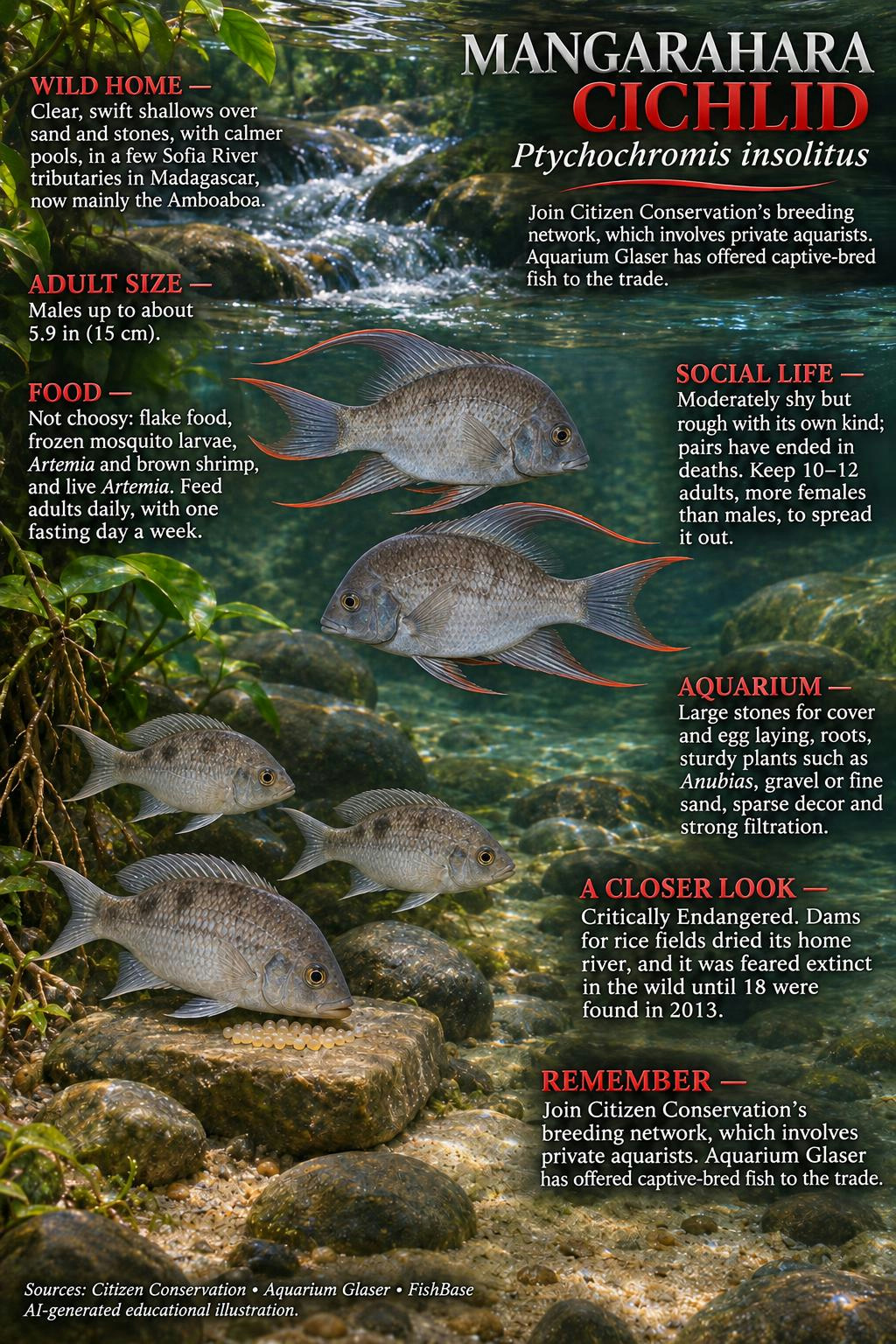
Read the infographic as text
- WILD HOME — Clear, swift shallows over sand and stones, with calmer pools, in a few Sofia River tributaries in Madagascar, now mainly the Amboaboa.
- ADULT SIZE — Males up to about 5.9 in (15 cm).
- FOOD — Not choosy: flake food, frozen mosquito larvae, Artemia and brown shrimp, and live Artemia. Feed adults daily, with one fasting day a week.
- SOCIAL LIFE — Moderately shy but rough with its own kind; pairs have ended in deaths. Keep 10–12 adults, more females than males, to spread it out.
- AQUARIUM — Large stones for cover and egg laying, roots, sturdy plants such as Anubias, gravel or fine sand, sparse decor and strong filtration.
- A CLOSER LOOK — Critically Endangered. Dams for rice fields dried its home river, and it was feared extinct in the wild until 18 were found in 2013.
- REMEMBER — Join Citizen Conservation’s breeding network, which involves private aquarists. Aquarium Glaser has offered captive-bred fish to the trade.
How to use these figures
Published care ranges and suggested tank sizes are starting points, not guarantees. Tank footprint, group size, filtration, feeding, companions and the individual fish all matter. Standard length excludes the tail fin. Do not abruptly change established water conditions to match a number on a page.
Use a cycled aquarium, monitor water quality and quarantine new arrivals using a suitable species-specific plan. Persistent appetite loss, rapid breathing or weight loss warrants investigation.
Common questions
What should I know before choosing this fish?
Join Citizen Conservation’s breeding network, which involves private aquarists. Aquarium Glaser has offered captive-bred fish to the trade. Moderately shy but rough with its own kind; pairs have ended in deaths. Keep 10–12 adults, more females than males, to spread it out.
What should I feed it?
Not choosy: flake food, frozen mosquito larvae, Artemia and brown shrimp, and live Artemia. Feed adults daily, with one fasting day a week.
Why is it rare?
Critically Endangered. Dams for rice fields dried its home river, and it was feared extinct in the wild until 18 were found in 2013.
Sources & review
Checked November 12, 2026. Retailer care guidance is not a universal biological minimum.
- Citizen Conservation — Mangarahara cichlid species page
- Citizen Conservation — Ptychochromis insolitus husbandry guidelines
- Aquarium Glaser — Ptychochromis insolitus species account — reviewed care reference
- FishBase — Ptychochromis insolitus species account