
At a glance
- Adult size
- About 6 in
- Space
- 50+ US gallons
- Social needs
- Peaceful with other fish but may be aggressive to its own kind. Wild adults usually live in pairs, and pairs stay together for life.
Starting guidance, not a universal minimum. See the care details and sources below.
Adult size
FishBase records a maximum of 13.0 cm (about 5.1 inches) total length, including the tail; a retailer care sheet lists a maximum of 6 inches.
Aquarium space
A retailer care sheet asks for at least 50 US gallons (189 litres) with plenty of swimming room and at least 3 inches of mixed substrate for burrowing. No other source gives a tank size.
Water conditions
A retailer care sheet lists 72–78°F (22–26°C), pH 8.1–8.4, dKH 8–12 and specific gravity 1.020–1.025; FishBase gives 22–28°C (72–82°F) in the wild. These are maintenance ranges, not targets to swing between; avoid abrupt changes.
Natural home
Sand and rubble patches on steep seaward slopes, 30–85 m deep, from the Philippines south to Indonesia and east to the Solomons.
Food and feeding
Meaty foods such as marine fish, crustacean flesh and mysis shrimp, fed at least twice a day.
Tankmates and behavior
Peaceful with other fish but may be aggressive to its own kind. Wild adults usually live in pairs, and pairs stay together for life.
Setting up the habitat
At least 50 gallons with open swimming room and 3 in or more of mixed substrate for burrows. Reef compatible; it has spawned in aquariums.
A closer look
Sources give no rarity reason beyond depth: FishBase says it lives 30–85 m down on steep seaward slopes and rates it Least Concern.
Read the infographic as text
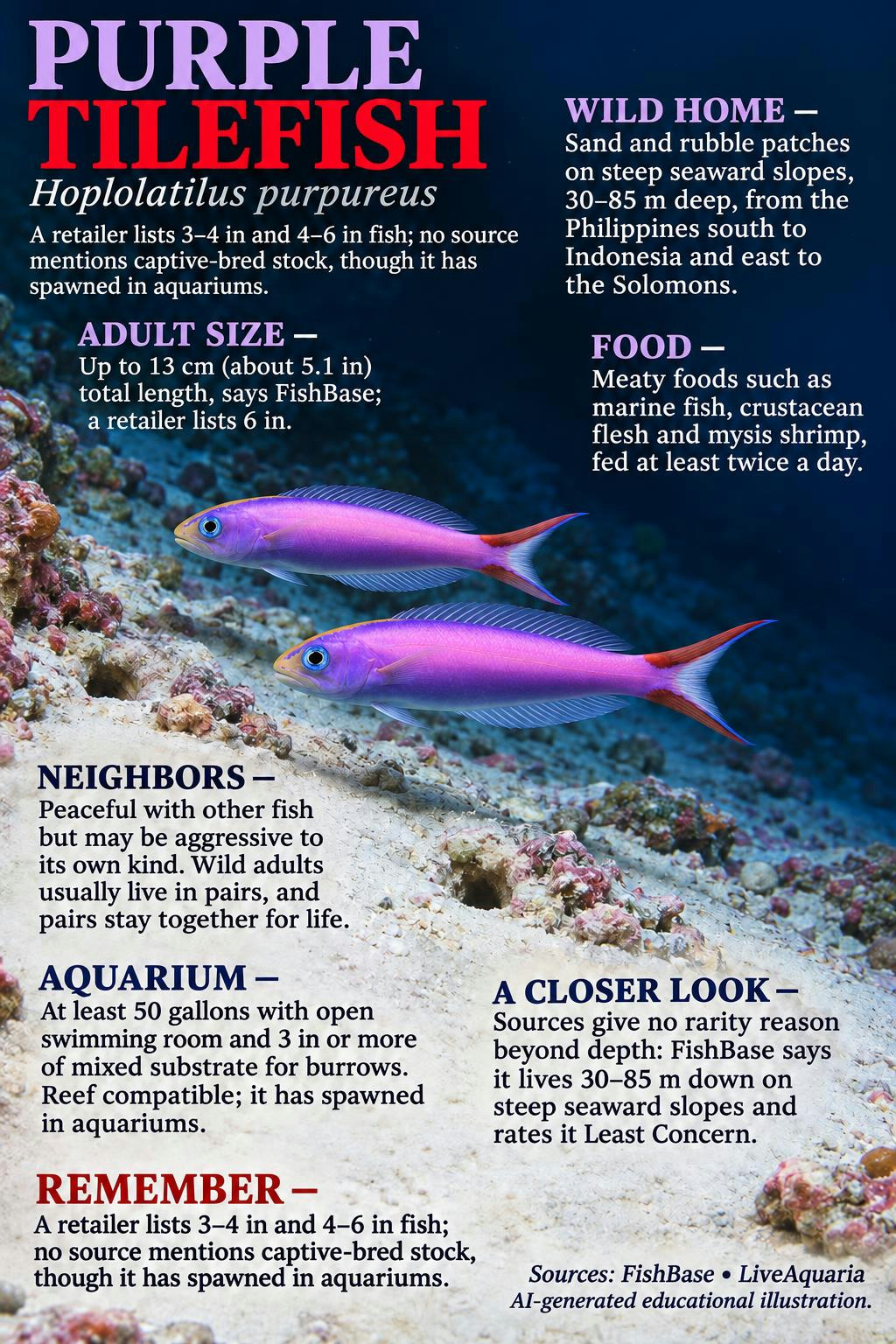
- WILD HOME — Sand and rubble patches on steep seaward slopes, 30–85 m deep, from the Philippines south to Indonesia and east to the Solomons.
- ADULT SIZE — Up to 13 cm (about 5.1 in) total length, says FishBase; a retailer lists 6 in.
- FOOD — Meaty foods such as marine fish, crustacean flesh and mysis shrimp, fed at least twice a day.
- NEIGHBORS — Peaceful with other fish but may be aggressive to its own kind. Wild adults usually live in pairs, and pairs stay together for life.
- AQUARIUM — At least 50 gallons with open swimming room and 3 in or more of mixed substrate for burrows. Reef compatible; it has spawned in aquariums.
- A CLOSER LOOK — Sources give no rarity reason beyond depth: FishBase says it lives 30–85 m down on steep seaward slopes and rates it Least Concern.
- REMEMBER — A retailer lists 3–4 in and 4–6 in fish; no source mentions captive-bred stock, though it has spawned in aquariums.
How to use these figures
Published care ranges and suggested tank sizes are starting points, not guarantees. Tank footprint, group size, filtration, feeding, companions and the individual fish all matter. Standard length excludes the tail fin. Do not abruptly change established water conditions to match a number on a page.
Use a cycled aquarium, monitor water quality and quarantine new arrivals using a suitable species-specific plan. Persistent appetite loss, rapid breathing or weight loss warrants investigation.
Common questions
What should I know before choosing this fish?
A retailer lists 3–4 in and 4–6 in fish; no source mentions captive-bred stock, though it has spawned in aquariums. Peaceful with other fish but may be aggressive to its own kind. Wild adults usually live in pairs, and pairs stay together for life.
What should I feed it?
Meaty foods such as marine fish, crustacean flesh and mysis shrimp, fed at least twice a day.
Why is it rare?
Sources give no rarity reason beyond depth: FishBase says it lives 30–85 m down on steep seaward slopes and rates it Least Concern.
Sources & review
Checked November 12, 2026. Retailer care guidance is not a universal biological minimum.
- FishBase — Hoplolatilus purpureus species account
- LiveAquaria — Purple Tilefish care profile — reviewed care reference