
At a glance
- Adult size
- Up to about 7 cm
- Space
- No size given; one fish, or a very large tank for a harem
- Social needs
- Shy and peaceful; avoid food competitors, docile fish such as firefish, and big bullies. Small groups fight as one becomes male.
Starting guidance, not a universal minimum. See the care details and sources below.
Adult size
FishBase records a maximum of 7.0 cm (about 2.8 inches) total length, including the tail; a retailer care sheet lists 5.5 cm (about 2.2 inches).
Aquarium space
No source gives a tank size. A retailer care sheet says keep one fish in an average tank, or one male with at least 8 females only in a very large one; the Reef Builders keeper thinks a bigger tank would have saved more of a group.
Water conditions
A retailer care sheet lists 22–25°C (72–77°F), specific gravity 1.020–1.025 and pH 8.1–8.4, and says never let it rise above 25°C (77°F); a chiller may be needed in summer. The Reef Builders keeper runs 23°C. These are maintenance ranges, not targets to swing between; avoid abrupt changes.
Natural home
Caves and coral rubble on steep drop-offs and channel walls 26–120 m deep, from the Great Barrier Reef to the islands of Oceania.
Food and feeding
A planktivore: at least four small meals a day of fish roe, mysis, enriched brine shrimp and fine frozen foods; many take pellets in time.
Tankmates and behavior
Shy and peaceful; avoid food competitors, docile fish such as firefish, and big bullies. Small groups fight as one becomes male.
Setting up the habitat
A mature, dimly lit deep-reef tank with shady crevices and overhangs, brisk flow, high oxygen, strong skimming and water kept cool.
A closer look
A deep drop-off fish often rated expert only; one keeper lost seven of eight wild fish. A Philippine hotspot has improved supply.
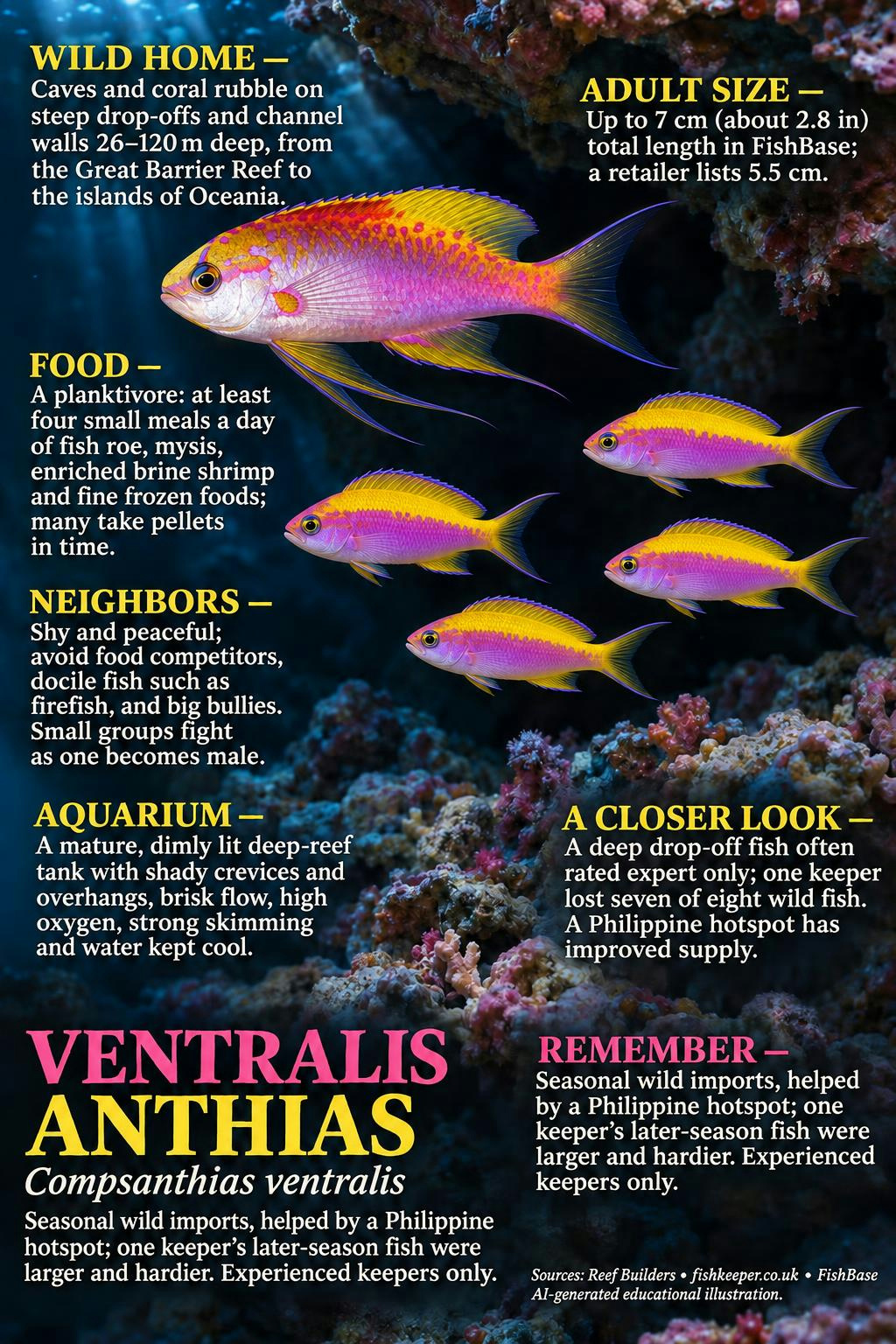
Read the infographic as text
- WILD HOME — Caves and coral rubble on steep drop-offs and channel walls 26–120 m deep, from the Great Barrier Reef to the islands of Oceania.
- ADULT SIZE — Up to 7 cm (about 2.8 in) total length in FishBase; a retailer lists 5.5 cm.
- FOOD — A planktivore: at least four small meals a day of fish roe, mysis, enriched brine shrimp and fine frozen foods; many take pellets in time.
- NEIGHBORS — Shy and peaceful; avoid food competitors, docile fish such as firefish, and big bullies. Small groups fight as one becomes male.
- AQUARIUM — A mature, dimly lit deep-reef tank with shady crevices and overhangs, brisk flow, high oxygen, strong skimming and water kept cool.
- A CLOSER LOOK — A deep drop-off fish often rated expert only; one keeper lost seven of eight wild fish. A Philippine hotspot has improved supply.
- REMEMBER — Seasonal wild imports, helped by a Philippine hotspot; one keeper’s later-season fish were larger and hardier. Experienced keepers only.
How to use these figures
Published care ranges and suggested tank sizes are starting points, not guarantees. Tank footprint, group size, filtration, feeding, companions and the individual fish all matter. Standard length excludes the tail fin. Do not abruptly change established water conditions to match a number on a page.
Use a cycled aquarium, monitor water quality and quarantine new arrivals using a suitable species-specific plan. Persistent appetite loss, rapid breathing or weight loss warrants investigation.
Common questions
What should I know before choosing this fish?
Seasonal wild imports, helped by a Philippine hotspot; one keeper’s later-season fish were larger and hardier. Experienced keepers only. Shy and peaceful; avoid food competitors, docile fish such as firefish, and big bullies. Small groups fight as one becomes male.
What should I feed it?
A planktivore: at least four small meals a day of fish roe, mysis, enriched brine shrimp and fine frozen foods; many take pellets in time.
Why is it rare?
A deep drop-off fish often rated expert only; one keeper lost seven of eight wild fish. A Philippine hotspot has improved supply.
Sources & review
Checked November 12, 2026. Retailer care guidance is not a universal biological minimum.
- Reef Builders — Ventralis Anthias, Observations and Experiences on their Captive Care (keeper’s account, 2020)
- fishkeeper.co.uk — Longfin Anthias (Pseudanthias ventralis ventralis) care sheet — reviewed care reference
- FishBase — Compsanthias ventralis species account