
At a glance
- Adult size
- About 3 in
- Space
- 20–30+ US gallons
- Social needs
- Shy but semi-aggressive: it defends its cave, may annoy small peaceful fish and may pick at small shrimps. Keep one per tank.
Starting guidance, not a universal minimum. See the care details and sources below.
Adult size
FishBase records a maximum of 7.0 cm (about 2.8 inches) total length, and Saltcorner gives 3 inches; KP Aquatics says most are 1.25–2.5 inches long.
Aquarium space
Saltcorner gives a minimum of 20 US gallons (76 litres) or more; KP Aquatics recommends at least 30 US gallons (114 litres), saying this deep-water fish prefers a large tank for its size.
Water conditions
Saltcorner lists 68–79°F (20–26°C), specific gravity 1.020–1.026 and pH 8.0–8.5; FishBase gives 22–26°C (72–79°F) for wild fish. These are maintenance ranges, not targets to swing between; avoid abrupt changes.
Natural home
Small caves and ledges on steep outer reef faces, 27–130 m deep, from Puerto Rico and the Bahamas to Central America.
Food and feeding
Enriched, finely chopped fish, crustacean and clam flesh and other meaty foods, two to three times daily; flake foods are accepted too.
Tankmates and behavior
Shy but semi-aggressive: it defends its cave, may annoy small peaceful fish and may pick at small shrimps. Keep one per tank.
Setting up the habitat
Many rocky caves and crevices. It prefers dim light but adjusts to bright reef tanks; cover the tank, as it can jump.
A closer look
It lives 27–130 m deep on outer reef faces; Saltcorner says it is rarely seen in the trade, and KP Aquatics seldom has it in stock.
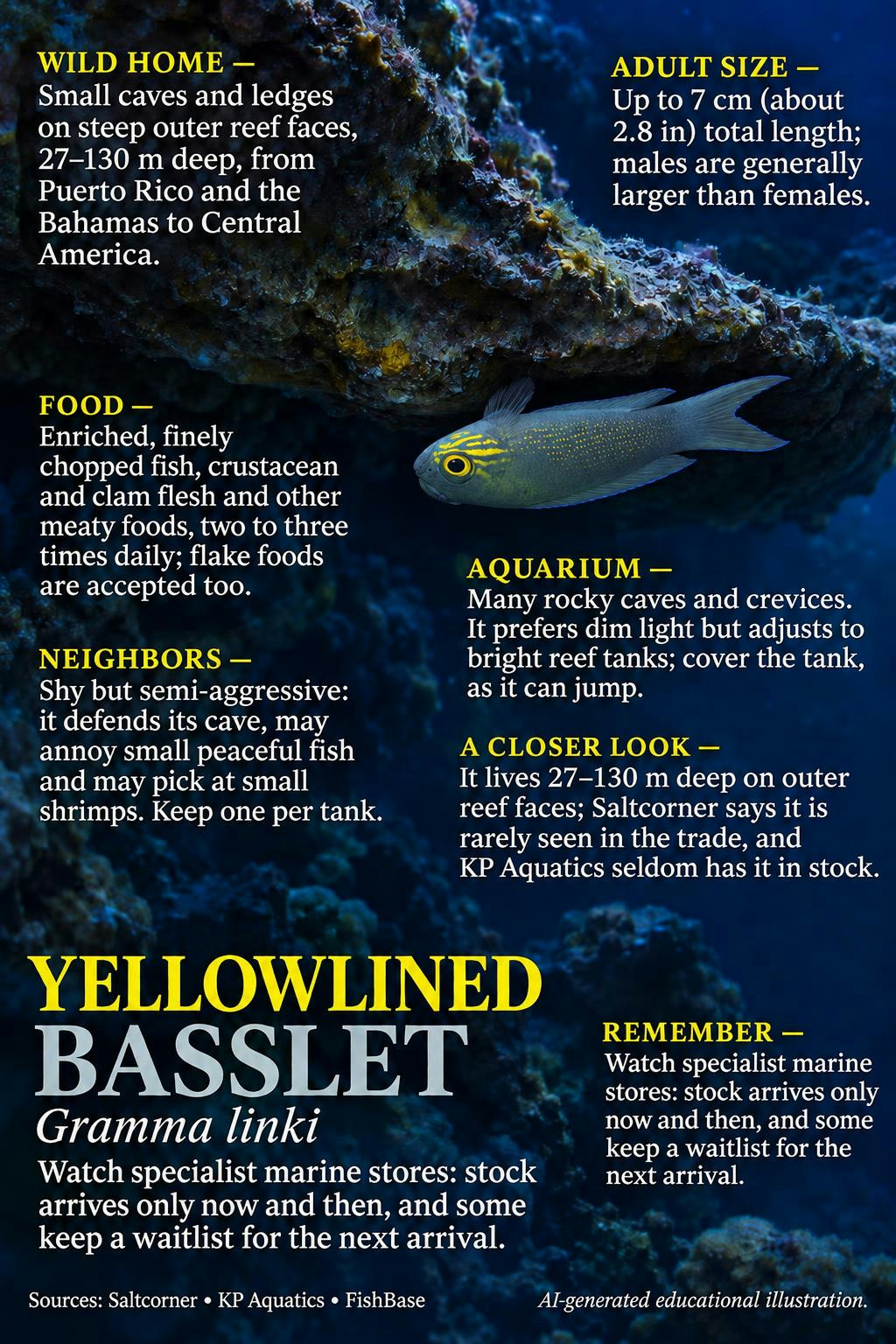
Read the infographic as text
- WILD HOME — Small caves and ledges on steep outer reef faces, 27–130 m deep, from Puerto Rico and the Bahamas to Central America.
- ADULT SIZE — Up to 7 cm (about 2.8 in) total length; males are generally larger than females.
- FOOD — Enriched, finely chopped fish, crustacean and clam flesh and other meaty foods, two to three times daily; flake foods are accepted too.
- NEIGHBORS — Shy but semi-aggressive: it defends its cave, may annoy small peaceful fish and may pick at small shrimps. Keep one per tank.
- AQUARIUM — Many rocky caves and crevices. It prefers dim light but adjusts to bright reef tanks; cover the tank, as it can jump.
- A CLOSER LOOK — It lives 27–130 m deep on outer reef faces; Saltcorner says it is rarely seen in the trade, and KP Aquatics seldom has it in stock.
- REMEMBER — Watch specialist marine stores: stock arrives only now and then, and some keep a waitlist for the next arrival.
How to use these figures
Published care ranges and suggested tank sizes are starting points, not guarantees. Tank footprint, group size, filtration, feeding, companions and the individual fish all matter. Standard length excludes the tail fin. Do not abruptly change established water conditions to match a number on a page.
Use a cycled aquarium, monitor water quality and quarantine new arrivals using a suitable species-specific plan. Persistent appetite loss, rapid breathing or weight loss warrants investigation.
Common questions
What should I know before choosing this fish?
Watch specialist marine stores: stock arrives only now and then, and some keep a waitlist for the next arrival. Shy but semi-aggressive: it defends its cave, may annoy small peaceful fish and may pick at small shrimps. Keep one per tank.
What should I feed it?
Enriched, finely chopped fish, crustacean and clam flesh and other meaty foods, two to three times daily; flake foods are accepted too.
Why is it rare?
It lives 27–130 m deep on outer reef faces; Saltcorner says it is rarely seen in the trade, and KP Aquatics seldom has it in stock.
Sources & review
Checked November 12, 2026. Retailer care guidance is not a universal biological minimum.
- Saltcorner — Gramma linki species page
- KP Aquatics — Yellowlined basslet product page — reviewed care reference
- FishBase — Gramma linki species account