
At a glance
- Adult size
- Up to about 3.1 inches (8 cm)
- Aquarium space
- 30 US gallons or more, with caves.
- Feeding
- Small varied marine foods near its retreat.
- Compatibility
- Peaceful companions; defendable cave space.
Starting guidance, not a universal minimum. See the care details and sources below.
Adult size
Up to about 3.1 inches (8 cm)
Aquarium space
30 US gallons or more, following LiveAquaria’s care recommendation; include caves and sheltered rockwork.
Water conditions
LiveAquaria lists 72–78°F (22–26°C), pH 8.1–8.4 and specific gravity 1.020–1.025. These are retailer fish-care ranges, not a universal salinity prescription for every coral or invertebrate. Match the whole system and keep conditions stable.
Natural home
Western Atlantic and Caribbean reefs. The Smithsonian records it from North Carolina to the southern Caribbean.
Food and feeding
A carnivore. Offer suitably small mysis and other varied frozen marine foods; watch that it comes out and eats rather than being excluded by faster fish.
Tankmates and behavior
Usually peaceful with similarly sized, nonaggressive fish but territorial toward its own kind. A single royal gramma is the straightforward choice for a modest community aquarium.
Setting up the habitat
Build secure caves and shaded ledges. Leave sheltered feeding space near its retreat instead of forcing a timid fish to cross exposed open water.
A closer look
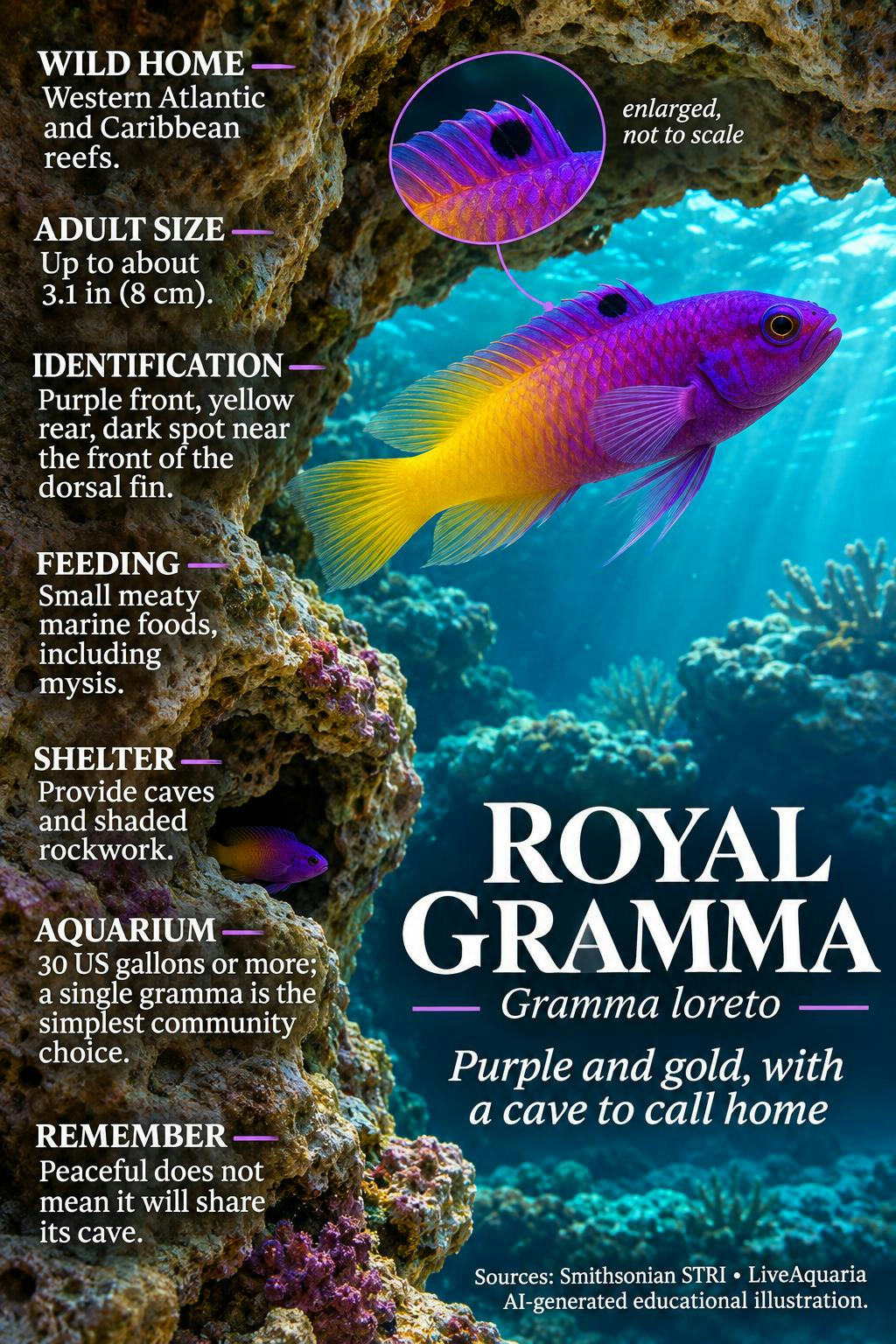
Purple covers the head and front of the body, yellow the rear. A dark spot near the front of the dorsal fin and lines near the eye help identify it; it is not the similarly colored bicolor dottyback.
Read the infographic as text
- WILD HOME — Western Atlantic and Caribbean reefs.
- ADULT SIZE — Up to about 3.1 in (8 cm).
- IDENTIFICATION — Purple front, yellow rear, dark spot near the front of the dorsal fin.
- FEEDING — Small meaty marine foods, including mysis.
- SHELTER — Provide caves and shaded rockwork.
- AQUARIUM — 30 US gallons or more; a single gramma is the simplest community choice.
- REMEMBER — Peaceful does not mean it will share its cave.
How to use these figures
Published care ranges and suggested tank sizes are starting points, not guarantees. Tank footprint, group size, filtration, feeding, companions and the individual fish all matter. Standard length excludes the tail fin. Do not abruptly change established water conditions to match a number on a page.
Use a cycled aquarium, monitor water quality and quarantine new arrivals using a suitable species-specific plan. Persistent appetite loss, rapid breathing or weight loss warrants investigation.
Common questions
Is a royal gramma the same as a bicolor dottyback?
Purple covers the head and front of the body, yellow the rear. A dark spot near the front of the dorsal fin and lines near the eye help identify it; it is not the similarly colored bicolor dottyback.
Can I keep several royal grammas together?
Usually peaceful with similarly sized, nonaggressive fish but territorial toward its own kind. A single royal gramma is the straightforward choice for a modest community aquarium.
Sources & review
Checked November 12, 2026. Retailer care guidance is not a universal biological minimum.
- Shorefishes of the Greater Caribbean online information system - The Fishes
- Saltwater Aquarium Fish – LiveAquaria — reviewed care reference