
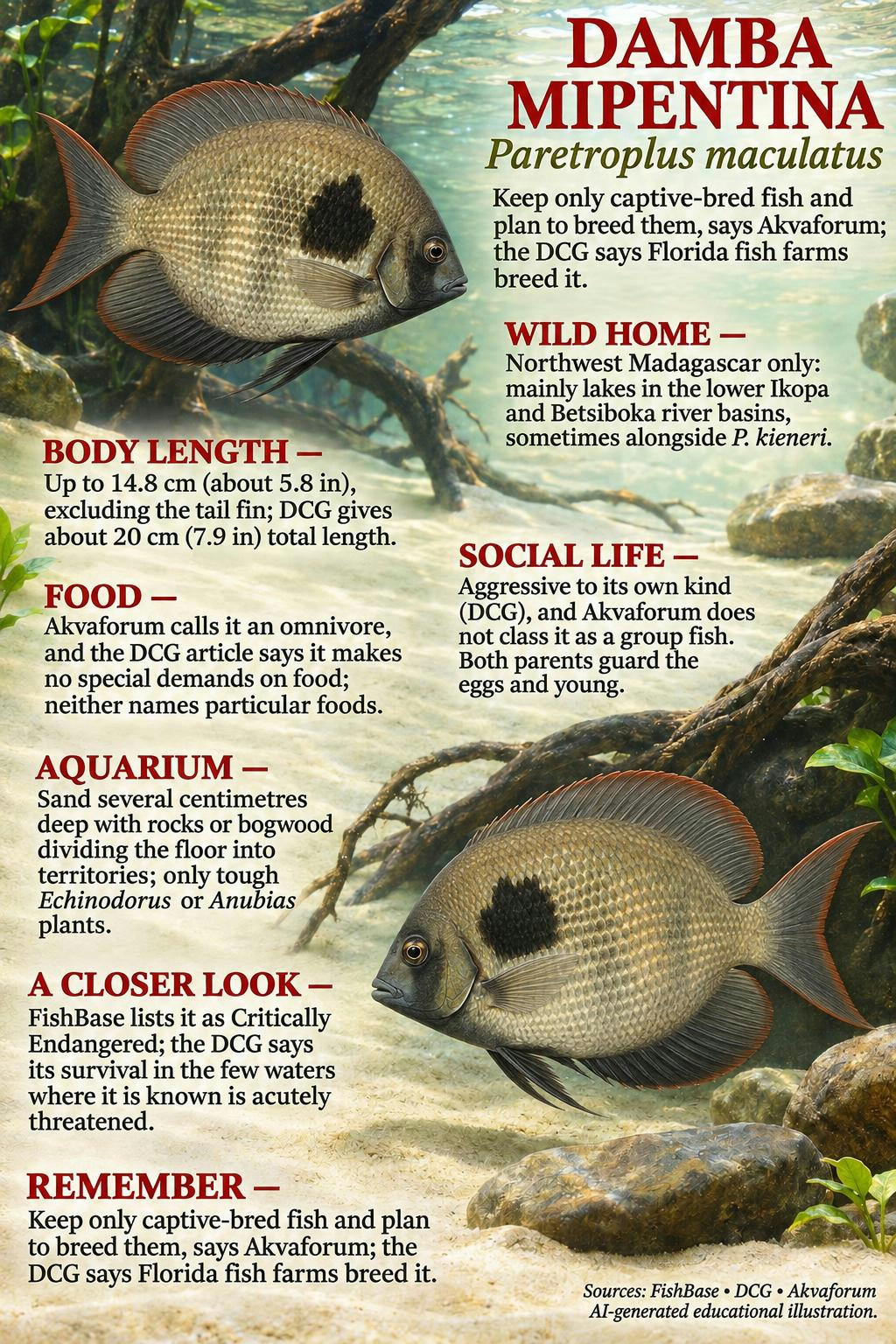
At a glance
- Adult size
- About 14.8 cm (5.8 in) body length
- Space
- 375 litres (about 99 US gallons); see details
- Social needs
- Aggressive to its own kind (DCG), and Akvaforum does not class it as a group fish. Both parents guard the eggs and young.
Starting guidance, not a universal minimum. See the care details and sources below.
Adult size
FishBase gives a maximum standard length of 14.8 cm (about 5.8 inches), excluding the tail fin; Akvaforum gives 15.8 cm, and the DCG article (Wolfgang Staeck) a total length of about 20 cm (about 7.9 inches). Adults have a much larger black side spot than young fish.
Aquarium space
The DCG article calls for an extremely spacious tank at least one and a half metres long, with shelter among rockwork or bogwood roots, and says the only problems in breeding it are its size and its aggression toward its own kind. Akvaforum gives a minimum of 375 litres (about 99 US gallons). Pairs like to spawn on vertical surfaces of hidden roots.
Water conditions
The DCG article gives about 25°C (77°F) and medium-hard to hard water at pH 6.5–8 as ideal, and says it makes no special demands on water values. Akvaforum gives softer, more acidic figures: 23–27°C (73–81°F), pH 6–7 and 0–8 GH. FishBase gives none. These are maintenance ranges, not targets to swing between; avoid abrupt changes.
Natural home
Northwest Madagascar only: mainly lakes in the lower Ikopa and Betsiboka river basins, sometimes alongside P. kieneri.
Food and feeding
Akvaforum calls it an omnivore, and the DCG article says it makes no special demands on food; neither names particular foods.
Tankmates and behavior
Aggressive to its own kind (DCG), and Akvaforum does not class it as a group fish. Both parents guard the eggs and young.
Setting up the habitat
Sand several centimetres deep with rocks or bogwood dividing the floor into territories; only tough Echinodorus or Anubias plants.
A closer look
FishBase lists it as Critically Endangered; the DCG says its survival in the few waters where it is known is acutely threatened.
Read the infographic as text
- WILD HOME — Northwest Madagascar only: mainly lakes in the lower Ikopa and Betsiboka river basins, sometimes alongside P. kieneri.
- BODY LENGTH — Up to 14.8 cm (about 5.8 in), excluding the tail fin; DCG gives about 20 cm (7.9 in) total length.
- FOOD — Akvaforum calls it an omnivore, and the DCG article says it makes no special demands on food; neither names particular foods.
- SOCIAL LIFE — Aggressive to its own kind (DCG), and Akvaforum does not class it as a group fish. Both parents guard the eggs and young.
- AQUARIUM — Sand several centimetres deep with rocks or bogwood dividing the floor into territories; only tough Echinodorus or Anubias plants.
- A CLOSER LOOK — FishBase lists it as Critically Endangered; the DCG says its survival in the few waters where it is known is acutely threatened.
- REMEMBER — Keep only captive-bred fish and plan to breed them, says Akvaforum; the DCG says Florida fish farms breed it.
How to use these figures
Published care ranges and suggested tank sizes are starting points, not guarantees. Tank footprint, group size, filtration, feeding, companions and the individual fish all matter. Standard length excludes the tail fin. Do not abruptly change established water conditions to match a number on a page.
Use a cycled aquarium, monitor water quality and quarantine new arrivals using a suitable species-specific plan. Persistent appetite loss, rapid breathing or weight loss warrants investigation.
Common questions
What should I know before choosing this fish?
Keep only captive-bred fish and plan to breed them, says Akvaforum; the DCG says Florida fish farms breed it. Aggressive to its own kind (DCG), and Akvaforum does not class it as a group fish. Both parents guard the eggs and young.
What should I feed it?
Akvaforum calls it an omnivore, and the DCG article says it makes no special demands on food; neither names particular foods.
Why is it rare?
FishBase lists it as Critically Endangered; the DCG says its survival in the few waters where it is known is acutely threatened.
Sources & review
Checked November 12, 2026. Retailer care guidance is not a universal biological minimum.