
At a glance
- Adult size
- About 13.6 cm (5.4 in) body length
- Space
- 375 litres (about 99 US gallons); see details
- Social needs
- Reports conflict: the GCCA found it fairly aggressive, the Nordic register calm, shy and a poor competitor, best in a species tank.
Starting guidance, not a universal minimum. See the care details and sources below.
Adult size
FishBase gives a maximum standard length of 13.6 cm (about 5.4 inches), excluding the tail fin; the Nordiska Ciklidsällskapet register gives 15 cm (about 5.9 inches). The GCCA author had read that it grows over 5 in, but his largest male was just over 2.25 in at a year old: it grows slowly.
Aquarium space
The Nordiska Ciklidsällskapet register gives 150 cm (about 59.1 inches) and 375 litres (about 99 US gallons) and rates it 3, medium, for difficulty. The GCCA author kept six with other small cichlids and plecos in a breeder tank of 40 US gallons (151 litres) and thinks the crowding reduced aggression. The register says it is not especially easy to spawn but often gives broods of 30 to 40 fry; females brood for 16 to 18 days.
Water conditions
The Nordiska Ciklidsällskapet register gives 22–28°C (72–82°F) and an unlabelled 7.5–8, which reads as a pH range; FishBase gives up to 25°C (77°F). The GCCA says it likes clean, hard water. No source gives a hardness figure. These are maintenance ranges, not targets to swing between; avoid abrupt changes.
Natural home
Inshore Lake Victoria over soft mud, down to 9 m; few were caught over sand. It has not been seen there since the early 1980s.
Food and feeding
Crushes snails in the wild. Feed shrimp mix plus frozen food, flakes or pellets; the Nordic register warns poorly fed fish soon sicken and die.
Tankmates and behavior
Reports conflict: the GCCA found it fairly aggressive, the Nordic register calm, shy and a poor competitor, best in a species tank.
Setting up the habitat
Plenty of sand and a calm tank with little competition for food; give females cover, as males may harass unready ones.
A closer look
Critically Endangered (FishBase), Extinct in the Wild for CARES (via Aquarist Species); only a few dedicated hobbyists keep it.
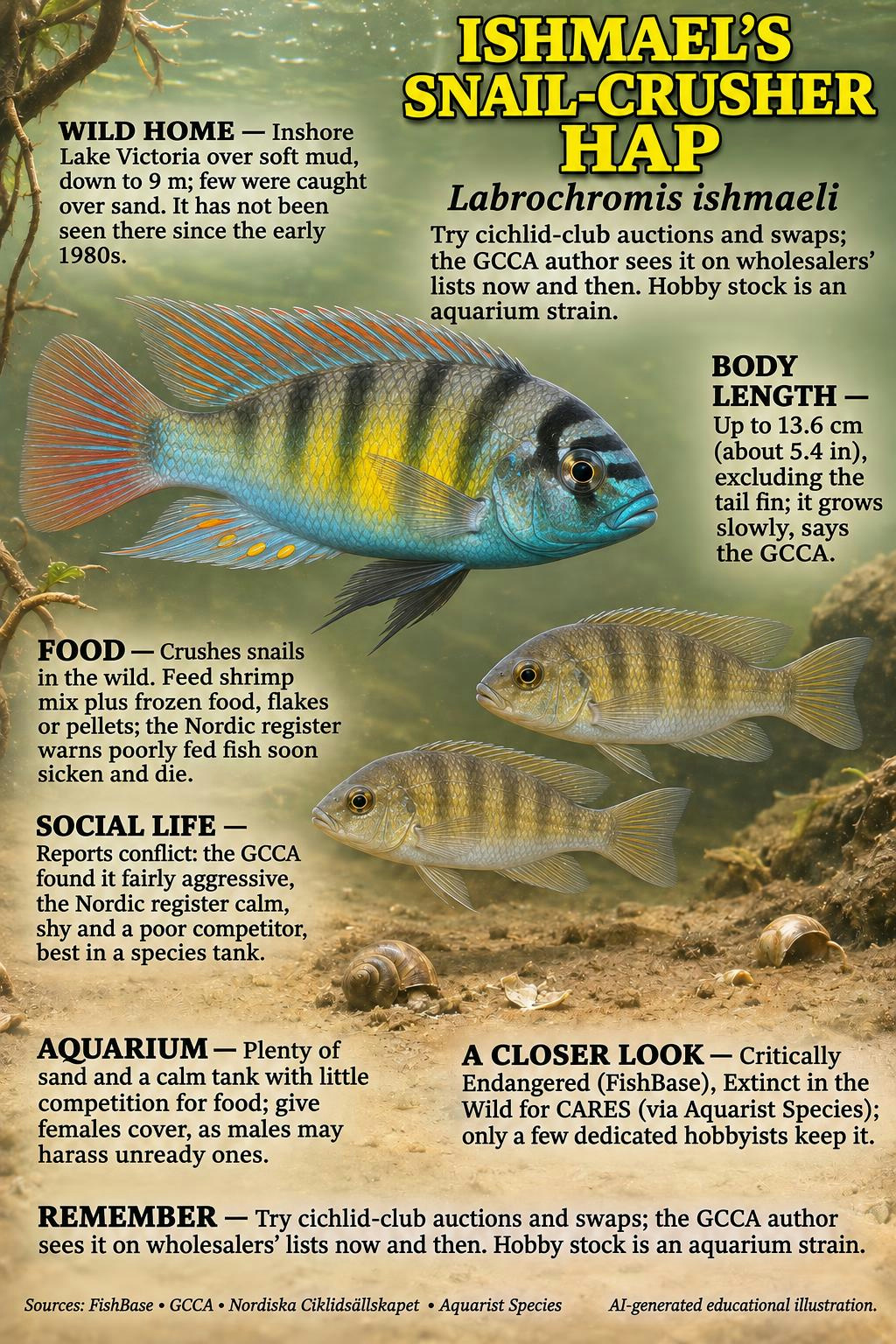
Read the infographic as text
- WILD HOME — Inshore Lake Victoria over soft mud, down to 9 m; few were caught over sand. It has not been seen there since the early 1980s.
- BODY LENGTH — Up to 13.6 cm (about 5.4 in), excluding the tail fin; it grows slowly, says the GCCA.
- FOOD — Crushes snails in the wild. Feed shrimp mix plus frozen food, flakes or pellets; the Nordic register warns poorly fed fish soon sicken and die.
- SOCIAL LIFE — Reports conflict: the GCCA found it fairly aggressive, the Nordic register calm, shy and a poor competitor, best in a species tank.
- AQUARIUM — Plenty of sand and a calm tank with little competition for food; give females cover, as males may harass unready ones.
- A CLOSER LOOK — Critically Endangered (FishBase), Extinct in the Wild for CARES (via Aquarist Species); only a few dedicated hobbyists keep it.
- REMEMBER — Try cichlid-club auctions and swaps; the GCCA author sees it on wholesalers’ lists now and then. Hobby stock is an aquarium strain.
How to use these figures
Published care ranges and suggested tank sizes are starting points, not guarantees. Tank footprint, group size, filtration, feeding, companions and the individual fish all matter. Standard length excludes the tail fin. Do not abruptly change established water conditions to match a number on a page.
Use a cycled aquarium, monitor water quality and quarantine new arrivals using a suitable species-specific plan. Persistent appetite loss, rapid breathing or weight loss warrants investigation.
Common questions
What should I know before choosing this fish?
Try cichlid-club auctions and swaps; the GCCA author sees it on wholesalers’ lists now and then. Hobby stock is an aquarium strain. Reports conflict: the GCCA found it fairly aggressive, the Nordic register calm, shy and a poor competitor, best in a species tank.
What should I feed it?
Crushes snails in the wild. Feed shrimp mix plus frozen food, flakes or pellets; the Nordic register warns poorly fed fish soon sicken and die.
Why is it rare?
Critically Endangered (FishBase), Extinct in the Wild for CARES (via Aquarist Species); only a few dedicated hobbyists keep it.
Sources & review
Checked November 12, 2026. Retailer care guidance is not a universal biological minimum.