
At a glance
- Adult size
- About 3.5 in total length
- Space
- No size given; see details
- Social needs
- Shy and secretive: keep it with calm, non-threatening fish so it can dominate. A tiny dwarf angel added later made one bolder.
Starting guidance, not a universal minimum. See the care details and sources below.
Adult size
FishBase records a maximum standard length of 5.5 cm (about 2.2 inches), excluding the tail fin; Reef Builders gives a maximum total length of 3.5 inches (9 cm).
Aquarium space
No source gives a tank size. The one conditioning account kept it in a well-established reef tank with stony corals, dim light, a large central cave and overhangs.
Water conditions
The Reef Builders keeper cooled the tank to 74°F (23°C) and calls 74°F the extreme upper limit: it needs cool water and low light. No source gives salinity, pH or alkalinity; FishBase calls it tropical. Keep conditions steady and avoid abrupt changes.
Natural home
Cracks and caves on vertical drop-offs 100–128 m deep off Rarotonga, Cook Islands; it has since been found in similar depths off Tahiti.
Food and feeding
Needs live food at first: it refused all frozen foods until live adult brine shrimp got it eating, then took frozen brine shrimp and mysis.
Tankmates and behavior
Shy and secretive: keep it with calm, non-threatening fish so it can dominate. A tiny dwarf angel added later made one bolder.
Setting up the habitat
Dim lighting, raised slowly over two months, and rockwork with caves and overhangs. It picked at fungiid corals and some chalice corals.
A closer look
Lives 100 m or more down, where only a handful of divers can collect and decompress fish; FishBase says it is almost never exported.
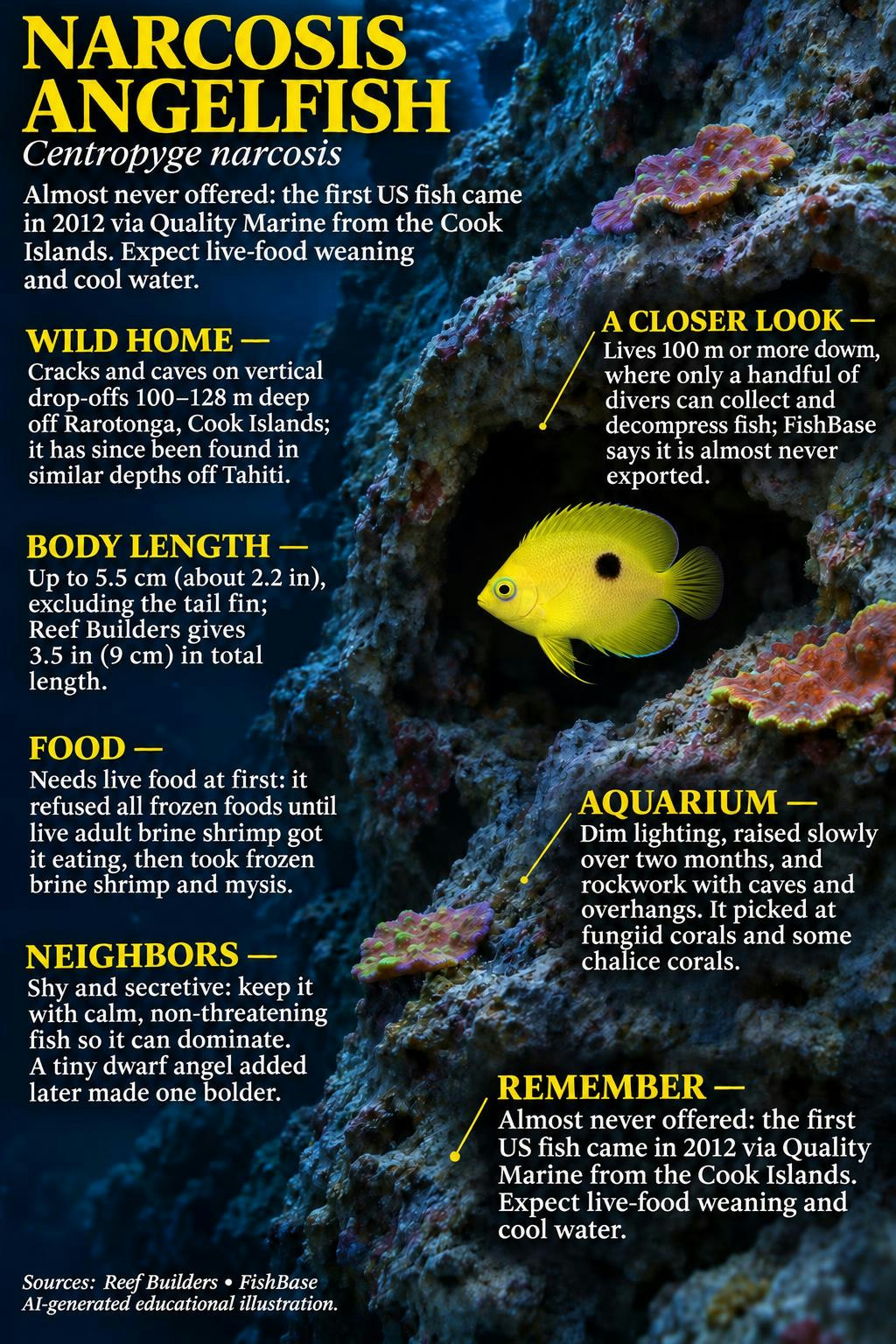
Read the infographic as text
- WILD HOME — Cracks and caves on vertical drop-offs 100–128 m deep off Rarotonga, Cook Islands; it has since been found in similar depths off Tahiti.
- BODY LENGTH — Up to 5.5 cm (about 2.2 in), excluding the tail fin; Reef Builders gives 3.5 in (9 cm) in total length.
- FOOD — Needs live food at first: it refused all frozen foods until live adult brine shrimp got it eating, then took frozen brine shrimp and mysis.
- NEIGHBORS — Shy and secretive: keep it with calm, non-threatening fish so it can dominate. A tiny dwarf angel added later made one bolder.
- AQUARIUM — Dim lighting, raised slowly over two months, and rockwork with caves and overhangs. It picked at fungiid corals and some chalice corals.
- A CLOSER LOOK — Lives 100 m or more down, where only a handful of divers can collect and decompress fish; FishBase says it is almost never exported.
- REMEMBER — Almost never offered: the first US fish came in 2012 via Quality Marine from the Cook Islands. Expect live-food weaning and cool water.
How to use these figures
Published care ranges and suggested tank sizes are starting points, not guarantees. Tank footprint, group size, filtration, feeding, companions and the individual fish all matter. Standard length excludes the tail fin. Do not abruptly change established water conditions to match a number on a page.
Use a cycled aquarium, monitor water quality and quarantine new arrivals using a suitable species-specific plan. Persistent appetite loss, rapid breathing or weight loss warrants investigation.
Common questions
What should I know before choosing this fish?
Almost never offered: the first US fish came in 2012 via Quality Marine from the Cook Islands. Expect live-food weaning and cool water. Shy and secretive: keep it with calm, non-threatening fish so it can dominate. A tiny dwarf angel added later made one bolder.
What should I feed it?
Needs live food at first: it refused all frozen foods until live adult brine shrimp got it eating, then took frozen brine shrimp and mysis.
Why is it rare?
Lives 100 m or more down, where only a handful of divers can collect and decompress fish; FishBase says it is almost never exported.
Sources & review
Checked November 12, 2026. Retailer care guidance is not a universal biological minimum.