
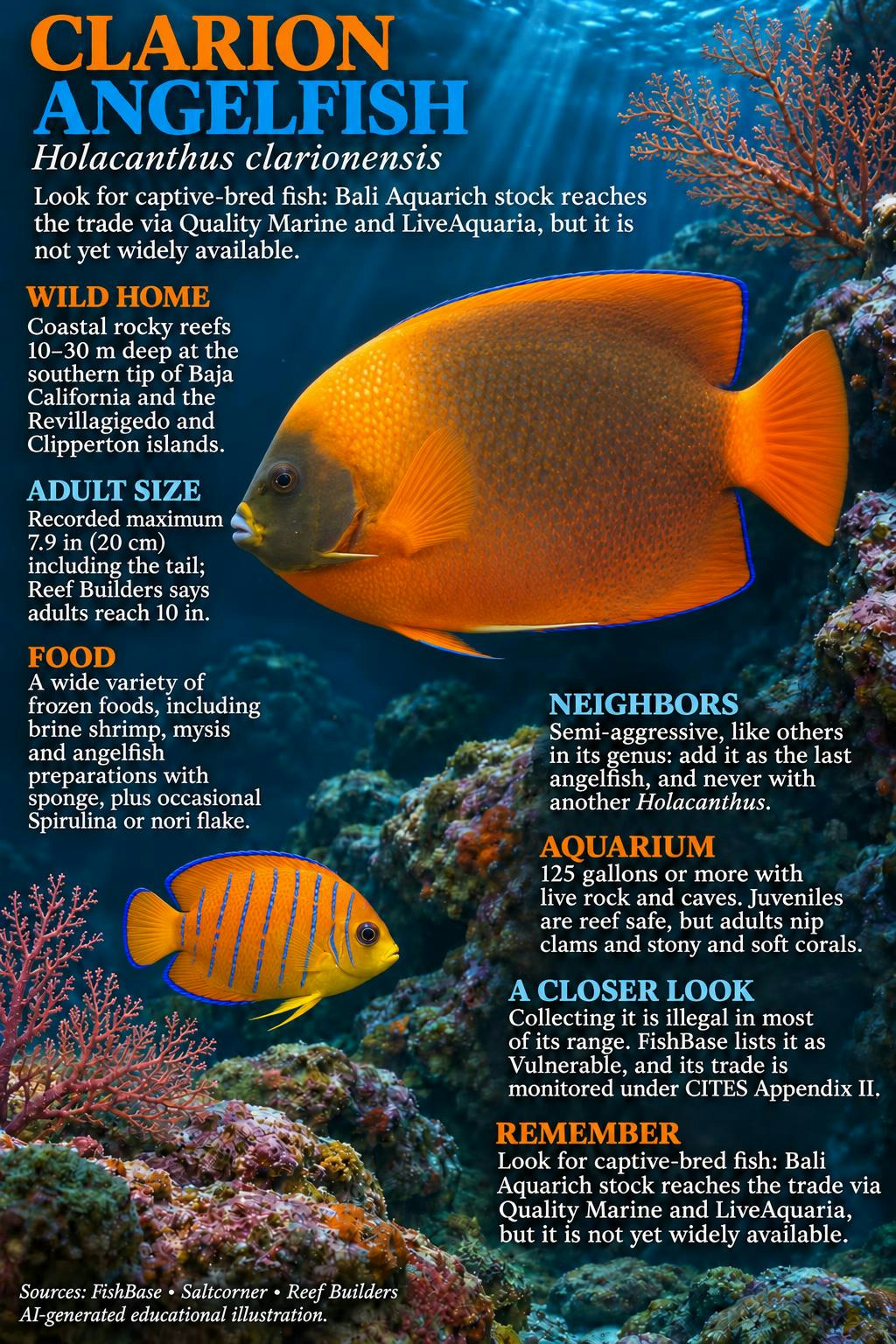
At a glance
- Adult size
- About 8–10 in
- Space
- 125+ US gallons
- Social needs
- Semi-aggressive, like others in its genus: add it as the last angelfish, and never with another Holacanthus.
Starting guidance, not a universal minimum. See the care details and sources below.
Adult size
FishBase records a maximum of 20 cm (7.9 inches) total length, including the tail; Saltcorner gives 8 inches, and Reef Builders 10 inches for adults.
Aquarium space
Saltcorner recommends a minimum of 125 US gallons (473 litres), preferably a well-established fish-only aquarium with lots of live rock and caves.
Water conditions
Saltcorner lists 68–77°F (20–25°C), specific gravity 1.020–1.026 and pH 8.0–8.5. These are maintenance ranges, not targets to swing between; keep conditions stable.
Natural home
Coastal rocky reefs 10–30 m deep at the southern tip of Baja California and the Revillagigedo and Clipperton islands.
Food and feeding
A wide variety of frozen foods, including brine shrimp, mysis and angelfish preparations with sponge, plus occasional Spirulina or nori flake.
Tankmates and behavior
Semi-aggressive, like others in its genus: add it as the last angelfish, and never with another Holacanthus.
Setting up the habitat
125 gallons or more with live rock and caves. Juveniles are reef safe, but adults nip clams and stony and soft corals.
A closer look
Collecting it is illegal in most of its range. FishBase lists it as Vulnerable, and its trade is monitored under CITES Appendix II.
Read the infographic as text
- WILD HOME — Coastal rocky reefs 10–30 m deep at the southern tip of Baja California and the Revillagigedo and Clipperton islands.
- ADULT SIZE — Recorded maximum 7.9 in (20 cm) including the tail; Reef Builders says adults reach 10 in.
- FOOD — A wide variety of frozen foods, including brine shrimp, mysis and angelfish preparations with sponge, plus occasional Spirulina or nori flake.
- NEIGHBORS — Semi-aggressive, like others in its genus: add it as the last angelfish, and never with another Holacanthus.
- AQUARIUM — 125 gallons or more with live rock and caves. Juveniles are reef safe, but adults nip clams and stony and soft corals.
- A CLOSER LOOK — Collecting it is illegal in most of its range. FishBase lists it as Vulnerable, and its trade is monitored under CITES Appendix II.
- REMEMBER — Look for captive-bred fish: Bali Aquarich stock reaches the trade via Quality Marine and LiveAquaria, but it is not yet widely available.
How to use these figures
Published care ranges and suggested tank sizes are starting points, not guarantees. Tank footprint, group size, filtration, feeding, companions and the individual fish all matter. Standard length excludes the tail fin. Do not abruptly change established water conditions to match a number on a page.
Use a cycled aquarium, monitor water quality and quarantine new arrivals using a suitable species-specific plan. Persistent appetite loss, rapid breathing or weight loss warrants investigation.
Common questions
What should I know before choosing this fish?
Look for captive-bred fish: Bali Aquarich stock reaches the trade via Quality Marine and LiveAquaria, but it is not yet widely available. Semi-aggressive, like others in its genus: add it as the last angelfish, and never with another Holacanthus.
What should I feed it?
A wide variety of frozen foods, including brine shrimp, mysis and angelfish preparations with sponge, plus occasional Spirulina or nori flake.
Why is it rare?
Collecting it is illegal in most of its range. FishBase lists it as Vulnerable, and its trade is monitored under CITES Appendix II.
Sources & review
Checked November 12, 2026. Retailer care guidance is not a universal biological minimum.