
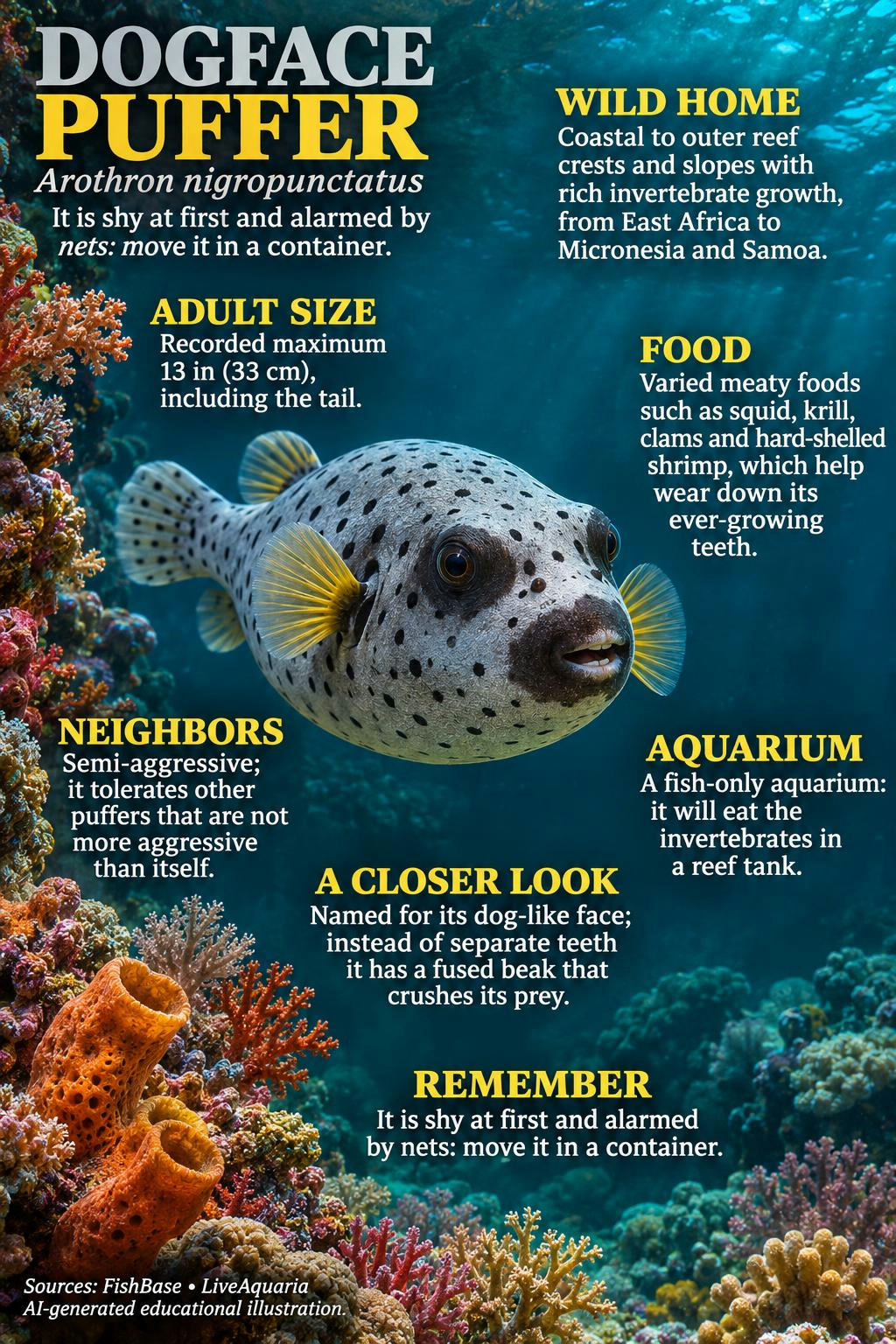
At a glance
- Adult size
- Recorded maximum 13 in; see length definition
- Space
- 100–150+ US gallons; see details
- Social needs
- Semi-aggressive; it tolerates other puffers that are not more aggressive than itself.
Starting guidance, not a universal minimum. See the care details and sources below.
Adult size
FishBase reports a maximum recorded length of 33 cm (13 inches), including the tail. A recorded maximum is not a promise of typical aquarium size. LiveAquaria lists a maximum of 13 inches.
Aquarium space
LiveAquaria’s quick-facts panel lists a minimum of 150 US gallons (568 litres); its care text calls a 100 gallon (379 litre) or larger fish-only aquarium suitable. Plan around the larger figure for adults.
Water conditions
LiveAquaria lists 72–78°F (22–26°C), pH 8.1–8.4, dKH 8–12 and specific gravity 1.020–1.025. These are retailer fish-care ranges, not a universal prescription for every coral or invertebrate; match the whole system and keep conditions stable.
Natural home
Coastal to outer reef crests and slopes with rich invertebrate growth, from East Africa to Micronesia and Samoa.
Food and feeding
Varied meaty foods such as squid, krill, clams and hard-shelled shrimp, which help wear down its ever-growing teeth.
Tankmates and behavior
Semi-aggressive; it tolerates other puffers that are not more aggressive than itself.
Setting up the habitat
A fish-only aquarium: it will eat the invertebrates in a reef tank.
A closer look
Named for its dog-like face; instead of separate teeth it has a fused beak that crushes its prey.
Read the infographic as text
- WILD HOME — Coastal to outer reef crests and slopes with rich invertebrate growth, from East Africa to Micronesia and Samoa.
- ADULT SIZE — Recorded maximum 13 in (33 cm), including the tail.
- FOOD — Varied meaty foods such as squid, krill, clams and hard-shelled shrimp, which help wear down its ever-growing teeth.
- NEIGHBORS — Semi-aggressive; it tolerates other puffers that are not more aggressive than itself.
- AQUARIUM — A fish-only aquarium: it will eat the invertebrates in a reef tank.
- A CLOSER LOOK — Named for its dog-like face; instead of separate teeth it has a fused beak that crushes its prey.
- REMEMBER — It is shy at first and alarmed by nets: move it in a container.
How to use these figures
Published care ranges and suggested tank sizes are starting points, not guarantees. Tank footprint, group size, filtration, feeding, companions and the individual fish all matter. Standard length excludes the tail fin. Do not abruptly change established water conditions to match a number on a page.
Use a cycled aquarium, monitor water quality and quarantine new arrivals using a suitable species-specific plan. Persistent appetite loss, rapid breathing or weight loss warrants investigation.
Common questions
What is the main consideration before buying?
It is shy at first and alarmed by nets: move it in a container. Semi-aggressive; it tolerates other puffers that are not more aggressive than itself.
What should this fish eat?
Varied meaty foods such as squid, krill, clams and hard-shelled shrimp, which help wear down its ever-growing teeth.
Sources & review
Checked November 12, 2026. Retailer care guidance is not a universal biological minimum.
- FishBase — Arothron nigropunctatus species account
- LiveAquaria — Arothron Dog Face Puffer care profile — reviewed care reference