
At a glance
- Adult size
- Usually 2–3 in; see details
- Space
- See details; the sources give no minimum
- Social needs
- It stays in schools of familiar fish. Breeding males turn territorial around their nests.
Starting guidance, not a universal minimum. See the care details and sources below.
Adult size
FishBase reports a maximum of 10.1 cm (4 inches) with the tail and a common length of 7.3 cm (2.9 inches). The Animal Diversity Web gives a typical body length of five to eight centimeters.
Aquarium space
Neither source reviewed gives an aquarium size. Both describe a schooling fish whose breeding males claim and defend a nest site, so plan for a group with room for more than one territory.
Water conditions
A temperate fish: FishBase records it in waters from 0–33°C (32–91°F), so it does not need tropical heat. That range is a tolerance, not a target; avoid abrupt swings.
Natural home
Muddy pools, creeks, small rivers, ponds and lakes over much of North America.
Food and feeding
An opportunistic omnivore: wild fish sift mud for algae, tiny crustaceans and insect larvae.
Tankmates and behavior
It stays in schools of familiar fish. Breeding males turn territorial around their nests.
Setting up the habitat
Flat rocks, wood or plants: males nest on the underside of horizontal objects.
A closer look
The male guards the eggs and cleans the nest with a spongy pad on his nape.
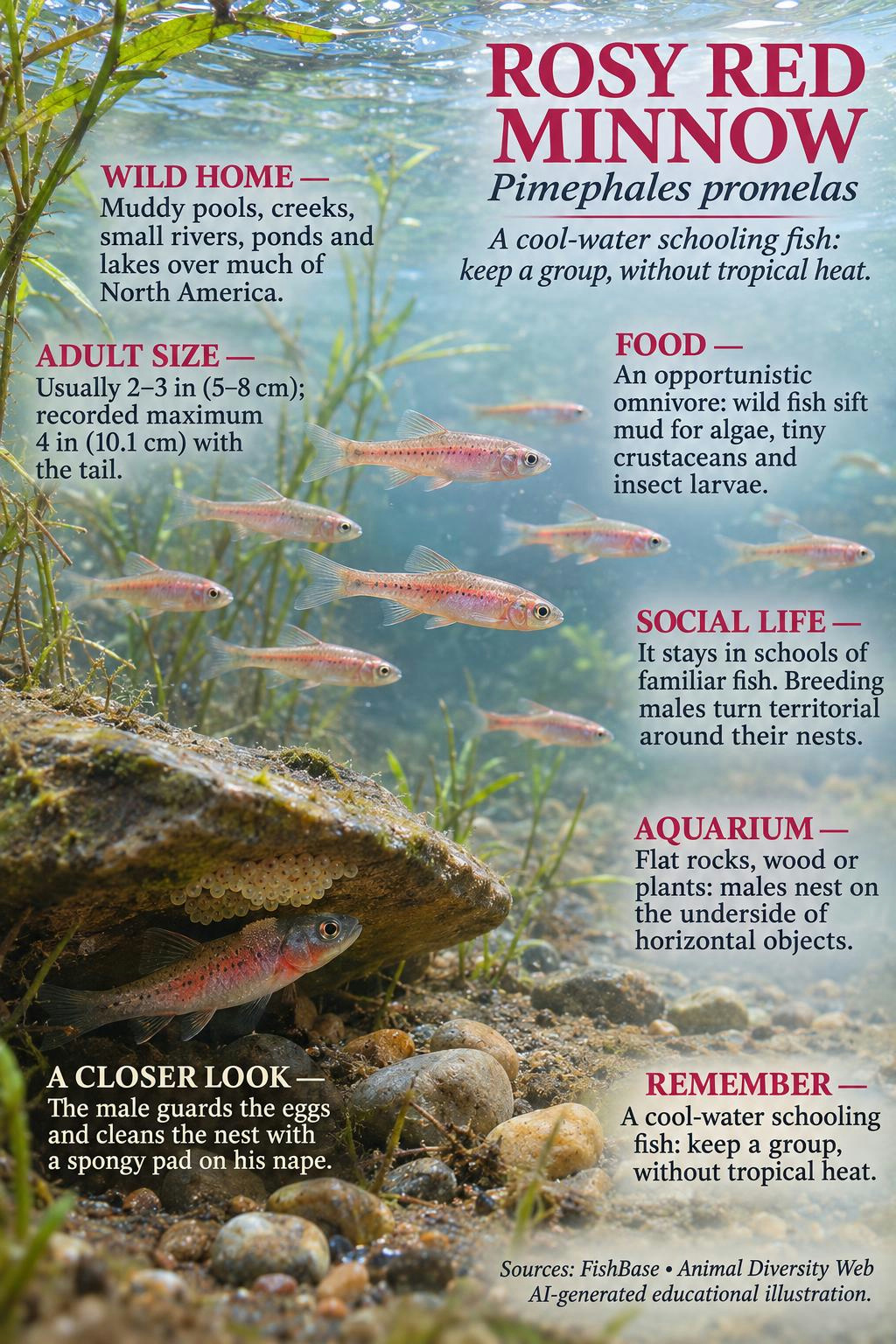
Read the infographic as text
- WILD HOME — Muddy pools, creeks, small rivers, ponds and lakes over much of North America.
- ADULT SIZE — Usually 2–3 in (5–8 cm); recorded maximum 4 in (10.1 cm) with the tail.
- FOOD — An opportunistic omnivore: wild fish sift mud for algae, tiny crustaceans and insect larvae.
- SOCIAL LIFE — It stays in schools of familiar fish. Breeding males turn territorial around their nests.
- AQUARIUM — Flat rocks, wood or plants: males nest on the underside of horizontal objects.
- A CLOSER LOOK — The male guards the eggs and cleans the nest with a spongy pad on his nape.
- REMEMBER — A cool-water schooling fish: keep a group, without tropical heat.
How to use these figures
Published care ranges and suggested tank sizes are starting points, not guarantees. Tank footprint, group size, filtration, feeding, companions and the individual fish all matter. Standard length excludes the tail fin. Do not abruptly change established water conditions to match a number on a page.
Use a cycled aquarium, monitor water quality and quarantine new arrivals using a suitable species-specific plan. Persistent appetite loss, rapid breathing or weight loss warrants investigation.
Common questions
What should I know before choosing this fish?
A cool-water schooling fish: keep a group, without tropical heat. It stays in schools of familiar fish. Breeding males turn territorial around their nests.
What should I feed it?
An opportunistic omnivore: wild fish sift mud for algae, tiny crustaceans and insect larvae.
Sources & review
Checked November 12, 2026. Retailer care guidance is not a universal biological minimum.