
At a glance
- Adult size
- 12 in or more; see details
- Space
- 100+ US gallons or a pond; see details
- Social needs
- Social and rarely aggressive with each other; keep a group. It also fares well in ponds with koi.
Starting guidance, not a universal minimum. See the care details and sources below.
Adult size
LiveAquaria lists a maximum of 18 inches (46 cm) for the common goldfish and 14 inches for the sarasa comet, and says goldfish can grow to 12 inches or more. FishBase records the species to 48 cm (18.9 inches) with the tail.
Aquarium space
LiveAquaria says smaller common goldfish do well in an aquarium of 30 US gallons or more while young, but will eventually outgrow aquariums of less than 100 gallons (379 litres). For the sarasa comet it describes a pond of at least 180 gallons (681 litres).
Water conditions
LiveAquaria lists pH 6.8–7.2 and a tolerated range of 36–90°F (2–32°C): a fish for unheated tanks and ponds. A tolerance is not a target; avoid abrupt swings.
Natural home
A domestic fish with no wild form; its ancestors come from still and slow waters of East Asia.
Food and feeding
Omnivorous: a goldfish flake or pellet as the staple, with protein limited to 30% of the diet.
Tankmates and behavior
Social and rarely aggressive with each other; keep a group. It also fares well in ponds with koi.
Setting up the habitat
Fine gravel, hardy cold-water plants and capable filtration: goldfish dig and are messy.
A closer look
The comet has a single tail and, unlike carp, no barbels at the mouth.
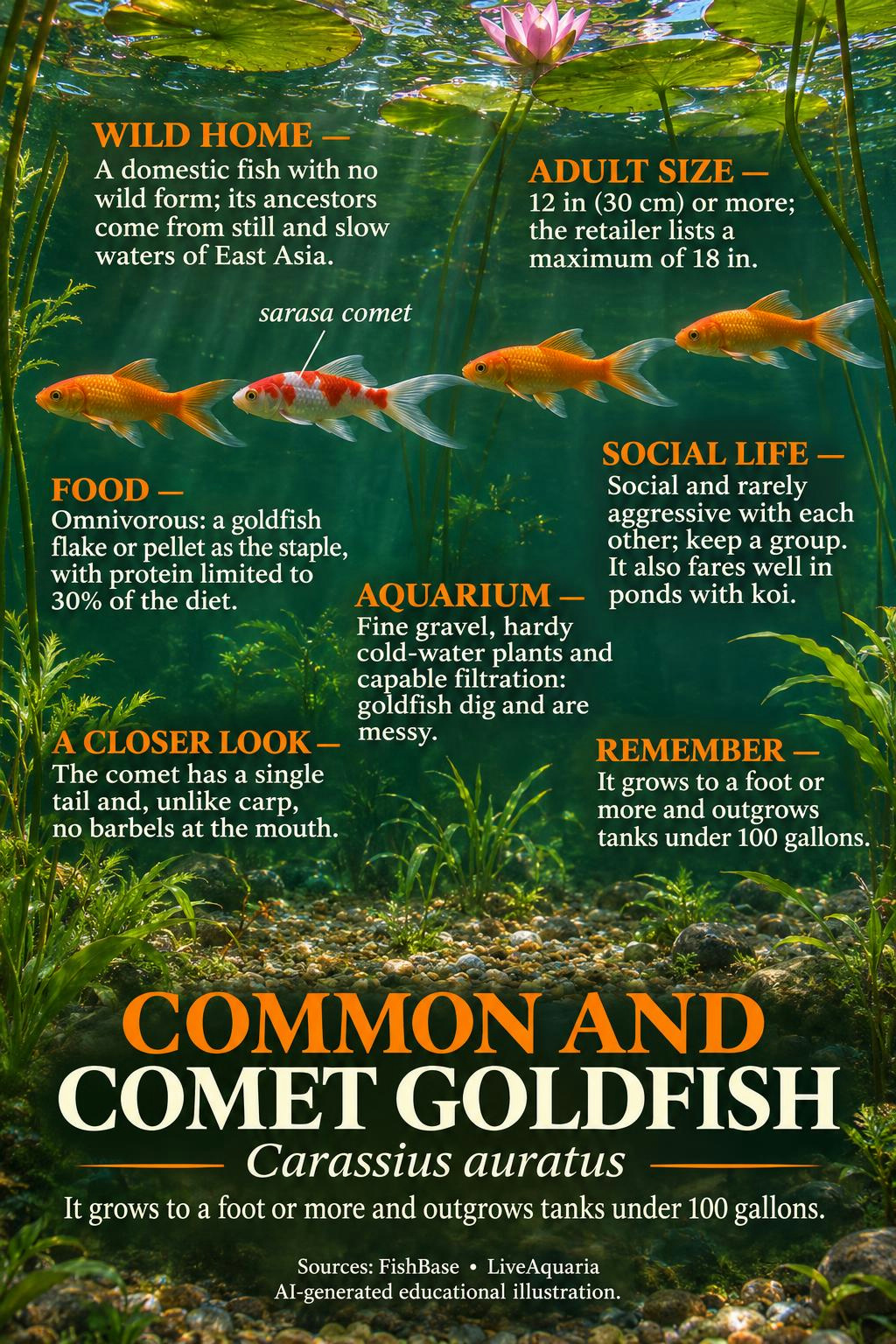
Read the infographic as text
- WILD HOME — A domestic fish with no wild form; its ancestors come from still and slow waters of East Asia.
- ADULT SIZE — 12 in (30 cm) or more; the retailer lists a maximum of 18 in.
- FOOD — Omnivorous: a goldfish flake or pellet as the staple, with protein limited to 30% of the diet.
- SOCIAL LIFE — Social and rarely aggressive with each other; keep a group. It also fares well in ponds with koi.
- AQUARIUM — Fine gravel, hardy cold-water plants and capable filtration: goldfish dig and are messy.
- A CLOSER LOOK — The comet has a single tail and, unlike carp, no barbels at the mouth.
- REMEMBER — It grows to a foot or more and outgrows tanks under 100 gallons.
How to use these figures
Published care ranges and suggested tank sizes are starting points, not guarantees. Tank footprint, group size, filtration, feeding, companions and the individual fish all matter. Standard length excludes the tail fin. Do not abruptly change established water conditions to match a number on a page.
Use a cycled aquarium, monitor water quality and quarantine new arrivals using a suitable species-specific plan. Persistent appetite loss, rapid breathing or weight loss warrants investigation.
Common questions
What should I know before choosing this fish?
It grows to a foot or more and outgrows tanks under 100 gallons. Social and rarely aggressive with each other; keep a group. It also fares well in ponds with koi.
What should I feed it?
Omnivorous: a goldfish flake or pellet as the staple, with protein limited to 30% of the diet.
Sources & review
Checked November 12, 2026. Retailer care guidance is not a universal biological minimum.
- FishBase — Carassius auratus species account
- LiveAquaria — Common Goldfish care profile — reviewed care reference
- LiveAquaria — Sarasa Comet care profile — reviewed care reference