
At a glance
- Adult size
- Up to about 10 in; see details
- Space
- 30+ US gallons; see details
- Social needs
- Goldfish are social and rarely aggressive with each other; the retailer suggests keeping a group.
Starting guidance, not a universal minimum. See the care details and sources below.
Adult size
LiveAquaria lists a maximum of 10 inches (25 cm) for the red cap oranda. FishBase records goldfish in general to 48 cm (18.9 inches) with the tail, with a common length of 10 cm.
Aquarium space
LiveAquaria says the red cap oranda will do well in a tank of 30 US gallons (114 litres) of water or more, or in a backyard pond of 180 gallons or more. Treat that as a starting recommendation: adult size and the number of fish can require more.
Water conditions
LiveAquaria lists 65–75°F (18–24°C) and pH 6.5–7.5, cooler than a tropical tank. FishBase notes that goldfish live better in cold water. Avoid abrupt changes.
Natural home
A domestic fish with no wild form; its ancestors come from still and slow waters of East Asia.
Food and feeding
Omnivorous: a goldfish flake or pellet as the staple; the retailer says to limit protein to 30% of the diet.
Tankmates and behavior
Goldfish are social and rarely aggressive with each other; the retailer suggests keeping a group.
Setting up the habitat
Fine gravel, hardy cold-water plants and smooth river rocks; goldfish dig and injure delicate plants.
A closer look
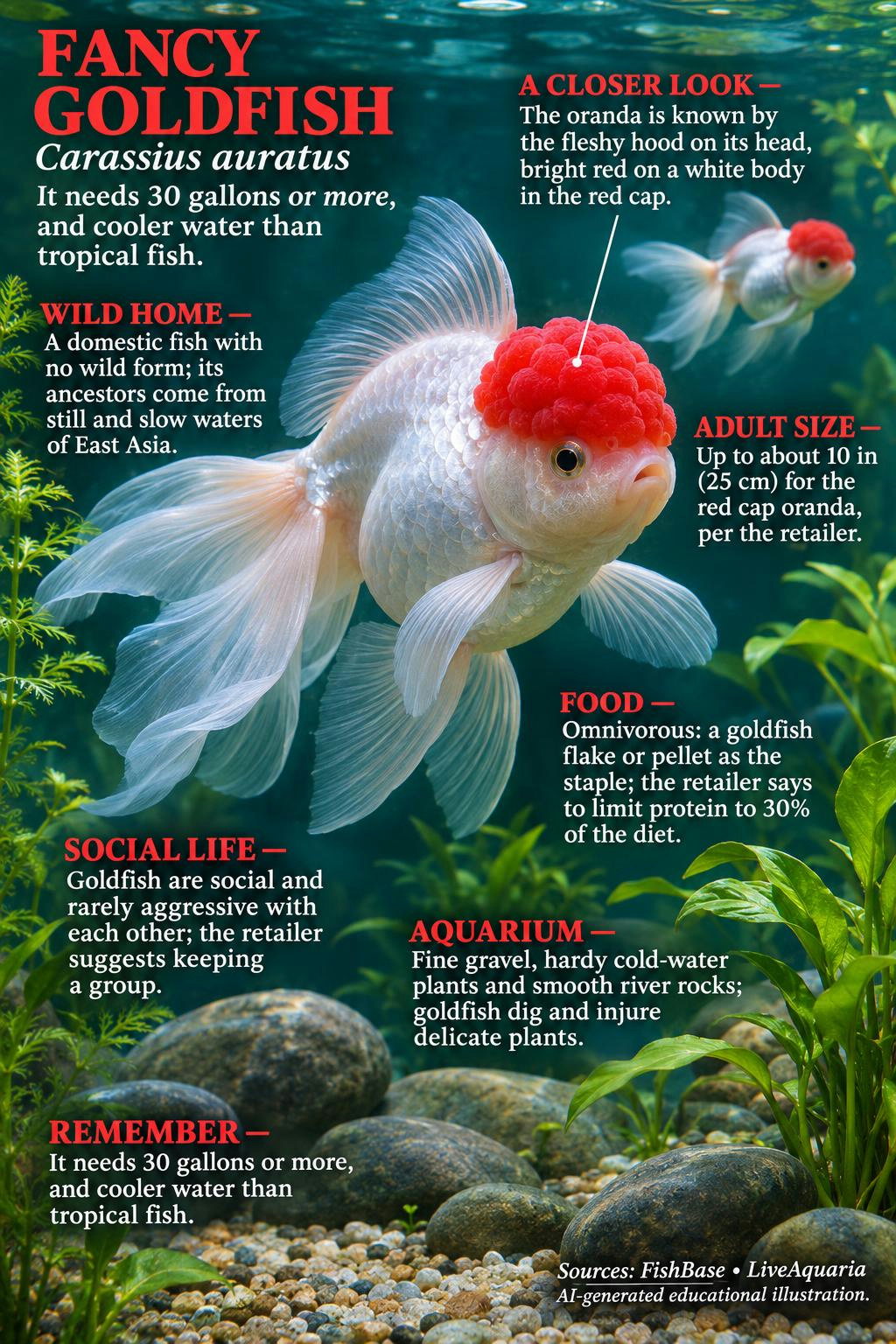
The oranda is known by the fleshy hood on its head, bright red on a white body in the red cap.
Read the infographic as text
- WILD HOME — A domestic fish with no wild form; its ancestors come from still and slow waters of East Asia.
- ADULT SIZE — Up to about 10 in (25 cm) for the red cap oranda, per the retailer.
- FOOD — Omnivorous: a goldfish flake or pellet as the staple; the retailer says to limit protein to 30% of the diet.
- SOCIAL LIFE — Goldfish are social and rarely aggressive with each other; the retailer suggests keeping a group.
- AQUARIUM — Fine gravel, hardy cold-water plants and smooth river rocks; goldfish dig and injure delicate plants.
- A CLOSER LOOK — The oranda is known by the fleshy hood on its head, bright red on a white body in the red cap.
- REMEMBER — It needs 30 gallons or more, and cooler water than tropical fish.
How to use these figures
Published care ranges and suggested tank sizes are starting points, not guarantees. Tank footprint, group size, filtration, feeding, companions and the individual fish all matter. Standard length excludes the tail fin. Do not abruptly change established water conditions to match a number on a page.
Use a cycled aquarium, monitor water quality and quarantine new arrivals using a suitable species-specific plan. Persistent appetite loss, rapid breathing or weight loss warrants investigation.
Common questions
What should I know before choosing this fish?
It needs 30 gallons or more, and cooler water than tropical fish. Goldfish are social and rarely aggressive with each other; the retailer suggests keeping a group.
What should I feed it?
Omnivorous: a goldfish flake or pellet as the staple; the retailer says to limit protein to 30% of the diet.
Sources & review
Checked November 12, 2026. Retailer care guidance is not a universal biological minimum.
- FishBase — Carassius auratus species account
- LiveAquaria — Red Cap Oranda Goldfish care profile — reviewed care reference
- LiveAquaria — Common Goldfish care profile — reviewed care reference