
At a glance
- Adult size
- About 3.5–4.5 in
- Space
- 30–40+ US gallons
- Social needs
- Non-aggressive with mild Malawi cichlids, Borstein says, but the dominant male chases other fulu from his territory.
Starting guidance, not a universal minimum. See the care details and sources below.
Adult size
FishBase records a maximum standard length of 8.6 cm (about 3.4 inches), excluding the tail fin. Borstein gives 4 inches for males and 3.5 inches for females; the GBAS article says males reach 4.5 inches.
Aquarium space
The GBAS club article says a small breeding group can be housed in a tank as small as 30 US gallons (114 litres) to 40 US gallons (151 litres).
Water conditions
The GBAS article gives 77–92°F (25–33°C) and hard water, and Borstein also says it likes hard water; neither source gives a pH. These are maintenance ranges, not targets to swing between; avoid abrupt changes.
Natural home
Shallow shore waters of Lake Victoria and Lake Kanyaboli, over sand or mud beside dense beds of rooted water plants.
Food and feeding
A plant eater: give vegetable or spirulina flake as the staple, plus cichlid pellets and dried shrimp, bloodworms or water fleas.
Tankmates and behavior
Non-aggressive with mild Malawi cichlids, Borstein says, but the dominant male chases other fulu from his territory.
Setting up the habitat
Rocks and bogwood placed to block lines of sight, sand or fine gravel for the male’s spawning pits, and hornwort if you like plants.
A closer look
The GBAS article says the fulu are extinct in Lake Victoria; Borstein also lists Lake Kanyaboli. IUCN rates it Data Deficient.
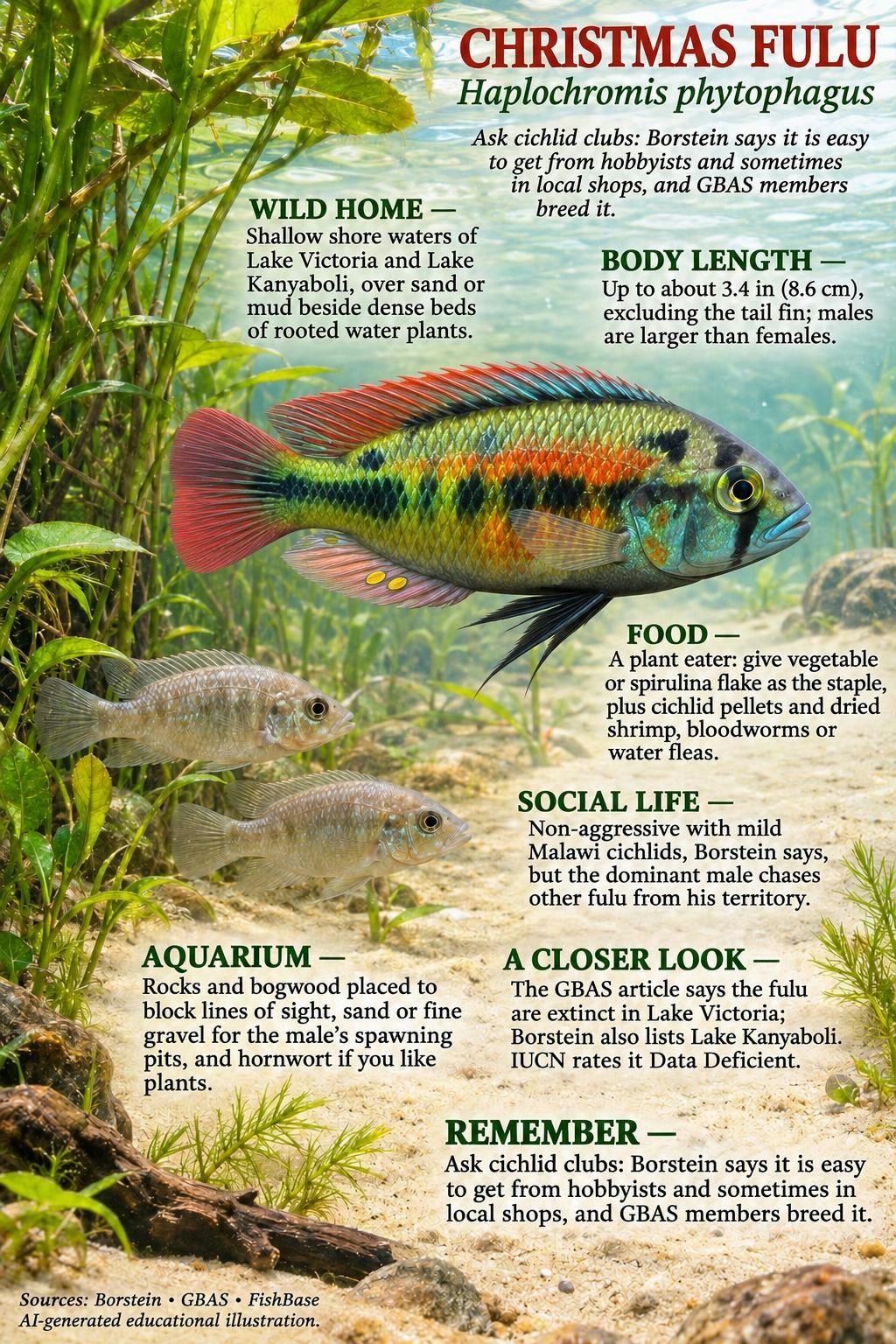
Read the infographic as text
- WILD HOME — Shallow shore waters of Lake Victoria and Lake Kanyaboli, over sand or mud beside dense beds of rooted water plants.
- BODY LENGTH — Up to about 3.4 in (8.6 cm), excluding the tail fin; males are larger than females.
- FOOD — A plant eater: give vegetable or spirulina flake as the staple, plus cichlid pellets and dried shrimp, bloodworms or water fleas.
- SOCIAL LIFE — Non-aggressive with mild Malawi cichlids, Borstein says, but the dominant male chases other fulu from his territory.
- AQUARIUM — Rocks and bogwood placed to block lines of sight, sand or fine gravel for the male’s spawning pits, and hornwort if you like plants.
- A CLOSER LOOK — The GBAS article says the fulu are extinct in Lake Victoria; Borstein also lists Lake Kanyaboli. IUCN rates it Data Deficient.
- REMEMBER — Ask cichlid clubs: Borstein says it is easy to get from hobbyists and sometimes in local shops, and GBAS members breed it.
How to use these figures
Published care ranges and suggested tank sizes are starting points, not guarantees. Tank footprint, group size, filtration, feeding, companions and the individual fish all matter. Standard length excludes the tail fin. Do not abruptly change established water conditions to match a number on a page.
Use a cycled aquarium, monitor water quality and quarantine new arrivals using a suitable species-specific plan. Persistent appetite loss, rapid breathing or weight loss warrants investigation.
Common questions
What should I know before choosing this fish?
Ask cichlid clubs: Borstein says it is easy to get from hobbyists and sometimes in local shops, and GBAS members breed it. Non-aggressive with mild Malawi cichlids, Borstein says, but the dominant male chases other fulu from his territory.
What should I feed it?
A plant eater: give vegetable or spirulina flake as the staple, plus cichlid pellets and dried shrimp, bloodworms or water fleas.
Why is it rare?
The GBAS article says the fulu are extinct in Lake Victoria; Borstein also lists Lake Kanyaboli. IUCN rates it Data Deficient.
Sources & review
Checked November 12, 2026. Retailer care guidance is not a universal biological minimum.